Is Patreon A Scam? Honest Review For 2026

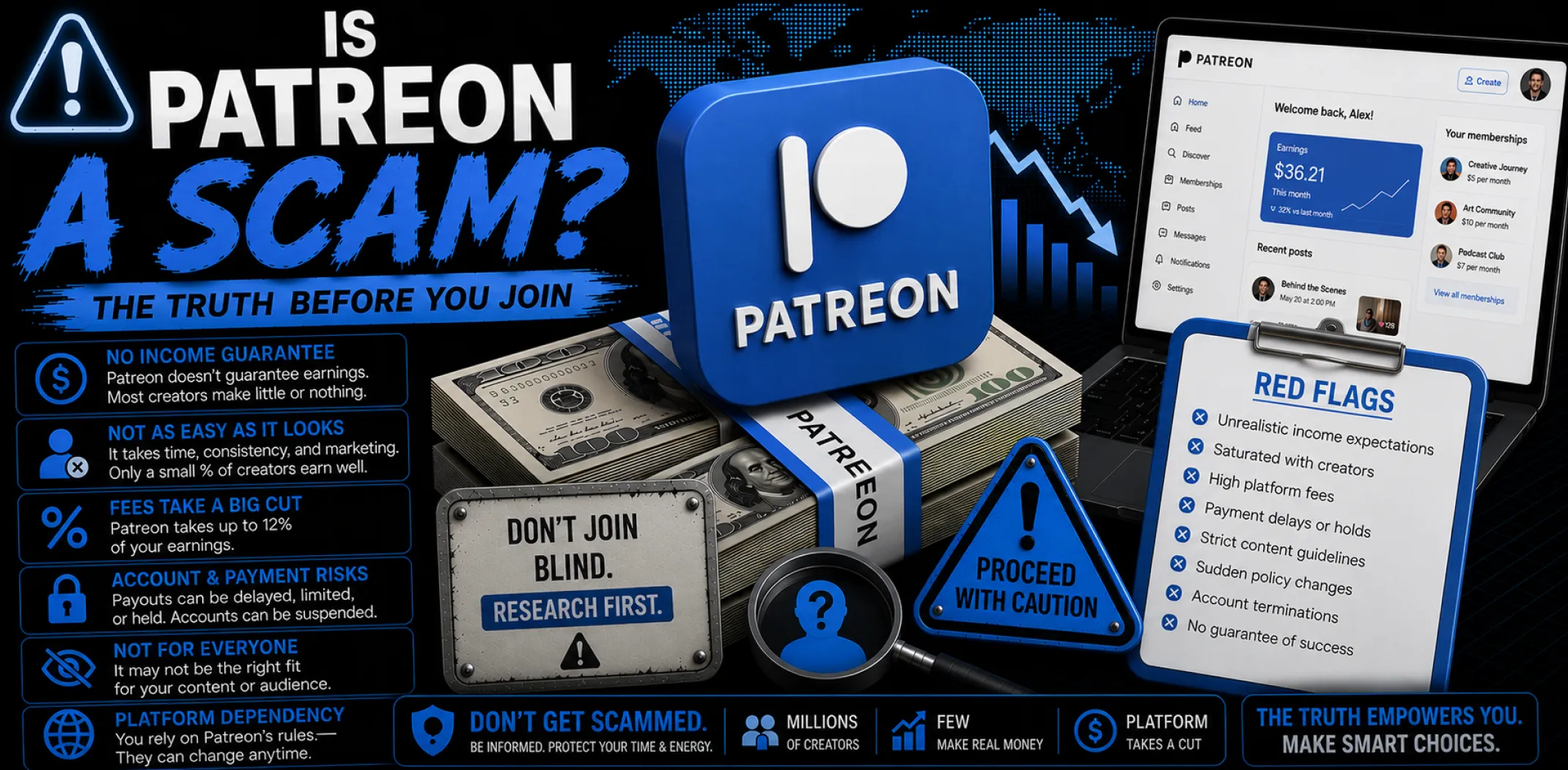
If you have ever searched “is Patreon a scam,” you are not alone. In 2026, that question gets typed into search engines thousands of times a month – by fans who were charged unexpectedly, by creators who had their accounts suspended without warning, and by people simply trying to figure out whether the platform is worth their time. The honest answer is nuanced, and that is exactly what this review covers.
Patreon is a real, registered company that has paid out over $10 billion to creators since 2013. It is not a scam in the fraudulent-website sense. But it does have documented problems – billing disputes, poor customer support, and sudden account suspensions – that have led a significant number of users to describe their experience in exactly those terms. Whether those issues are dealbreakers depends on how you plan to use it.
Quick verdict
Patreon is a legitimate membership platform founded in 2013 and headquartered in San Francisco. It is not a scam. However, its Trustpilot rating of 1.2 out of 5 reflects widespread frustration with billing errors, unhelpful AI-only support, and unexplained account suspensions. It works well for established creators with an existing audience; it is a poor fit for those just starting out.
Key takeaways
- Patreon has paid over $10 billion to creators since launching in May 2013, making it one of the largest membership platforms in the world.
- Patreon charges creators a platform fee of 8 to 10 percent depending on their plan, plus payment processing fees on every transaction.
- The platform holds a 1.2 out of 5 rating on Trustpilot, driven primarily by billing complaints, account suspension issues, and the near-total absence of human customer support.
- Patreon works best for creators who already have an established audience; building one from scratch on the platform alone is extremely difficult.
- Alternatives such as AliDropship offer a fundamentally different model – selling products rather than relying on audience donations – with lower platform fees and a built-in advertising system.
What is Patreon and how does it work?
In 2026, Patreon describes itself as a membership platform that lets creators earn recurring income directly from their audience. The concept is straightforward: you create content, your fans pay a monthly subscription to access it, and Patreon takes a percentage of whatever you earn.
Founded in May 2013 by musician Jack Conte and software engineer Sam Yam, Patreon was built to solve a problem Conte faced personally – he was generating millions of YouTube views but earning almost nothing from it.
The platform has grown significantly since then. As of 2026, Patreon serves creators across 180+ countries and has surpassed $10 billion in cumulative payouts since launch. The model is subscription-based: fans (called “patrons”) pledge a fixed amount per month in exchange for exclusive content, early access, behind-the-scenes posts, or community access. Creators set their own tier pricing and decide what benefits each tier unlocks.
Patreon makes money by taking a cut of everything creators earn. The current Standard plan for creators who joined after August 2025 charges a flat 10% platform fee. Legacy plan holders pay between 5% and 12% depending on when they joined.
On top of that, Patreon charges payment processing fees for every transaction. So if a patron pays you $10 per month, you will actually receive somewhere between $7.50 and $8.50 after all fees are deducted. That is an important number to understand before you sign up.
Is Patreon legitimate? What the evidence shows
The short answer is yes – Patreon is a legitimate, registered business operating out of San Francisco. It is incorporated as Patreon, Inc. and has raised over $412 million in verified venture capital funding from institutional investors including Index Ventures and Lone Pine Capital. The platform has been covered by major outlets including TechCrunch, Forbes, and CNBC. These are not the hallmarks of a fly-by-night operation.
The scale of the platform adds to that credibility. In 2025, Patreon confirmed that cumulative creator payouts had surpassed $10 billion since launch – a figure verified by the company directly. Annual creator earnings exceed $2 billion as of 2025, and the platform supports over 286,000 creators with at least one paying subscriber as of early 2026. Those are real numbers, paid to real people.
However, legitimacy is not the same as a good experience. The contradiction at the heart of Patreon is that a platform moving billions of dollars per year in creator income has a 1.2 out of 5 Trustpilot rating. That gap is worth understanding before you commit to using the platform – either as a creator or as a paying patron.
What are the common complaints and red flags with Patreon?
A review of Trustpilot, the Better Business Bureau, and Reddit threads in 2025 and 2026 reveals consistent complaint patterns. These are not isolated incidents – the same issues appear repeatedly across different user types and geographies. Understanding them will help you decide whether Patreon is right for your situation.
Billing errors and ghost charges. Multiple Trustpilot reviewers in 2025 and early 2026 reported being charged after cancelling their subscriptions.
In several BBB complaints, users described being billed for months after cancellation, with Patreon support claiming the charges came from a “ghost account” the user never created. In one documented BBB case, a user was charged from July 2025 through February 2026 despite having cancelled in the first month.
Common misconception: ✕ “The scam is Patreon itself stealing money from users.”
✓ What is actually true: Patreon is a real company, not a fraud scheme. The billing complaints on Trustpilot and the BBB reflect genuine platform problems – specifically, a subscription management system that is difficult to cancel and customer support that relies heavily on AI bots with minimal human escalation. These are serious operational failures, but they are different from intentional fraud.
Account suspensions with no warning. A recurring theme in 2025 and 2026 Trustpilot reviews involves creators having accounts removed suddenly, without prior notice or explanation. One reviewer described building a Patreon presence for nearly two years before receiving an abrupt suspension with no communication. Others reported accounts being flagged for “suspicious activity” simply for completing the creator setup process.
Customer support that does not function. This is perhaps the most consistent complaint across all review sources. Multiple reviewers in 2026 described submitting support tickets four or more times with no human response – only automated replies or AI-generated deflections. When an active subscription is erroneously charging your card and the only support option is a chatbot, frustration is understandable.
Important: If you cancel a Patreon subscription, screenshot the confirmation and monitor your bank statement for at least two billing cycles. Multiple documented cases show charges continuing after cancellation, and Patreon’s refund policy is narrow – typically limited to a 48-hour window if you have not accessed any content.
Creator-side scams enabled by the platform. A separate category of complaints involves individual creators who disappear after collecting pledges, or who provide content that does not match what was advertised. Patreon provides very limited recourse in these cases, typically directing patrons to resolve disputes directly with the creator.
What do real users say about Patreon?
The picture from user reviews in 2025 and 2026 is mixed, and it breaks down fairly clearly along creator experience lines. Established creators with large existing audiences tend to report positive experiences; newer creators and patrons dealing with billing issues tell a very different story.
How does Patreon compare to alternatives for making money online?
In 2026, the creator economy offers several ways to generate recurring income. Understanding how Patreon sits within that landscape helps you decide whether it is the right tool – or whether a different model fits your situation better. The table below compares the main options across the dimensions that matter most to people starting out.
The most significant difference between Patreon and alternatives like AliDropship is the dependency on an existing audience. Patreon is a monetization layer – it converts an audience you already have into recurring income. If you do not have a following, you are not going to build one through Patreon itself. The platform provides no discovery mechanism, no advertising tools, and no way for new fans to find you organically through the site.
Is Patreon worth it – honest verdict
Patreon is worth using if you meet one specific condition: you already have an established audience that trusts you and wants to support your work directly. Podcasters, independent journalists, visual artists, and musicians with dedicated fan bases have made Patreon work extremely well. The platform genuinely does deliver recurring income at scale – $2 billion a year in creator payouts is not a small number.
The platform is not worth the frustration if you are starting from zero, if you are a patron who has had billing problems in the past, or if you need functional customer support as a baseline requirement. The 1.2 out of 5 Trustpilot rating is one of the lowest of any major platform in the creator economy, and the complaint patterns documented in 2025 and 2026 are consistent enough to take seriously.
The single biggest strategic limitation is that Patreon does not grow your audience. It monetizes the one you already have. For anyone starting an online income journey in 2026 without an existing following, this makes Patreon a poor starting point – you need to build an audience first through YouTube, a podcast, a newsletter, or social media, and only then does Patreon become a viable revenue layer on top of that foundation.
Legitimate platform with important operational caveats
Patreon is a real, established company that has paid out over $10 billion to creators and is not a scam. However, its 1.2 out of 5 Trustpilot rating reflects genuine, recurring problems with billing management, account suspensions, and the near-total absence of human customer support. It is best suited to creators who already have a loyal audience and can tolerate a platform that treats support as a low priority. It is a poor fit for beginners or for anyone who needs responsive help when something goes wrong.
Who should use Patreon – and who should look elsewhere?
The right platform depends heavily on where you are in your online business journey. Here are four realistic user profiles and an honest assessment of whether Patreon fits each one.
Established creator with a following
If you already have 1,000+ engaged subscribers on YouTube, a podcast, or a newsletter, Patreon can generate meaningful recurring income. Your audience already trusts you – Patreon just gives them a way to pay you directly for more.
Beginner with no existing audience
Patreon will not help you here. Without an existing audience, a Patreon page will sit empty regardless of how good your content is. The platform has no discovery mechanism. A product-based model like AliDropship – which uses paid advertising to drive traffic – is a more practical starting point in 2026.
Patron worried about billing problems
The documented billing issues on Trustpilot and the BBB are real and worth taking seriously as a patron. If you do subscribe to a creator, use a virtual card with a spending limit, cancel only through the Patreon dashboard settings, and screenshot every confirmation immediately.
Someone looking for product-based income
Patreon is entirely the wrong tool for this. Selling physical or digital products requires an ecommerce platform, not a membership site. If your goal is online income without first building a content following, a fully built dropshipping or digital products store is a fundamentally different – and more accessible – starting point.
Start selling today – no audience, no experience needed
AliDropship builds your store, loads it with products, and includes a full Amazon Seller Kit – giving you two potential income streams from a single free signup. The built-in ad system means you can start attracting buyers without a social media following or content library.
Want online income without an existing audience? Here is what AliDropship does differently
The fundamental limitation of Patreon – and most membership platforms – is that they require you to already have an audience. AliDropship solves the income problem from a completely different angle: instead of monetizing followers, you sell products to buyers you reach through paid advertising.
No content creation. No waiting months to build a following. The platform builds your store, loads it with products, and includes a built-in ad system so you can start generating traffic from day one.
Free turnkey store – built, designed, and filled with products
Your store arrives professionally designed, pre-loaded with 50 bestselling products, and fully optimized to convert. No setup fees, no coding, no design time. You start at the product-testing stage – not the store-building stage. Hosting, SSL, and payment gateway are all included.
Winning products, one-click import
Browse trending and niche items from AliDropship’s catalog – including brand-name and digital products – and import them to your store in one click. The catalog updates regularly so your store always has fresh, competitive inventory without manual research.
Automated fulfillment and real-time tracking
Orders are processed automatically through global supplier connections. Customers receive real-time tracking updates – building trust and reducing support volume. You do not touch the shipping logistics; the platform handles it end-to-end.
Built-in marketing and promotion tools
Email campaigns, discount management, abandoned-cart recovery, live countdown timers, and social media integration are all included or available as add-ons. No prior marketing experience required – the tools guide you through each campaign type.
Beginner-friendly – no coding, no learning curve
An intuitive dashboard walks you through every step. Adding products, running campaigns, and scaling your catalog require no technical knowledge. As your business grows, the platform scales with you – adding features without adding complexity.
AliExpress integration – one-click imports, synced inventory
AliDropship connects directly to AliExpress for one-click product imports, automated order processing, and synced tracking. Inventory stays current with the latest products and prices. Combined with the turnkey store and automated fulfillment, this integration makes the entire operation manageable for one person.
Get a free turnkey store pre-loaded with products and an ad system ready to go
50 bestselling products loaded. Built-in automatic promotion. 14-day free trial, 39 dollars per month after. No design or coding required.
Add an Amazon presence from the same signup – 514 billion dollar marketplace, 300 million buyers
Full Amazon Seller Kit included. Import file ready to upload. Access a marketplace with 300 million active buyers without building from scratch.
Is Patreon a scam or a legitimate platform?
How does Patreon make money from creators?
Patreon earns money by taking a percentage of everything creators receive from their patrons. Creators who joined after August 2025 are on the Standard plan, which charges a 10 percent platform fee on all processed earnings. Older plan holders pay between 5 and 12 percent depending on their legacy tier. Patreon also charges payment processing fees on every individual transaction, which adds roughly 2 to 3 percent on top of the platform fee. This means creators typically receive between 75 and 88 cents of every dollar their patrons pay.
Does Patreon really pay creators?
Yes, Patreon does pay creators. As of August 2025, the platform confirmed it had paid out more than 10 billion dollars in cumulative creator earnings since launching in 2013. Annual creator payouts exceed 2 billion dollars as of 2025, and the platform hosts over 286,000 creators with at least one paying subscriber. The earning potential varies enormously – only 31 creators on the platform have more than 20,000 paying members, while the majority of creators earn under 500 dollars per month.
What are the main risks of using Patreon?
The main risks of using Patreon are billing-related for patrons and platform-stability-related for creators. Patrons have reported being charged after cancelling subscriptions, with Patreon support attributing the charges to ghost accounts tied to their payment details. Creators face the risk of sudden account suspension without prior warning, as documented across multiple 2025 and 2026 Trustpilot reviews and BBB complaints. Customer support is heavily automated, and human escalation is difficult to access. Both creators and patrons should document all account actions and monitor statements carefully.
What are the best alternatives to Patreon for online income?
The best alternatives to Patreon depend on your goal. For writers and newsletter creators, Substack charges 10 percent and offers built-in discovery. For digital product sellers, Gumroad and Ko-fi allow direct sales with lower fees. For creators who want income without an existing audience, AliDropship offers a fully built ecommerce store pre-loaded with products, a built-in advertising system, and a complete Amazon Seller Kit at 39 dollars per month after a 14-day free trial – no content creation or following required.