Is OnlyFans Legit? An Honest Review For Creators In 2026

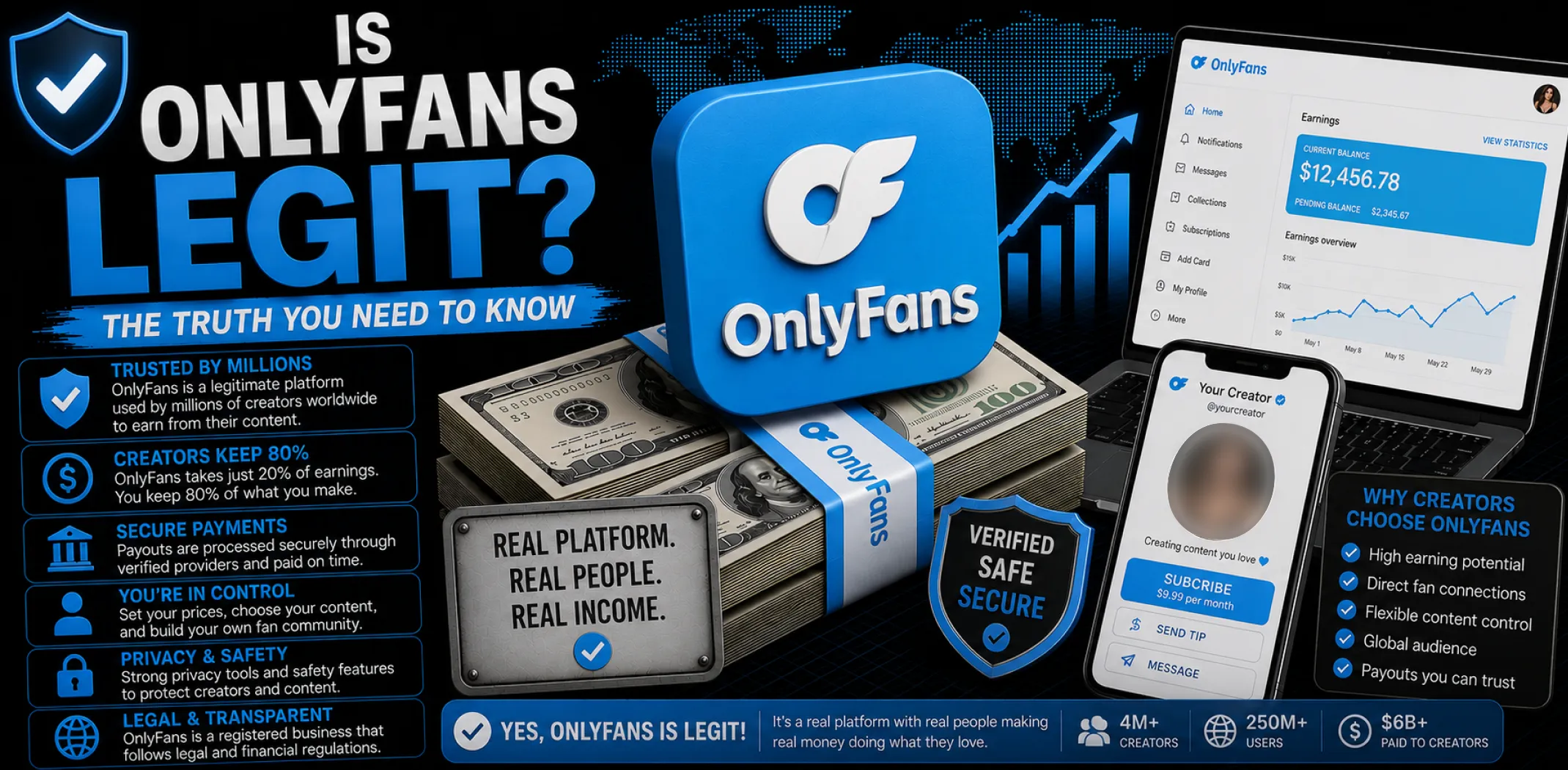
OnlyFans generates billions of dollars. That much is not in question. In 2024 alone, fans spent $7.22 billion on the platform, and the company has paid out over $25 billion to creators since it launched in 2016.
By any financial measure, it is one of the largest creator platforms on the internet. So the question is not really whether the company is real – it is whether it is a legitimate path to income, and whether the risks are worth it for the creators and supporters considering it.
The honest answer is nuanced. OnlyFans is a real, registered UK business with a proven payout record. But it also has a 1.3-star Trustpilot rating driven primarily by subscribers who feel misled, a brutal income curve where the average creator earns around $131 per month, and a well-documented ecosystem of fake accounts and catfishing that the platform has struggled to contain.
Whether it is right for you depends entirely on what you are trying to do – and what you understand going in.
Quick verdict
OnlyFans is a legitimate UK-registered company that has paid out over $25 billion to creators since 2016. It is not a scam in the operational sense – it pays creators reliably and processes real transactions. However, it carries significant risks: a 1.3-star Trustpilot rating driven by subscriber fraud and content misrepresentation, an income curve where 70% of creators earn under $200 per month, and chargeback exposure that can freeze creator accounts. Go in with clear expectations.
Key takeaways
- OnlyFans is a real UK-registered company (Fenix International Ltd) founded in 2016, with $7.22 billion in gross payments processed in 2024 and over $25 billion paid to creators since launch.
- OnlyFans takes a 20% cut of all creator earnings – creators keep 80%, which compares favorably to many competing platforms.
- The average creator earns around $131 to $180 per month; the top 1% of creators earn approximately 33% of all platform revenue.
- The 1.3-star Trustpilot rating reflects primarily subscriber frustration with individual creator fraud – fake accounts, catfishing, and content misrepresentation – rather than problems with the platform itself.
- OnlyFans holds earnings for 7 days before release and suspends creator accounts if chargeback rates exceed 1% of transactions.
What is OnlyFans and how does it work?
OnlyFans was founded in 2016 by British entrepreneur Tim Stokely, built with a £10,000 loan from his father. In 2018, Leonid Radvinsky – a Ukrainian-American entrepreneur with experience in the adult content industry – acquired a majority stake in the parent company, Fenix International Ltd, through which he now controls the platform.
Radvinsky sold a 16% minority stake to San Francisco-based Architect Capital in May 2026 at a valuation of approximately $3.15 billion, though he retains a large ownership position. The platform is headquartered in London.
The core model is simple: creators set a monthly subscription price (between $4.99 and $49.99) for access to their content, and fans pay to subscribe. Creators can also earn through pay-per-view messages, tips, and custom content requests. OnlyFans takes a 20% cut of all earnings; creators keep 80%.
The platform originally served a broad range of creator types – fitness coaches, chefs, musicians – but adult content became dominant and now drives the overwhelming majority of platform revenue.
How payouts work is important to understand before you commit time to the platform. OnlyFans holds all creator earnings for 7 days before they become available to withdraw – a fraud and chargeback protection measure that cannot be bypassed.
After the 7-day hold, payouts are processed and typically reach bank accounts within an additional 1 to 10 business days depending on your payment method and country. There is no PayPal option for receiving payouts; withdrawals go via bank transfer or certain e-wallets depending on your region.
One thing OnlyFans cannot do for you: build your audience. The platform has no internal discovery algorithm, no “explore” feed, and no traffic generation tools. Every subscriber you earn starts with someone who found you on another platform – Instagram, TikTok, Reddit, Twitter, or elsewhere – and followed a link to your OnlyFans page.
If you do not have an existing following on at least one external channel, you will struggle significantly to earn anything meaningful on the platform regardless of the quality of your content.
Is OnlyFans legitimate? What the evidence shows
OnlyFans is legitimate as a company. It is a registered UK business, has paid out over $25 billion to creators since 2016, and processes billions of dollars in real transactions every year. Those are not numbers a fly-by-night operation produces. The platform pays creators reliably – the 7-day hold and chargeback risks are real, but they are documented policies, not hidden traps.
The 1.3-star Trustpilot score needs context. Looking at the actual complaints, the overwhelming majority are from subscribers who feel misled by individual creators – not from creators experiencing payout fraud by OnlyFans itself.
The pattern is consistent: a subscriber pays for content that was advertised as exclusive, finds the content disappointing or identical to free material elsewhere, contacts OnlyFans support, and is told refunds are not available under the platform’s terms. The frustration is real, but it points to a problem with creator accountability on the platform rather than with the platform stealing money.
That is an important distinction. OnlyFans as a company is not defrauding creators or subscribers in the traditional scam sense. What it has is an ecosystem problem: a platform at massive scale with millions of creator accounts, limited moderation of individual content claims, and a no-refund policy that leaves dissatisfied subscribers with few options. The complaints are real; the company behind them is not fraudulent.
Common complaints and real risks – what to know before signing up
Whether you are thinking about subscribing to OnlyFans or creating on it, the risks are different – and both are worth understanding clearly.
Common misconception: Many people conflate scams that happen on OnlyFans with OnlyFans itself being a scam. The distinction matters. Individual creators – or agencies impersonating solo creators – can and do mislead subscribers, overpromise content, or use AI-generated personas. OnlyFans the company does not operate these accounts. However, the platform’s limited moderation, no-refund policy, and lack of identity verification beyond a basic ID check create conditions that make subscriber-side fraud easier to sustain than on other platforms.
Risks for subscribers
Fake and agency-run accounts are the most documented subscriber risk. A significant portion of accounts that appear to be solo creators are actually managed by agencies – sometimes with teams of people responding to messages and impersonating the creator.
Subscribers believe they are building a personal connection with a real individual; in many cases, they are messaging a hired chat operator in another country. This is not against OnlyFans’ terms, but it is deceptive, and it is widespread enough that entire Reddit communities exist to identify which accounts are agency-run.
Content misrepresentation is the second major subscriber issue. Creators are not required to verify that their promotional content matches what subscribers actually receive behind the paywall.
Misleading previews, recycled material, and pay-per-view upsells that do not deliver as described are among the most common Trustpilot complaints. OnlyFans does not offer refunds under most circumstances, and its support team typically defers to the creator’s content rights when disputes arise.
Outright fake accounts using stolen photos also exist – particularly new accounts impersonating popular creators. These are against OnlyFans’ terms and can be reported, but detection relies largely on subscribers recognizing that something is wrong.
Risks for creators
Chargeback exposure is the primary financial risk for creators. When a subscriber disputes a charge with their bank – whether legitimately or not – the payment is reversed, a chargeback fee of $15 to $25 is applied to the creator’s account, and the creator loses both the revenue and the fee.
OnlyFans monitors chargeback rates: above 1% of transactions triggers warnings; above 2% to 3% triggers account review; above 5% risks suspension. Creators with audiences that include a higher proportion of impulsive or regret-driven purchasers face disproportionate exposure to this risk.
Agency and management scams targeting creators are a separate category worth flagging. Third-party agencies that offer to manage OnlyFans accounts have been documented engaging in contract manipulation, redirecting creator earnings to their own accounts, and using coercive exit terms that charge creators large fees to leave.
These are not OnlyFans’ doing – they are predatory third parties – but creators new to the platform who sign with an agency before they understand the business are particularly vulnerable.
How to reduce risk as a creator: Always describe your content accurately. Respond promptly to subscriber concerns before they escalate to chargebacks. Avoid signing with any management agency until you fully understand the contract terms and have independent legal advice. Never share your banking details with a third party claiming to manage your account on your behalf.
How much do OnlyFans creators actually earn?
The income picture on OnlyFans is one of the starkest in the creator economy. The headline numbers – $7.22 billion in annual gross payments, creators who have earned tens of millions – are real. But they describe the platform’s top percentile, not its typical experience.
What do real users say about OnlyFans in 2026?
User experiences on OnlyFans divide sharply depending on whether you are looking at it from a creator or subscriber perspective, and within each group, how well-prepared you were going in. Two representative experiences illustrate the range.
Is OnlyFans worth it – honest verdict
OnlyFans is worth it for a specific, narrow profile of creator: someone with an existing social media following of at least 10,000 engaged people, a clear understanding of the content they are willing to produce consistently, and the time and willingness to treat it as a full business operation including subscriber management, chargeback monitoring, and active promotion across multiple platforms.
For everyone outside that profile – new creators with small followings, people hoping to earn a secondary income with modest time investment, or subscribers looking for a reliable, high-quality content experience – the reality is harder. The income curve is brutal, the subscriber-side fraud ecosystem is well-documented, and the platform’s no-refund policy and limited moderation create an environment where disappointment is common.
Legitimate company, real risks, narrow path to meaningful income
OnlyFans is a real UK-registered business that pays creators reliably and processes billions in legitimate transactions annually. It is not a scam. But it has a 1.3-star Trustpilot rating driven by subscriber fraud and content misrepresentation, an average creator income of around $131 per month, and a chargeback exposure that can freeze creator accounts. It rewards creators with existing large audiences who treat it as a full-time business – and delivers poor outcomes for most who approach it casually.
One signup. Two income streams. Zero upfront cost.
AliDropship builds your ecommerce store and gives you a complete Amazon Seller Kit – product listings ready to upload, a step-by-step guide, and access to 300 million buyers on a $514 billion marketplace. Your $40 ad coupon covers your first campaign, and the 14-day free trial means you risk nothing to get started.
Who should use OnlyFans – and who needs a different approach?
Based on the evidence above, here is a clear-eyed breakdown of when OnlyFans fits and when another approach makes more sense.
Good fit: existing audience, full-time commitment
If you already have an engaged following of 10,000 or more on social media and are willing to treat OnlyFans as a full-time business – managing subscribers, monitoring chargebacks, posting consistently, and promoting across multiple platforms – meaningful income is achievable. The 80% revenue share and direct subscriber relationships are real advantages for creators who show up at this level.
Poor fit: starting from zero followers
Without an existing audience, OnlyFans income in the first three to six months is typically close to zero. The platform has no discovery algorithm, no traffic generation, and no way to surface your content to new subscribers organically. New creators without a social media following spend months building it before they see meaningful OnlyFans revenue – if ever.
Consider carefully: income that depends on personal content creation
OnlyFans income is tied directly to you – your face, your persona, your time, and your ongoing content production. It cannot be scaled or automated, it creates ongoing privacy and professional reputation considerations, and it stops the moment you stop creating. Creators who want income that is not dependent on personal content production should explore product-based or ecommerce models instead.
Better for scalable income: an owned ecommerce business
If your goal is scalable online income that does not require a pre-existing audience or personal content creation, an ecommerce store is a fundamentally different and more scalable model. A store sells products to customers discovered through advertising – you are not the product, you do not need an existing following, and income can grow beyond what any single creator can manually sustain.
Want online income that does not depend on personal content creation? Here is how AliDropship works
OnlyFans ties your income directly to your personal brand and ongoing content production. AliDropship works differently: it builds you a complete ecommerce store with products ready to sell, a built-in advertising system to reach new customers, and an Amazon Seller Kit that opens access to 300 million buyers from day one – no existing audience, no personal content, no camera required.
Free turnkey store – built, designed, and filled with products
Your store arrives professionally designed, pre-loaded with 50 bestselling products, and fully optimized to convert. No setup fees, no coding, no design time. You start at the product-testing stage – not the store-building stage. Hosting, SSL, and payment gateway are all included.
Winning products, one-click import
Browse trending and niche items from AliDropship’s catalog – including brand-name and digital products – and import them to your store in one click. The catalog updates regularly so your store always has fresh, competitive inventory without manual research.
Automated fulfillment and real-time tracking
Orders are processed automatically through global supplier connections. Customers receive real-time tracking updates – building trust and reducing support volume. You do not touch the shipping logistics; the platform handles it end-to-end.
Built-in marketing and promotion tools
Email campaigns, discount management, abandoned-cart recovery, live countdown timers, and social media integration are all included or available as add-ons. No prior marketing experience required – the tools guide you through each campaign type.
Beginner-friendly – no coding, no learning curve
An intuitive dashboard walks you through every step. Adding products, running campaigns, and scaling your catalog require no technical knowledge. As your business grows, the platform scales with you – adding features without adding complexity.
AliExpress integration – one-click imports, synced inventory
AliDropship connects directly to AliExpress for one-click product imports, automated order processing, and synced tracking. Inventory stays current with the latest products and prices. Combined with the turnkey store and automated fulfillment, this integration makes the entire operation manageable for one person.
Is OnlyFans a legitimate platform or a scam?
How does OnlyFans make money?
OnlyFans earns money by taking a 20% cut of all creator earnings – subscriptions, tips, pay-per-view messages, and custom content. Creators keep 80% of what they earn. The platform does not charge creators a monthly fee to maintain their page. OnlyFans generated approximately 1.4 billion dollars in net revenue in fiscal 2024 from its 20% share of the 7.22 billion dollars in gross creator earnings.
How much do OnlyFans creators realistically earn?
The average OnlyFans creator earns between 131 and 180 dollars per month, which works out to roughly 1,500 to 2,200 dollars per year. Approximately 70% of creators earn under 200 dollars per month. The top 1% of creators earn around 33% of all platform revenue. Creators who reach 1,000 dollars or more per month typically have an existing social media following of at least 10,000 engaged people, post consistently, and treat the platform as a full-time business with active subscriber management and promotion across multiple external channels. Results vary widely.
What are the biggest risks of creating on OnlyFans?
The two biggest risks for creators are chargeback exposure and management agency fraud. OnlyFans holds all earnings for 7 days before they become available; if a subscriber initiates a chargeback during that period, the creator loses the revenue plus a fee of 15 to 25 dollars. Accounts with chargeback rates above 1% of transactions face warnings, review, or suspension. Separately, predatory third-party management agencies have been documented redirecting creator earnings, locking creators into coercive contracts, and impersonating creators in subscriber communications. These agencies are not operated by OnlyFans but target its creator base.
What are the best OnlyFans alternatives for making money online?
For creators who want income that does not depend on personal content creation or an existing audience, an owned ecommerce store is a fundamentally different model. A platform like AliDropship builds a complete store with products pre-loaded and a built-in advertising system – so you can reach new customers through paid ads rather than relying on fans who already know you. For creators who already have an audience and want a supplementary direct-support layer, platforms like Ko-fi offer 0% fees on tips with instant payouts and a significantly better Trustpilot record than OnlyFans.