Is OnlyFans A Scam? The Truth Creators Need In 2026

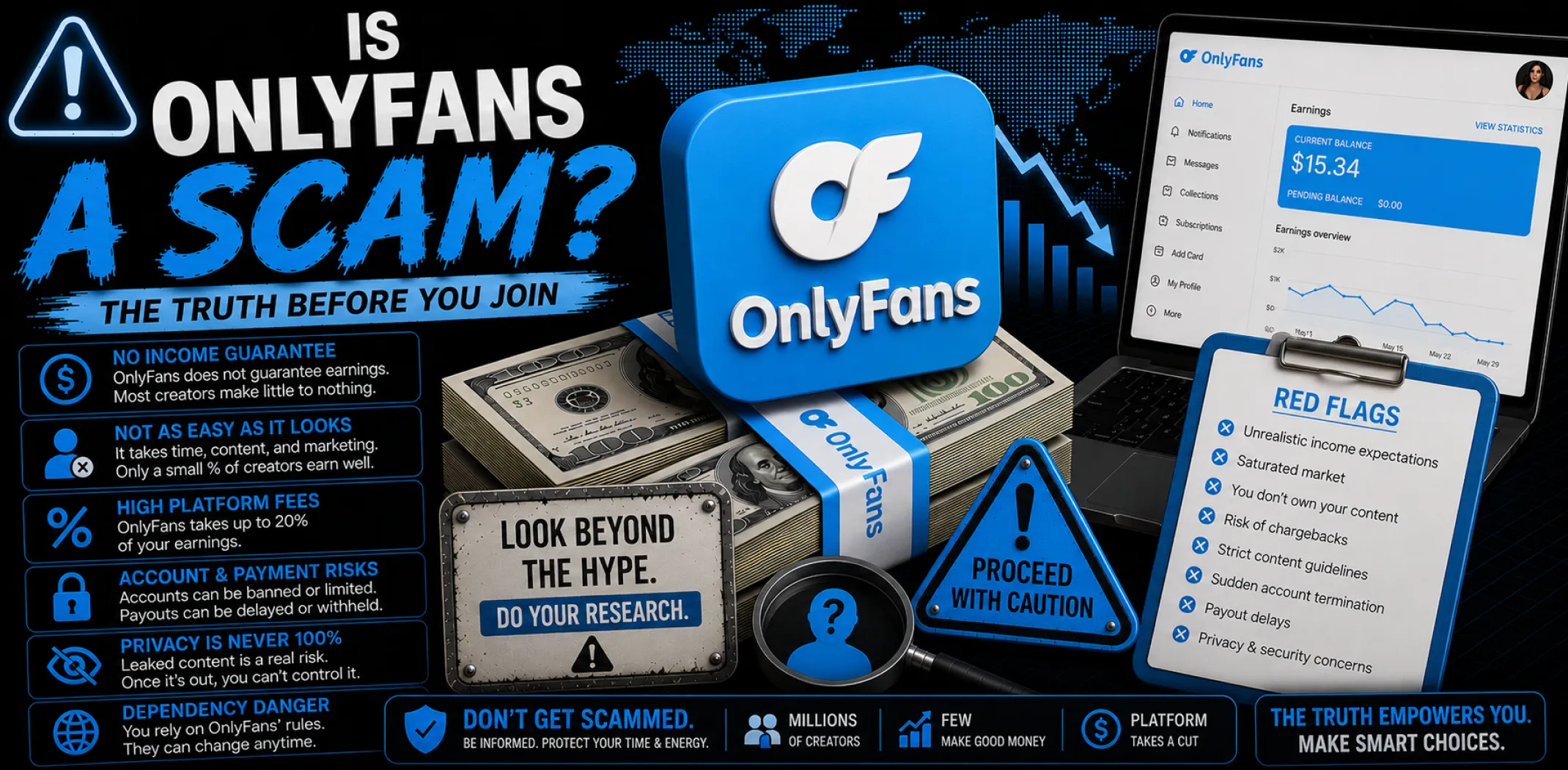
The Trustpilot page for OnlyFans reads like a warning sign: 1.3 stars from over 4,000 reviews, hundreds of people calling it a scam, complaints about fake accounts, money taken for content that was never delivered, and support that closes tickets without resolution. If you have been researching whether OnlyFans is safe – whether as a potential creator or a potential subscriber – that picture is legitimately alarming.
Quick verdict
OnlyFans is not a scam as a company – it is a legitimate UK-registered business with $25 billion in creator payouts since 2016. However, the platform hosts a well-documented fraud ecosystem: fake accounts, catfishing, agency impersonation of creators, and content misrepresentation that its no-refund policy and limited moderation do little to curb. The risks are real, the income curve is brutal, and both subscribers and creators need to go in with clear expectations.
Key takeaways
- OnlyFans (Fenix International Ltd) is a real UK company that paid over $25 billion to creators since 2016 and generated $7.22 billion in gross payments in 2024 – it is not a fraudulent operation.
- The 1.3-star Trustpilot score is driven almost entirely by subscriber complaints about individual creator behavior – fake accounts, catfishing, and content not matching its description – not by OnlyFans stealing money.
- A significant portion of accounts that appear to be solo creators are managed by agencies, with hired operators responding to subscriber messages while pretending to be the creator.
- OnlyFans holds creator earnings for 7 days before release; chargeback rates above 1% can trigger account suspension.
- The average creator earns around $131 per month; the top 1% of creators earn 33% of all platform revenue – the income concentration is severe.
What is OnlyFans – and why does the scam question keep coming up?
OnlyFans was founded in 2016 by Tim Stokely using a £10,000 loan, built as a subscription platform where creators could charge fans for exclusive content. In 2018, Leonid Radvinsky – an entrepreneur experienced in the adult content industry – acquired a majority stake through parent company Fenix International Ltd, and the platform scaled dramatically from there.
By 2024 it was processing $7.22 billion in gross annual payments across 4.6 million creators and 377 million registered users. In May 2026, Radvinsky sold a 16% minority stake to Architect Capital at a $3.15 billion valuation. The platform is headquartered in London.
The scam question comes up because of the gap between what subscribers expect and what they receive. OnlyFans does not require creators to verify that their promotional content matches what subscribers get behind the paywall. It does not offer refunds under most circumstances.
Its support team generally defers to the creator’s content rights in disputes. And the sheer scale of the platform – 4.6 million creator accounts – makes consistent quality enforcement essentially impossible.
The result is a platform where legitimate, high-quality creators operate alongside a long tail of accounts that mislead subscribers, use stolen or repurposed content, or are run entirely by agencies impersonating the person shown in the profile photos.
The 1.3-star Trustpilot score is one of the lowest of any major internet platform. But before accepting it at face value, it is worth looking at what the reviews actually say. The dominant complaint pattern is not “OnlyFans stole my money.”
It is “I paid a creator for content that was nothing like what was advertised” and “the account I subscribed to was not being run by the person I thought it was.” Those are real, legitimate grievances – but they are complaints about individual actors on the platform, not about OnlyFans committing fraud against users.
Is OnlyFans a scam? Breaking down what the evidence actually shows
To answer the scam question properly, it helps to separate the question into its two distinct parts: is OnlyFans the company defrauding people, and does the platform enable scams that harm its users? The answers are different.
Is OnlyFans the company defrauding people? No. It processes real transactions and pays creators their 80% share consistently. The 7-day earnings hold is documented, the 20% fee is transparent, and the payout mechanism – bank transfer or e-wallet – works as described.
Creators who have built audiences on the platform and run it as a genuine business report that the financial mechanics function reliably. OnlyFans has no documented history of taking creator money for itself beyond its stated 20% fee.
Does the platform enable scams that harm users? Yes, significantly. The combination of minimal content verification requirements, a strict no-refund policy, limited moderation of 4.6 million accounts, and a massive financial incentive for bad actors creates conditions where subscriber fraud thrives. The platform is not committing the fraud – but its design choices make it easier to sustain than on better-moderated platforms.
The scam ecosystem on OnlyFans – what is actually happening
Understanding the specific types of fraud that occur on OnlyFans is essential before you subscribe or create. They fall into distinct categories with different levels of platform complicity.
Common misconception: Many people assume that because OnlyFans has a low Trustpilot rating, the company itself is stealing from them. In nearly every documented case, the financial harm described in negative reviews comes from an individual creator account – not from OnlyFans’ own operations. OnlyFans makes money from a 20% cut of completed transactions; it has no financial incentive to withhold money from creators or subscribers. The platform’s problem is that it creates favorable conditions for individual bad actors, not that it is itself the bad actor.
Agency-run accounts impersonating solo creators
This is the most widespread and hardest-to-detect form of deception on OnlyFans. A significant portion of accounts that appear to be individual creators are actually managed by agencies employing teams of operators who read and respond to subscriber messages while pretending to be the creator. Subscribers believe they are forming a personal connection with a real person – paying for custom content, intimate messages, and direct interaction – when they are in fact communicating with a hired chat operator, often based overseas. This practice is not prohibited by OnlyFans’ terms, which allows creators to employ assistants. It is, however, routinely misrepresented to subscribers who are not told they are messaging a third party.
Content misrepresentation and pay-per-view upsell traps
Creators are not required to ensure their promotional material matches what subscribers receive. A common pattern documented across Trustpilot and Reddit: a creator advertises explicit or exclusive content to attract subscribers, then delivers a page consisting almost entirely of pay-per-view locked items that each require additional payment. The subscriber has paid the subscription fee for access to content that barely exists without further purchases. When they contact OnlyFans support, they are typically told refunds are not available. OnlyFans’ no-refund policy, combined with no content verification requirement, makes this pattern functionally impossible for the platform to penalize short of repeated chargebacks.
Outright fake accounts using stolen content
A smaller but more clearly fraudulent category: accounts created using photos and videos stolen from real creators, typically those with a modest online presence who are unlikely to be immediately recognized. These accounts collect subscription fees and tips, produce no original content, and disappear or rebrand when challenged. OnlyFans requires ID verification to create an account, which provides some deterrent – but the verification process does not confirm that the identity matches the content being posted. Accounts flagged by subscribers or the original creator can be reported, but discovery relies on users recognizing something is wrong.
Management agency scams targeting creators
Predatory agencies targeting OnlyFans creators are a well-documented separate risk. Documented cases include agencies that redirected creator earnings to their own bank accounts by changing payout details, locked creators into contracts with exit fees of thousands of dollars, and dismissed verbal assurances given during onboarding while enforcing written terms that were never properly explained. Creators who sign with a management agency – particularly one that promises fast growth in exchange for a revenue share – are advised to have contract terms reviewed by an independent lawyer before signing anything. No legitimate agency requires immediate signature under time pressure.
None of items 01 through 03 above constitute OnlyFans defrauding anyone directly. They are fraud patterns that exist within its ecosystem and that its platform design – particularly the no-refund policy and minimal content moderation – makes harder to combat than it otherwise would be.
Item 04 involves third-party companies, not OnlyFans. The distinction matters both for assessing the platform fairly and for knowing where to direct your caution.
What do real users say about OnlyFans in 2026?
The user experience picture on OnlyFans breaks cleanly along one axis: creators who run their accounts with genuine transparency and active subscriber management report a platform that works as described. Subscribers who subscribed based on promotional material without independently vetting the account are far more likely to feel misled. Here are two representative experiences that illustrate both sides.
How does OnlyFans make money – and does that create a scam incentive?
OnlyFans earns a 20% cut of every transaction that passes through the platform – subscriptions, tips, pay-per-view messages, and custom content sales. That is its only revenue source. It generates no income from advertising and charges no monthly fee to creators.
This structure means OnlyFans has a direct financial interest in creators making money – not in defrauding them. Every dollar a creator earns means $0.20 to OnlyFans. Every dollar a subscriber pays that gets charged back means OnlyFans loses its fee and incurs processing costs.
The platform is not financially motivated to scam its users. What it is financially motivated to do is grow the number of transactions, which creates pressure to allow as many creators as possible – including ones whose practices are misleading – rather than enforcing content quality standards that would reduce volume.
The 7-day hold is a friction point worth understanding. Unlike Ko-fi – which sends money directly to your Stripe or PayPal in real time – OnlyFans holds your earnings in its own system for a week before release.
This creates a short window during which a chargeback can take back what you thought you had earned. Creators whose subscribers frequently dispute charges – whether legitimately or not – accumulate chargeback fees and risk account suspension even if their content is entirely above board.
Is OnlyFans worth it – honest verdict
OnlyFans is not a scam. But it has genuine, documented problems that anyone considering it – as a creator or subscriber – should understand before committing time or money to it.
As a creator, the platform works reliably for people with existing large audiences who treat it as a full-time business. The 80% revenue share is genuinely competitive, and the direct subscriber relationships that OnlyFans enables can be financially rewarding at scale.
The barriers are real: you need an existing audience of at least 10,000 to 20,000 engaged followers to have a realistic shot at meaningful income, the chargeback exposure requires active management, and the management agency risk is serious enough to warrant caution about any third-party involvement.
The average creator earns around $131 per month – a number that reflects the brutal reality of an income distribution where the top 1% capture 33% of all revenue.
As a subscriber, the platform carries real risk of content misrepresentation that its no-refund policy does nothing to mitigate. Independently vetting creators on Reddit before subscribing is not optional if you want to avoid the most common disappointments.
Not a scam – but hosts a well-documented fraud ecosystem it does little to contain
OnlyFans the company is legitimate, registered, and pays out reliably. The scam problem on the platform is real – but it lives in individual creator practices and predatory third-party agencies, not in OnlyFans’ own operations. The platform’s design choices, particularly its no-refund policy and minimal content verification, create conditions that make subscriber fraud easier to sustain than it should be. For creators with large existing audiences who manage the platform professionally, it can generate real income. For most others, the income curve and fraud ecosystem represent significant risks to manage carefully.
A free store and a free Amazon business – launched in under 60 seconds
Sign up once and walk away with two complete income streams: a done-for-you store loaded with 100+ digital products, and an Amazon Seller Kit with listings already formatted and ready to go live. Keep 50–70% of every sale, with no inventory, no shipping, and no logistics on your end.
Who should use OnlyFans – and who is better served by something else?
The evidence points clearly to specific situations where OnlyFans makes sense and specific situations where it does not. Here is the breakdown.
Viable: existing audience, full business commitment
Creators with a social media following of 10,000 to 20,000 or more who are prepared to treat OnlyFans as a full-time job – responding to subscribers personally, managing chargebacks actively, promoting consistently across external platforms, and avoiding any management agency that asks for payout access – can generate meaningful income. The 80% revenue share and direct subscriber model reward this level of commitment.
Not viable: no existing audience
OnlyFans has no discovery algorithm, no built-in traffic, and no way to surface your content to people who do not already know you. Creators who start with no external following typically earn close to nothing in their first three to six months, regardless of content quality. The platform cannot build your audience for you – it can only monetize one you already have.
High risk: signing with a management agency
The management agency space targeting OnlyFans creators includes both legitimate operators and predatory ones that have been documented redirecting creator earnings and trapping creators in coercive exit contracts. The inability to tell the two apart without legal review makes any agency engagement high-risk. If you are considering working with an agency, never grant them access to your payout banking details, never sign on the day you are approached, and have the full contract reviewed by an independent lawyer first.
Better alternative: income that does not require personal content
OnlyFans ties your income to your personal brand, your face, your ongoing content production, and your willingness to maintain an active subscriber relationship indefinitely. It cannot be automated and carries long-term privacy and professional considerations. If you want scalable online income that is product-based rather than persona-based, an owned ecommerce store serves that goal without any of those constraints.
Looking for online income without the risks? Here is how AliDropship works
OnlyFans requires you to be the product – your persona, your content, your time. AliDropship works the opposite way: it builds you a complete ecommerce store with 100+ products pre-loaded, a built-in ad system that reaches new customers without requiring an existing audience, and a free Amazon Seller Kit that opens access to 300 million buyers from day one. No personal content, no camera, no audience required to get started.
Free turnkey store – built, designed, and filled with products
Your store arrives professionally designed, pre-loaded with 50 bestselling products, and fully optimized to convert. No setup fees, no coding, no design time. You start at the product-testing stage – not the store-building stage. Hosting, SSL, and payment gateway are all included.
Winning products, one-click import
Browse trending and niche items from AliDropship’s catalog – including brand-name and digital products – and import them to your store in one click. The catalog updates regularly so your store always has fresh, competitive inventory without manual research.
Automated fulfillment and real-time tracking
Orders are processed automatically through global supplier connections. Customers receive real-time tracking updates – building trust and reducing support volume. You do not touch the shipping logistics; the platform handles it end-to-end.
Built-in marketing and promotion tools
Email campaigns, discount management, abandoned-cart recovery, live countdown timers, and social media integration are all included or available as add-ons. No prior marketing experience required – the tools guide you through each campaign type.
Beginner-friendly – no coding, no learning curve
An intuitive dashboard walks you through every step. Adding products, running campaigns, and scaling your catalog require no technical knowledge. As your business grows, the platform scales with you – adding features without adding complexity.
AliExpress integration – one-click imports, synced inventory
AliDropship connects directly to AliExpress for one-click product imports, automated order processing, and synced tracking. Inventory stays current with the latest products and prices. Combined with the turnkey store and automated fulfillment, this integration makes the entire operation manageable for one person.
Is OnlyFans a scam or a legitimate business?
Why does OnlyFans have such a low Trustpilot rating?
OnlyFans holds a 1.3 out of 5 Trustpilot rating from over 4,000 reviews, driven almost entirely by subscriber complaints about individual creator behavior. The most common complaints are paying for subscriptions whose content did not match what was advertised, being unable to get refunds through OnlyFans support, and discovering that the creator they subscribed to was actually an agency with hired operators responding to messages. OnlyFans itself is not taking subscriber money – its no-refund policy and minimal content moderation create conditions where misleading creator practices are difficult for subscribers to challenge.
Are most OnlyFans accounts run by real creators or agencies?
A significant portion of accounts on OnlyFans that appear to be individual solo creators are managed in whole or in part by agencies. These agencies employ operators to respond to subscriber messages, manage content uploads, and handle promotions – often without disclosing this to subscribers. This is permitted under OnlyFans terms, which allows creators to employ assistants. The practice becomes deceptive when subscribers pay premium prices specifically for personal interaction and receive templated responses from hired staff. There is no reliable way to know from the platform itself which accounts are agency-run; Reddit communities covering specific creators are often the most useful independent source.
What happens to creator earnings if a subscriber does a chargeback?
OnlyFans holds all earnings for 7 days before they become withdrawable. If a subscriber initiates a bank chargeback during this period – or after the hold clears for charges already in the system – the creator loses the disputed amount plus a chargeback fee of 15 to 25 dollars. OnlyFans monitors creator chargeback rates: above 1% of total transactions triggers a warning, and rates above 2 to 3% risk account review or suspension. Creators whose audiences include a higher proportion of impulsive buyers face disproportionate exposure to this even when their content is legitimate.
What are safer alternatives to OnlyFans for making money online?
For creators who want income that does not depend on personal content creation or an existing social media following, an owned ecommerce store offers a fundamentally different model. A platform like AliDropship builds the store, pre-loads products, and includes built-in advertising tools that reach new customers – no audience required to start. For creators who already have an audience and want a direct fan support layer with better protections than OnlyFans, Ko-fi charges 0% on tips and sends money directly to your Stripe or PayPal in real time, with no 7-day hold and no chargeback exposure on the platform side.