Is Starting an Online Business Really Worth It? An Honest Look

You have probably seen the pitch: sign up, launch a store, and start making money online. Ads for online business platforms show up constantly these days, often next to a screenshot of someone smiling at their phone. It sounds a little too easy, and if you are asking yourself whether an online business is actually worth it, that skepticism is a good instinct, not a red flag on your part.
The honest answer sits in the middle. An online business is not a scam, and it is not an automatic payday either. It is a real, unglamorous business model with numbers you can actually check, real people running real stores, and tradeoffs that are worth understanding before you spend a single dollar on ads.
Worth it also means something different depending on who is asking. Someone with a stable full time job weighing a side project is really asking a different question than someone between jobs who needs income soon. This guide tries to be honest about both situations rather than pretending one answer fits everyone.
Here is what it actually covers: the real numbers behind the model, how starting an online business stacks up against staying in a traditional job, what current store owners say about the experience once the initial excitement wears off, the myths that make the decision feel scarier than it needs to be, and where one specific platform, AliDropship, fits into that picture as a free option you can test before deciding anything.
Is an online business worth it? What the real numbers show
Before getting into opinions, it helps to look at figures you can actually verify instead of taking anyone word for it. These numbers describe the AliDropship platform specifically, since it is the example used throughout this guide, but the broader point applies to any online business you are sizing up: real scale and real reviews are worth more than a slick sales page.
If you want to sanity check any of this yourself rather than take an article word for it, that is exactly the right instinct for a skeptical reader to have. Look up the Trustpilot page directly, read a mix of recent five star and one star reviews, and check whether the company is registered where it claims to be. AliDropship is a real, registered business, Sunshine Ecommerce LLC, headquartered in Irvine, California, founded in 2015, which is the kind of detail a fly by night operation typically does not have.
None of these numbers promise that your own store will succeed, and no honest article should tell you otherwise. What they do show is that the model itself is not fringe or unproven: a large number of real people have gone through the same signup process you are considering, and a large number of them have rated the experience afterward. If you want the full walkthrough of that signup process before going further, our complete guide to starting an online business covers it step by step.
It is also worth being honest about what a big number like 1,500,000 stores launched does not tell you. It does not tell you how many of those stores are still active today, and it does not tell you what a typical store earns. A large aggregate total describes scale and longevity, not a promise about any single outcome, yours included.
Scale and ratings are a reasonable starting filter, but they are not the whole picture. A platform can be legitimate and still not be the right fit for your particular budget, schedule, or risk tolerance, which is exactly what the rest of this guide is built to help you sort out.
Cost transparency is another piece of the worth it question worth spelling out plainly upfront. Beyond the 39 dollars a month plan after the trial ends, the other real cost is advertising, typically 10 to 50 dollars a day depending on the budget you set, plus a small order fee taken per completed sale. None of this sits in fine print, and knowing the full cost picture before you start is part of what makes a decision worth trusting either way.
That caution applies broadly, not just to AliDropship. Any time you are comparing online business options, the presence of verifiable numbers, real reviews you can read for yourself, and a clear, honest cost structure matters more than an exciting pitch. Keep that filter in mind as you weigh the tradeoffs in the next section.
Online business vs a traditional job: what you are really trading
Worth it is really a question about tradeoffs, so it helps to put an online business side by side with the alternative most people are actually weighing it against: staying in, or taking, a traditional job. Neither option is universally better, and the honest version of this comparison includes what you give up on both sides, not just what you gain.
This comparison also lands differently depending on your starting point. If you already have steady income and are weighing whether to add a side project, the online business column is lower stakes, since you can start small and stop anytime without disrupting your main income. If you are currently between jobs and considering this as your main plan, the variability in that same column deserves more weight, since a slow first few months matters more when there is no other paycheck behind it.
Neither column is the objectively correct choice. Some people value the certainty of a fixed paycheck more than they value flexibility, and that is a completely reasonable preference, not a failure of ambition. Others would rather trade a bit of certainty for control over their own schedule and no cap on what a good month could look like. If this specific tradeoff, employer-controlled income versus a self-directed one, is the part you are still weighing, our dedicated comparison of online business versus traditional employment goes deeper on this exact question.
What an online business does not trade away is effort. Every row in that right hand column still requires you to show up, choose products, and manage an ad budget. The appeal is control, not the absence of work.
Neither starting point makes online business a bad idea, but they do change how much cushion you should have before relying on it. A side project can absorb a slow month without consequence. A primary income source cannot, which is why most honest advice on this topic suggests starting while you still have a steady paycheck rather than after it is gone.
One more honest point on risk: if an online business does not work out for you, the downside is generally limited to whatever you spent on the monthly plan and ads while testing it, not a long term lease or a large upfront investment. That downside is still worth weighing on purpose, not waving away, but it is a much smaller downside than taking out a loan to open a traditional storefront business.
Real store owners on whether it was worth it
Numbers and comparison tables only go so far. The most honest answer to whether an online business is worth it usually comes from people who have actually run one for a while, so here are two composite examples built from the kinds of experiences AliDropship store owners commonly describe.
Neither story describes overnight success, and that is the point. The people who tend to say an online business was worth it are usually the ones who treated it like a real, if small, business from day one: a modest ad budget, a willingness to adjust, and patience measured in weeks rather than days.
Not every story ends the way these two did, and a fair worth it discussion should say so plainly. The most common reason a store does not work out is rarely fraud or a broken platform, it is usually giving up within the first month before ads have had a real chance to find an audience, or setting an ad budget too small to generate enough data to learn from. Neither of those is a mystery, and both are avoidable with a bit more patience.
That pattern also lines up with how the built in advertising system is actually designed to work. Rather than requiring you to learn Google Ads or Facebook Ads from scratch, the system handles targeting, creatives, and optimization on your behalf, and your store is set up to be ready to sell from the day you turn ads on. That describes a capability of the platform, not a promise about your specific timeline, and most owners still spend their first few weeks testing products and budgets before finding a rhythm.
The myths that make online business seem riskier than it is
A lot of the doubt around online business comes from a handful of myths that get repeated so often they start to feel like fact. The biggest one is that a legitimate online business runs itself with no ongoing effort once it is set up. That is not accurate for AliDropship or for almost any real business model, and believing it is what usually leads to disappointment a few weeks in.
Another common myth is that you need money or experience you do not have to even get started. In reality, the free trial exists specifically so you can test the model before spending anything, and the platform is built so that no coding or design background is required. If either of those worries, cost or experience, is what has been holding you back, we cover that separately in starting with no money or experience.
A third myth worth naming directly: that there is a closing window, and if you have not started already you have missed your chance. Online business is not a limited time opportunity in that sense. If that particular fear is part of what is holding you back, our honest look at whether it is too late to start an online business tackles it head on.
A fourth myth worth naming: that you need an existing social media following or some kind of online fame before any of this can work. Most store owners start with zero followers and rely on the built in ad system to reach potential customers, rather than their own audience, which is a very different starting point than what platforms built around personal branding tend to require.
For a wider look at misconceptions beyond these four, our dedicated piece on online business myths that keep people stuck goes further, and our broader gut check on the truth about starting an online business in 2026 pulls the honest picture together in one place.
So does AliDropship itself hold up to this test?
No experience? No problem. If you want the simplest way to start an online business in 2026, AliDropship is one of the most beginner-friendly platforms out there. It brings your store, your products, your delivery, and your marketing together in one place, so you can launch fast and grow with confidence. Over 1,500,000 stores have already been built on AliDropship, and the platform has been featured by Forbes, Entrepreneur, Inc, NBC, Business, and Fox News.
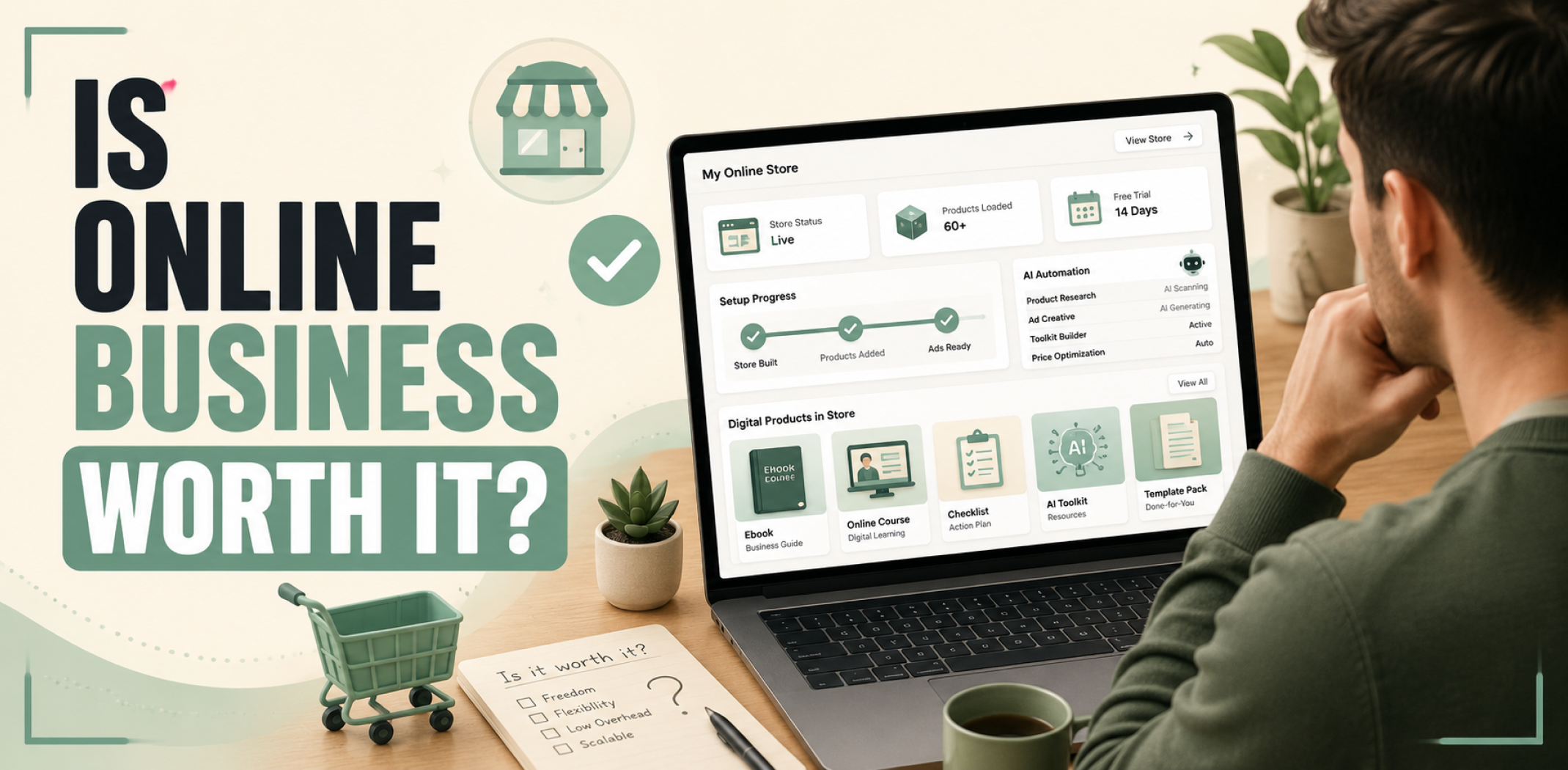
The 14 day free trial exists for exactly this reason: to let you look under the hood before spending anything. During those 14 days you get full access to the platform, a store preloaded with 60 or more digital products, and a 40 dollar ad coupon to test the built in ad system without your own money on the line yet.
Based on everything covered in this guide, an online business through AliDropship tends to be worth it for people who want a low cost way to test entrepreneurship without quitting a day job, who are comfortable spending a modest, ongoing amount on ads, and who can commit to checking in on their store regularly rather than setting it up once and forgetting about it. It tends to be a weaker fit for anyone looking for a truly hands off investment, or anyone who needs a fast, certain source of income right away, since neither expectation matches how the model actually works.
None of this changes the honest tradeoffs covered earlier in this guide. A free trial and a simple setup lower the barrier to finding out, they do not decide the outcome once you are inside. If you want the complete, step by step version of that process before you commit to anything, our guide to starting an online business is the natural next stop.
So, is an online business worth it in 2026? The honest, complete answer is that it can be, for the right person, under real conditions: a modest ad budget, patience measured in weeks rather than days, and expectations set by real numbers rather than a highlight reel. It is not a shortcut, and it is not a scam. It is a real business model with a low cost, low risk way to find out if it fits your particular situation, starting with a free trial rather than a leap of faith.
Is starting an online business actually worth it in 2026?
Is AliDropship a legit platform or is it a scam?
How much does it cost to start an online business with AliDropship?
How long does it take to see results from an online business?