Is Mary Kay Legit? An Honest 2026 Review Of The Beauty MLM

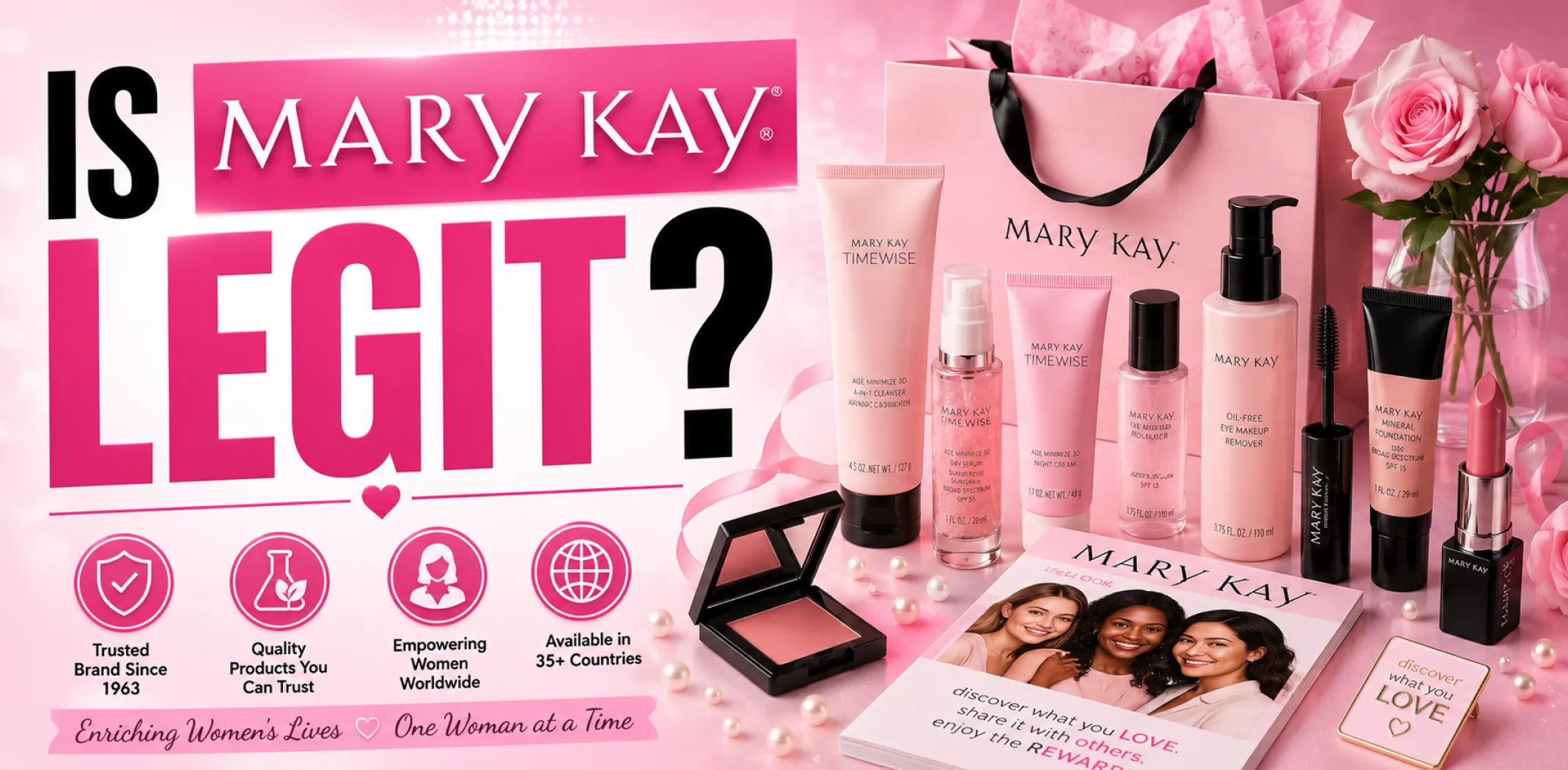
Quick verdict
Mary Kay is a legitimate company founded in 1963 that sells real, well-regarded cosmetics and skincare products – it is not a scam and has never been classified as a pyramid scheme. But its own Canadian income disclosure states that “a typical participant does not earn any commissions or bonuses,” and only 11.7% of consultants are eligible for commissions at all. The FTC sent Mary Kay a formal Penalty Offense Notice for misleading income claims, and the direct selling industry’s own self-regulator found Mary Kay made deceptive income claims on two separate occasions.
Key takeaways
- Mary Kay is a real company founded in 1963 selling genuine cosmetics and skincare products in 35-plus markets; it has been recognized as the number one direct-selling skincare brand globally by Euromonitor for three consecutive years (2023-2025).
- The FTC sent Mary Kay a formal Penalty Offense Notice in October 2021 for misleading money-making opportunity claims – the same formal regulatory action sent to hundreds of MLMs following TINA.org’s complaint campaign.
- The direct selling industry’s own self-regulator, the DSSRC, found Mary Kay’s income claims to be deceptive on two separate occasions – in 2021 and again in a second case that found continued use of claims including “five-figure residual income.”
- Mary Kay’s own Canadian income disclosure – the only government-mandated disclosure available, as the US does not require one – states that “a typical participant does not earn any commissions or bonuses.” Only 11.7% of all consultants are eligible for commissions, averaging $208 CAD per year.
- Staying “active” and eligible for commissions requires approximately $200 in product purchases every quarter – around $800 per year – meaning the average commission-eligible consultant is spending more to maintain eligibility than she earns in commissions.
What is Mary Kay and how does it work in 2026?
Mary Kay Inc. was founded on September 13, 1963 by Mary Kay Ash and her son Richard Rogers in Dallas, Texas. Ash’s founding premise was straightforward and genuinely radical for 1963: give women an equal opportunity to succeed in business by providing a direct sales platform where effort, not corporate politics, determined income.
She started with $5,000 in savings and a roster of products based on the skin softener her mother had developed. The business grew from a single storefront into one of the world’s largest direct selling cosmetics companies, generating approximately $2.4 billion in annual revenue in 2024 and maintaining a consultant network across 35-plus markets globally.
In 2026, Mary Kay is still family-owned and family-led. Ryan Rogers – Mary Kay’s grandson – became CEO in 2022. The company remains headquartered in Addison, Texas, with its primary manufacturing and R&D facility in Lewisville, Texas, and holds more than 1,600 patents.
It has been recognized by Euromonitor International as the number one direct-selling brand for skincare and color cosmetics globally for three consecutive years from 2023 through 2025.
Independent Beauty Consultants (IBCs) earn money by purchasing products at wholesale prices (a 50% discount off suggested retail) and selling them to customers, and by earning commissions on the sales volume of consultants they recruit into their team.
Is Mary Kay legitimate? What the evidence shows
Yes, Mary Kay is legitimate. It is a 62-year-old family-owned company with genuine, well-regarded beauty products, real manufacturing facilities, more than 1,600 patents, and a global footprint verified by independent market analysis. Euromonitor International ranked it the number one direct-selling skincare and color cosmetics brand globally for three consecutive years through 2025.
Its ANEW-equivalent skincare lines, TimeWise skin care range, and fragrance products have genuine consumer loyalty built over decades. The company has never been shut down, never been classified as a pyramid scheme, and is not under any active regulatory enforcement action.
What the legitimacy picture requires examining more carefully is the business opportunity. Mary Kay is a real company with real products. Whether it is a financially viable income opportunity for most of the people who join as consultants is a separate question – and the available data, including Mary Kay’s own government-mandated Canadian disclosures, gives a clear and sobering answer to that separate question.
The income data – what Mary Kay’s own disclosure actually says
Mary Kay does not publish an income disclosure for the United States – unlike many of its direct selling competitors. The US does not require this disclosure. What is available comes from Canada, where government regulation mandates it. The Canadian market is comparable to the US in structure and culture, making this data the most credible proxy available for the US consultant experience.
The language in Mary Kay’s own Canadian Earnings Representation is unusually precise and unusually clear. It states: “A typical participant in the Mary Kay Independent Sales Force does not earn any commissions or bonuses.” All Canadian sales force members are included in this figure – not just active ones.
Only 11.7% of all consultants are even eligible for commissions. Of those eligible, the average annual commission in 2022 was $208 CAD – roughly $150 USD at typical exchange rates.
The hidden cost that makes $208 a net loss:
To be eligible for any commission at all, a Mary Kay consultant must maintain “active” status by purchasing at least $200 in products every quarter – approximately $800 per year. The average consultant who qualifies for commissions earns $208 in commissions per year. After the $800 minimum in annual product purchases required to stay eligible, the average commission-eligible consultant is running a net loss of approximately $600 per year before accounting for any other business expenses. This is not a fringe interpretation – it is the arithmetic of the company’s own disclosed numbers.
The 2024 Canadian data shows the same pattern continuing and worsening. National Sales Directors – the top rank in the company, representing the highest-earning consultants – saw average Canadian income drop from $149,440 CAD in 2023 to $122,000 CAD in 2024 (approximately $88,000 USD).
Sales Directors averaged $19,658 CAD (approximately $14,000 USD) in 2024. These are gross figures before any business expenses. For consultants below the Director level – the vast majority of the sales force – the pattern described in the Earnings Representation applies: typical earnings are zero.
The regulatory record on income claims
Mary Kay has been the subject of a sustained and multi-layered regulatory and watchdog response specifically focused on its income representations – a more extensive record than most MLMs of comparable size.
TINA.org December 2017. As part of its investigation of all DSA-member companies, TINA.org notified Mary Kay that it was engaged in deceptive marketing through atypical income claims. Mary Kay was one of the first major MLMs to receive this formal notification in the investigation series.
DSSRC first case decision (March-July 2021). After TINA.org filed a complaint with the Direct Selling Self-Regulatory Council – the direct selling industry’s own self-regulator – the DSSRC investigated and found that the income claims identified by TINA.org were deceptive and had to be removed.
This is notable because the DSSRC is the industry’s own body, not an external regulator; its finding that Mary Kay’s claims were deceptive carries particular weight.
FTC Penalty Offense Notice (October 2021). The FTC sent Mary Kay a formal Notice of Penalty Offenses for money-making opportunity claims. This notice formally put the company on record that misrepresenting typical participant earnings is an unfair and deceptive trade practice that could result in civil penalties of up to $51,744 per violation if the conduct continues.
DSSRC second case decision. Following the first DSSRC decision, Mary Kay’s distributors continued making deceptive income claims. The DSSRC issued a second case decision finding that Mary Kay and its distributors were still using atypical and unsubstantiated income claims, specifically including claims about “financial freedom” and the ability to earn “five-figure residual income.”
The DSSRC determined that Mary Kay had made good faith efforts to remove the claims at issue and closed its investigation – but the fact of a second finding of continued deceptive claims is significant context.
TINA.org 2023 investigation. Mary Kay was included in TINA.org’s major 2023 investigation of 100 MLM companies that found 98% using atypical and unsubstantiated income claims to promote their business opportunities. TINA.org audited its findings for the Mary Kay database in July 2024.
Evaluating Mary Kay for its income opportunity? The company’s own Canadian income disclosure states a typical participant earns zero commissions. The FTC and the direct selling industry’s own self-regulator both found the income claims used to recruit new consultants to be deceptive. If you are looking for an online income model with transparent earnings data and without the inventory pressure pattern, our guide covers the realistic options: How to make money online.
Is Mary Kay worth it in 2026 – honest verdict
In 2026, the Mary Kay assessment requires separating two genuinely different questions.
As a product brand: Mary Kay products are real, well-manufactured, and have earned genuine consumer loyalty over six decades. The TimeWise skincare system, the Chromafusion makeup range, and the fragrance lines are competitive with mainstream department store brands.
The company has more than 1,600 patents and was ranked the number one direct-selling skincare brand globally for three consecutive years. Buying Mary Kay products as a customer is a low-risk decision based on genuinely good products.
As a business opportunity: The evidence is stark. The company’s own Canadian income disclosure states that a typical participant earns zero commissions or bonuses. Only 11.7% of consultants are even eligible. Of those eligible, the average annual commission is approximately $208 CAD – less than the $800 minimum annual product purchase required to maintain active status.
The FTC sent a Penalty Offense Notice for income claims. The direct selling industry’s own self-regulator found deceptive income claims on two separate occasions. TINA.org found Mary Kay among 98% of MLMs making atypical income representations.
The Pink Cadillac and six-figure earnings stories are real – but they represent a fraction of 1% of the sales force, and achieving them requires five to twelve years of full-time dedication.
Legitimate company. Genuine products. The income opportunity does not work for most consultants – per the company’s own disclosed data.
Mary Kay is not a scam and has never been classified as a pyramid scheme. Its products are genuinely well-regarded. But the income opportunity is documented by the company’s own Canadian disclosure as producing zero earnings for the typical participant. The $208 average annual commission for eligible consultants is less than the $800 annual minimum product purchase cost of maintaining eligibility. The FTC issued a Penalty Notice; the industry’s own self-regulator found deceptive claims twice. Buying the products is reasonable. Joining as a consultant with income expectations is a decision that should be made with the disclosed data – not the recruiting pitch – as your baseline.
Looking for an income model where the earnings data is transparent?
Mary Kay’s US operation publishes no income disclosure. The Canadian data that is available shows typical earnings of zero. Ecommerce and digital income models offer a different structure where your income is not capped by your personal network size and you are not required to purchase inventory to stay eligible to earn. Our guide covers what is realistic: How to make money online.
Is Mary Kay a legitimate company?
Is Mary Kay a pyramid scheme?
No. Mary Kay has never been classified as an illegal pyramid scheme by the FTC or any court. It sells real cosmetics products to real customers and earns revenue from genuine product sales rather than from recruitment fees alone. The FTC defines a pyramid scheme by whether revenue comes primarily from recruiting new members rather than real product sales, and Mary Kay does not meet that definition. However, the company has received an FTC Penalty Offense Notice for misleading income claims, and the direct selling industry own self-regulator found its income claims to be deceptive on two separate occasions. The pyramid scheme label is legally incorrect; the income claims concerns are documented.
How much do Mary Kay consultants actually earn?
According to Mary Kay own government-mandated Canadian income disclosure – the most comparable proxy for US earnings, as Mary Kay does not publish a US income disclosure – a typical participant in the Mary Kay Independent Sales Force does not earn any commissions or bonuses. Only 11.7% of all Canadian consultants are eligible for commissions at all. Of those eligible, the average annual commission in 2022 was 208 Canadian dollars, roughly 150 US dollars. To remain eligible for any commission, consultants must purchase at least 200 dollars in products per quarter, which totals approximately 800 dollars per year in minimum purchases. The average commission of 208 Canadian dollars is less than the minimum annual cost of maintaining eligibility. 2024 data showed National Sales Directors averaging 122,000 Canadian dollars annually and Sales Directors averaging 19,658 Canadian dollars annually – both before business expenses.
Why does Mary Kay have so many income claim complaints?
Mary Kay has accumulated a substantial regulatory and watchdog record specifically on income claims. TINA.org notified the company of deceptive income claims in 2017 as part of its DSA-member investigation. In 2021, after TINA.org filed a complaint with the Direct Selling Self-Regulatory Council – the direct selling industry own self-regulator – the DSSRC found the identified claims were deceptive and required their removal. That same year, the FTC sent Mary Kay a formal Penalty Offense Notice for money-making opportunity claims. A second DSSRC case found that Mary Kay and its distributors continued making deceptive claims including promises of financial freedom and five-figure residual income. Mary Kay was also included in TINA.org 2023 investigation of 100 MLM companies that found 98% using atypical income claims, with findings audited in July 2024. The income claims concern is significant because Mary Kay does not publish a US income disclosure, meaning prospective consultants in the US have no official earnings data available to evaluate recruiting representations.
What are better alternatives to Mary Kay for earning money online?
If your goal is to earn money online without the structural limitations documented in Mary Kay income data – zero typical earnings, minimum inventory costs to maintain eligibility, income dependent on personal network size, and a small percentage reaching meaningful income after years of effort – ecommerce and digital business models offer a structurally different approach. With a dropshipping store, you sell products to any customer online without purchasing inventory in advance, and your income is not tied to two-week campaign cycles or a personal network ceiling. For a comparison of realistic online income models with transparent earnings data, see: https://alidropship.com/how-to-make-money-online/