Is M1 Finance Legit? A Straight-Talking 2026 Review

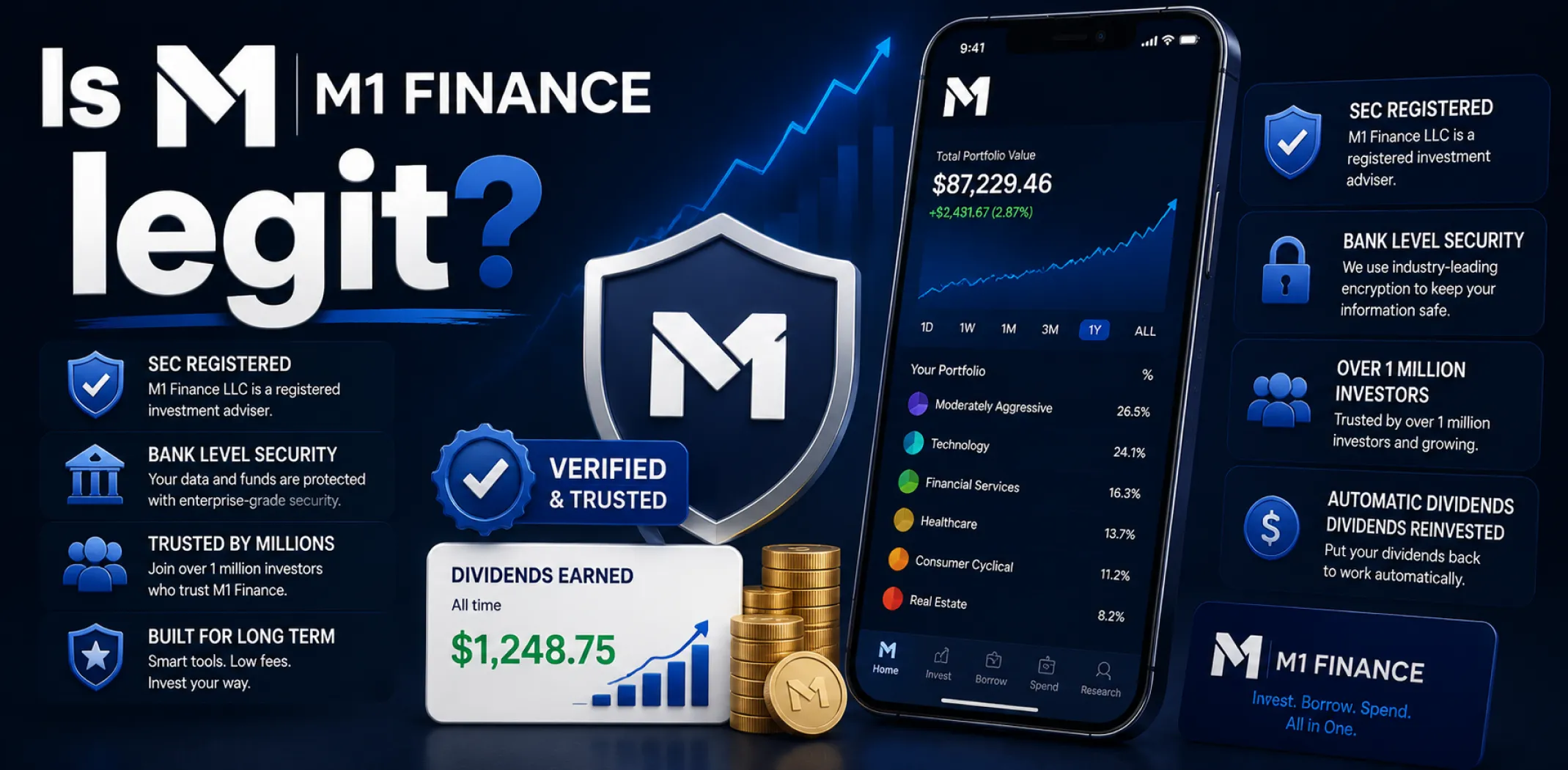
If you landed here wondering whether M1 Finance is legit or some kind of elaborate scam, the short answer is: it is a real, regulated investment platform. But “legit” only tells part of the story.
In 2026, M1 Finance has over $12 billion in assets under management and more than a million users – yet its Trustpilot score sits at a concerning 1.6 out of 5. That gap between institutional credibility and user frustration is exactly what this review unpacks so you can decide with clear eyes.
Quick verdict
M1 Finance is a legitimate SEC-registered broker-dealer, founded in 2015 and a member of FINRA and SIPC. It is not a scam. However, its fee structure – including a $100 outgoing transfer fee and a $3 monthly platform charge – catches many users off guard, and customer support quality is a documented, recurring complaint.
Key takeaways
- M1 Finance is an SEC-registered broker-dealer and FINRA/SIPC member, which means your invested assets are protected up to $500,000 through SIPC coverage.
- M1 manages over $12 billion in assets for more than 1 million users as of 2025, making it a mid-sized but established platform.
- The platform charges a $3 monthly fee unless you maintain at least $10,000 in your account or hold an active personal loan.
- A $100 outgoing transfer fee and a $100 IRA termination fee are the most complained-about charges across Trustpilot and ConsumerAffairs reviews.
- M1 is designed for long-term, buy-and-hold investors – it is not built for active traders, day traders, or people who need fast withdrawals.
What is M1 Finance and how does it work?
M1 Finance launched in 2015 and is headquartered in Chicago, Illinois. Its parent company is M1 Holdings Inc., a privately held fintech group. The core product is a “Pie” investing model: you build a portfolio by selecting individual stocks, ETFs, or pre-built model portfolios and assign each a percentage slice of your total investment.
M1 then automatically allocates every deposit across those slices and rebalances your portfolio when it drifts from your target allocation.
In 2026, M1 positions itself as a “Finance Super App” combining investing, borrowing, and a high-yield cash account under one roof. The platform is self-directed – meaning you choose your own investments – with a layer of automation on top. It is not a robo-advisor in the traditional sense, because M1 does not ask about your risk tolerance and build a portfolio for you. You are in control of the asset selection.
Is M1 Finance legitimate? What the evidence shows
Yes – M1 Finance is a legitimate financial services company. The brokerage arm, M1 Finance LLC, is an SEC-registered broker-dealer and a member of both FINRA and SIPC. SIPC coverage protects your invested securities up to $500,000 (including up to $250,000 in cash claims) in the event the firm fails. This is the same regulatory framework that covers major brokerages like Fidelity and Charles Schwab.
From a company scale perspective, M1 crossed $10 billion in AUM in late 2024 and reached $12 billion by November 2025 – a level that reflects genuine institutional traction, not a fly-by-night operation. The platform has been operating for nearly a decade, has raised multiple institutional funding rounds including a $75 million Series D, and has been covered by mainstream financial publications including Forbes and TechCrunch.
The low Trustpilot score does not mean the platform is fraudulent – it reflects a specific pattern of complaints around fees and customer service that we cover in the next section. Scam platforms do not register with the SEC, maintain SIPC membership, raise $75 million from institutional investors, or operate for nearly a decade.
M1 Finance is a real company with real regulatory standing. What it is not is a frictionless, complaint-free experience for all user types.
Common complaints and red flags – what real users report
The complaints against M1 Finance are real, documented, and follow consistent patterns across Trustpilot, ConsumerAffairs, and BBB reviews in 2025 and 2026. They do not indicate fraud – but they do indicate a platform that prioritizes fee clarity and ease of exit less than users expect.
The single most common complaint is the $100 outgoing transfer fee. Multiple users across review platforms describe discovering this fee only when attempting to move their account to another broker. A $100 IRA termination fee compounds this – reviewers on ConsumerAffairs reported that for small IRA balances, the fee amounted to a substantial percentage of their total portfolio.
A second major complaint is the $3 monthly platform fee, which was introduced after many users had already opened accounts. Several Trustpilot reviewers describe a “dark pattern” scenario: the fee kicked in after reopening an account, with a $100 exit penalty making it difficult to leave.
Common misconception:
✕ “M1 Finance is free to use.”
✓ M1 charges a $3 monthly platform fee on accounts under $10,000 that do not hold an active personal loan. There is also a $100 outgoing transfer fee and a $100 IRA termination fee – none of which are prominently disclosed at signup, based on patterns reported by users on Trustpilot and ConsumerAffairs through early 2026.
Customer support quality is the third main complaint category. Reviewers consistently describe difficulty reaching a human agent, unhelpful AI-only initial responses, and long resolution timelines.
One ConsumerAffairs reviewer reported being unable to close their account or withdraw their funds for an extended period, eventually reaching a phone agent whose solution still left them limited to $1,000 per day in withdrawals. These are operational frustrations, not fraud indicators – but they are material if you are the type of investor who values fast, responsive support.
Finally, M1 does accept payment for order flow (PFOF) – a practice that has drawn regulatory scrutiny in recent years. NerdWallet notes this introduces a potential conflict of interest, though it is less impactful on M1 than on day-trading platforms given M1’s long-term, set-and-forget model. Trades execute in fixed windows rather than on-demand, so real-time execution quality is less critical here than it would be for active traders.
What do real users say about M1 Finance?
User sentiment on M1 Finance splits sharply between long-term holders who love the platform and users who hit friction at the exit. In 2026, both camps are vocal. Here is what that looks like in practice.
How does M1 Finance compare to alternatives?
For the type of investor M1 targets – long-term, buy-and-hold, low turnover – there are several direct alternatives worth comparing. The key differentiators are fee structure, investment flexibility, and exit costs.
Is M1 Finance worth it? An honest verdict
M1 Finance is worth it for a specific type of investor. If you are a long-term, buy-and-hold investor who wants more control than a robo-advisor offers but more automation than a traditional brokerage provides, M1 hits a real gap in the market.
The Pie model is genuinely innovative, the fractional shares feature keeps every dollar invested, and the margin loan rates are competitive. If you plan to stay on the platform for years and maintain a balance above $10,000 to waive the monthly fee, the total cost is very low.
It is not worth it if you are a beginner who might need to move your money quickly, if you are opening a small IRA that could be disproportionately hit by the $100 termination fee, or if you want active trader features like real-time order execution. The Trustpilot score is a genuine signal that a meaningful subset of users have had frustrating experiences – primarily around fees they did not anticipate and support that was slow to resolve issues.
Legitimate platform – but fee transparency is a real concern
M1 Finance is a fully regulated, FINRA/SIPC-member investment platform with over $12 billion in assets under management. It is best suited to long-term investors who plan to hold their portfolio within M1 and maintain a balance above $10,000. The exit fee structure – particularly the $100 outgoing transfer fee and the $100 IRA termination fee – is the single biggest caveat and should be reviewed thoroughly before opening an account.
Your own store and your Amazon business – both free to start
Unlike investing platforms that charge exit fees and monthly subscriptions, AliDropship gives you a fully built ecommerce store and a complete Amazon Seller Kit for free. No monthly fee surprises. No transfer fees. No platform lock-in – you own the store outright.
Looking for an alternative way to build online income?
If you came to this review because you are exploring ways to build income online – not just invest existing savings – there is a broader category worth knowing about. Investing platforms like M1 grow money you already have. Ecommerce platforms let you generate new income from scratch.
AliDropship is one of the most accessible entry points in that second category: a fully built online store, pre-loaded with products, ready to sell from day one – no inventory, no technical setup, no experience required.
Free turnkey store – built, designed, and filled with products
Your store arrives professionally designed, pre-loaded with 50 bestselling products, and fully optimized to convert. No setup fees, no coding, no design time. You start at the product-testing stage – not the store-building stage. Hosting, SSL, and payment gateway are all included.
Winning products, one-click import
Browse trending and niche items from AliDropship’s catalog – including brand-name and digital products – and import them to your store in one click. The catalog updates regularly so your store always has fresh, competitive inventory without manual research.
Automated fulfillment and real-time tracking
Orders are processed automatically through global supplier connections. Customers receive real-time tracking updates – building trust and reducing support volume. You do not touch the shipping logistics; the platform handles it end-to-end.
Built-in marketing and promotion tools
Email campaigns, discount management, abandoned-cart recovery, live countdown timers, and social media integration are all included or available as add-ons. No prior marketing experience required – the tools guide you through each campaign type.
Beginner-friendly – no coding, no learning curve
An intuitive dashboard walks you through every step. Adding products, running campaigns, and scaling your catalog require no technical knowledge. As your business grows, the platform scales with you – adding features without adding complexity.
AliExpress integration – one-click imports, synced inventory
AliDropship connects directly to AliExpress for one-click product imports, automated order processing, and synced tracking. Inventory stays current with the latest products and prices. Combined with the turnkey store and automated fulfillment, this integration makes the entire operation manageable for one person.
A fully built store, products loaded, ads ready to switch on
50 bestselling products, hosting included, built-in ad system. You start selling – not building.
The Amazon Seller Kit – 300M buyers, import file ready to upload
Access the $514B Amazon marketplace with a ready-made product import file. Both tracks ship in one free signup.
Is M1 Finance a legitimate investment platform?
What fees does M1 Finance charge in 2026?
As of 2026, M1 charges a 3 dollar monthly platform fee unless you maintain at least 10,000 dollars in assets or hold an active personal loan. There is also a 100 dollar fee for outgoing account transfers and a 100 dollar IRA termination fee. Trades themselves are commission-free across stocks and ETFs. There is also a 50 dollar inactivity fee for accounts with balances of 50 dollars or less that have had no activity for 90 or more days.
Does M1 Finance really pay out to investors?
M1 Finance does pay out to investors – it is a real brokerage that processes trades, pays dividends, and allows withdrawals. The concern flagged in user reviews is not non-payment but friction around withdrawals and account transfers. A small number of Trustpilot and ConsumerAffairs reviewers reported difficulty closing accounts or transferring funds, though M1 is a regulated entity and SIPC-insured. Results from investing always depend on market conditions and the specific assets held.
What are the biggest risks of using M1 Finance?
The main risks are fee-related rather than fraud-related. The 100 dollar outgoing transfer fee creates a form of platform lock-in that has frustrated users who wished to move their portfolio. The 3 dollar monthly fee reduces returns on small balances. M1 also accepts payment for order flow, which introduces a potential conflict of interest around trade execution. And like all investment platforms, M1 does not protect against market losses – only against firm failure up to SIPC limits.
What are the best alternatives to M1 Finance?
The most commonly cited alternatives to M1 Finance are Fidelity, Charles Schwab, Robinhood, and Betterment. Fidelity and Schwab are traditional brokerages with no outgoing transfer fees, broader customer support, and no monthly platform fees. Robinhood offers a similar self-directed experience without the Pie portfolio model. Betterment is a true robo-advisor that builds and manages your portfolio for you based on a risk questionnaire. The best choice depends on how hands-on you want to be and how important exit flexibility is to you.