Is Le-Vel Thrive Legit? An Honest Review For 2026

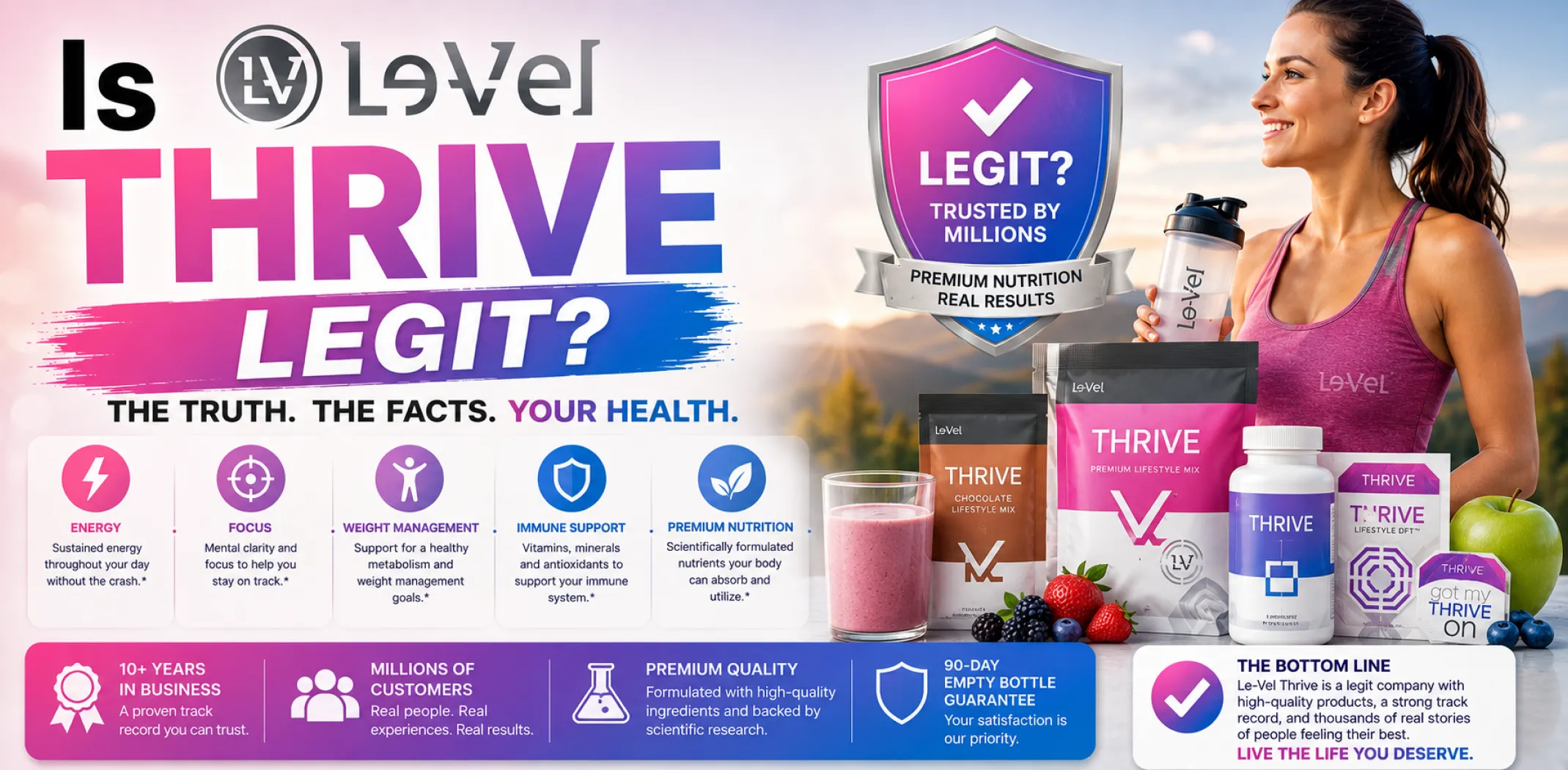
Quick verdict
Le-Vel Thrive is a legitimate, operating company founded in 2012 and still active in 2026 – it sells real products, has a genuine customer base, and is not a scam in the fraud sense. However, the flagship DFT patch lacks independent clinical evidence for its specific claims, the DSSRC found Le-Vel and its promoters used inappropriate income and health claims, and most Brand Promoters earn very little. Legitimate does not mean risk-free or well-evidenced.
- Le-Vel is a real, privately held company founded in 2012 in Frisco, Texas, by Jason Camper and Paul Gravette – it is not closing, not under direct FTC enforcement action, and still actively operating in 2026.
- The Thrive Experience costs around 300 dollars for a four-week supply and combines capsules, a nutritional shake, and the DFT (Derma Fusion Technology) patch worn on the skin for 24 hours daily.
- No independent clinical studies specifically examine the Thrive DFT patch; reviewers at Healthline and Diet vs Disease note that it is unclear whether the transdermal delivery system can even raise blood levels of the active ingredients.
- The industry self-regulator DSSRC found in 2020 that Le-Vel and its promoters used inappropriate health claims and atypical income claims; TINA.org documented 140 instances of deceptive earnings claims by Le-Vel promoters.
- Most Brand Promoters earn very little from commissions – estimates suggest the majority earn under 500 dollars per month, consistent with FTC findings across the broader MLM industry.
What is Le-Vel Thrive and how does it work?
In 2026, Le-Vel is a privately held health and wellness company headquartered in Frisco, Texas, operating entirely on cloud-based infrastructure – it has no physical retail stores or traditional office overhead. Founded in 2012 by co-CEOs Jason Camper and Paul Gravette, the company built its business around the THRIVE product line and the multi-level marketing model it calls Brand Promoter.
Le-Vel reached one billion dollars in lifetime sales within its first five years and continues to operate at an estimated annual revenue of 350 to 450 million dollars, though as a private company it does not publish audited financials.
The flagship offering is the Thrive Experience – a three-step daily supplement routine marketed as an eight-week premium lifestyle plan. Step one is taking two Thrive Premium Lifestyle Capsules first thing in the morning. Around twenty minutes later, step two is drinking a Thrive Ultra Micronized Shake Mix.
Step three – and the product that generates the most attention and skepticism – is the Thrive DFT patch, a skin adhesive worn for 24 hours that uses Derma Fusion Technology to supposedly deliver nutrients transdermally. The full four-week program costs around 300 dollars, putting it at a premium price point relative to standard supplement alternatives.
As of 2025 and into 2026, Le-Vel has expanded into GLP-1 adjacent products with its THRIVE myGLP Support system – marketed as a nutraceutical complement for people using or considering GLP-1 weight loss medications. The company also announced a partnership with USA Pickleball in June 2025, signalling an ongoing marketing push in active lifestyle demographics.
Is Le-Vel Thrive legitimate? What the evidence actually shows
Le-Vel Thrive is a legitimate, operating company. It has been in business for thirteen years, generated over a billion dollars in lifetime sales, maintains a real product line manufactured in the US and Canada, and is actively expanding in 2026. It is not about to close, is not under direct FTC enforcement action, and is not a fraud in the legal sense. Those are the baseline facts.
On the product efficacy side, the picture is more complicated – and worth being direct about. The Thrive Experience combines three products. The capsules and shakes contain ingredients (B vitamins, probiotics, plant extracts, protein) that have individual research support for general wellness benefits. The DFT patch is the more scientifically contested element.
Healthline and Diet vs Disease – both respected health review sources – note that no independent clinical studies specifically examine the Thrive DFT patch, and that it is currently unclear whether the transdermal delivery mechanism can raise blood levels of the active ingredients at meaningful concentrations.
Le-Vel holds patents on the DFT technology and has conducted its own internal research, but that is not the same as peer-reviewed independent replication.
The regulatory record is clearer. In 2020, the Direct Selling Self-Regulatory Council (DSSRC) – the MLM industry’s own self-regulatory body – concluded a case against Le-Vel finding that the company and its promoters had made inappropriate health claims about the Thrive product line and atypical income claims about the business opportunity.
TINA.org, the advertising watchdog, documented 140 instances of deceptive earnings claims made by Le-Vel promoters. Le-Vel engaged with the DSSRC process and stated its commitment to compliance, but the record establishes a pattern that goes beyond isolated promoter misconduct.
Common complaints and red flags – what to know before buying
Le-Vel Thrive generates a distinct set of complaints depending on whether someone is evaluating it as a consumer buying supplements or as a prospective Brand Promoter. Understanding both sides gives a more complete picture than either camp alone typically offers.
⚠️ Common misconceptions – and what the evidence actually says
✕ “The Thrive patch is a scientifically proven delivery system”
✓ Transdermal delivery technology is a legitimate medical concept – nicotine patches and certain hormone therapies use it effectively. Le-Vel holds patents on the DFT formulation. However, independent reviewers including Healthline note that no peer-reviewed studies specifically test the Thrive DFT patch, and that it is not established whether the delivery mechanism raises blood levels of the active ingredients at clinically meaningful concentrations. Patents confirm a novel formulation process – they do not confirm efficacy.
✕ “If I become a Brand Promoter I can earn a significant income”
✓ The DSSRC found Le-Vel and its promoters promoted the income opportunity using atypical examples – results achieved by a small minority at the top of the earnings distribution, not typical participants. Industry research consistently finds the majority of MLM participants earn under 500 dollars per month, and many earn nothing after accounting for product costs. Le-Vel does not publish a transparent public income disclosure statement in the way that Medifast/Optavia does via SEC filings.
✕ “All the positive reviews online prove Thrive works as claimed”
✓ Because Thrive is sold via Brand Promoters who earn commissions on sales, a significant proportion of positive reviews online come from people with a financial incentive to endorse the product. This does not mean the products do not work for some users – many report genuine energy improvements. It means independent reviews and commercially motivated reviews are hard to separate, and the overall evidence base for the specific claims made (especially around the DFT patch) is weaker than the volume of positive content suggests.
Consumer complaints center on cost and results not matching marketing. At around 300 dollars for a four-week supply, Thrive is priced at a significant premium over comparable individual supplements.
Users who experience energy improvements – the most consistently reported benefit – are generally satisfied. Users who expected the patch specifically to drive weight loss or mental clarity breakthroughs report disappointment. The skin irritation from the patch adhesive is also a documented complaint, particularly for users with sensitive skin.
Promoter complaints center on income expectations not matching reality. The structure that allows promoters to earn free product by referring new customers has genuine appeal – but building to the income levels shown in promotional materials requires recruiting and managing a large downline, which most people do not achieve.
The DSSRC finding and the TINA.org documentation indicate this gap between marketed and typical income was not just anecdotal – it was systematic enough to draw formal regulatory attention.
What do real users say about Le-Vel Thrive?
User sentiment on Le-Vel Thrive is more polarized than on most wellness products, partly because the MLM structure makes it difficult to separate genuine consumer reviews from promoter-driven content.
With that context in mind, the clearest signal from independent sources is that energy improvement is the most consistently reported effect, weight loss results are inconsistent, and the DFT patch specifically is the most controversial element.
Looking for online income that does not depend on recruiting?
Brand Promoter income depends on your downline – product-based businesses depend on you
The Le-Vel Brand Promoter model works for people who build large networks – the income data shows that is a small minority. If you are interested in building online income independently – where your earnings are tied to your own store and your own customers rather than a downline and a company compensation plan – product-based ecommerce offers a fundamentally different structure. Our guide covers the most practical starting points, with realistic timelines and what each model actually requires.
How does Le-Vel Thrive compare to alternatives?
Thrive sits in a large and competitive wellness supplement market. Whether you are evaluating it as a consumer or considering the Brand Promoter opportunity, the alternatives look meaningfully different across price, evidence, and business structure.
Is Le-Vel Thrive worth it – honest verdict
Le-Vel Thrive is a legitimate company selling real products to a genuine and substantial customer base. It is not a scam, not closing, and not under FTC enforcement action in 2026. Thirteen years of operation and over a billion dollars in sales make the basic legitimacy question straightforward to answer.
Whether the products justify their cost is a separate and harder question. The capsules and shakes contain ingredients with individual research support. The DFT patch – the signature product – lacks independent peer-reviewed evidence for its specific claims, and reviewers note it is not even established that the transdermal delivery mechanism works as described.
Energy improvement is the most reliably reported benefit from users who are not promoters. Significant weight loss is not consistently reported. At 300 dollars per month for the full system, the price-to-evidence ratio is unfavorable compared to individual supplements sourced separately.
As a Brand Promoter income opportunity, the evidence is clearer: most promoters earn little or nothing after product costs, the DSSRC found the income claims made by Le-Vel and its promoters to be atypical and insufficiently disclosed, and the structural dynamics of MLM income mean results are heavily concentrated among a small top tier.
That does not make the opportunity impossible, but it does mean entering it with realistic expectations grounded in data, not promotional content.
Legitimate company – but approach the patch claims and income opportunity with scepticism
Le-Vel Thrive is a real business that has operated for over a decade with a large and genuine customer base. It is best suited to consumers who want a structured, convenient supplement routine and are comfortable paying a premium for it – with realistic expectations that the energy benefit is the most evidence-supported outcome. The DFT patch claims are not independently validated. The Brand Promoter income opportunity is challenging for the majority who try it, and income was found by the DSSRC to have been promoted using atypical examples.
If you are researching Thrive because you want to earn online
Many people arrive at the Le-Vel Brand Promoter opportunity because it offers an appealing premise: earn commissions (and free product) by sharing something you already use with people you know. The friction comes when that natural network runs out and the income expectation does not match the reality of building a large downline in a competitive wellness market already saturated with similar-looking MLM offers.
If building income online is the underlying goal, the structural difference between MLM-adjacent income and product-based ecommerce is worth understanding clearly. In ecommerce, your customers are your own, your margins are your own, and your income does not depend on a company’s compensation plan changing or a downline going quiet.
Our guide to making money online covers the most practical models for building that kind of income from scratch – what realistic first-year results look like, which models require the least upfront capital, and what separates income that scales from income that stalls.
Read the full make-money-online guide here.
Is Le-Vel Thrive legit?
Does the Thrive DFT patch actually work?
Independent evidence for the Thrive DFT patch is limited. Transdermal delivery technology is a legitimate and established medical concept, and Le-Vel holds patents on its Derma Fusion Technology formulation. However, reviewers at Healthline and Diet vs Disease note that no peer-reviewed studies specifically examine the Thrive patch, and that it is not established whether the delivery mechanism raises blood levels of the active ingredients at meaningful concentrations. Most users who report noticeable effects attribute them to increased energy rather than weight loss or mental clarity.
What do Le-Vel Brand Promoters actually earn?
Most Le-Vel Brand Promoters earn very little from commissions. Industry research and the DSSRC finding indicate most MLM participants earn under 500 dollars per month, and many earn nothing after accounting for product purchases required to qualify for bonuses. Le-Vel does not publish a widely available transparent income disclosure statement comparable to publicly traded MLM companies. TINA.org documented 140 instances of promoters making atypical income claims – examples from the top of the earnings distribution presented as typical results.
What regulatory actions have been taken against Le-Vel?
In 2020 the Direct Selling Self-Regulatory Council (DSSRC) concluded a case finding that Le-Vel and its promoters had made inappropriate health claims about the Thrive product line and atypical income claims about the Brand Promoter opportunity. Truth in Advertising (TINA.org) catalogued 140 instances of deceptive earnings claims made by Le-Vel promoters. Le-Vel engaged with the DSSRC process. No direct FTC enforcement action against the company itself has been publicly announced as of 2026.
What are the best alternatives to Le-Vel Thrive?
For wellness supplement needs similar to what Thrive promises, individual B vitamins, probiotics, and protein powders from established brands like Thorne Research offer overlapping ingredients for 30–60 dollars per month with stronger individual research backing. Optavia offers a more structured weight loss program with clinical evidence, though it carries its own side effect profile and cost. A consultation with a registered dietitian provides personalized, evidence-based nutrition guidance. For those interested in online income rather than the supplement itself, the AliDropship guide at alidropship.com/how-to-make-money-online covers product-based models that do not depend on recruiting.