Is Le-Vel Thrive A Scam? The Honest Answer For 2026

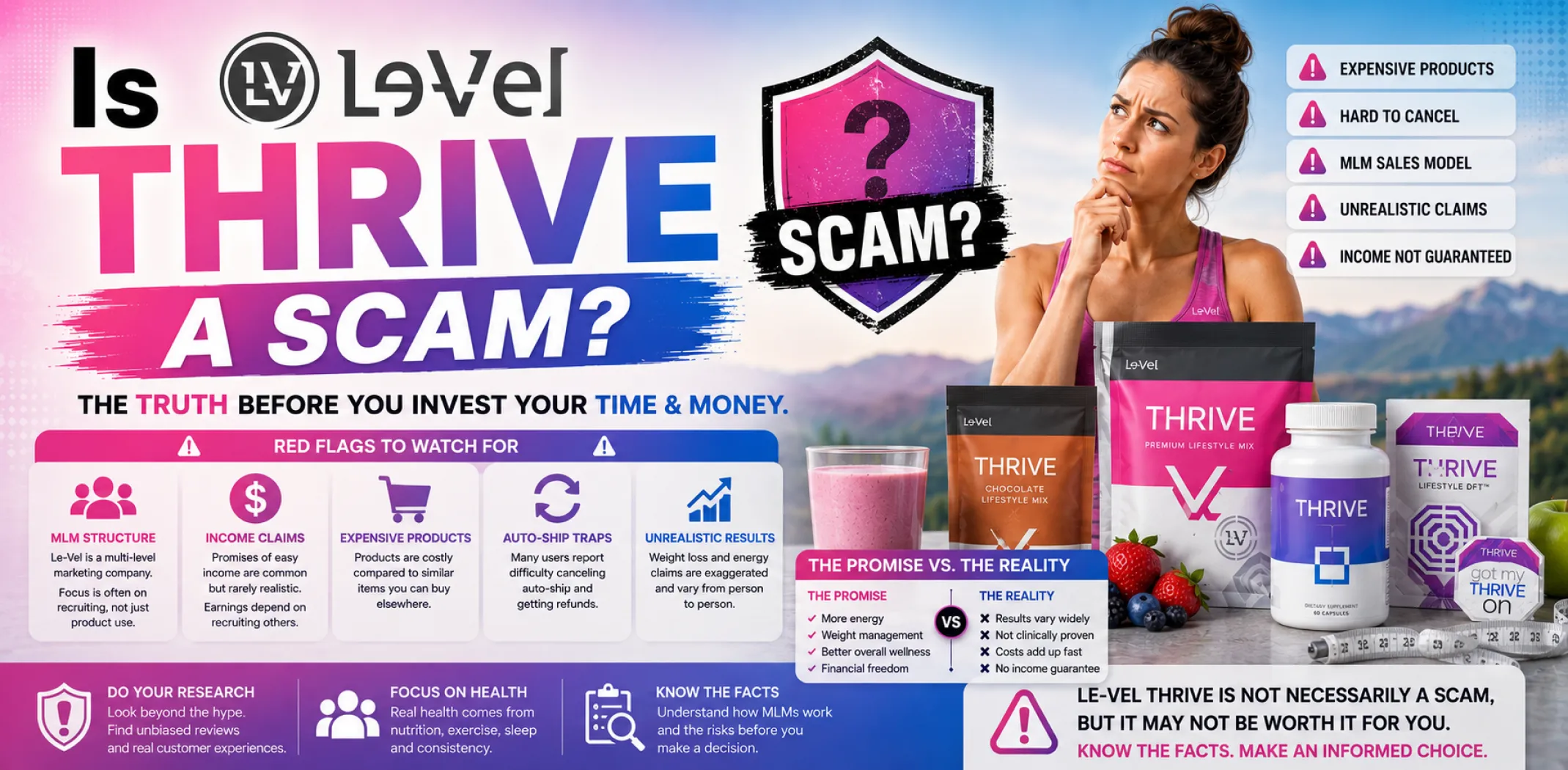
Quick verdict
Le-Vel Thrive is not a scam. It is a real company founded in 2012 that sells real products and has passed one billion dollars in lifetime sales. The scam label gets applied for specific reasons – the DFT patch has no independent clinical studies backing its claims, the industry self-regulator found Le-Vel and its promoters used inappropriate income and health claims, and most Brand Promoters earn very little. Those are legitimate criticisms of a real company, not evidence of fraud.
- Le-Vel Thrive is not a scam – it is a privately held company founded in 2012 in Frisco, Texas, with over a billion dollars in lifetime sales, real manufactured products, and no direct FTC enforcement action as of 2026.
- The most common driver of the scam label is the Thrive DFT patch – no independent peer-reviewed studies specifically test it, and reviewers note it is unclear whether the transdermal delivery mechanism raises blood levels of active ingredients at meaningful concentrations.
- In 2020 the Direct Selling Self-Regulatory Council (DSSRC) found Le-Vel and its promoters made inappropriate health claims about Thrive products and atypical income claims about the Brand Promoter opportunity.
- TINA.org documented 140 instances of deceptive earnings claims made by Le-Vel promoters – income examples drawn from the top of the distribution, not typical results.
- Most Brand Promoters earn very little – industry data consistently finds the majority of MLM participants earn under 500 dollars per month after product costs, and many earn nothing at all.
What is Le-Vel Thrive and why do people call it a scam?
In 2026, Le-Vel is a privately held wellness company headquartered in Frisco, Texas, founded in 2012 by co-CEOs Jason Camper and Paul Gravette. Its flagship offering is the Thrive Experience – a three-step daily supplement routine combining capsules, a nutritional shake, and the DFT patch, a skin adhesive worn for 24 hours.
The program costs around 300 dollars for a four-week supply and is sold exclusively through an MLM network of independent “Brand Promoters.” Le-Vel passed one billion dollars in lifetime sales within its first five years and continues to operate with an estimated annual revenue of 350 to 450 million dollars.
So why does “is Le-Vel Thrive a scam” generate so many searches? The frustration lands in four distinct places. Users who spent 300 dollars a month and felt no meaningful weight loss effect feel the product underdelivered on its claims. People who became Brand Promoters and made little money after spending on product feel the income opportunity was misrepresented.
Anyone who looks closely at the Thrive DFT patch and finds no independent clinical research behind it reasonably asks whether the marketing holds up. And the DSSRC finding on inappropriate income and health claims gives the skepticism a regulatory foundation it is hard to dismiss. This article addresses each of those concerns directly.
Is Le-Vel Thrive a scam? What the evidence actually shows
No – and being precise about why matters. Le-Vel Thrive is not a scam in the legal or operational sense. The company manufactures real products in the US and Canada, delivers them to real customers, and has operated continuously for thirteen years. It is not a Ponzi scheme, it is not collecting money for products it does not ship, and it is not under direct FTC enforcement action in 2026. The scam label does not fit the facts.
What the scam label is pointing at – imprecisely but not without basis – is a cluster of legitimately concerning issues. The DSSRC, the direct selling industry’s own self-regulator, found in 2020 that Le-Vel and its promoters used inappropriate health claims about the Thrive product line and atypical income claims about the Brand Promoter opportunity.
TINA.org, a respected advertising watchdog, compiled 140 documented instances of promoters making earnings claims that did not reflect typical results. And the DFT patch – the signature and most heavily marketed product – has no independent peer-reviewed clinical studies behind it.
Those are real criticisms with documented evidence. They do not add up to fraud, but they do add up to a company and compensation structure that required regulatory intervention around the gap between its marketing and its typical outcomes.
Why do people call Le-Vel Thrive a scam? Four sources unpacked
The scam label arrives from four different directions. Each has a different explanation and a different implication for how seriously to take it.
⚠️ Why people call it a scam – and what is actually happening
I wore the patch every day and lost no weight – the whole thing is fake
Reviewers at Healthline and Diet vs Disease both note that no independent peer-reviewed studies specifically test the Thrive DFT patch, and that it is not established whether the transdermal delivery mechanism raises blood levels of the active ingredients at meaningful concentrations. This does not mean every user notices nothing – energy is the most consistently reported effect – but it does mean the specific weight loss and mental clarity claims made in promoter marketing are not backed by independent science. A product with insufficient evidence for its headline claims is not the same as a deliberate fraud, but it is a meaningful limitation to know before spending 300 dollars a month.
My promoter showed me income screenshots and said I could replace my salary – that was a lie
TINA.org catalogued 140 instances of promoters making earnings claims that represent atypical outcomes – examples from the top of the distribution shown as if they were typical results. The DSSRC found this practice systemic enough to warrant a formal decision. Most Brand Promoters earn very little: industry research consistently finds the majority of MLM participants make under 500 dollars per month, and many earn nothing after product costs. This is not a lie invented by critics – it is what the industry’s own self-regulatory body concluded based on evidence.
Le-Vel is a pyramid scheme – you can only make money by recruiting
Le-Vel is not legally classified as a pyramid scheme. It sells real products to real end customers, which legally distinguishes it from a recruitment-only operation. The legitimate concern is that the compensation structure incentivizes recruiting heavily, and that the ratio of income from recruiting versus direct retail sales matters for legal and ethical evaluation. Le-Vel’s marketing emphasis on team-building and downline income reflects this dynamic, but it does not on its own constitute fraud.
The patch ingredients cannot be absorbed through skin – it is pseudoscience
Transdermal delivery is a legitimate, well-established medical technology used in nicotine patches, hormone therapies, and pain management. Le-Vel holds over 25 patents on its DFT formulation. The issue is not that transdermal delivery is inherently fake – it is that independent researchers have not specifically tested whether the Thrive DFT formulation delivers its ingredient list at effective concentrations through skin. Patents protect a novel process; they do not confirm that the process produces the claimed outcomes.
The thread running through all four concerns is the same gap: what Le-Vel and its promoters market, and what independent evidence and regulatory findings support, are meaningfully different in places. That gap is the real issue – not fraud, but a marketing-to-evidence mismatch that the DSSRC found systemic and TINA.org documented at scale.
Researching Thrive because you wanted a way to earn online?
Brand Promoter income depends on your downline – there are more direct ways to build income online
The Le-Vel Brand Promoter opportunity works for people who build large teams. For most, commissions do not cover the cost of staying active. If you are looking to build online income independently – where your earnings depend on your own store, your own customers, and your own effort – product-based ecommerce offers a fundamentally different structure. Our guide covers the most practical approaches, with realistic first-year expectations and what each model actually requires.
What are the real risks of Le-Vel Thrive?
Calling Thrive a scam overstates the case. But there are real risks worth naming plainly, and they fall into different categories depending on whether you are considering it as a consumer or a Brand Promoter.
The DFT patch has no independent clinical validation
Healthline and Diet vs Disease both note that no peer-reviewed studies specifically examine the Thrive DFT patch and that it is unclear whether the delivery mechanism raises blood levels of active ingredients effectively. Le-Vel holds patents on the formulation and conducts internal research, but that is not a substitute for independent replication. Buying a product whose core mechanism has not been independently validated means accepting real uncertainty about whether you are getting what the marketing describes.
At 300 dollars per month, the cost-to-evidence ratio is unfavorable
Comparable individual supplements – B vitamins, probiotics, protein powder – from established third-party tested brands like Thorne Research cost roughly 30 to 60 dollars a month and carry stronger individual research backing for their specific ingredients. If your goal is nutritional gap-filling rather than the Thrive program specifically, the price premium is hard to justify on evidence alone. Where Thrive adds value is convenience and the structured three-step routine – if that structure matters to you, that is a fair trade-off to make knowingly.
Skin irritation from the patch is a documented complaint
The DFT patch adhesive causes skin irritation, redness, or dermatitis in some users – particularly those with sensitive skin or adhesive allergies. This is the most consistent physical side effect documented in independent reviews and user forums. Rotating patch placement sites and doing a small test application before committing to full use can help identify sensitivity before spending on a full supply.
Most Brand Promoters earn very little after product costs
Le-Vel does not publish a widely available income disclosure statement comparable to publicly traded MLM companies. Industry research consistently finds the majority of MLM participants earn under 500 dollars per month, and the DSSRC found Le-Vel’s income marketing used atypical examples. TINA.org’s 140-instance documentation of deceptive income claims shows the pattern was not isolated – it was systematic. Anyone considering the Brand Promoter opportunity should ask for, read, and apply the actual income disclosure data before joining, not the testimonials.
Reviews are hard to separate from promoter content
Because Brand Promoters earn commissions on sales, a substantial portion of positive Thrive content online comes from people with a financial stake in the outcome. This is not unique to Le-Vel – it is a structural feature of all MLM-distributed products. When researching, weight independent sources (registered dietitians, academic reviewers, consumer watchdogs) more heavily than user testimonials, which you cannot reliably distinguish from promotional content.
What do real users say about Le-Vel Thrive in 2026?
Independent consumer sentiment on Thrive – separated from promoter content – is mixed and follows a recognizable pattern. Energy is the most reliably reported positive effect. Weight loss is inconsistent and often attributed to broader lifestyle changes users make alongside the program.
The patch specifically is the most debated component, with some users reporting noticeable effects and many reporting nothing distinguishable from the capsules and shake alone.
Is Le-Vel Thrive worth it – honest verdict
Le-Vel Thrive is not a scam. That is the accurate answer, and the evidence supports it. The company has been operating for thirteen years, ships real products, and has not been subject to direct FTC enforcement action. The products work for some users in some respects – energy improvement is the most reliably reported consumer outcome from independent sources.
The legitimate concerns are equally clear. The DFT patch has no independent peer-reviewed studies validating its specific claims. The income opportunity was found by the DSSRC to have been promoted with atypical examples, and TINA.org documented 140 instances of this pattern in promoter content.
Most Brand Promoters earn very little after product costs. At 300 dollars per month, the price-to-evidence ratio is high. None of these things are fraud – but all of them are facts worth knowing before you decide.
Not a scam – but the patch evidence is weak and the income claims drew regulatory action
Le-Vel Thrive is a real company selling real products with a genuine customer base. Energy improvement is the most consistently reported consumer benefit. The DFT patch lacks independent validation, the Brand Promoter income opportunity was found to have been marketed with atypical claims, and most promoters earn very little after costs. It is best suited to consumers who want a convenient supplement routine and are realistic about the evidence – not people expecting the patch to deliver weight loss on its own, and not people expecting the income opportunity to replace a salary.
If you are looking for online income that does not depend on recruiting
The Brand Promoter opportunity appeals because it lets you earn from something you already use. The friction comes when your natural social network runs out and building beyond it requires the kind of active recruitment effort that the DSSRC found was being promoted with misleading income expectations. For the small percentage of promoters who build large teams it works. For most it does not.
If building income online is the real goal, it helps to understand the structural difference between MLM-adjacent income – which depends on a downline, a compensation plan, and a company staying solvent – and product-based ecommerce income, which depends on your own store, your own pricing, and your own customers.
Our guide to making money online covers the most practical entry points for building that kind of independent income from scratch, with realistic timelines and honest assessments of what each model requires.
Read the full make-money-online guide here.
Is Le-Vel Thrive a scam?
Why do people say the Thrive patch does not work?
Reviewers at Healthline and Diet vs Disease note that no independent peer-reviewed studies specifically test the Thrive DFT patch, and that it is not established whether the transdermal delivery mechanism raises blood levels of the active ingredients at clinically meaningful concentrations. Le-Vel holds over 25 patents on its Derma Fusion Technology formulation and conducts internal testing, but independent replication is the standard for scientific validation. Energy improvement is the most consistently reported consumer benefit; weight loss results are inconsistent across independent reviews.
What regulatory actions have been taken against Le-Vel?
In 2020 the Direct Selling Self-Regulatory Council (DSSRC) – the direct selling industry self-regulator – concluded a case finding that Le-Vel and its promoters made inappropriate health claims about the Thrive product line and atypical income claims about the Brand Promoter business opportunity. Truth in Advertising (TINA.org) independently catalogued 140 instances of deceptive earnings claims made by Le-Vel promoters. Le-Vel engaged with the DSSRC process and stated its commitment to compliance. No direct FTC enforcement action has been announced against Le-Vel itself as of 2026.
Can you actually make money as a Le-Vel Brand Promoter?
Most Le-Vel Brand Promoters earn very little from commissions. Industry research consistently finds the majority of MLM participants earn under 500 dollars per month after product costs, and many earn nothing at all. Le-Vel does not publish a widely available independent income disclosure statement. TINA.org documented 140 instances of promoters using atypical income examples – results from the top of the earnings distribution presented without disclosure that they are not representative. Anyone considering the Brand Promoter opportunity should request and review the actual income disclosure data before joining.
What are the best alternatives to Le-Vel Thrive?
For energy and general wellness support at lower cost, individual B vitamins, probiotics, and protein powders from third-party tested brands like Thorne Research cover similar ingredient territory for 30 to 60 dollars per month with stronger individual research backing. For weight management with more clinical evidence, Optavia offers a structured program through its parent company Medifast, though it carries its own side effect profile at a similar price point. A registered dietitian can provide personalized nutrition guidance based on your specific health history. For online income that does not depend on recruiting, the AliDropship guide at alidropship.com/how-to-make-money-online covers product-based ecommerce models as a practical alternative.