Is Ko-fi A Scam? What The Evidence Shows In 2026

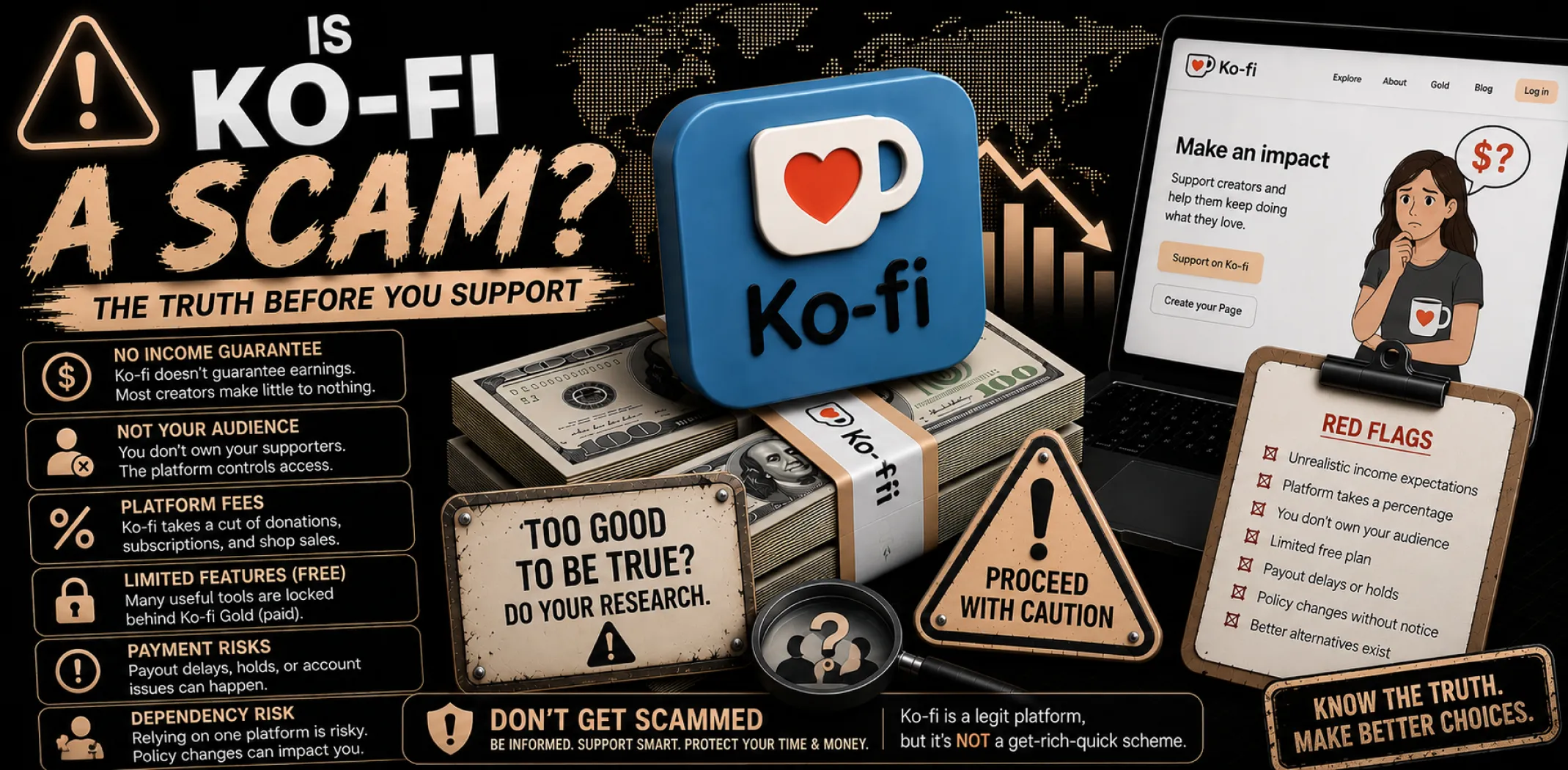
You have probably seen the occasional negative review – a creator who says Ko-fi banned their account with no warning, or a Trustpilot post complaining about slow support. Those reviews are real, and they are worth taking seriously. But do they mean Ko-fi is a scam? After looking at the full evidence picture across review platforms, payment mechanics, and how the platform’s business model actually works, the answer is a clear no.
Ko-fi has been operating since 2012, has paid out over $200 million to creators, and holds a 4.6-star Trustpilot rating from over 700 reviews – a score that places it comfortably ahead of every major competing platform in the creator support space.
The complaints that exist are concentrated in a specific, identifiable area: automated content moderation that occasionally acts faster than human review can catch up with. That is a real problem worth knowing about. It is not a scam.
Quick verdict
Ko-fi is not a scam. It is a UK-registered company operating since 2012 with over $200 million in verified creator payouts and a 4.6-star Trustpilot rating. Payments go directly to your Stripe or PayPal account instantly – Ko-fi never holds your money. The platform has real limitations around content moderation, but those are content policy issues, not financial fraud. For creators with existing audiences, it is one of the most trustworthy platforms in its category.
Key takeaways
- Ko-fi is a real UK-registered company (Ko-fi Labs Ltd) with a 14-year operating history and more than $200 million paid out to creators since launch.
- Ko-fi cannot withhold your earnings – money goes directly from supporter to your Stripe or PayPal account in real time, bypassing Ko-fi entirely.
- Ko-fi holds a 4.6-star Trustpilot rating from 700+ reviews – compared to 3.5 stars for Buy Me a Coffee and 1.2 stars for Patreon.
- The most common complaints involve automated content moderation bans – a real issue, but categorically different from financial fraud or payout withholding.
- Ko-fi has a formal three-strikes system and documented appeals process – its moderation is more transparent than most competitors.
What is Ko-fi – and why do people ask if it is a scam?
Ko-fi started in 2012 as a simple tool for creators to accept small tips from their audience – the digital equivalent of someone dropping a few dollars in a tip jar to say thank you for your work.
Founded by Henry Hoffman in the UK and formalized as Ko-fi Labs Ltd in 2017, the platform grew steadily through the creator economy boom, reaching over 1.5 million active creator pages by 2025. Artists, writers, podcasters, open-source developers, and educators use it to accept tips, run memberships, sell digital products, and take commissions – all through a single free page.
The scam question comes up for a few reasons. A vocal minority of negative reviews on Trustpilot describe account bans that felt sudden and unexplained. Some creators who produce content that edges toward Ko-fi’s policy limits have found their pages taken down after linking to external profiles.
And the general wariness people have developed about creator platforms – after years of high-profile problems with Patreon, OnlyFans policy changes, and Buy Me a Coffee payout freezes – means any negative review gets amplified. Looking at the actual pattern of complaints puts those reviews in context.
One detail stands out as the most important indicator of whether a platform is operating in good faith with creators: how does it handle your money? Ko-fi passes payments directly from the supporter’s card to your Stripe or PayPal account the moment the transaction completes. Ko-fi never holds the funds.
There is no central payout queue, no monthly release cycle, and no mechanism by which Ko-fi can freeze your balance or redirect your earnings. That structural reality separates Ko-fi from several competing platforms where withheld payouts are a documented and recurring problem.
Is Ko-fi a scam? What the evidence actually shows
Answering the scam question requires separating two things: whether the platform commits financial fraud against creators, and whether it has operational problems that create real harm. On the first question, the evidence is decisive. On the second, there are legitimate concerns – but they are not what most scam accusations imply.
The Trustpilot score is the most practical signal here, and the comparisons are stark.
Patreon – the best-known platform in the creator membership space – holds 1.2 stars from nearly 900 reviews, with chronic complaints about withheld payouts, poor support, and arbitrary account restrictions. Buy Me a Coffee holds 3.5 stars from over 1,400 reviews, with a documented pattern of accounts being suspended at payout time with balances refunded to supporters rather than creators.
Ko-fi at 4.6 stars is not just better – it is in a different category of creator trust.
The direct payout model explains much of that difference. Patreon and Buy Me a Coffee hold your money in their own accounts before releasing it. Ko-fi does not. When there is no central pool of creator funds sitting in a platform’s accounts, there is no mechanism for the platform to freeze or redirect those funds. The money that flows through Ko-fi moves from supporter to creator without stopping anywhere in between.
Where do the scam claims actually come from?
Most of the negative reviews that fuel Ko-fi scam concerns fall into two categories. Understanding what is actually happening in each case changes how alarming those reviews should seem.
Common misconception: Many creators read a “Ko-fi banned my account” review and assume the platform is targeting legitimate creators arbitrarily or trying to steal their earnings. In the vast majority of documented cases, the suspension is triggered by Ko-fi’s automated content moderation system – not by a human decision to target a specific creator. Ko-fi does not profit from suspensions. Since money goes directly to the creator via Stripe or PayPal, there are no held funds for Ko-fi to capture. The issue is automation errors and content policy edge cases – not financial fraud.
Automated content moderation bans
Ko-fi’s automated system flags pages that appear to violate its content guidelines – including adult content, content linked to external adult profiles, commercial spam, and SEO abuse. The system can trigger a permanent ban before human review takes place, and the notification creators receive often does not include specific details about what triggered it. Ko-fi’s published guidelines document a three-strikes system for most violations and a formal appeals process for creators who believe the decision was made in error. The financial impact is minimal since no money is held by Ko-fi – but losing access to a page you have spent time building is genuinely disruptive.
External content policy – the part creators miss
Ko-fi’s terms allow it to take action against your page based on content you post outside Ko-fi – including on social media, personal websites, or adult platforms – if that content is incompatible with Ko-fi’s guidelines. This catches some creators off guard, particularly those who produce adult content elsewhere and use Ko-fi as a separate tip link. Ko-fi does not allow adult content on its platform or via associated external profiles, and this policy is documented in its content guidelines – but it is not prominently flagged during account setup. Creators who work in this content area should read the guidelines before investing time in a Ko-fi page.
Support response times on edge cases
Ko-fi is a small, independent company. For standard queries, support is responsive and frequently praised by name in Trustpilot reviews – individual team members like Harry and Jonathan are called out positively across multiple reviews. For technical account-level issues or appeal cases, wait times can stretch longer. One reviewer documented a 15-day wait before a ticket was auto-closed. Ko-fi replied to that review publicly within 24 hours and acknowledged the problem – a good-faith response, even if it did not fix the underlying capacity issue. This is an operational limitation, not evidence of bad intent.
To put those complaints in context: the categories above account for the vast majority of Ko-fi’s negative Trustpilot reviews. None of them involve Ko-fi taking or holding money that belongs to creators.
Compare that to competing platforms where the primary complaint category is specifically payout withholding and account suspension at withdrawal time – a structurally different and more serious problem – and Ko-fi’s complaint profile looks substantially better, not worse.
How Ko-fi makes money – and why the business model matters for trust
Understanding how Ko-fi earns revenue is important context for evaluating the scam question. A platform that profits from withholding your money has a financial incentive to do so. Ko-fi does not have that incentive – and its fee structure makes that clear.
Ko-fi’s revenue comes from active, completed transactions – not from holding or redirecting money. On tips, the platform earns nothing. On shop and membership sales, it earns a 5% fee when creators succeed. That alignment of incentives – Ko-fi makes more money when creators make more money – is a meaningful structural difference from platforms where the business model can conflict with creator interests.
The platform has also chosen to remain independent and bootstrapped, explicitly positioning itself as having no outside investors whose returns it needs to prioritize. That positioning has been consistent for over a decade. The 0% tip fee has remained in place since launch despite competitive pressure.
The Gold subscription at $12 per month has not inflated over time. These are signals of a company that has chosen long-term creator trust over short-term revenue extraction.
What do real users say about Ko-fi in 2026?
Across Trustpilot and Product Hunt in 2026, the Ko-fi user experience divides along one clear line: creators whose content is fully within Ko-fi’s guidelines consistently report a smooth, positive experience. Creators whose content touches the platform’s policy edges – particularly around adult content or linked external profiles – are more likely to hit problems. Two representative stories illustrate this divide.
How does Ko-fi compare to platforms that have real problems?
One of the clearest ways to evaluate Ko-fi fairly is to compare it directly with the platforms whose problems gave rise to widespread creator platform skepticism. The differences are material.
Is Ko-fi worth using – honest verdict
Ko-fi is not a scam, and the evidence for that is strong enough to state plainly without qualification. Its direct payment model, 14-year operating history, $200 million in verified creator payouts, and 4.6-star Trustpilot rating place it in a different category from platforms whose problems have justifiably made creators cautious.
Its real limitations are different in kind from what scam accusations imply. It uses automated content moderation that can act faster than human review. It has a firm policy against adult content that extends to linked external profiles. It is a small independent team whose support capacity can be stretched by volume.
None of those are fraud. They are the operational tradeoffs of a platform that has prioritized fee structure and payment integrity over feature depth and moderation sophistication.
Not a scam – one of the most trustworthy platforms in its category
Ko-fi is a legitimate, creator-aligned platform with a stronger trust record than any major competitor. Its direct payment model means there is no financial risk from account actions, its fee structure is genuinely generous, and its 14-year track record speaks for itself. Creators whose content fits within its guidelines and who already have an audience will find it one of the most reliable tools available for supplementary income. The ceiling – earnings depend on your existing audience, not the platform – is the main practical limitation, not any question of legitimacy.
Your ecommerce store and Amazon business – both built and ready today
AliDropship sets up everything: a fully built store with 100+ best-selling digital products, plus an Amazon Seller Kit with a product import file, beginner guide, and access to 300 million active buyers. The 14-day free trial includes a $40 ad coupon – so your first campaign on either channel costs you nothing.
Who should use Ko-fi – and who needs something different?
Ko-fi is a strong tool for a specific situation. Here is where it genuinely excels and where a different approach serves creators better.
Use Ko-fi: you want the safest tip and support layer available
If you have an existing audience and want a platform to accept their support without platform risk to your earnings, Ko-fi is the best option in 2026 based on its fee structure, payout model, and Trustpilot record. Start with the free plan and upgrade to Gold at $12 per month once monthly shop or membership income passes $240.
Proceed carefully: your content touches Ko-fi policy edges
If you produce adult content, link to adult platforms, or work in content categories Ko-fi considers restricted, read the full content guidelines carefully before investing time in a page. Ko-fi’s automated moderation can act quickly and the initial notification may not explain the specific trigger. Financial risk is zero – but losing a page you have built is disruptive.
Consider alternatives: you want income that does not require an existing audience
Ko-fi has no built-in audience discovery or advertising tools. Every dollar you earn starts with someone who already knows and follows your work elsewhere. If you are starting from zero and want to reach new customers through paid advertising, an owned ecommerce store gives you the infrastructure to do that – Ko-fi cannot.
Best combination: Ko-fi plus an owned ecommerce store
The strongest online income strategy in 2026 combines a creator support layer with an owned business. Ko-fi handles direct fan support – no fees on tips, instant payouts, zero platform risk to earnings. An owned ecommerce store handles product sales to a broader audience through advertising that does not depend on existing followers.
Want income that goes beyond your existing fanbase? Here is how AliDropship works
Ko-fi is genuinely good at what it does – but its ceiling is your existing audience size. AliDropship removes that ceiling entirely: a done-for-you ecommerce store with 100+ products pre-loaded, a built-in one-click ad system, and a free Amazon Seller Kit that opens access to 300 million buyers on day one – no prior audience required.
Free turnkey store – built, designed, and filled with products
Your store arrives professionally designed, pre-loaded with 50 bestselling products, and fully optimized to convert. No setup fees, no coding, no design time. You start at the product-testing stage – not the store-building stage. Hosting, SSL, and payment gateway are all included.
Winning products, one-click import
Browse trending and niche items from AliDropship’s catalog – including brand-name and digital products – and import them to your store in one click. The catalog updates regularly so your store always has fresh, competitive inventory without manual research.
Automated fulfillment and real-time tracking
Orders are processed automatically through global supplier connections. Customers receive real-time tracking updates – building trust and reducing support volume. You do not touch the shipping logistics; the platform handles it end-to-end.
Built-in marketing and promotion tools
Email campaigns, discount management, abandoned-cart recovery, live countdown timers, and social media integration are all included or available as add-ons. No prior marketing experience required – the tools guide you through each campaign type.
Beginner-friendly – no coding, no learning curve
An intuitive dashboard walks you through every step. Adding products, running campaigns, and scaling your catalog require no technical knowledge. As your business grows, the platform scales with you – adding features without adding complexity.
AliExpress integration – one-click imports, synced inventory
AliDropship connects directly to AliExpress for one-click product imports, automated order processing, and synced tracking. Inventory stays current with the latest products and prices. Combined with the turnkey store and automated fulfillment, this integration makes the entire operation manageable for one person.
Is Ko-fi a scam or a legitimate platform?
Why do some people say Ko-fi banned them for no reason?
Ko-fi uses automated content moderation rules to enforce its content guidelines, and this system can trigger an account suspension or ban before human review takes place. The notification creators receive often does not include a specific explanation of the trigger. Common causes include adult content on or linked from the Ko-fi page, content that references prohibited categories, and automated spam or fraud detection. Ko-fi documents a three-strikes system and a formal appeals process for most violations. Since Ko-fi never holds creator earnings – money goes directly to Stripe or PayPal – a suspension does not result in financial loss. The disruption is loss of page access, not loss of funds.
Can Ko-fi hold or take your money?
No. Ko-fi cannot hold or take your money because it never touches it. When a supporter makes a payment on Ko-fi, the funds go directly from the supporter to the creator via Stripe or PayPal in real time. Ko-fi earns its fee through a percentage of transactions or a monthly Gold subscription – not by holding and disbursing funds. This direct payment model is one of the most important structural differences between Ko-fi and platforms where withheld payouts are a documented concern.
How does Ko-fi compare to other creator platforms in terms of trust?
Ko-fi compares very favorably to its main competitors on Trustpilot in 2026. Ko-fi holds 4.6 out of 5 stars from over 700 reviews, rated "Excellent." Patreon holds 1.2 out of 5 from nearly 900 reviews, with chronic complaints about withheld payouts, arbitrary account restrictions, and poor support. Buy Me a Coffee holds 3.5 out of 5 from over 1,400 reviews, with a documented pattern of accounts being suspended at withdrawal time with balances refunded to supporters rather than creators. Ko-fi is not just better than its competitors by a small margin – it is in a different category of creator trust.
What is a better alternative to Ko-fi for building serious online income?
Ko-fi works well as a supplementary income layer for creators with existing audiences – but it cannot help you build a new one. It has no built-in advertising, no audience discovery, and no traffic generation. For creators who want to reach new customers and generate income that grows independently of an existing fanbase, an owned ecommerce store provides a fundamentally different model. A platform like AliDropship builds the store for you, pre-loads it with digital products, and includes a built-in one-click advertising system and a free Amazon Seller Kit – so you can generate sales from day one without needing followers who already know your work.