Is eToro Legit? An Honest Review For Traders In 2026

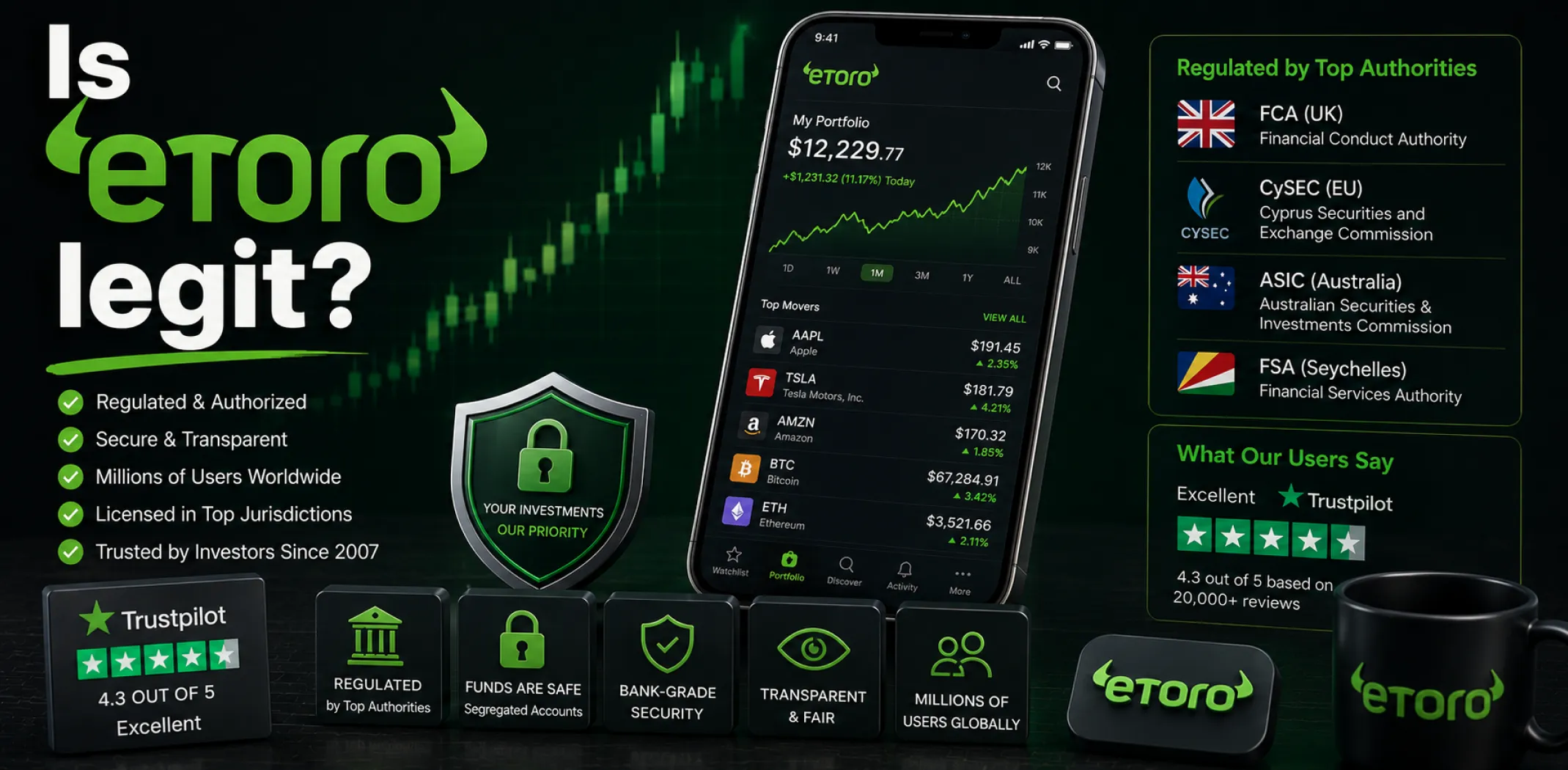
eToro is a legitimate, Nasdaq-listed trading and investing platform founded in 2007 and regulated by the FCA, ASIC, CySEC, and others. It is not a scam. That said, two regulatory enforcement actions – a 2018 fine from Ontario’s securities regulator and a 2024 SEC settlement over unregistered crypto trading in the US – are part of the public record and worth knowing about. The platform also carries real costs that the “zero commission” headline understates: a 5-dollar withdrawal fee for USD accounts, currency conversion fees up to 1.5%, and CFD overnight charges.
- eToro was founded in 2007, listed on Nasdaq in May 2025 (ticker: ETOR), and is regulated by the FCA (UK), CySEC (Cyprus), ASIC (Australia), MAS (Singapore), and others.
- It had approximately 3.81 million funded accounts and 18.5 billion dollars in assets under administration at year-end 2025.
- In 2018, eToro paid a fine to Ontario’s securities regulator for operating without registration. In 2024, it paid 1.5 million dollars to the US SEC for operating as an unregistered broker for crypto assets.
- Real costs include a 5-dollar withdrawal fee for USD accounts, currency conversion fees up to 1.5%, a 10-dollar monthly inactivity fee after 12 months, and overnight funding charges on CFD positions.
- eToro is strongest as a zero-commission stock and ETF platform with copy trading. It is less competitive for active CFD or forex traders who need tight spreads and advanced tooling.
What is eToro and how does it work?
In 2026, eToro is one of the world’s most recognizable social trading platforms. It was founded in Tel Aviv, Israel in 2007 by brothers Yoni and Ronen Assia and David Ring, originally under the name RetailFX.
The company went public on the Nasdaq in May 2025 under the ticker ETOR, giving it the same level of financial transparency and regulatory accountability as any publicly listed company. If you have seen eToro ads and are wondering whether it is a legitimate platform you can safely use, the answer is yes – with specific things to understand before you deposit.
The platform has two distinct core products. The Invest account lets you buy real stocks and ETFs with zero commission, plus fractional shares and a range of cryptocurrency assets. The CFD account allows leveraged trading on price movements across forex, indices, commodities, and individual shares without owning the underlying asset.
Sitting across both is eToro’s flagship differentiator: CopyTrader, which lets you automatically replicate the trades of other investors on the platform. No other major broker offers copy trading at the same scale.
eToro earns revenue primarily from spreads on CFD trades, currency conversion fees (applied when you trade assets in a currency different from your account base currency), and interest income on client cash. In the US, withdrawals from USD accounts incur a flat 5-dollar fee per transaction.
Outside the US, withdrawal fees vary by account currency. There are no commissions on real stock or ETF purchases, but other costs still apply depending on what you trade, how long you hold positions, and which currency your account runs on.
Is eToro legitimate? What the evidence shows
As of 2026, eToro is unambiguously a legitimate, operating financial services company. Several layers of evidence support this. The strongest is its May 2025 Nasdaq listing (ticker: ETOR). Public companies on the Nasdaq are subject to SEC disclosure requirements, mandatory quarterly earnings reports, and annual independent audits.
You can read eToro’s financials on the SEC’s EDGAR database. That level of transparency is not available from scam operations.
Beyond the listing, eToro holds regulatory licenses from some of the world’s strictest financial supervisors. FCA authorization in the UK means client funds are held in segregated accounts at major banks, and UK retail clients are covered by the Financial Services Compensation Scheme up to 85,000 pounds.
CySEC authorization in Cyprus covers EU clients, who also receive additional private insurance through Lloyd’s of London covering up to one million euros in the event of company insolvency. ASIC authorization covers Australian clients under similar segregation and compensation rules.
There are, however, two regulatory enforcement actions that any honest review of eToro must address. In 2018, Canada’s Ontario Securities Commission fined eToro (Europe) Ltd. for operating without registration in Ontario and serving approximately 2,500 local CFD accounts it was not authorized to serve. eToro paid a fine of 550,000 Canadian dollars and disgorged approximately 1.79 million US dollars in revenues earned from those accounts.
In September 2024, eToro USA LLC paid 1.5 million US dollars to the SEC to settle charges that it operated as an unregistered broker and clearing agency for crypto assets. Following the settlement, eToro’s US platform was limited to trading Bitcoin, Bitcoin Cash, and Ether only – a significant restriction that affected US crypto users.
Both actions were resolved. No fraud charges were brought. But both are documented instances of eToro offering products in markets where it lacked the required authorization – a pattern worth knowing about.
What are the common complaints and red flags with eToro?
eToro holds a 4.1-star Trustpilot rating from over 31,500 reviews as of mid-2026 – a reasonable score, though notably lower than Trading 212 (4.6 stars) among European retail brokers. A review of negative feedback reveals four consistent complaint categories.
✗ Misconception: “eToro is zero commission – it is completely free to use.”
✓ Reality: Zero commission applies to real stock and ETF purchases, but eToro charges a 5-dollar flat withdrawal fee per transaction for USD accounts, currency conversion fees of up to 1.5% when trading in a non-account currency, a 10-dollar monthly inactivity fee after 12 months without a login, and overnight financing charges on all CFD positions. These costs are disclosed but understated in most marketing.
✗ Real issue: Customer support delays during KYC and withdrawal verification
✓ What actually happens: A consistent pattern in negative Trustpilot reviews involves accounts being suspended or withdrawal requests held pending identity verification documents. Users report submitting documents that are then rejected or lost in the queue, with support tickets marked “resolved” without the issue being addressed. This is a genuine service quality problem – not evidence of theft, but real friction that has resulted in extended delays for some users before funds were released.
✗ Real issue: Copy trading does not remove investing risk
✓ Reality: CopyTrader is eToro’s most distinctive feature, but copying another investor does not mean copying their returns. The platform displays past performance metrics for popular traders, but past performance is not a reliable indicator of future results. Several negative reviews describe users copying high-rated traders and still losing significant sums when market conditions changed. The risk disclosure applies to copy trading the same as to any other form of investing.
The fourth complaint pattern is specific to CFD and forex spreads. Independent broker analysis from 2025 found eToro’s average EUR/USD CFD spread at approximately 1 pip under normal conditions – competitive by industry standards – but spreads on individual stock CFDs and crypto assets are noticeably wider, particularly outside peak trading hours.
Traders using eToro primarily for stock CFDs rather than indices or major forex pairs will find the cost structure less competitive than dedicated CFD platforms like IG or CMC Markets.
What do real users say about eToro?
The picture from genuine user reviews is more mixed than eToro’s marketing suggests. The platform has vocal fans – particularly among beginner investors who value the social layer and the simplicity of copy trading – and vocal critics, primarily among more experienced traders who encounter the fee structure or support issues. Here is a cross-section.
If you found eToro while researching ways to build online income, investing platforms are just one approach. Business models like ecommerce and digital product sales have different economics – no conversion fees, no withdrawal delays, and no copy-trading risk – and are worth understanding alongside any platform-based investing strategy.
See a breakdown of online income models worth comparing in 2026 →
How does eToro compare to its main alternatives?
If you are deciding between eToro and similar retail investing platforms, here is how it compares on the dimensions that matter most for the typical investor choosing between social/copy trading options.
The choice between eToro and Trading 212 comes down to one question: do you want copy trading? If yes, eToro is the only serious option. If no, Trading 212 wins on minimum deposit (1 pound vs up to 10,000 dollars depending on region), Trustpilot rating, absence of withdrawal fees, and daily cash interest on uninvested funds.
For CFD-focused traders who need tight spreads and advanced charting, neither platform competes with IG Markets or CMC Markets.
Is eToro worth it – our honest verdict
In 2026, eToro earns a legitimacy verdict with amber caveats. The platform is real, regulated, Nasdaq-listed, and has been paying out customers for nearly two decades. The two regulatory enforcement actions – the 2018 Ontario fine and the 2024 SEC crypto settlement – both involved eToro operating in markets without the required authorization, not defrauding users.
Both were resolved through settlements. They do, however, place eToro in the same category as Trading 212 (the January 2026 FCA crypto ETN gap) as a platform that has occasionally prioritized speed over regulatory process.
The more practical concern for most users is the fee structure. The “zero commission” headline is accurate but incomplete. Currency conversion fees, the 5-dollar USD withdrawal fee, and the 10-dollar monthly inactivity charge after 12 months collectively mean eToro is not as low-cost as it appears from the homepage.
For buy-and-hold investors in GBP or EUR accounts who use the platform regularly and take advantage of copy trading, the cost structure is reasonable. For users who trade frequently across currencies or want to withdraw regularly, the costs accumulate.
Legitimate Nasdaq-listed broker – unique copy trading feature, but fees and two regulatory fines deserve attention
eToro is a real, regulated, publicly traded company with 3.81 million funded accounts and 18.5 billion dollars in assets under administration. It is not a scam. Its copy trading feature is genuinely unique and valuable for the right user. The caveats worth knowing: a 2018 OSC fine and a 2024 SEC settlement both involved operating without required registration; the fee structure is less transparent than the marketing suggests; and customer support quality during KYC and withdrawal verification is a documented weakness. eToro is best suited to beginner investors in GBP or EUR accounts who want a social, copy-trading approach. It is less suited to active traders, US users, or anyone who needs to withdraw funds on short notice.
Investing platforms put your capital at the mercy of markets, platform fees, and platform decisions. If you are looking for a way to build online income where you control more of the variables – your products, your pricing, your timeline – there are business models worth comparing alongside any investing strategy.
Explore online income opportunities worth comparing in 2026 →
Is eToro a legitimate platform?
Is eToro safe for UK investors?
Yes, eToro is safe for most UK investors. UK clients are regulated under eToro (UK) Ltd, which is FCA-authorized and covered by the Financial Services Compensation Scheme (FSCS) up to 85,000 pounds per person. Client funds are held in segregated accounts and are not mixed with the company operating capital. The main financial risks for UK investors are the standard investment risks associated with the assets they trade and the currency conversion fee of up to 1.5% that applies when trading assets in a currency other than the account base currency.
Does eToro really charge no fees?
No, eToro is not entirely free. While it charges no commissions on real stock and ETF purchases, it applies a flat 5-dollar fee on every withdrawal from USD accounts. GBP and EUR account withdrawals are free. It also charges currency conversion fees of up to 1.5% when trading in a non-account currency, overnight financing charges on all CFD positions, and a 10-dollar monthly inactivity fee after 12 months without a login.
What are the main risks of using eToro?
The primary risk for investors using the real stock and ETF accounts is standard market risk – asset values can fall as well as rise. For CFD account users, the additional risk is leverage, which amplifies both gains and losses; the regulatory disclosure states that the majority of retail CFD accounts lose money. Copy trading carries its own risk: copying another investor does not remove investing risk, and the copied trader can and does incur losses. eToro also displays past performance data for popular traders, which is not a reliable indicator of future results.
What are the best alternatives to eToro?
The most commonly compared alternatives to eToro include Trading 212 (no withdrawal fees, higher Trustpilot rating, pays daily interest on cash, but no copy trading), Interactive Brokers (wider instrument range, lower costs for active traders, no copy trading), Robinhood (US-focused, zero commission, no CFDs), and Plus500 (CFD-focused, simpler interface, no real stock ownership). For investors who specifically value copy trading, eToro has no meaningful like-for-like competitor at the same scale.