Is eToro A Scam? The Evidence Reviewed For 2026

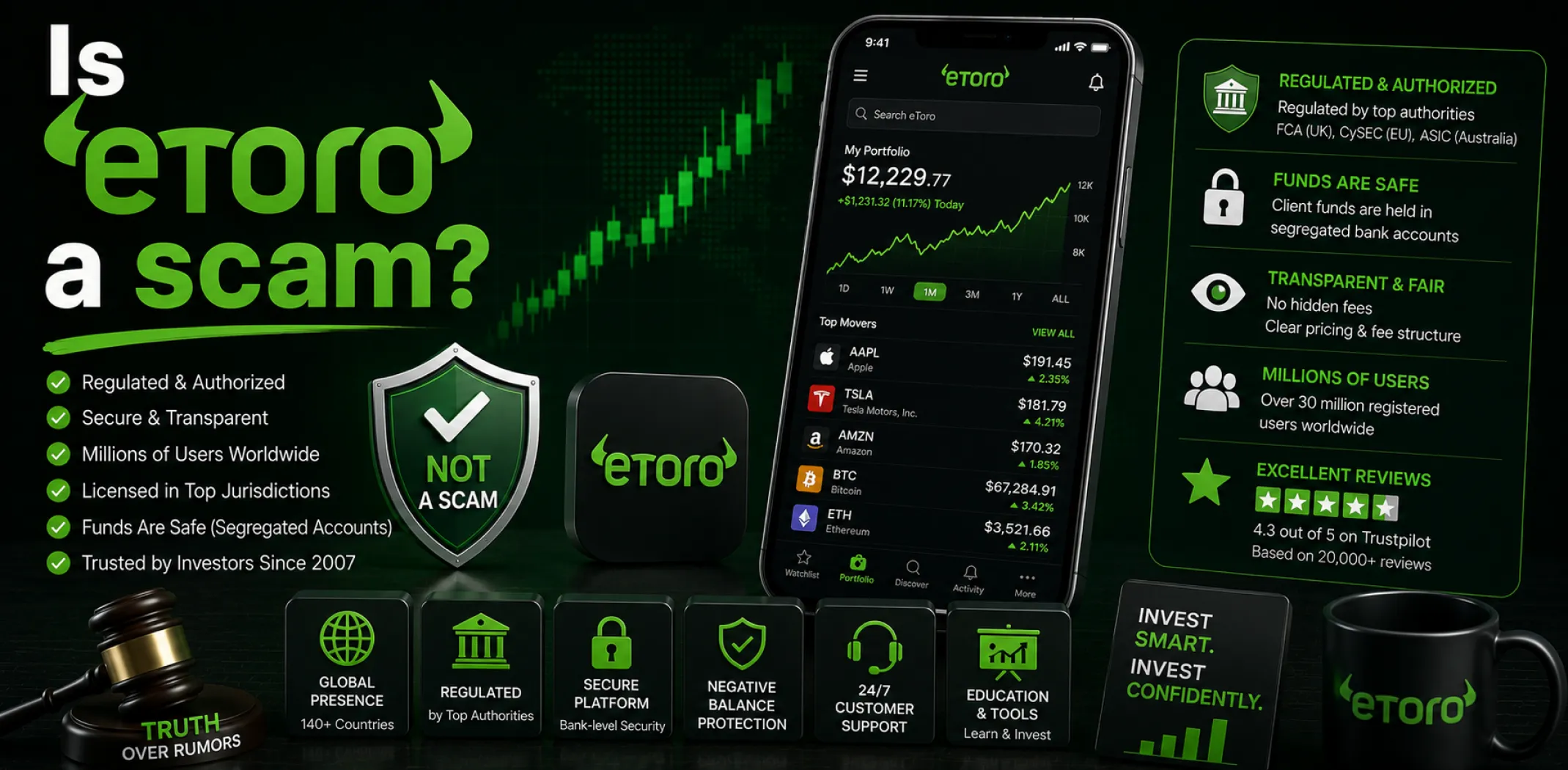
eToro is not a scam. It is a Nasdaq-listed trading platform founded in 2007, regulated by the FCA, ASIC, CySEC, and others, with 3.81 million funded accounts. However, two regulatory enforcement actions are public record: a 2018 fine from Ontario’s securities regulator and a 2024 SEC settlement over unregistered crypto trading in the US. Neither involved fraud – both involved eToro operating without required authorization in specific markets. The more common reason people call eToro a scam is the fee structure: a 5-dollar withdrawal fee, currency conversion charges up to 1.5%, and overnight CFD costs that are easy to miss on a platform that advertises “zero commission.”
- eToro is Nasdaq-listed (ticker: ETOR since May 2025) and regulated by the FCA, CySEC, ASIC, MAS, and other Tier 1 financial authorities.
- In 2018, the Ontario Securities Commission fined eToro and ordered disgorgement of approximately 1.79 million US dollars for serving Ontario CFD clients without registration.
- In September 2024, eToro paid the US SEC 1.5 million dollars to settle charges it operated as an unregistered broker for crypto assets in the US.
- Real hidden costs include a 5-dollar flat withdrawal fee (USD accounts), up to 1.5% currency conversion fees, overnight CFD financing charges, and a 10-dollar monthly inactivity fee after 12 months.
- Withdrawal delays and KYC verification holds are the most common complaint category – caused by AML compliance requirements, not theft.
Why do people think eToro is a scam?
In 2026, “is eToro a scam” generates hundreds of thousands of monthly searches. Understanding why requires separating two very different things: the platform itself, and the experience of using it.
eToro is a real, regulated, publicly listed company. But there are specific aspects of how it operates that have generated genuine anger – and in some cases, pushed users toward calling it a scam when the more precise word would be “misleading” or “frustrating.”
The single biggest driver is the gap between “zero commission” marketing and actual costs. eToro charges no commission on real stock and ETF purchases, which is accurate.
But its revenue model includes a 5-dollar flat withdrawal fee per transaction for USD accounts, currency conversion fees of up to 1.5% on trades in non-account currencies, overnight financing charges on all CFD positions, and a 10-dollar monthly inactivity fee after 12 consecutive months without a login.
For users who discover these costs after depositing – especially the currency conversion fee, which applies to every single trade in a foreign currency – the reaction is often “I was misled,” which slides into “this is a scam.”
The second driver is withdrawal and KYC friction. A consistent pattern in negative Trustpilot reviews – eToro holds 4.1 stars from over 31,500 reviews as of mid-2026, a noticeably lower score than most major UK-based retail brokers – involves users finding their withdrawal requests held pending identity document verification.
Submitting documents, receiving conflicting instructions, and having support tickets closed without resolution is a genuinely poor experience, even when it ends with the funds being released. For users who needed that money quickly, it can feel exactly like theft – even when it is not.
Third: the two documented regulatory enforcement actions. These are real, public, and worth treating seriously – which this review does in the next section.
What do the two regulatory fines actually mean?
This is the section most “is eToro a scam” reviews skip over or distort in one direction or the other. The facts are available on public regulatory websites, so here they are plainly.
The 2018 Ontario Securities Commission (OSC) action. eToro (Europe) Ltd. admitted to the OSC that it had operated approximately 2,500 accounts for Ontario-based investors and earned revenues of around 1.79 million US dollars from those accounts – without being registered to operate in Ontario.
The OSC had raised concerns with eToro in 2010, 2011, and 2015, receiving assurances each time that eToro would stop accepting Ontario clients.
Despite those assurances, the accounts continued. eToro paid a fine of 550,000 Canadian dollars, disgorged the 1.79 million US dollars in revenues, paid 25,000 Canadian dollars in costs, and closed all Ontario accounts. No fraud charge was brought.
No client funds were misappropriated. But the pattern of receiving regulatory warnings and continuing the behavior across three separate occasions is the most concerning element of eToro’s compliance history.
The 2024 SEC settlement. In September 2024, eToro USA LLC paid 1.5 million US dollars to the SEC after the regulator found it had operated as an unregistered broker and clearing agency for crypto assets in the US since at least 2020.
Following the settlement, eToro’s US platform was restricted to trading only Bitcoin, Bitcoin Cash, and Ether – representing less than 3% of the dollar value of US customers’ crypto holdings at the time. No customer funds were confiscated or lost. The SEC explicitly stated the settlement was not an admission of wrongdoing. But the action forced a meaningful contraction of eToro’s US crypto offering.
Taken together, the two enforcement actions point to a pattern: eToro has a history of expanding into new markets or product areas ahead of obtaining the required local authorization, then resolving regulatory consequences after the fact.
This is not the same as defrauding clients – but it is a meaningful distinction between eToro and platforms like Plus500 or Interactive Brokers that have not received comparable enforcement actions from major regulators.
Whether that history matters to you as a user depends on which market you are in and what you are trading. UK and EU investors using the FCA and CySEC-regulated entities, buying real stocks and ETFs, are in a well-protected environment. US crypto traders were the most materially affected group.
What do real complaints about eToro actually show?
Beyond the regulatory record, the day-to-day complaints about eToro split into four categories. None constitute scam behavior – but all are real friction worth understanding before you deposit.
✗ Claim: “eToro stole my money – they will not let me withdraw.”
✓ Reality: Withdrawal holds at eToro are almost always triggered by AML identity verification requirements – standard financial regulation that applies to all FCA and CySEC-licensed brokers. Users with multiple saved payment methods, recent address changes, or large withdrawal amounts are most likely to be asked for supporting documents. The genuine problem is eToro’s support quality during this process: tickets are sometimes marked “resolved” without resolution, and different agents give contradictory instructions. Funds are not confiscated – but the process can stretch over days or weeks, which is a real operational failure.
✗ Claim: “Zero commission is a lie – eToro charges fees on everything.”
✓ Reality: The zero commission claim is technically accurate for real stock and ETF purchases. But eToro earns revenue through a 5-dollar flat withdrawal fee (USD accounts), currency conversion fees of up to 1.5% applied to every trade in a non-account currency, overnight financing on CFD positions, and a 10-dollar monthly inactivity fee after 12 months. These are disclosed in the fee schedule but understated in the main marketing. Calling this a scam overstates it – but calling it fully transparent would also be wrong.
✗ Claim: “eToro liquidated my positions without my permission.”
✓ Reality: Several Trustpilot reviews describe eToro closing or selling positions without the user initiating it. In most documented cases, this is either a margin call on a leveraged CFD position that hit the stop-out level, or a compliance action related to account verification – including cases where positions in assets that fall outside an entity’s regulatory permissions were closed. These are not arbitrary thefts, but the lack of clear prior communication from eToro about when and why this can happen is a legitimate grievance.
What do real users say about eToro?
eToro’s Trustpilot profile tells a specific story: a 4.1-star rating from over 31,500 reviews, with eToro actively responding to 99% of negative comments. The gap between eToro’s rating and Trading 212’s (4.6 stars from 86,000 reviews) reflects real differences in user experience – primarily around cost transparency and support quality. Here is a cross-section of what genuine users report in 2025 and 2026.
If your interest in eToro is about building income online rather than a specific passion for investing, it is worth knowing that investing platforms are just one category. Business models like ecommerce and digital product sales have no conversion fees, no withdrawal delays, and no leverage risk – and are worth comparing before you commit capital to any platform.
How does eToro make money – and is that a problem?
Understanding eToro’s revenue model helps clarify what is and is not a legitimate concern. eToro earns through four main mechanisms: spreads on CFD trades; currency conversion fees of up to 1.5% applied on every trade outside your account base currency; overnight financing charges on CFD positions; and the flat 5-dollar withdrawal fee for USD accounts. It also earns interest income on the cash balances it holds on behalf of clients.
The currency conversion fee deserves particular attention because it is the cost most users discover late. If your account runs in USD and you buy shares of a UK company, eToro converts USD to GBP to execute the purchase – and charges up to 1.5% for that conversion. If you then sell and withdraw, it converts back and charges again.
For a long-hold investor buying a diversified global portfolio, these conversion costs accumulate significantly and are not reflected in the headline “zero commission” figure. This is not a scam – it is a fee that is disclosed in eToro’s published fee schedule – but it is a material cost that changes the economics of using the platform for investors in non-USD or multi-currency portfolios.
Is eToro worth using – honest verdict
In 2026, the evidence is clear on the central question: eToro is not a scam. It is a real, Nasdaq-listed, multiply-regulated broker with nearly two decades of operation, 3.81 million funded accounts, and 18.5 billion dollars in assets under administration.
The two enforcement actions – the 2018 OSC fine and the 2024 SEC settlement – are documented and serious, but neither involved defrauding clients. In both cases, eToro operated without required authorization in specific markets, paid the penalties, and moved on.
What is legitimate to criticize is a pattern of expanding ahead of regulatory compliance, a fee structure that is less transparent than the marketing suggests, and customer support quality that falls short during the moments users need it most – specifically during withdrawal verification.
These are not scam characteristics. They are the characteristics of a platform that has grown fast, encountered regulatory friction in multiple markets, and not kept support quality at pace with its user base.
eToro makes most sense for investors in GBP or EUR accounts who value copy trading and are buying real stocks or ETFs for the long term. It makes less sense for US users who want broad crypto access (now restricted), for active traders who need tight CFD spreads, or for anyone who may need to withdraw frequently and wants zero friction doing so.
Not a scam – but two regulatory fines, opaque fees, and support gaps are documented and real
eToro is a legitimate, Nasdaq-listed broker regulated by the FCA, CySEC, ASIC, and others. It is not a scam. The 2018 OSC action and the 2024 SEC settlement are both public record and both involved eToro operating without required authorization – not fraud. The “zero commission” headline is accurate but incomplete: currency conversion fees, a 5-dollar USD withdrawal fee, and overnight CFD charges are real costs that should factor into your decision. Customer support quality during KYC verification is a genuine and recurring weakness. If you use eToro for long-hold stock investing in a GBP or EUR account and take advantage of copy trading, the platform delivers on its core promise. If you are a US crypto trader, an active CFD trader, or someone who values frictionless withdrawals, the platform has specific gaps that alternatives handle better.
Investing platforms like eToro involve platform risk: fee changes, regulatory restrictions, and support quality all affect your experience in ways you cannot control. If you are exploring ways to build income online with more direct control over your own economics, there are business models worth understanding alongside any platform-based strategy.
Is eToro a scam or is it legit?
Why does eToro hold withdrawals?
eToro places withdrawal holds as part of its AML and KYC compliance obligations – standard requirements for all FCA and CySEC-regulated brokers. Holds are most commonly triggered by large withdrawal amounts, multiple saved payment methods, recent account changes, or first-time withdrawals. Users are required to submit identity documents before the hold is lifted. The genuine complaint is not the requirement itself but the quality of support during the process: tickets are sometimes closed without resolution and response times can be slow, stretching a process that should take days into weeks for some users.
What happened with the eToro SEC fine?
In September 2024, eToro USA LLC paid 1.5 million dollars to the US Securities and Exchange Commission to settle charges that it had operated as an unregistered broker and clearing agency for crypto assets in the US since at least 2020. Following the settlement, eToro restricted its US crypto offering to Bitcoin, Bitcoin Cash, and Ether only. No eToro customers lost funds as a result of the settlement, and eToro did not admit wrongdoing. The SEC stated the settlement offers a pathway for other crypto platforms to come into compliance.
What are the real fees on eToro?
eToro charges no commissions on real stock and ETF purchases, but applies a flat 5-dollar fee per withdrawal for USD accounts (GBP and EUR account withdrawals are free), currency conversion fees of up to 1.5% on trades in a currency other than your account base currency, overnight financing charges on all CFD positions held past market close, and a 10-dollar monthly inactivity fee after 12 consecutive months without logging in. These fees are disclosed in the fee schedule but are not prominently featured in most eToro marketing.
What are the best alternatives to eToro in 2026?
The most commonly compared alternatives to eToro include Trading 212 (no withdrawal fee, higher Trustpilot rating, daily cash interest, no copy trading), Plus500 (CFD-focused, simple interface, no real stock ownership, no copy trading), Interactive Brokers (wider instrument range, lower costs for active traders, no copy trading), and Freetrade (UK-focused, simple, limited range). For investors who specifically want copy trading, no other major platform currently offers it at the same scale as eToro.