Is Drop Ship Lifestyle A Scam? The Red Flags Explained

Quick verdict
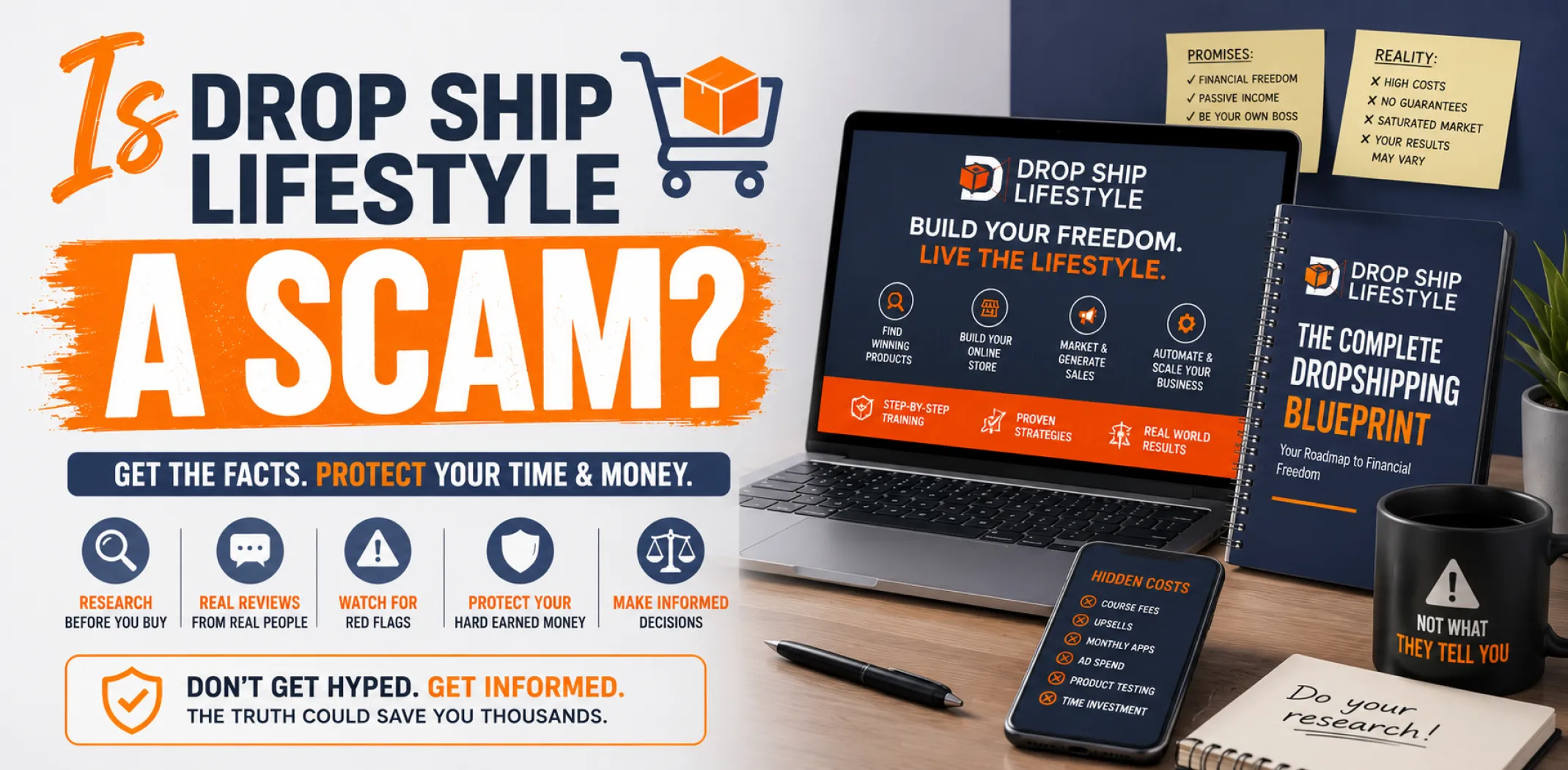
Drop Ship Lifestyle is not a scam – Anton Kraly built real ecommerce stores before teaching others to do the same, the course content is genuine, and some students do reach significant revenue. But the sales presentation creates expectations that the actual experience consistently fails to match, and the five structural problems documented across BBB, SiteJabber, and Trustpilot make the “scam” label understandable even if it is technically wrong.
Key takeaways
- Drop Ship Lifestyle is not a scam in the legal sense – it sells a real course, Anton Kraly has verifiable ecommerce credentials, and a segment of students do build profitable stores using the system.
- The gap between the sales webinar and the actual product is the root cause of most scam accusations: the pitch emphasizes speed, ease, and lifestyle freedom while the reality requires months of setup, a large ad budget, and tolerance for technical setbacks.
- Five structural problems drive the scam label: a conditional refund students cannot practically qualify for, an upsell ladder that starts at the point of refund request, Discord moderation that removes critical feedback, outdated technical modules, and a “done-for-you” claim that overstates what is actually built for you.
- BBB complaints from 2024 and 2025 document multiple cases of refund requests being ignored, delayed, or denied after students were explicitly told they would receive a full refund within 30 days.
- Only 10 to 20 percent of dropshippers report making a profit in their first year – a baseline that applies regardless of which course they use, and one that DSL sales presentations do not surface.
Why do people call Drop Ship Lifestyle a scam?
In 2026, “is Drop Ship Lifestyle a scam” generates real search volume – and that is not because Drop Ship Lifestyle is a fraudulent product.
Anton Kraly built genuine seven-figure ecommerce stores before ever selling a course, the 7-Step Drop Ship Blueprint contains real, actionable training on high-ticket dropshipping, and students who follow the system with the right capital and background do build profitable businesses. None of that is in question.
What drives the scam label is the gap between the experience the sales webinar sells and the experience most buyers actually have. The webinar presents an accessible, fast-moving path to income freedom. The reality is a demanding, expensive, technically challenging process with a refund policy that is structured to be nearly impossible to use.
When those two things collide – premium pricing, high expectations, poor support at the critical moment, and no way out – people reach for the word that best describes how they feel. That word is “scam,” even when the legal definition does not apply.
What are the five red flags that drive the scam label?
The following five structural problems appear consistently across BBB filings, SiteJabber reviews, Trustpilot complaints, and independent course review sites. None of them individually make DSL a scam. Together, they explain why the word keeps appearing.
A refund policy designed to be unclaimable
The official 30-day money-back policy sounds protective, but qualifying requires completing all DSL action tasks within the window: selecting a verified niche, contacting at least 20 suppliers, and building a functional Shopify store. The course itself instructs students to move carefully through each module. Doing both at once – following the course properly and completing every qualifying task – is not possible in 30 days for the vast majority of buyers. BBB records from 2024 and 2025 include multiple cases where students who completed partial steps, or who tried to cancel for legitimate reasons like illness, were denied refunds or received no response at all.
Upsells triggered at the refund moment
Multiple BBB complainants and independent reviewers describe the same pattern: they contacted DSL to request a refund or cancel their subscription, and instead of receiving the requested response, they were pitched an upgrade. One BBB complaint from 2025 describes a student who paid $3,497, requested a refund within 30 days citing health reasons, received confirmation that her subscription was cancelled, and then never received her money back while simultaneously being sent upgrade emails. The fact that the upsell consistently appears at the point of refund request – rather than during the natural course experience – is the most specific complaint in the record.
Discord moderation removes negative feedback
Several independent reviewers on SiteJabber describe posting critical questions or concerns in the DSL Discord community and having those messages deleted. One reviewer documents a specific exchange: after noticing their message had been removed, they asked openly whether posts were being deleted, and that follow-up was also removed. The practical consequence is that prospective students reading the Discord see an environment that appears uniformly positive – not because all students are satisfied, but because dissatisfied voices are being filtered out. This directly undermines the community’s value as an honest signal of typical outcomes.
Technical modules that do not match current platform realities
The Google Merchant Center and Google Shopping setup modules are the course’s most technically demanding sections and also the ones most commonly cited as outdated. Google changes its merchant approval requirements, suspension triggers, and shopping ad policies regularly. Students following DSL video instructions from even 12 to 18 months ago encounter a different interface and different approval logic than what is shown on screen. The result – Google suspensions that the course does not adequately prepare students to resolve – is the single most common reason first-year students stall without making a sale, and it is the point where support quality most visibly falls short.
The “done-for-you” label overstates what is built for you
The Ultimate package prominently features a “done-for-you store” as a core selling point. In practice, what is built is a Shopify storefront with 20 pre-loaded test products. Niche selection, supplier approvals, content marketing, advertising setup, and ongoing store management remain entirely the student’s responsibility. At least one BBB complainant paid $2,000 specifically for the done-for-you website service, did not use the service before the delivery window passed, and was refused a refund on those funds. The gap between “done for you” as a marketing phrase and “done for you” as an experience is wide enough to constitute a material misrepresentation for buyers whose purchase decision is driven by that specific claim.
How does the DSL sales pitch differ from the actual experience?
The most instructive way to evaluate the scam question is to compare what the sales webinar promises against what the documented student experience actually shows. The gap is specific and measurable.
The webinar that brings most students into the program promotes a 21-day zero-to-launch plan. Every student account from successful DSL graduates qualifies that timeline: success took one to two years, required a sustained advertising budget, and involved multiple setbacks that the course did not prepare them for.
Anton himself has acknowledged that students learn at different paces and that outcomes depend heavily on effort, availability, and technical aptitude. That acknowledgment does not appear prominently in the initial pitch.
The presentation of the Trustpilot rating as evidence of quality deserves scrutiny. Independent reviewers note that DSL’s Trustpilot reviews arrive in concentrated bursts – the pattern associated with solicited reviews from active community members rather than a representative cross-section of all buyers. SiteJabber, where reviews are harder to solicit in bulk, shows a 2.5-star rating.
Neither rating is the full truth on its own, but the gap between the two is more informative than either figure alone.
Common misconception:
✕ “Anton Kraly makes all his money from selling courses, not dropshipping – so DSL is just a scheme to sell dreams.”
✓ This argument is frequently made but overstated. Anton started ecommerce stores in 2007, built multiple seven-figure stores before launching DSL in 2013, and the course teaches a model he used himself. Course revenue does not invalidate the underlying method. What is fair to say is that his primary public-facing income today comes from the course business, not from running active dropshipping stores – and the incentive structure that creates, where course sales benefit from optimistic expectations, is worth factoring into how you evaluate the pitch.
What do real student accounts reveal about Drop Ship Lifestyle?
The most useful student accounts are not the success stories on the DSL homepage – those are curated – or the one-star SiteJabber reviews written in frustration. They are the detailed, specific accounts that include both what worked and what did not, from people who spent enough time in the program to form an informed view.
Who does Drop Ship Lifestyle actually work for – and who should avoid it?
Setting aside the scam question, the practical question every prospective buyer needs to answer is whether they fit the profile of a student who succeeds with DSL. The evidence from documented successes and documented failures points to a specific and fairly narrow profile on both sides.
Best for: experienced operators with capital
You have run a business before, you can absorb $500 to $2,000 per month in Google Ads spend for 6 to 12 months without financial stress, and you treat the first year as a learning investment rather than an income source. DSL delivers genuine value in this context – the niche framework, supplier directory, and live coaching are worth the cost if the surrounding conditions are right.
Risky for: beginners drawn in by the webinar
You watched the DSL webinar, felt inspired by the lifestyle angle and the 21-day timeline, and are considering the Premium package as your first ecommerce investment. The combination of a high entry price, a refund you likely cannot qualify for, and a technical setup process that will take months – not weeks – creates real financial risk before you have validated whether the model works for you personally.
Wrong fit: people who need income fast
High-ticket dropshipping has a long sales cycle by design – customers buying $800 sofas or $1,500 gym setups research carefully before purchasing. Even with a working store and active ads, weeks can pass between sales early on. If you need your investment to start returning money within 90 days, the DSL model is structurally misaligned with that timeline regardless of how well you execute the course.
Already bought and want out?
If you are within 30 days, document your progress immediately: screenshot every step you have completed, every email you have sent to suppliers, and every piece of work on your store. Submit your refund request in writing citing the specific tasks you completed, and CC the date-stamped records. If DSL denies the request despite documented task completion, file a dispute with your credit card company and a complaint with the BBB. Multiple buyers have recovered funds this way.
Is Drop Ship Lifestyle a scam – honest verdict
Drop Ship Lifestyle is not a scam. It is a real course selling a real business model, built by someone who genuinely operated that model at scale before teaching it. Students who enter well-capitalized, with prior business experience, and realistic expectations about a 12 to 24-month build timeline do build profitable stores. That fact is documented and not seriously disputed.
What keeps the scam label alive is a set of structural decisions that have nothing to do with the quality of the course content and everything to do with how the course is sold and how departures are handled.
A refund policy that is technically offered but practically unavailable. Upsells deployed at the cancellation point. Community moderation that suppresses negative feedback. A sales webinar that frames a multi-year, five-figure investment as a 21-day launch. These are not the behaviors of a company that is confident its typical student will have a good experience.
The honest position is that DSL occupies the same gray zone as many premium education products: the content is real, but the marketing creates expectations the experience does not meet for most buyers, and the exit process is designed to make leaving expensive.
Whether that crosses the line from “bad value for the average buyer” into “scam” depends on where you draw it – and on whether the specific misrepresentations in the sales materials cross into false advertising under your jurisdiction.
Not a scam – but the pitch and the product are two different things
Drop Ship Lifestyle contains real, usable training built on a legitimate ecommerce model. The scam label is driven by a sales pitch that oversells speed and ease, a refund policy that most students cannot qualify for, and a support structure that fails at the moments that matter most. For the right buyer, it delivers. For the average buyer drawn in by the webinar, the gap between expectation and reality is wide enough to cause real financial harm.
Want to test ecommerce without the course-fee risk?
If the goal is a working online store that generates income – not mastery of a high-ticket training system – there is a lower-risk path into ecommerce that does not require a four-figure upfront payment, a conditional refund, or months of technical setup before your first sale.
Free turnkey store – built, designed, and filled with products
Your store arrives professionally designed, pre-loaded with 50 bestselling products, and fully optimized to convert. No setup fees, no coding, no design time. You start at the product-testing stage – not the store-building stage. Hosting, SSL, and payment gateway are all included.
Winning products, one-click import
Browse trending and niche items from AliDropship’s catalog – including brand-name and digital products – and import them to your store in one click. The catalog updates regularly so your store always has fresh, competitive inventory without manual research.
Automated fulfillment and real-time tracking
Orders are processed automatically through global supplier connections. Customers receive real-time tracking updates – building trust and reducing support volume. You do not touch the shipping logistics; the platform handles it end-to-end.
Built-in marketing and promotion tools
Email campaigns, discount management, abandoned-cart recovery, live countdown timers, and social media integration are all included or available as add-ons. No prior marketing experience required – the tools guide you through each campaign type.
Beginner-friendly – no coding, no learning curve
An intuitive dashboard walks you through every step. Adding products, running campaigns, and scaling your catalog require no technical knowledge. As your business grows, the platform scales with you – adding features without adding complexity.
AliExpress integration – one-click imports, synced inventory
AliDropship connects directly to AliExpress for one-click product imports, automated order processing, and synced tracking. Inventory stays current with the latest products and prices. Combined with the turnkey store and automated fulfillment, this integration makes the entire operation manageable for one person.
Your free store and your Amazon business – both live from day one
AliDropship builds your store, loads it with products, and hands you a complete Amazon Seller Kit – two income streams from a single free signup. The built-in ad system means you can start receiving orders the same day you activate it, with a $40 ad coupon included in the trial.
Your dropshipping store
A fully built ecommerce store, pre-loaded with products and a built-in ad system. Orders fulfilled automatically. No inventory, no packing, no logistics.
Your Amazon business
A complete Amazon Seller Kit – $514B marketplace, 300M active buyers, import file ready to upload. Two income streams from one signup at no extra cost.
What makes people say Drop Ship Lifestyle is a scam?
How does the DSL sales webinar differ from what students actually experience?
The sales webinar presents a 21-day zero-to-launch timeline, emphasizes lifestyle freedom and financial independence, and features exceptional student success stories as representative outcomes. The actual experience documented across independent reviews involves 6 to 18 months before meaningful revenue, a total first-year cost of 8,000 to 20,000 dollars when ad spend is included, and a technically demanding setup process around Google Shopping that the course does not adequately prepare students to navigate. Students who succeed with DSL consistently say the course works but that the sales presentation did not accurately represent how difficult and expensive the process would be.
What does the Drop Ship Lifestyle done-for-you store actually include?
The done-for-you store included in the Ultimate package is a professionally built Shopify storefront with 20 pre-loaded test products. It does not include niche selection, supplier approvals, advertising setup, content marketing, or ongoing store management – all of which remain the responsibility of the student. The store build also does not begin until the student has completed the first several weeks of training. Buyers who purchase the Ultimate package specifically to skip the setup work have been disappointed to discover that the done-for-you element covers the storefront design only, not the full business launch process.
How do I evaluate whether Drop Ship Lifestyle is right for me?
Evaluate DSL against three specific criteria before purchasing. First, capital: can you sustain 500 to 2,000 dollars per month in Google Ads spend for 12 months without financial stress? Second, experience: have you run a business or managed paid traffic before, or will this be your first encounter with both? Third, timeline: can you commit to 12 to 24 months before expecting consistent revenue? If the answer to any of these is no, DSL is high-risk for your situation regardless of course quality. A lower-risk entry point is to test the dropshipping model at minimal cost first, validate whether you enjoy and can execute the work, and consider a premium course only once the model has proven itself with your own store.
What should I do if I already bought Drop Ship Lifestyle and want a refund?
If you are within 30 days, document everything immediately: screenshot every completed task, every supplier email, and every piece of work on your store. Submit a written refund request that lists each completed action task with date stamps. If DSL denies the request despite documented completion, file a dispute with your credit card provider citing the specific refund terms you were given at purchase. Also file a complaint with the Better Business Bureau. Multiple buyers have successfully recovered funds through the credit card dispute route after DSL initially denied the refund. If you are outside the 30-day window, a chargeback is less likely to succeed, but a BBB complaint still creates a public record and may prompt a resolution offer.