Is Dreamstime Legit? An Honest Review For Creators In 2026

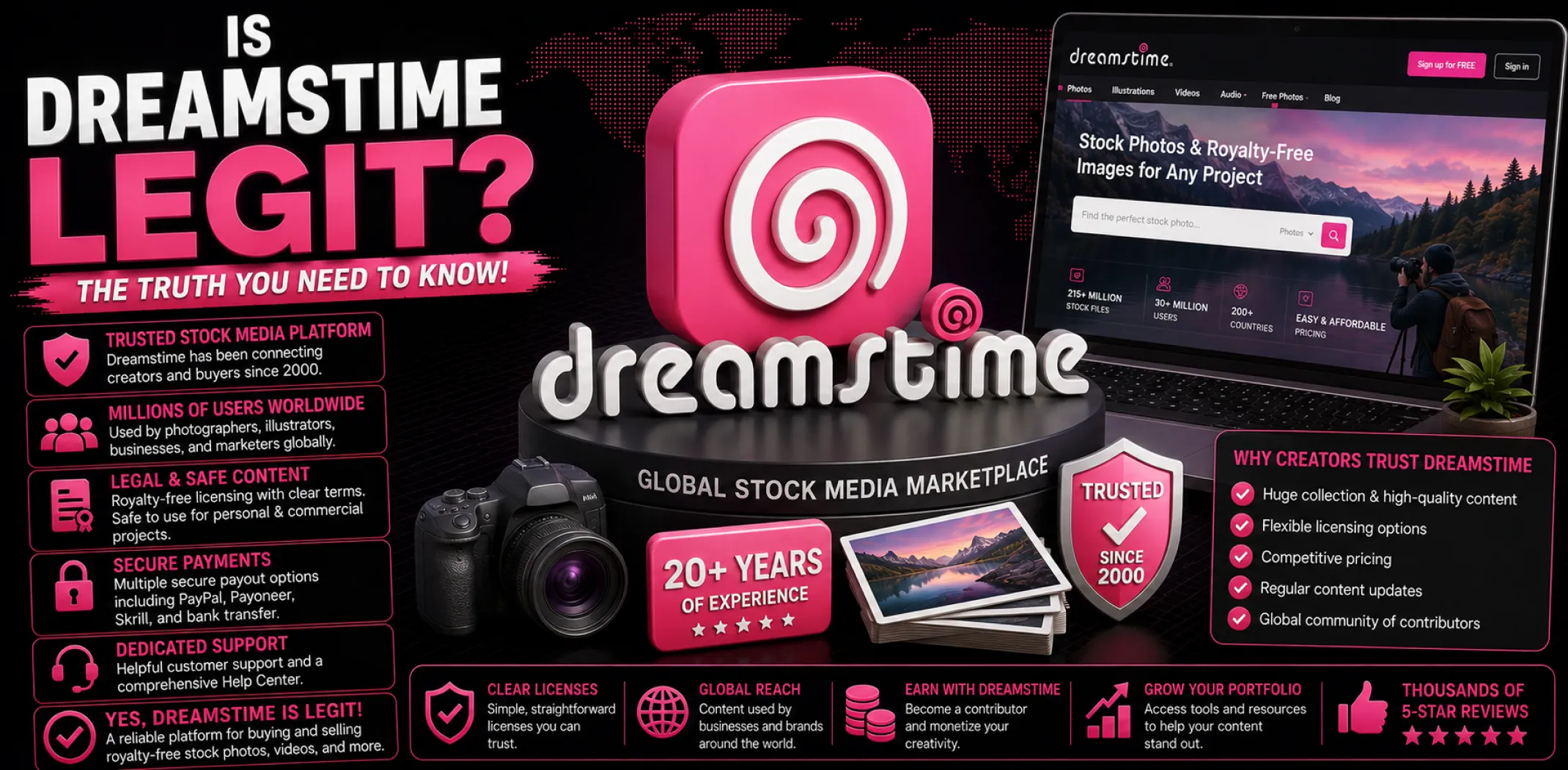
Dreamstime has been operating since 2000 – it is one of the oldest stock media platforms still running independently, without external funding and without being acquired by a larger company. With over 355 million files, 59 million registered members, and 1.3 million contributing photographers, it is the world’s largest community-driven stock photo platform by a significant margin.
That track record alone answers the legitimacy question: a scam does not run for 26 years, accumulate 59 million users, hold an A+ rating with the Better Business Bureau, and respond to 97% of its Trustpilot reviews.
The honest picture is more nuanced than a simple green light, though. Dreamstime holds a 3.8-star Trustpilot rating from over 2,300 reviews – solidly mixed rather than excellent. The pricing system is genuinely complex and the free images section specifically creates confusion that generates frustrated reviews from buyers who expected fully usable content at no cost.
Contributors also flag that the $100 minimum withdrawal threshold and below-average per-download payouts make the platform less rewarding than competitors for casual sellers. These are real limitations worth understanding before you subscribe or upload.
Quick verdict
Dreamstime is legitimate – a 26-year-old independent company with 59 million members, 355 million files, an A+ BBB rating, and a phone line that actually answers. Its documented limitations are a genuinely confusing pricing and “free” images system that catches first-time users off guard, contributor payouts that run lower than major competitors, and a $100 minimum withdrawal threshold for sellers. None of those are fraud – they are specific operational design choices worth knowing before you commit time or money.
Key takeaways
- Dreamstime was founded in 2000 in Tennessee, is independently owned by CEO Șerban Enache, and has never raised external funding or been acquired – it is one of very few truly independent large stock media platforms still operating.
- The platform holds a 3.8-star Trustpilot rating from 2,300+ reviews and an A+ BBB rating. Support responds to 97% of negative Trustpilot reviews and the company maintains a phone number that reaches real agents.
- The “free” images section serves watermarked files only – fully licensed, unwatermarked downloads require paid credits or a subscription regardless of what the free section implies at first glance.
- The pricing system uses a “level” structure where image price increases with download popularity – making costs less predictable than flat-rate competitors.
- Contributors earn approximately $0.35 per download on average, below the $0.65 average on Adobe Stock; withdrawals require a $100 minimum balance.
What is Dreamstime and how does it work?
Dreamstime was launched in 2000 by Șerban Enache, a Romanian-American architect and designer who wanted to let photographers sell their images directly to buyers during their travels.
It is headquartered in Brentwood, Tennessee and has never raised venture capital or been acquired – a rare distinction in the stock media space, where nearly every major platform has either sought institutional funding or been absorbed by Shutterstock, Getty, or Adobe.
That independence means Dreamstime answers to no investors and has no pressure to optimize for short-term exit metrics. It also means it has scaled more slowly and with fewer resources than venture-backed competitors.
The platform operates as a contributor marketplace. Over 1.3 million photographers, illustrators, and videographers upload content, which is reviewed and curated before going live. Buyers purchase access through subscriptions, credit packs, or one-time per-image purchases. Dreamstime takes a commission on each sale and pays contributors a royalty.
The platform also maintains a free section where a rotating selection of images is available at no charge – though with the important limitation that these free downloads carry watermarks for commercial purposes unless specific licensing terms apply, a detail that generates significant confusion among first-time users.
One aspect of Dreamstime that consistently distinguishes it from tech-backed competitors is the quality of its human support. Multiple independent reviewers cite named support agents – Tom, Kimberly, Cookie – who resolved problems quickly, issued refunds for accidental purchases, and answered phone calls rather than routing to chatbot loops.
Dreamstime responds to 97% of negative Trustpilot reviews, typically within two weeks. The platform also maintains a toll-free phone number that users across multiple 2025 and 2026 reviews describe as actually reaching a real person. For a stock media platform at this scale, that level of direct human accessibility is genuinely uncommon.
Is Dreamstime legitimate? What the evidence shows
Dreamstime is legitimate. The 26-year operating history, 59 million registered members, 1.3 million contributors, BBB A+ accreditation, DMLA membership, and 97% negative review response rate collectively describe a functional, accountable business – not a fraudulent operation.
The 3.8-star Trustpilot rating deserves honest interpretation. It is not a glowing score like Pond5’s 4.6 or Storyblocks’ 4.7 – it reflects genuine user friction. But it also comes from over 2,300 reviews, nearly half of which are five-star, and the platform responds publicly to nearly every critical review rather than ignoring them.
The frustrations captured in the negative reviews are real and worth understanding. They point primarily to a confusing pricing architecture and a free section that does not deliver fully usable content – not to financial fraud, withheld payments, or platform dishonesty.
The pricing system – what actually confuses people
Dreamstime’s pricing architecture is more complex than most competing platforms, and that complexity generates a specific category of frustrated review that can sound like a scam accusation but is more accurately described as a transparency failure. Understanding the system clearly prevents the most common sources of confusion.
The “free images” confusion – what the free section actually is: Dreamstime has a free photos section that adds new images weekly and describes itself as royalty-free. What many first-time users do not realize is that the free images served on the site carry watermarks – the watermarked version is free to preview but not commercially usable. Downloading the full, unwatermarked high-resolution version still requires paid credits or a subscription, even for images listed in the free section. Some free images carry a more limited “RF-LL” license (one-person, non-commercial use) rather than a full commercial license. The free section is real – it gives useful preview access and limited personal-use images – but it is not a source of commercially licensed, production-ready images at zero cost. Multiple negative reviews trace back to this expectation gap. It is a transparency problem, not a bait-and-switch in the traditional sense.
The level-based pricing system adds a second layer of complexity. Dreamstime assigns a “level” to each image based on how many times it has been downloaded – images with more download history cost more per download. A new image may cost 1 credit; a popular image that has been downloaded thousands of times may cost 6 credits or more.
This system means the price of any specific image is not predictable from the outside before you view the image details page, which requires more effort to budget than flat-pricing platforms. It also means that subscribing and then finding specific images exceed your subscription’s per-image allowance is a real possibility.
Subscription vs credit packs is a third complexity source. Dreamstime offers subscriptions (a fixed number of downloads per month at a set price, unused downloads roll over), credit packs (prepaid credits that expire after 12 months and can be used across any asset type including videos and extended licenses), and a Zero Gravity unlimited plan ($40/month for unlimited level-0 images – the lowest tier of content).
Each model suits different use patterns, but the existence of multiple models with different scope and limitations means buyers who choose the wrong model for their actual needs routinely encounter confusing situations where expected downloads require extra payment.
How to navigate Dreamstime pricing without frustration: Ignore the free section entirely if your goal is commercially usable images. Use subscriptions if you download a consistent volume of standard images each month. Use credit packs if you need flexibility across asset types (videos, extended licenses) or only download occasionally. Check the image level displayed on any image detail page before purchasing – higher-level images cost more credits. The Zero Gravity unlimited plan is only worth it if the level-0 library contains what you need – check a few representative searches at that tier before subscribing.
What contributors need to know – earnings and withdrawal limits
Dreamstime operates as a contributor marketplace where photographers and videographers can earn royalties from image sales. Understanding the earnings reality before you invest time uploading a portfolio is important.
Contributors earn royalties on a sliding scale based on exclusivity. Exclusive contributors – those who sell a particular image only through Dreamstime – earn higher rates, up to 60% of the sale price. Non-exclusive contributors earn lower rates. In practice, the average payout per download runs around $0.35, according to multiple contributor reviews from 2025 and 2026.
For comparison, contributors on Adobe Stock report averages of approximately $0.65 per download. Dreamstime is not the highest-paying contributor marketplace in the industry.
The $100 minimum withdrawal threshold is a real friction point for casual contributors. A photographer who uploads 50 images and earns $0.35 per occasional sale needs to accumulate approximately 286 sales before they can withdraw anything. For high-volume contributors with large portfolios selling regularly, this threshold is irrelevant – they reach it easily and regularly.
For hobbyist contributors with small portfolios, it can mean earnings sit inaccessible for extended periods. This is a policy choice by Dreamstime that primarily disadvantages small contributors. It is not fraud; it is a design decision worth knowing before you decide whether Dreamstime is the right contributor platform for your volume.
What do real users say about Dreamstime in 2026?
User experiences at Dreamstime reflect the platform’s mixed review profile cleanly. Buyers and contributors who understand the pricing system and work within it at appropriate volume describe an affordable, easy-to-use platform with genuinely excellent support. Users who hit the free section confusion or the subscription complexity describe frustration that escalates to “scam” accusations. Both are genuine experiences.
Using stock images for content or creative projects?
Dreamstime is a tool for sourcing images – if you are also exploring how to build income from your creative work, the AliDropship blog covers practical strategies from ecommerce to digital products that work well alongside a content creation practice.
How Dreamstime compares to the main alternatives
Understanding Dreamstime’s position in the market requires comparing it honestly against the platforms most buyers consider alongside it.
The comparison positions Dreamstime clearly: the largest library by file count among independent platforms, genuinely affordable pricing once you understand the system, and a responsive support team. Its weaknesses are pricing complexity, lower contributor payouts, and the mixed Trustpilot score that reflects real user friction.
For buyers who prioritize library breadth and affordability and are willing to invest the time to understand the pricing model, Dreamstime delivers real value. For contributors who prioritize per-download earnings, Adobe Stock or Getty Images via iStock remain more rewarding at moderate and high volumes.
Is Dreamstime worth it – honest verdict
Dreamstime is worth it for buyers who understand its pricing architecture and operate within the right plan for their volume. The library is genuinely enormous – 355 million files from 1.3 million contributors is a real competitive advantage for finding specific, unusual, or diverse imagery that narrower libraries do not cover.
The support team is a genuine strength that distinguishes Dreamstime from platforms where getting a human response is difficult. The pricing, once understood, is competitive with the major alternatives.
It is a weaker fit for buyers who want predictable flat-rate pricing without the overhead of understanding levels, tiers, and the difference between subscription and credit pack scope. It is also a weaker fit for contributors who are uploading primarily to maximize per-download earnings – Adobe Stock and Getty Images pay more per sale for most content types.
Legitimate and long-established – real value for informed users, real friction for first-timers
Dreamstime is a real, independent stock media platform that has operated for 26 years, serves 59 million members, and responds to 97% of public complaints. It is not a scam. Its genuine limitations – pricing complexity, a misleading free section, below-average contributor payouts, and a $100 withdrawal minimum – are real and documented. None constitute fraud. The platform delivers what it promises to users who understand what it promises, and its human support team has a documented record of resolving problems when they arise.
Building content and want to turn it into income?
If stock media is part of your creative production workflow and you are looking for ways to build sustainable income from that work, the AliDropship blog covers practical, creator-friendly approaches to online income worth exploring.
Is Dreamstime a legitimate platform?
Why does Dreamstime have a 3.8-star Trustpilot rating?
Dreamstime holds a 3.8-star Trustpilot rating from over 2,300 reviews, reflecting a genuinely mixed user experience. Positive reviews – approximately 48% five-star – praise the library depth, affordability, and responsive human support. Negative reviews predominantly trace to three sources: new users who expected fully commercially usable content from the free section and found only watermarked images, buyers who encountered auto-renewal charges after believing they had cancelled, and contributors who find the $100 minimum withdrawal threshold restrictive. Dreamstime responds to 97% of negative reviews and issues refunds for billing mistakes, which suggests the mixed score reflects real operational friction rather than systematic fraud.
Are the free images on Dreamstime actually free to use commercially?
Not for most commercial uses. The free photos section on Dreamstime provides watermarked previews for browsing and a limited number of images under a restricted RF-LL license that covers personal, non-commercial use only. To download a full-resolution, unwatermarked image with a standard commercial royalty-free license, you need a paid subscription or credits regardless of whether the image appears in the free section. Some images in the free section can be used commercially under specific terms – check the individual license displayed on each image detail page before assuming free commercial usability. This is the single most common source of first-user frustration on Dreamstime, and its marketing of the free section could be more transparent about this limitation.
How much do contributors earn on Dreamstime?
Dreamstime contributors earn royalties on a sliding scale based on exclusivity. Exclusive contributors – those who sell a specific image only through Dreamstime – earn higher rates up to 60% of the sale price. Non-exclusive contributors earn lower rates. In practice, the average payout per download runs approximately $0.35 based on multiple contributor reviews from 2025 and 2026. For comparison, Adobe Stock contributors report averages of approximately $0.65 per download. Dreamstime is not the highest-paying contributor marketplace in the industry. The $100 minimum withdrawal threshold means contributors must accumulate at least $100 in earnings before any payout is released – which takes longer at the Dreamstime average per-download rate than at higher-paying competitors.
Is Dreamstime better than Shutterstock or Adobe Stock?
The best platform depends on your priorities. Dreamstime offers the largest independent stock photo library by file count – 355 million files – at prices comparable to Shutterstock and Adobe Stock, with genuinely responsive human support and a phone line that answers. Its weaknesses are pricing complexity and a confusing free section. Shutterstock has a larger vetted photo library, clearer flat-rate pricing, and NYSE-listed accountability as a Shutterstock subsidiary, but its contributor rates are similar to Dreamstime and its support is less directly accessible. Adobe Stock has the advantage of native Creative Cloud integration in Premiere Pro and After Effects, perpetual rights on all tiers, higher contributor payouts averaging $0.65 per download, and a more straightforward pricing structure – making it the better fit for contributors and for buyers embedded in Adobe workflows. For price-sensitive buyers who prioritize library breadth and are willing to learn the pricing model, Dreamstime is a genuinely competitive choice.