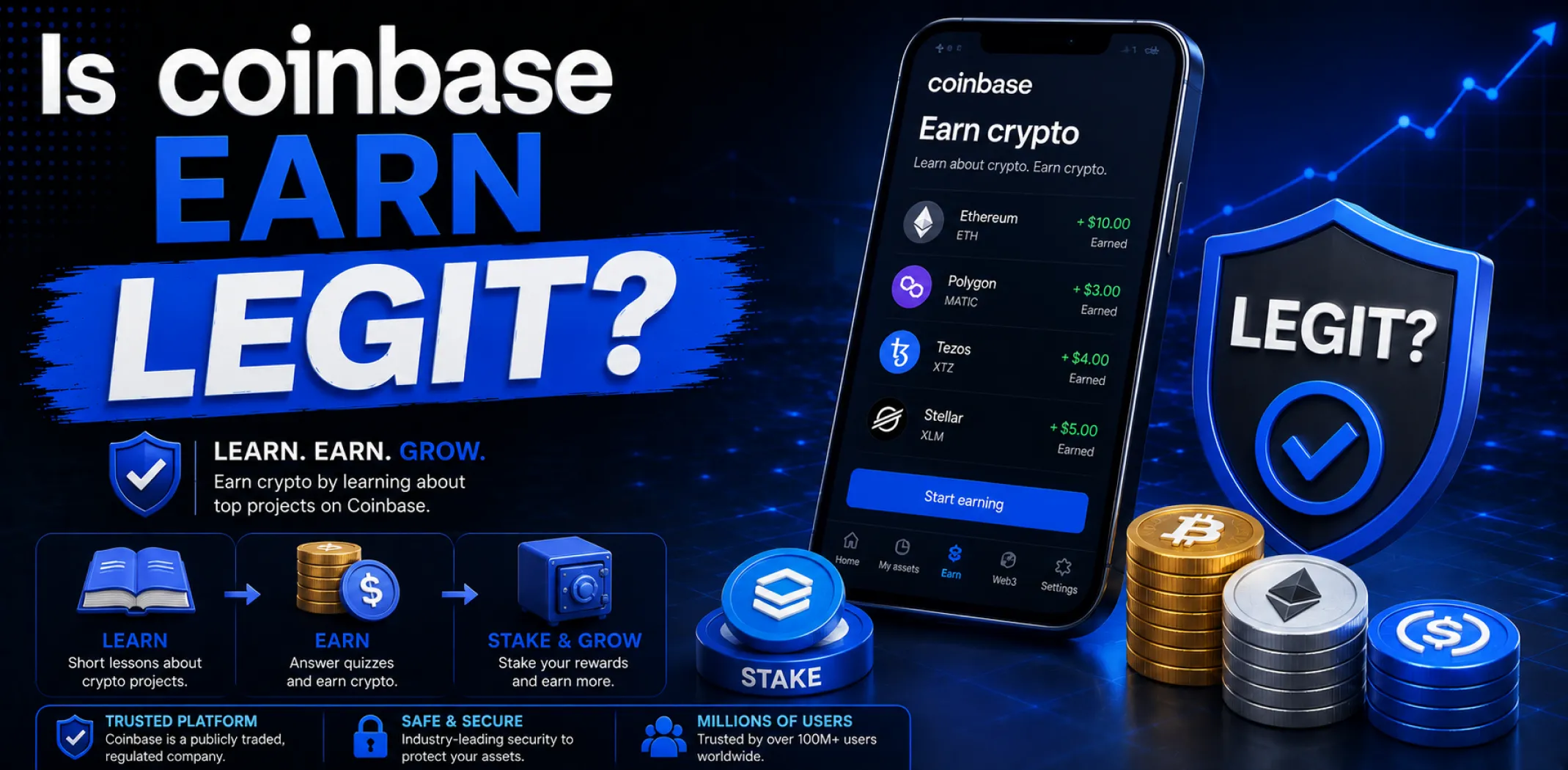
Is Coinbase Earn Legit? Full Honest Review For 2026

Quick verdict
Coinbase Earn is a legitimate feature of Coinbase – a Nasdaq-listed, US-regulated cryptocurrency exchange founded in 2012. The quiz-based learning rewards program ended in May 2025, but “Coinbase Earn” now refers to a broader suite: crypto staking, USDC rewards, and Coinbase Wallet Quests. All three pay real rewards to eligible users and none require any upfront deposit to begin exploring.
- Coinbase is a publicly traded US company (Nasdaq: COIN) founded in 2012, regulated across all 50 US states and licensed in the UK, EU, and other major jurisdictions – one of the most compliance-focused crypto platforms available.
- The original quiz-based Coinbase Learning Rewards program was discontinued on May 27, 2025 – any article or guide that still describes it as active is out of date.
- The Coinbase Earn suite in 2026 covers crypto staking (ETH, SOL, ADA and others), USDC rewards (2–3.5% APY for standard accounts, higher for Coinbase One members), and Coinbase Wallet Quests.
- In May 2025, rogue overseas support contractors were bribed to steal data from around 69,000 users; Coinbase disclosed the breach within days via an SEC filing and estimated remediation costs of 180–400 million dollars.
- Coinbase holds a ~4.0 out of 5 Trustpilot rating across 18,500+ reviews – substantially stronger than most crypto exchanges – though common complaints include account lockouts and slow customer support.
What is Coinbase Earn and how does it work in 2026?
In 2026, “Coinbase Earn” covers a family of reward features rather than a single program. That distinction matters because the most widely searched version – the quiz-based learning rewards program where users earned small crypto amounts for watching videos and answering questions – was officially discontinued on May 27, 2025.
Coinbase confirmed this on its Help Centre with a brief note directing users toward staking instead. A lot of content published before that date still describes the quiz program as active, which is why so many people searching “is Coinbase Earn legit” in 2026 are working from outdated information.
What Coinbase Earn actually refers to today is a broader suite of reward mechanisms, all hosted under the same banner. Staking lets you earn yield on proof-of-stake cryptocurrencies like ETH, SOL, ADA, and others by delegating them through Coinbase. USDC Rewards pays an ongoing APY on stablecoin balances held in your account.
And Coinbase Wallet Quests – the closest current equivalent to the old quiz program – rewards users with crypto or NFTs for completing on-chain tasks like swapping tokens, minting assets, or exploring DeFi protocols through the self-custody Coinbase Wallet app.
Is Coinbase Earn legitimate? What the evidence shows
Yes – Coinbase Earn is legitimate. Coinbase is not a fly-by-night operation: it has been running since 2012, went public on the Nasdaq in April 2021 (ticker: COIN), is regulated by FinCEN and holds money-transmitter licences across all US states except Hawaii. It also holds an FCA licence in the UK, a BaFin licence in Germany, and a MiCA licence covering the EU.
The platform serves 120 million monthly users, holds over 400 billion dollars in assets under custody, and files quarterly financial disclosures as a public company. That regulatory and disclosure infrastructure makes it one of the most audited crypto platforms in existence.
The earn features sit on that foundation. Staking is facilitated through Coinbase acting as a delegator on your behalf – your assets stay in your account, and rewards accumulate based on protocol rates for each network. USDC Rewards is a loyalty program funded by Coinbase itself, paying weekly on balances of at least one dollar of USDC.
Coinbase Wallet Quests is a learn-by-doing model where completing real on-chain actions – not just watching videos – unlocks crypto or NFT rewards. All three features pay what they say they pay.
Common complaints and red flags – what users actually run into
Coinbase Earn itself generates very few complaints – the staking and USDC reward mechanisms are transparent and pay consistently. The frustration in Coinbase reviews tends to come from the broader platform rather than the earn features specifically. Here is an honest account of what can go wrong.
⚠️ Things people get wrong about Coinbase Earn
✕ “Coinbase Earn still has quiz-based learning rewards”
✓ Coinbase officially ended its Learning Rewards program on May 27, 2025. Searching for quiz answer guides for Coinbase Earn will lead to outdated content. The current earn products are staking, USDC rewards, and Wallet Quests – no quiz program exists.
✕ “Staking on Coinbase means you could lose your crypto”
✓ Coinbase states that its customers have never lost staked crypto through its platform. Your assets are not lent out – they remain in your account and are delegated to validators on your behalf. The main trade-off is that some assets have unstaking periods ranging from a few minutes to several weeks before they can be transferred or sold.
✕ “The 2025 hack means Coinbase is not safe to use”
✓ In May 2025, rogue overseas support contractors were bribed to steal account data from around 69,000 users – roughly 1% of monthly active users. No passwords, private keys, or funds were compromised. Coinbase disclosed the incident within days via an SEC 8-K filing and estimated costs of 180–400 million dollars for remediation and user protection. The platform itself was not hacked.
Account lockouts are the most common legitimate complaint. Coinbase’s Trustpilot reviews and Reddit threads from 2025 and 2026 consistently name the same issue: accounts frozen or restricted, often without clear communication from support, and resolution timelines measured in weeks rather than days.
This is a customer service problem, not a sign of fraud – but it is a real operational limitation at scale that affects a meaningful number of users.
Staking rates are lower than some competitors. Coinbase staking rates are driven by underlying protocol yields and are generally competitive, but they are not the highest available. Users willing to stake directly on-chain or through DeFi protocols can often find better rates – at the cost of additional complexity and smart-contract risk. Coinbase trades yield for simplicity and regulatory standing.
USDC rewards require holding a stablecoin on a centralised platform. USDC Rewards pays 2–3.5% APY, which compares favourably with most bank savings accounts but is not the highest available for USDC holders.
The trade-off is keeping funds on a centralised exchange – a model that carries counterparty risk compared to self-custody. USDC balances are not FDIC-insured, though Coinbase holds them fully reserved rather than lending them out.
What do real users say about Coinbase Earn?
Coinbase sits at around 4.0 out of 5 on Trustpilot based on more than 18,500 reviews – a meaningfully better score than most crypto exchanges, including Binance. Reviewers who focus on the core trading and earn features are generally positive: they describe the platform as easy to use, reliable for deposits and withdrawals, and trustworthy for staking.
The negative reviews cluster around a specific pattern: accounts restricted during routine verification checks, support slow to respond, and no clear timeline for resolution.
How does Coinbase Earn compare to alternatives?
In 2026, several platforms offer earn-style reward programs, each with different structures, rates, and risk profiles. Here is how the main options stack up against Coinbase.
For US-based users, Coinbase is the clear go-to for a regulated, straightforward staking and rewards experience. For users outside the US who want quiz-style learning rewards, Binance Learn & Earn or OKX are the most comparable active alternatives – with the caveats their own histories carry. DeFi protocols offer higher rates but at the cost of support, simplicity, and regulatory protection.
Your free ecommerce store and Amazon business start here
AliDropship builds your store, loads it with products, and connects a full Amazon Seller Kit – so you have two income streams ready from the moment you sign up. No experience, no inventory, no upfront cost.
Is Coinbase Earn worth it – honest verdict
For existing Coinbase users, yes – the earn features add real value with no extra cost. Staking turns idle crypto holdings into yield-generating assets. USDC Rewards offers a meaningful interest rate on a stablecoin with no lock-up period. Wallet Quests are a genuine on-chain learning experience for users who want to explore DeFi without full self-custody risk. None of these require you to do anything unusual, and all three pay consistently.
For someone opening a Coinbase account specifically to access earn features, the case is slightly more nuanced. Staking rates are real but not the highest available. USDC Rewards at 2–3.5% APY is solid but Kraken and some DeFi alternatives pay more.
Wallet Quests involve gas fees on some networks, meaning you need a small funded wallet before you can participate. And if you are still looking for the old quiz-based learning rewards, those ended in May 2025 and there is no replacement in that exact format.
What Coinbase uniquely offers is the combination of regulatory standing, ease of use, and scale. It is one of the only crypto platforms where institutional custody standards, SEC-compliant disclosures, and retail earn features sit on the same platform. If compliance and simplicity matter to you as much as rate optimisation, Coinbase Earn is the strongest all-round choice in its category.
Legitimate and among the most regulated crypto earn platforms available
Coinbase Earn is genuine – staking, USDC Rewards, and Wallet Quests all pay real returns to eligible users on one of the most compliance-focused crypto platforms in the world. The quiz-based learning program ended in May 2025. It is best suited to users who value regulatory standing and simplicity alongside their returns, and who can accept that rates are modest compared to higher-risk alternatives.
Want to build income that goes beyond crypto rewards?
Coinbase Earn is a solid feature for existing crypto users. But even at its best – 3.5% APY on stablecoins, staking yields on ETH or SOL – these are supplements to a financial strategy, not a standalone income engine. If what you are really looking for is a way to generate meaningful online income from scratch, crypto rewards programs have a fundamental ceiling: your returns are tied to how much capital you already have or how much platform activity you do.
Product-based online businesses work differently. You set the margins, you control the audience, and the income does not depend on holding a specific asset or waiting for protocol rewards to accrue. AliDropship builds you a complete ecommerce store and connects a full Amazon Seller Kit – both ready from day one, with no inventory to manage, no tech skills required, and no upfront cost. That is two income streams at zero startup cost.
How AliDropship turns one free signup into two income streams
While crypto earn features pay you fractions of a percent at a time, AliDropship gives you a fully built ecommerce store and an Amazon Seller Kit from the same free signup. Here is what comes with it.
Free turnkey store – built, designed, and filled with products
Your store arrives professionally designed, pre-loaded with 50 bestselling products, and fully optimized to convert. No setup fees, no coding, no design time. You start at the product-testing stage – not the store-building stage. Hosting, SSL, and payment gateway are all included.
Winning products, one-click import
Browse trending and niche items from AliDropship’s catalog – including brand-name and digital products – and import them to your store in one click. The catalog updates regularly so your store always has fresh, competitive inventory without manual research.
Automated fulfillment and real-time tracking
Orders are processed automatically through global supplier connections. Customers receive real-time tracking updates – building trust and reducing support volume. You do not touch the shipping logistics; the platform handles it end-to-end.
Built-in marketing and promotion tools
Email campaigns, discount management, abandoned-cart recovery, live countdown timers, and social media integration are all included or available as add-ons. No prior marketing experience required – the tools guide you through each campaign type.
Beginner-friendly – no coding, no learning curve
An intuitive dashboard walks you through every step. Adding products, running campaigns, and scaling your catalog require no technical knowledge. As your business grows, the platform scales with you – adding features without adding complexity.
AliExpress integration – one-click imports, synced inventory
AliDropship connects directly to AliExpress for one-click product imports, automated order processing, and synced tracking. Inventory stays current with the latest products and prices. Combined with the turnkey store and automated fulfillment, this integration makes the entire operation manageable for one person.
Your own store, your own brand, your own margins
A fully built dropshipping store with 50 products loaded, automated fulfillment, and one-click ads. You set the price – suppliers handle the rest.
Sell on Amazon – 300M buyers, import file ready to upload
The full Amazon Seller Kit is included with your free store signup. Product listings, competitor research, and setup guide – everything ready to go on a 514-billion-dollar marketplace.
Is Coinbase Earn legit?
Does Coinbase still have a learn and earn quiz program?
No. Coinbase officially ended its quiz-based Learning Rewards program on May 27, 2025. The Coinbase Help Centre confirms the program is no longer available, with staking suggested as an alternative. Any guide still describing the quiz program as active is out of date. The current earn features are crypto staking, USDC Rewards, and Coinbase Wallet Quests, which reward users for completing real on-chain tasks rather than answering questions.
What does Coinbase Earn actually pay in 2026?
Coinbase Earn covers three products in 2026. Staking pays protocol-based rewards on assets like ETH and SOL, with rates varying by network. USDC Rewards pays 2 to 3.5 percent APY on stablecoin balances held in the account, distributed weekly. Coinbase Wallet Quests reward users with crypto or NFTs for completing on-chain tasks, though some quests involve small gas fees. Coinbase One members qualify for boosted USDC rates and zero trading fees on a monthly subscription starting at 4.99 dollars.
What are the risks of using Coinbase Earn?
The main risks are platform-level rather than earn-specific. In May 2025, rogue overseas support contractors were bribed to steal data from roughly 69,000 users, exposing personal information but no passwords or funds. Coinbase disclosed this within days and committed 180 to 400 million dollars to remediation. Staking also involves network unstaking periods of minutes to several weeks depending on the asset, during which funds cannot be transferred. USDC Rewards balances are not FDIC-insured.
What are the best alternatives to Coinbase Earn?
Kraken offers competitive staking rates and strong regulatory standing across the US and EU, with USDC APY reaching 4 to 6 percent in some regions. Binance Learn and Earn runs quiz-based campaigns for users outside the US, with rewards of 2 to 20 dollars per course, though reward pools cap out quickly and Binance settled a 4.3 billion dollar DOJ case in 2023. OKX Learn and Earn operates a similar quiz model for non-US users. Users looking for product-based online income rather than crypto rewards can explore options at alidropship.com/free-ecommerce-store-plus-amazon-package.