Is Betterment Legit? An Honest Review For Investors In 2026

Quick verdict
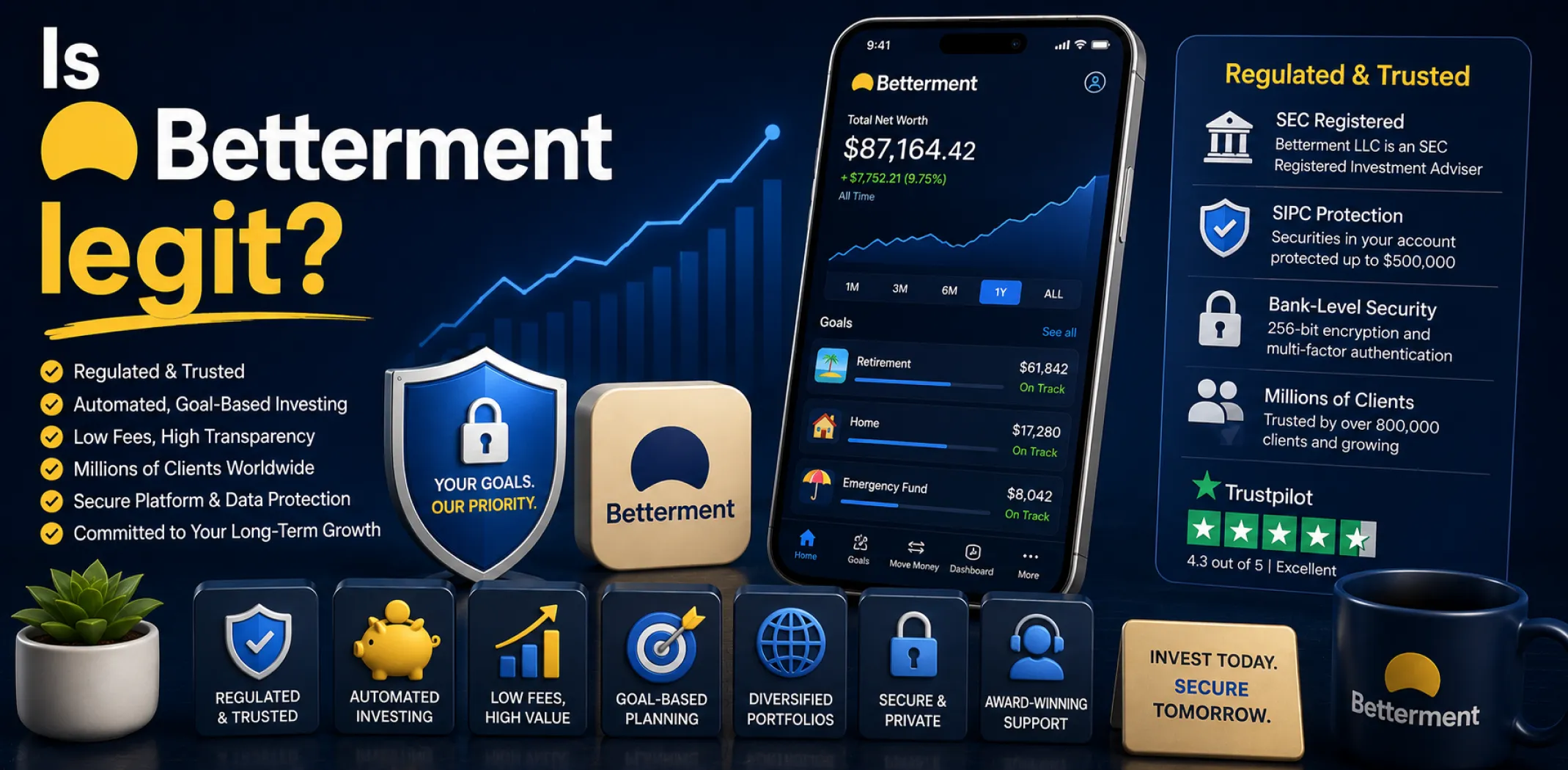
Betterment is a legitimate, SEC-registered robo-advisor founded in 2008 with over 1 million customers and 65 billion dollars in assets under management. Investment accounts are protected by SIPC up to 500,000 dollars. In January 2026, a social engineering attack on a third-party platform exposed contact data for 1.4 million users – though investment accounts and login credentials were not compromised. That breach is the most important recent caveat for prospective users.
Key takeaways
- Betterment is registered with the SEC as an investment advisor and broker-dealer, and is a FINRA member with SIPC protection up to 500,000 dollars per account.
- As of 2025, it manages more than 65 billion dollars across over 1 million customer accounts, making it the largest independent robo-advisor in the US.
- A January 2026 data breach via social engineering exposed contact data for 1.4 million users – investment accounts and passwords were not accessed.
- Fees are 0.25% per year (or 5 dollars per month for smaller accounts) – transparent and among the lowest in the robo-advisor category.
- The main complaints center on slow customer support, limited phone access on the Digital plan, and a 75-dollar outbound transfer fee.
What is Betterment and how does it work?
In 2026, Betterment is the largest independent robo-advisor in the United States. It was founded in 2008 by Jon Stein and Eli Broverman in New York City and launched publicly at TechCrunch Disrupt in 2010, pioneering the category of automated, algorithm-driven investment management that is now an industry standard.
If you are searching “is Betterment legit” before opening an account, you are asking a sensible question – and the answer is clearly yes, with one meaningful recent caveat to understand first.
The platform works by building you a diversified portfolio of low-cost index-tracking ETFs, automatically rebalancing it over time, and applying tax strategies – including tax-loss harvesting – without requiring you to manage any of it manually.
You set a goal (retirement, a house down payment, a general investing target), answer a few questions about your timeline and risk tolerance, and Betterment constructs an appropriate portfolio. The company calls this a goal-based investing framework, and it is the approach that has made it particularly popular with first-time and hands-off investors.
Betterment charges no trading commissions, no deposit fees, and no withdrawal fees for cash transfers. The main costs are the 0.25% annual management fee (or 5 dollars per month if your balance is below 24,000 dollars and you do not have a recurring deposit of 250 dollars or more per month), plus the embedded expense ratios of the underlying ETFs, which run between 0.04% and 0.11% for the core portfolio.
There is also a 75-dollar fee if you transfer your investments out to another brokerage – a real cost to factor into any decision to join or leave.
Is Betterment legitimate? What the evidence shows
As of 2026, Betterment is unambiguously a legitimate, regulated, financially sound company. The regulatory case for this is strong and multi-layered. Betterment LLC is registered with the SEC as a Registered Investment Advisor (RIA) – the same registration required of all professional investment advisors in the US.
Betterment Securities, its broker-dealer arm, is a FINRA member and a member of SIPC, which protects investment accounts up to 500,000 dollars (including 250,000 dollars for cash) in the event the brokerage fails. These are not self-reported claims – they are publicly verifiable registrations you can confirm on the SEC’s EDGAR database and FINRA’s BrokerCheck.
The scale is also significant. Betterment manages over 65 billion dollars in assets across more than 1 million customer accounts as of 2025. It acquired Ellevest’s automated investing business in February 2025 (approximately 70,000 clients and 1.1 billion dollars in AUM) and absorbed the Marcus Invest account transfers from Goldman Sachs in 2024.
Those are not transactions that happen to fly-by-night operations. The company also launched self-directed, commission-free stock and ETF trading in November 2025, expanding from its robo-advisor core into broader investing.
There are no regulatory enforcement actions – no SEC fines, no FINRA sanctions, no state securities violations – in Betterment’s history. This distinguishes it meaningfully from platforms like eToro (two enforcement actions settled) or Trading 212 (January 2026 FCA crypto permission gap). Betterment has a clean regulatory record across 16 years of operation.
What happened with the Betterment data breach in 2026?
This is the most important recent development for anyone evaluating Betterment, and it deserves an honest account rather than dismissal or exaggeration.
In January 2026, attackers used a social engineering technique – manipulating a third-party platform employee into sharing credentials rather than exploiting any technical flaw in Betterment’s core systems – to gain unauthorized access to marketing and communications tools Betterment used for customer outreach.
With that access, the attackers sent fraudulent crypto-themed messages to Betterment customers, promising to triple their cryptocurrency if they sent funds to attacker-controlled wallets. The messages were phishing scams sent through Betterment’s own communication infrastructure, which made them look legitimate.
Betterment detected and shut down the attack on January 9 and 10, 2026, and notified customers. In subsequent disclosures, the company confirmed that the personal data of approximately 1.4 million users had been exfiltrated – including names, email addresses, geographic location data, and for a subset of users, dates of birth, phone numbers, and physical addresses.
Important: Betterment confirmed that customer investment accounts, login credentials, and financial account data were not accessed or compromised during the breach. The attack targeted communications infrastructure, not the core investment platform.
The ransomware group ShinyHunters claimed responsibility and, after Betterment declined to pay a ransom, published the stolen data. The breach was added to HaveIBeenPwned in February 2026 under 1.4 million affected accounts. Betterment responded by revoking all unauthorized session tokens, implementing enhanced access controls on third-party platforms, and engaging federal authorities.
For current users: if you received crypto-related messages from Betterment in January 2026, those were fraudulent. If you sent cryptocurrency to any external wallet in response to those messages, that money was stolen by the attackers, not Betterment. Betterment itself did not commit fraud – its communications platform was compromised by external threat actors.
This breach is a genuine concern and a reason to be more alert to phishing attempts using your Betterment contact details going forward. It is not evidence that Betterment is a scam or that your investment funds are at risk.
What are the common complaints about Betterment?
Betterment’s Trustpilot profile is sparsely reviewed – only around 60 reviews with a 2.1-star rating – which is not a reliable indicator given the sample size. Its BBB listing shows complaints resolved in a timely manner. Reddit discussions are more positive, with users praising the fee structure and the automated investing experience. The consistent friction points from independent sources fall into three categories.
✗ Complaint: “Customer support is nearly impossible to reach.”
✓ Reality: On the Digital plan, Betterment offers email-only support and limited phone access. Multiple reviewers report slow response times – in some cases going days without a reply during busy periods. This is a genuine and acknowledged weakness for a platform managing tens of thousands of dollars per customer. The Premium plan (0.65% fee, 100,000 dollar minimum) includes unlimited access to certified financial planners by phone. Users on the Digital plan who anticipate needing frequent human support should factor this in.
✗ Complaint: “Transfers take too long and the 75-dollar fee is unfair.”
✓ Reality: The 75-dollar outbound transfer fee for moving investments to another broker is real and disclosed in the fee schedule. Cash withdrawals to a linked bank account are free and typically process in 4 to 5 business days. Some users also report IRA rollover checks taking longer than expected to process – a documented operational weakness in the paper-check handling workflow. These are real friction points, not evidence of fraud.
✗ Complaint: “The 5-dollar monthly fee is a surprise charge.”
✓ Reality: Betterment charges 5 dollars per month for accounts with less than 24,000 dollars in eligible investments that do not have a recurring deposit of 250 dollars or more per month. This is disclosed in the pricing section and is not hidden – but the BBB lists several complaints from users who did not notice this fee structure before opening an account and were surprised to see recurring 5-dollar charges. The fix is straightforward: set up a recurring deposit or grow the balance above the threshold.
What do real users say about Betterment?
Independent review aggregators and forum discussions paint a picture that is more positive than the Trustpilot sample suggests. Reddit users on personal finance subreddits consistently describe Betterment as a reliable, low-maintenance option for retirement and goal-based investing.
The negative experiences cluster around the support and transfer issues described above, plus frustrations during the January 2026 data breach aftermath. Here is a cross-section of documented user experiences.
How does Betterment compare to its main alternatives?
If you are deciding between Betterment and other automated investing options, here is how the main alternatives compare on the dimensions most investors care about.
Betterment’s clearest advantage over bank-backed competitors like Fidelity Go and Schwab Intelligent Portfolios is its independent, goal-focused design: the entire product is built around helping individuals hit specific targets rather than serving as an add-on to a broader financial institution.
Its clearest disadvantage is the absence of direct indexing (available at Wealthfront) and the limited human advisor access on the Digital plan. For most first-time and passive investors, Betterment’s fee structure, zero account minimum, and tax-loss harvesting tooling make it a strong starting point.
Your free store and your Amazon business – both ready from day one
Betterment grows your money passively over time. AliDropship gives you an active income channel – a free turnkey ecommerce store pre-loaded with products to sell, plus a ready-to-upload Amazon Seller Kit so you can reach 300 million buyers on the world’s largest marketplace. Zero inventory, zero design work, zero coding.
Is Betterment worth it – our honest verdict
In 2026, Betterment earns a clear green verdict. It is a well-regulated, financially sound, SEC-registered robo-advisor with a 16-year track record, no regulatory enforcement actions, and genuine product strengths – particularly automated tax-loss harvesting, goal-based portfolio construction, and an accessible fee model.
The January 2026 data breach is a meaningful caveat that should be disclosed in any honest review, but it did not compromise investment accounts, and Betterment responded with appropriate remediation steps.
The platform makes most sense for hands-off investors who want a low-cost, professionally managed ETF portfolio without the involvement that self-directed investing requires. It is less suited to active traders, investors who want direct indexing or a broad selection of individual securities, or people who anticipate needing frequent human advisor access without paying the Premium fee.
For someone starting a retirement account, a Roth IRA, or a long-term taxable investing account with a modest starting balance, Betterment is among the most credible options in the category.
Legitimate – SEC-registered, clean regulatory record, strong product for passive investors
Betterment is a real, SEC-registered, SIPC-protected investment platform with over 65 billion dollars under management and a 16-year operating history. It has no regulatory fines or enforcement actions on record. The January 2026 data breach was caused by external attackers targeting a third-party communications platform – investment accounts were not compromised. Real weaknesses include limited phone support on the Digital plan, slow verification during large initial deposits, and a 75-dollar outbound transfer fee. For the right user – a passive, goal-oriented investor who wants professional-grade portfolio management without paying for a human advisor – it is one of the most credible platforms in the category.
What else can you do to build income while your Betterment account grows?
Betterment works on a long timeline – you deposit, the market compounds, and meaningful returns materialize over years and decades. If you are also looking for ways to generate income in the shorter term, the same mindset that draws people to robo-advisors – low overhead, automated systems, minimal ongoing effort – applies to certain online business models too.
Ecommerce, in particular, has a version of this structure that does not require inventory, product creation, or prior experience.
Free turnkey store – built, designed, and filled with products
Your store arrives professionally designed, pre-loaded with 50 bestselling products, and fully optimized to convert. No setup fees, no coding, no design time. You start at the product-testing stage – not the store-building stage. Hosting, SSL, and payment gateway are all included.
Winning products, one-click import
Browse trending and niche items from AliDropship’s catalog – including brand-name and digital products – and import them to your store in one click. The catalog updates regularly so your store always has fresh, competitive inventory without manual research.
Automated fulfillment and real-time tracking
Orders are processed automatically through global supplier connections. Customers receive real-time tracking updates – building trust and reducing support volume. You do not touch the shipping logistics; the platform handles it end-to-end.
Built-in marketing and promotion tools
Email campaigns, discount management, abandoned-cart recovery, live countdown timers, and social media integration are all included or available as add-ons. No prior marketing experience required – the tools guide you through each campaign type.
Beginner-friendly – no coding, no learning curve
An intuitive dashboard walks you through every step. Adding products, running campaigns, and scaling your catalog require no technical knowledge. As your business grows, the platform scales with you – adding features without adding complexity.
AliExpress integration – one-click imports, synced inventory
AliDropship connects directly to AliExpress for one-click product imports, automated order processing, and synced tracking. Inventory stays current with the latest products and prices. Combined with the turnkey store and automated fulfillment, this integration makes the entire operation manageable for one person.
Your free ecommerce store – built and loaded
A professionally designed online store pre-loaded with 50 winning products. Start selling from day one. No inventory, no design work, no coding required.
Your Amazon business – import file ready to upload
The Amazon Seller Kit gives you a ready-to-upload product file for the world’s largest marketplace – 300 million active buyers, zero sourcing required. Included free with your store signup.
Is Betterment a legitimate investment platform?
Is my money safe with Betterment?
Yes, your investment funds are protected. Betterment Securities is a SIPC member, which protects brokerage accounts up to 500,000 dollars (including 250,000 dollars for cash claims) in the event of company insolvency. Cash deposits in the Cash Reserve account are FDIC-insured up to 4 million dollars per individual account across a network of program banks. Investment account balances and login credentials were not compromised in the January 2026 data breach.
What happened in the Betterment data breach in 2026?
In January 2026, attackers used a social engineering technique to access a third-party marketing and communications platform that Betterment used for customer outreach. They used that access to send fraudulent crypto-themed messages to customers and to exfiltrate contact data for approximately 1.4 million users, including names, email addresses, and geographic location data. Investment accounts, passwords, and financial account data were not accessed. Betterment detected and shut down the attack on January 9 and 10, 2026, and notified affected customers.
What are the fees for using Betterment?
Betterment charges 5 dollars per month for accounts with less than 24,000 dollars in eligible investments that do not have a recurring deposit of 250 dollars or more per month. For accounts above that threshold, the fee is 0.25% per year, billed monthly based on daily balance. The Premium plan costs 0.65% per year and requires a minimum of 100,000 dollars in eligible investments; it includes unlimited access to certified financial planners. Betterment also charges 75 dollars to transfer investments out to another brokerage. There are no commissions, no deposit fees, and no cash withdrawal fees.
What are the best alternatives to Betterment?
The most commonly compared alternatives to Betterment include Wealthfront (same 0.25% fee, adds direct indexing and more robust financial planning tools, 500-dollar minimum), Schwab Intelligent Portfolios (no management fee but requires 5,000 dollars and earns revenue through cash allocation), Fidelity Go (no fee on accounts under 25,000 dollars, higher fee above), and Vanguard Digital Advisor (approximately 0.20% all-in, uses Vanguard funds, 3,000-dollar minimum). For investors who want human advisor access without the Premium fee, M1 Finance and SoFi Automated Investing are also worth comparing.