Is Betterment A Scam? The Evidence Reviewed For 2026

Quick verdict
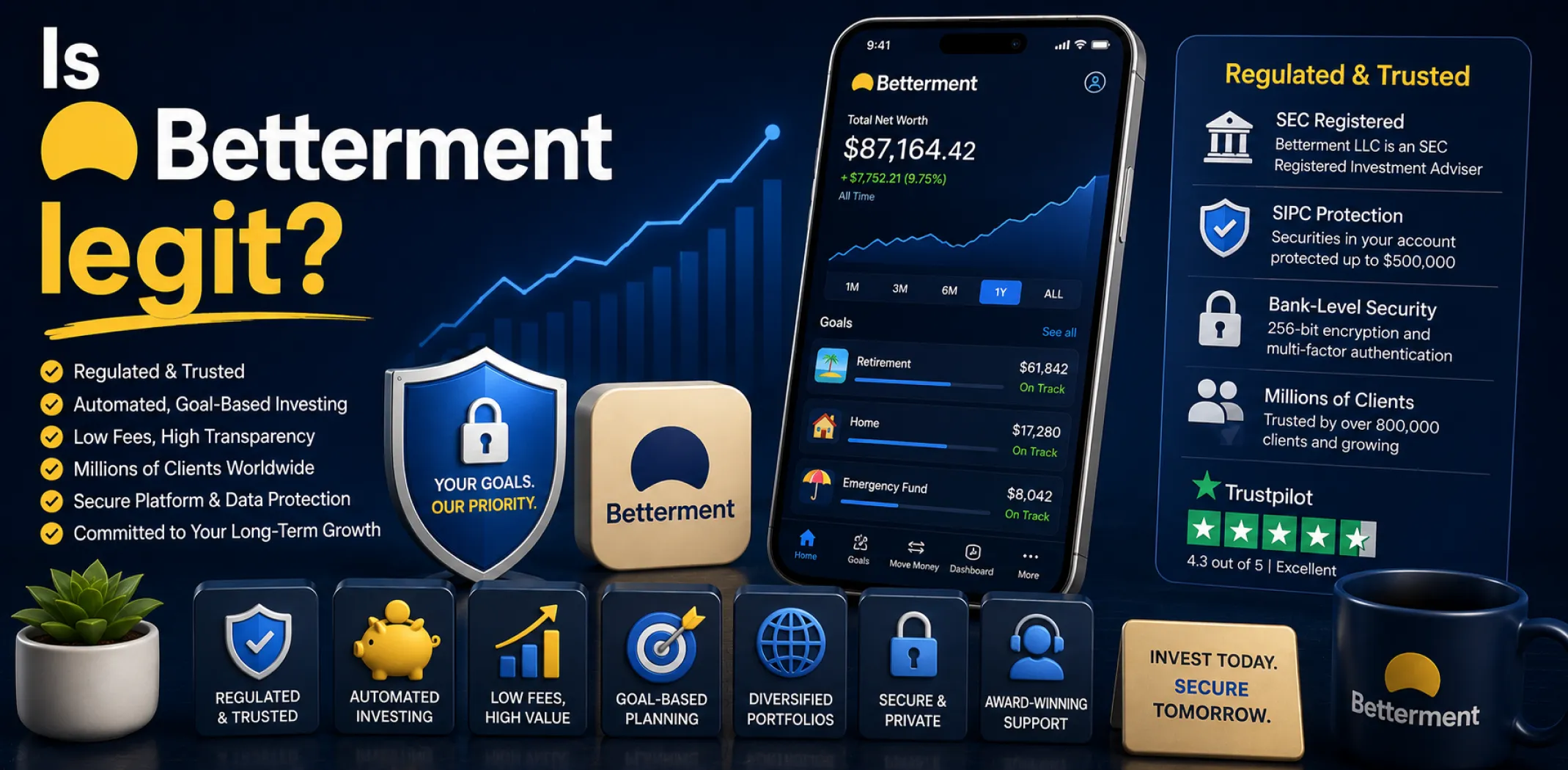
Betterment is not a scam. It is an SEC-registered, SIPC-protected robo-advisor that has managed investor money for 16 years, currently overseeing more than 65 billion dollars across 1 million accounts. The most common reason people ask whether it is a scam is a January 2026 data breach in which attackers – not Betterment – sent fraudulent crypto messages to 1.4 million users. Investment accounts were not compromised. No money was taken by Betterment.
Key takeaways
- Betterment is SEC-registered, FINRA-member, and SIPC-protected – the same regulatory framework as Fidelity and Charles Schwab.
- It has no regulatory fines or enforcement actions in 16 years of operation – a cleaner record than eToro, Trading 212, or Plus500.
- The January 2026 data breach exposed contact data for 1.4 million users via a third-party platform – investment accounts and passwords were not accessed.
- Real complaints center on email-only support on the Digital plan, slow verification during large deposits, and a 75-dollar outbound transfer fee.
- Betterment is not a get-rich-quick scheme – it is a long-term, passive investing tool that charges a transparent 0.25% annual fee.
Why do people search “is Betterment a scam?”
In 2026, the question of whether Betterment is a scam has a clear answer: no. But understanding why the question gets asked at all is more useful than just stating that conclusion. There are three distinct reasons people arrive at this search, and each deserves a direct response.
The first is the January 2026 data breach. In January 2026, attackers used social engineering to compromise a third-party communications platform Betterment used for customer outreach. They sent fraudulent crypto-themed messages to Betterment customers promising to triple their cryptocurrency if they sent funds to external wallets.
Many recipients assumed these messages came from Betterment itself and were alarmed – some lost money to the scam. The breach exposed contact data for approximately 1.4 million users.
People who received those fraudulent messages and lost cryptocurrency were victimized by external cybercriminals who exploited Betterment’s communications infrastructure, not by Betterment itself. Investment accounts, login credentials, and financial data were not compromised.
The second reason is the 5-dollar monthly fee. Betterment charges 5 dollars per month for accounts below 24,000 dollars that do not have a recurring deposit of 250 dollars or more. Users who opened accounts with small balances and did not set up recurring deposits discovered they were being charged monthly – and some described this as a surprise “hidden fee.”
It is disclosed in the pricing section, but it is genuinely easy to miss during onboarding. The frustration is real even if the accusation of fraud is not.
The third is a category-level skepticism about robo-advisors in general. Any platform that manages your money without you actively directing trades attracts suspicion, especially from investors who have never used one before.
The automated, hands-off model can feel like a black box – money goes in, something happens, returns arrive (or do not). That unfamiliarity generates distrust, even when the underlying platform is regulated and transparent.
What actually happened in the 2026 Betterment breach – and is it a scam signal?
The January 2026 security incident is the most important recent event in Betterment’s history and the primary driver of current scam searches. Here is what the public record shows, with no embellishment in either direction.
On January 9, 2026, attackers using social engineering techniques convinced an employee at a third-party platform – one that Betterment used for customer marketing and communications – to hand over access credentials.
With that access, the attackers sent fraudulent push notifications and emails to Betterment customers, claiming to offer a cryptocurrency promotion that would triple deposits if users sent funds to specified wallet addresses. This was a phishing scam, delivered through Betterment’s own communication channels, which made it look legitimate to recipients.
Betterment detected and shut down the unauthorized access on January 9 and 10. It warned customers about the fraudulent messages and began an investigation.
Subsequent disclosures confirmed that approximately 1.4 million users had their contact data exfiltrated – names, email addresses, geographic location data, and for a subset, dates of birth, phone numbers, and physical addresses. The ransomware group ShinyHunters claimed responsibility and, after Betterment declined to pay a ransom, published the stolen data.
Important: Betterment confirmed that investment accounts, login credentials, Social Security numbers, and financial account data were not accessed during the breach. The attack targeted a third-party communications tool, not Betterment’s core investment infrastructure.
Is this a scam signal? No – but it is a real security failure worth being honest about. The attackers exploited human vulnerability at a vendor, not a flaw in Betterment’s own systems. The people who lost money to the fraudulent crypto messages were victimized by the attackers, not by Betterment.
Betterment’s investment platform, account security, and fund protection mechanisms functioned correctly throughout. The lesson for current users: if you received crypto promotion messages from Betterment in January 2026, those were fraudulent. Betterment does not run cryptocurrency promotions of that type.
What do real complaints about Betterment show?
Separating the scam search from the platform’s actual complaint record reveals a different picture. Betterment has a sparsely populated Trustpilot profile (around 60 reviews, low by the standards of platforms like eToro or Trading 212) and a BBB listing with complaints that have generally been resolved. Reddit discussions on personal finance forums are more positive. The documented frustrations cluster into four areas – none of which are fraud.
✗ Claim: “Betterment charged me without my permission.”
✓ Reality: This almost always refers to the 5-dollar monthly fee applied to accounts below the 24,000-dollar balance threshold with no qualifying recurring deposit. The fee is disclosed in Betterment’s pricing documentation but is easily missed during quick onboarding. The fix is straightforward: set up a recurring monthly deposit of 250 dollars or more, or grow the balance above the threshold, and the fee drops to 0.25% annually. Several BBB complaints also involve confusion around the 0.25% annual advisory fee being charged on top of the underlying ETF expense ratios – both are disclosed but presented separately.
✗ Claim: “Betterment stole my money – I cannot get it out.”
✓ Reality: Cash withdrawals to a linked bank account are free and typically process in 4 to 5 business days. The friction users describe is almost always identity verification delays during initial large deposits – Betterment is required to complete KYC checks under financial regulations, and these can take longer than expected when large sums arrive before verification is complete. Several reviewers describe depositing significant sums and finding the money inaccessible for days or weeks while KYC completed. The money was not taken; it was in a compliance hold that the support team was slow to communicate about.
✗ Claim: “The 2026 breach proves Betterment is fraudulent.”
✓ Reality: The January 2026 breach was caused by an external ransomware group using social engineering against a vendor, not by Betterment misusing customer funds or data. Betterment did not conduct the breach; it was a victim of one. The response included immediate system lockdown, federal law enforcement engagement, customer notification, and security enhancements. Investment accounts were never at risk. Attributing the breach to Betterment as a form of fraud conflates the company with the attackers.
The fourth recurring complaint – the 75-dollar outbound transfer fee – is the most legitimate grievance. When users decide to leave Betterment and transfer their investments to another broker (Vanguard, Fidelity, Schwab), Betterment charges 75 dollars per account for the transfer.
This is disclosed in the fee schedule, but it functions as a meaningful exit cost that some users describe as a financial trap. It is not unique to Betterment – many brokers charge transfer fees – but it creates frustration that reads as a scam to users who did not notice it before joining.
How does Betterment make money – and does that model create conflicts?
Understanding how Betterment earns revenue is the most direct way to evaluate whether its interests align with yours as a customer. The answer is more favorable than many financial platforms.
This is meaningfully different from the revenue model of platforms like Plus500 or eToro. CFD brokers earn through spreads and overnight charges on every trade, regardless of whether the client profits. Betterment earns a percentage of your balance – which means it earns more only when your portfolio grows.
It also earns interest income on uninvested cash balances held before they are invested or swept to the Cash Reserve program. These are disclosed revenue streams, and neither creates the kind of conflict of interest that leads to the market-manipulation concerns raised against CFD platforms.
What do real users say about Betterment?
The authentic user experience at Betterment is more nuanced than either the 2.1-star Trustpilot average (based on only around 60 reviews) or the marketing copy suggests. Long-term users on Reddit personal finance forums are consistently positive about the automated investing experience and the tax-loss harvesting tooling. Newer users and those who ran into support issues tell a different story.
Is Betterment worth using – our honest verdict
In 2026, the answer to “is Betterment a scam” is an unambiguous no. The platform is SEC-registered, SIPC-protected, FINRA-member, and has managed investor money for 16 years without a single regulatory enforcement action.
Its revenue model – a flat percentage of assets under management – aligns its incentives with investors in a way that CFD broker models do not. The January 2026 data breach was caused by external attackers exploiting a third-party vendor, not by Betterment misusing customer information.
The legitimate criticisms of Betterment are about service quality and fee transparency, not fraud. The Digital plan provides email-only support, which fails users who encounter complex account issues and need a faster resolution. The 5-dollar monthly fee structure catches out small-balance investors who did not read the pricing page carefully. The 75-dollar outbound transfer fee creates a real financial cost to leaving.
The January 2026 breach has made more users aware of Betterment as a potential phishing vector, meaning current users should be more alert to any crypto-related communications claiming to come from the platform.
Betterment is well suited to investors who want long-term, automated, goal-oriented portfolio management at a low fee. It is less suited to active traders, investors who want direct access to individual stocks (the self-directed feature launched in November 2025 adds this, but it is a newer offering), and users who may need to transfer large sums quickly and want phone-accessible support on call.
Not a scam – SEC-registered, clean regulatory record, aligned incentive model
Betterment is not a scam. It is a real, regulated, 16-year-old investment platform with no enforcement actions, 65 billion dollars under management, and a fee model that grows only when your portfolio grows. The January 2026 data breach was a real security incident caused by external attackers – not Betterment fraud. The genuine criticisms – email-only support, the 5-dollar fee threshold, the 75-dollar transfer exit cost – are service and fee concerns, not evidence of deception. For long-term passive investors, it remains one of the most credible and cost-transparent robo-advisors available.
What else should you consider alongside a Betterment account?
Betterment is built for the long game – the 0.25% fee compounds your wealth slowly over years and decades. If you are also looking for ways to build active income while that account grows, ecommerce is one model that shares Betterment’s core appeal: low overhead, automated systems, no specialist expertise required.
AliDropship provides a free turnkey store pre-loaded with products to sell, plus a ready-to-upload Amazon Seller Kit for the world’s largest marketplace – two income channels from one free signup.
Free turnkey store – built, designed, and filled with products
Your store arrives professionally designed, pre-loaded with 50 bestselling products, and fully optimized to convert. No setup fees, no coding, no design time. You start at the product-testing stage – not the store-building stage. Hosting, SSL, and payment gateway are all included.
Winning products, one-click import
Browse trending and niche items from AliDropship’s catalog – including brand-name and digital products – and import them to your store in one click. The catalog updates regularly so your store always has fresh, competitive inventory without manual research.
Automated fulfillment and real-time tracking
Orders are processed automatically through global supplier connections. Customers receive real-time tracking updates – building trust and reducing support volume. You do not touch the shipping logistics; the platform handles it end-to-end.
Built-in marketing and promotion tools
Email campaigns, discount management, abandoned-cart recovery, live countdown timers, and social media integration are all included or available as add-ons. No prior marketing experience required – the tools guide you through each campaign type.
Beginner-friendly – no coding, no learning curve
An intuitive dashboard walks you through every step. Adding products, running campaigns, and scaling your catalog require no technical knowledge. As your business grows, the platform scales with you – adding features without adding complexity.
AliExpress integration – one-click imports, synced inventory
AliDropship connects directly to AliExpress for one-click product imports, automated order processing, and synced tracking. Inventory stays current with the latest products and prices. Combined with the turnkey store and automated fulfillment, this integration makes the entire operation manageable for one person.
Your free ecommerce store and Amazon business – both ready from day one
While your Betterment account compounds quietly, your AliDropship store and Amazon listing can generate income in the shorter term. One free signup gets you both – a built store loaded with products and an Amazon import file ready to upload to a 514 billion dollar marketplace. No inventory, no design, no coding required.
Your free ecommerce store – built and loaded
A professionally designed online store pre-loaded with 50 winning products. Start selling from day one. No inventory, no design work, no coding required.
Your Amazon business – import file ready to upload
The Amazon Seller Kit gives you a ready-to-upload product file for the world’s largest marketplace – 300 million active buyers, zero sourcing required. Included free with your store signup.
Is Betterment a scam?
Did Betterment steal money from customers?
No, Betterment has not stolen money from customers. The platform is SIPC-protected up to 500,000 dollars and FDIC-insured on Cash Reserve deposits up to 4 million dollars. Complaints about funds being inaccessible almost always relate to identity verification holds required under anti-money laundering regulations during large initial deposits – a standard compliance process, not theft. Funds are released once verification is complete.
What was the 2026 Betterment scam message about?
In January 2026, external attackers used social engineering to gain access to a third-party marketing platform that Betterment used for customer communications. The attackers sent fraudulent push notifications and emails to Betterment customers, falsely claiming that Betterment was running a cryptocurrency promotion that would triple deposits. These messages were scams sent by the attackers using Betterment infrastructure – they were not from Betterment. Investment accounts, login credentials, and financial data were not accessed. Users who sent cryptocurrency in response to those messages lost funds to the attackers, not to Betterment.
Why is Betterment charging me 5 dollars per month?
Betterment charges 5 dollars per month for accounts that have less than 24,000 dollars in eligible investments and do not have a recurring deposit of 250 dollars or more per month set up. This fee is disclosed in the Betterment pricing documentation but is easy to miss during quick onboarding. To avoid the monthly fee, set up a qualifying recurring deposit or grow the account balance above 24,000 dollars, at which point the fee structure changes to 0.25% per year. Betterment does not charge 5 dollars per month to accounts meeting either of those conditions.
What are the best alternatives to Betterment?
The most commonly compared alternatives to Betterment include Wealthfront (same 0.25% fee, stronger financial planning tools and direct indexing, 500-dollar minimum), Schwab Intelligent Portfolios (no management fee, 5,000-dollar minimum, revenue from cash allocation), Fidelity Go (no fee on accounts under 25,000 dollars, 0.35% above), and Vanguard Digital Advisor (approximately 0.20% all-in, 3,000-dollar minimum). For users specifically frustrated by limited phone support, SoFi Automated Investing includes access to financial advisors at no additional fee.