Is Amway Legit? An Honest Review Of The MLM Opportunity

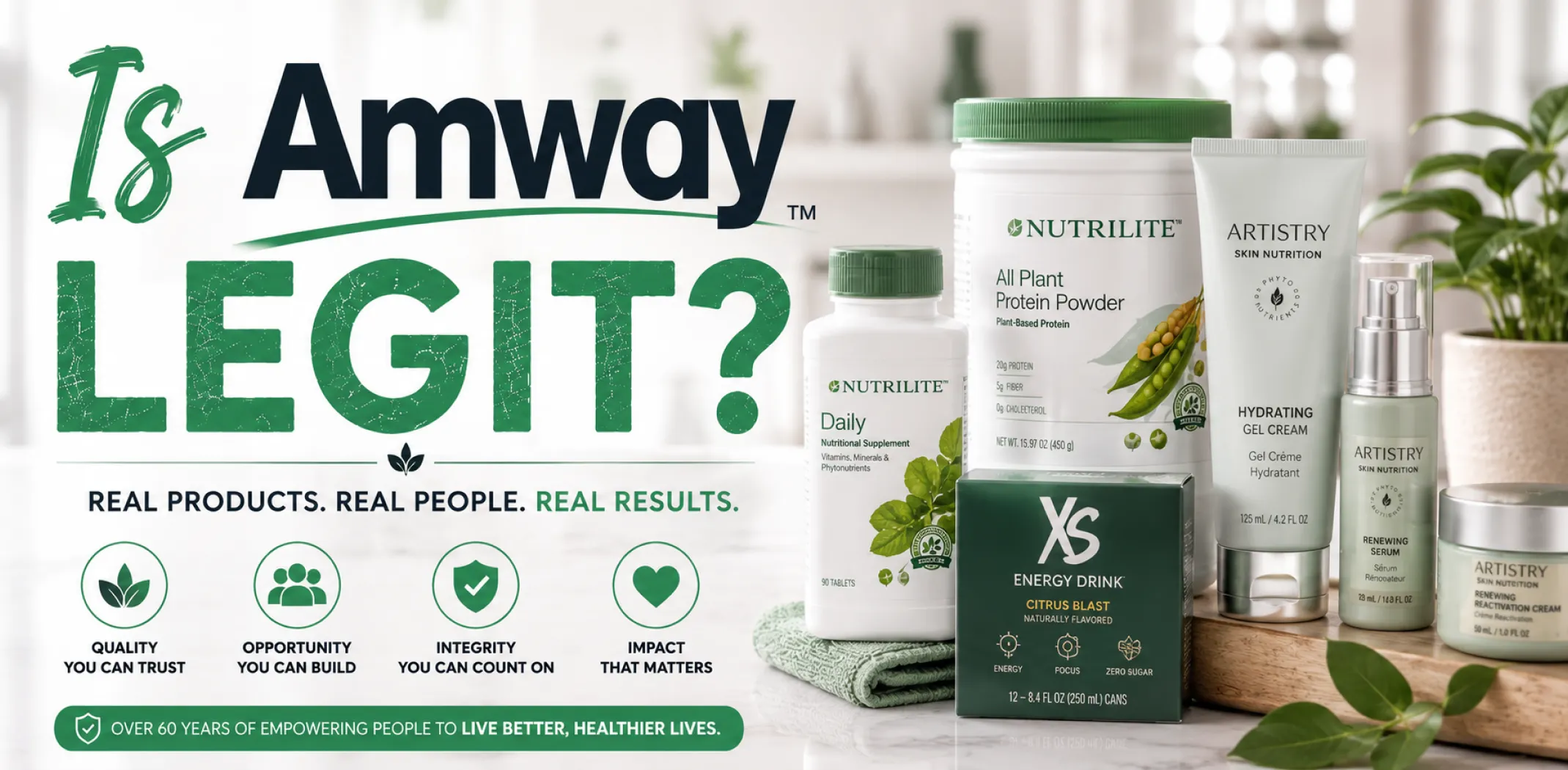
Quick verdict
Amway is a legitimate, legally operating company that has sold real products for over 60 years and holds the title of the world’s largest direct selling company. However, its own 2024 income disclosure shows average U.S. IBO earnings of $723 per year before expenses, and 38% of IBOs earn nothing at all. The products are real; the income opportunity works for very few.
Key takeaways
- Amway was founded in 1959 and reported $7.4 billion in global sales for 2024, making it the number-one direct selling company in the world for the 14th consecutive year.
- The FTC investigated Amway in 1979 and ruled it was not an illegal pyramid scheme, though it issued a consent order requiring specific rule enforcement that critics argue has never been meaningfully implemented.
- Amway’s own 2024 U.S. income disclosure shows average annual earnings of $723 before expenses for IBOs at the Founders Platinum level and below, which covers the vast majority of the sales force.
- Active class action litigation in 2026 alleges income misrepresentation, deceptive recruitment tactics, and a compensation structure that made it statistically impossible for most IBOs to profit.
- A major undisclosed complaint is the “tools” system: separate businesses run by upline leaders selling motivational materials, books, and events to downline IBOs that can cost thousands of dollars per year.
What is Amway and how does it work?
Amway is a direct-selling company founded in 1959 by Jay Van Andel and Rich DeVos in Ada, Michigan, where it is still headquartered today. In 2026, it operates across more than 100 countries and territories, employs over 14,000 people globally, and generates billions in annual revenue through a network of independent sellers called Amway Business Owners (ABOs) or Independent Business Owners (IBOs).
Its top-selling product lines are Nutrilite (vitamins and nutritional supplements), Artistry (skincare and cosmetics), and XS (energy drinks and sports nutrition). Nutrilite alone accounts for roughly 64% of total global sales as of 2024.
The business model is multi-level marketing. IBOs purchase Amway products at wholesale prices and resell them to customers at retail, keeping the markup as profit. They can also recruit other IBOs, building a “downline,” and earn commissions on the sales volume generated by everyone they recruit.
The more volume your entire downline generates, the higher your commission percentage and your rank within Amway’s recognition structure.
What separates Amway from a simple product company is the emphasis placed on network building. In practice, the income potential at the entry level is limited by retail selling alone. The path to meaningful earnings almost always runs through recruiting, which is why understanding the actual earnings data matters so much before you decide to join.
Is Amway legit? What the evidence shows
In 2026, the question of whether Amway is “legit” has two distinct answers depending on what you are asking about. As a company that sells real, manufactured products to real customers, yes: Amway is legitimate.
The Nutrilite supplement line has genuine scientific backing, the Artistry skincare products are real, and the company has operated at massive global scale for over 65 years without being shut down by any regulator. It is not a vanishing act designed to take your money and disappear.
As a business opportunity, the picture is considerably more complicated. Amway publishes an annual income disclosure for U.S. IBOs, and the 2024 data is the clearest source of truth available. It is worth reading carefully before you go any further.
The $723 annual average works out to roughly $60 per month before any deductions. Among IBOs who reported at least some product sales activity in 2024, that figure rose to $1,199 per year before expenses. Typical IBO expenses include product samples, shipping, mileage, an annual renewal fee, and optional training materials.
Conservative estimates put annual expenses at $500 to $2,000 for an active IBO, meaning the typical income-earning IBO likely runs at a net loss after costs. Fewer than 1% of IBOs reach income levels that could reasonably substitute for a part-time wage.
That is the honest answer to “is Amway legit?” The company is real. The income opportunity, for the overwhelming majority of participants, does not deliver what the business presentations tend to promise.
What are the common complaints and red flags with Amway?
Understanding the complaint landscape around Amway requires distinguishing between the company itself and the behaviors of individual upline leaders and independent training organizations (ITOs). Critics argue that Amway’s structure makes those behaviors almost inevitable. In 2026, the following patterns are well-documented across court filings, Reddit communities, consumer review platforms, and regulatory records.
Common misconception:
✕ “Amway was declared an illegal pyramid scheme by the FTC.”
✓ The FTC investigated Amway in 1979 and ruled it was not an illegal pyramid scheme, largely because it sold real products to genuine customers. However, the FTC did find other violations and issued a consent order requiring Amway to enforce specific retail sales rules. Critics and ongoing litigation argue those rules were never meaningfully enforced in practice, meaning the structural problem remains unresolved.
The “tools” system is one of the least-discussed but most financially damaging aspects of the Amway experience. Many Amway upline leaders operate separate businesses selling motivational books, CDs, recordings, event tickets, and training programs to their downline. These Independent Training Organizations go by names like WWDB, BWW, and Network 21.
Participation is often presented as essential to success, but the costs can reach $1,000 to $5,000 per year on top of product purchases. This income flows directly to upline leaders, not to Amway corporate, and is entirely separate from any commissions an IBO might earn.
Active legal challenges in 2026 include ongoing class action filings alleging that Amway misrepresented income potential, used deceptive recruitment tactics, and structured its compensation in ways that made it statistically impossible for most IBOs to profit.
Plaintiffs in multiple U.S. jurisdictions argue that the tools business model specifically was designed to extract money from lower-level IBOs while enriching upline leaders. A 2010 class action resulted in a settlement paid from a $34 million fund. As of 2026, new and pending filings continue in several states.
Important: High-pressure recruitment tactics are widely reported by former IBOs. Common patterns include being told to make a list of everyone you know, presenting the “business opportunity” before revealing it is Amway, and framing skepticism from friends and family as a negative mindset that will hold you back from success. These behaviors are not officially sanctioned by Amway corporate, but they are widespread enough to be a pattern, not an exception.
Product pricing is a persistent complaint among both customers and IBOs. Amway products are positioned as premium, but many reviewers on Trustpilot and consumer forums note that comparable products are available at a fraction of the price through conventional retail. For an IBO trying to find genuine retail customers, competing on price is very difficult when customers can easily find cheaper alternatives online.
What do real users say about the Amway business opportunity?
As with most MLM companies, Amway IBO experiences vary sharply by rank and timeline. People who reached Diamond level or above after years of dedicated team-building describe a completely different company than people who signed up, attended meetings for six months, and quit having spent more than they earned. Both experiences are real. The math, however, is unambiguous about which outcome is more common.
Looking for income models without recruiting? If the MLM structure does not fit your goals, there are online income approaches that do not depend on building a downline. See our full breakdown at how to make money online for an honest comparison of options with different risk profiles and startup costs.
How does Amway compare to alternatives in the MLM space?
Compared to other MLM companies in the health and wellness category, Amway has a few structural advantages worth acknowledging alongside its well-documented challenges. It has stronger brand recognition than most peers, manufactures its own products (rather than relying on third-party suppliers), and publishes a more detailed income disclosure than many competitors.
On the downside, its products are priced at a premium that makes retail selling harder, and the tools system adds a layer of financial risk that is absent from simpler direct-selling models.
Is Amway worth it – honest verdict
Amway is not a scam in the conventional sense. The company has been legally operating for over 65 years, sells manufactured products backed by genuine research, and has survived regulatory scrutiny in dozens of countries. The FTC’s landmark 1979 decision confirmed that Amway’s structure, as written, is not an illegal pyramid scheme.
If you want to buy Nutrilite supplements or Artistry skincare products directly, that is a straightforward consumer purchase that carries no significant risk.
The income opportunity is a different matter. Amway’s own 2024 income disclosure is unambiguous: average U.S. IBO earnings are $723 per year before expenses, and 38% of IBOs earn nothing at all. The typical active IBO spending on products, tools, renewal fees, and events is likely running at a net loss.
The path to meaningful income requires reaching Platinum level or above, which accounts for a small fraction of the total IBO base and typically requires sustained, full-time effort over multiple years. On top of this, Amway faces active class action litigation in 2026 alleging systematic income misrepresentation, adding legal risk to the picture for anyone considering building a business around the brand.
Who might find Amway worth considering? Someone who genuinely wants to use Nutrilite or Artistry products and is comfortable paying a slight premium for them, who can register as an IBO for the wholesale discount without expecting significant business income, and who avoids the tools systems entirely.
Anyone approaching it as a primary or significant secondary income source should study the income disclosure document carefully and ask every upline contact to show them their actual tax returns before committing time or money.
Legitimate company, low income odds for most IBOs
Amway is a real, long-operating company with genuine products – not a scam. But its own income disclosure data shows the business opportunity fails to produce meaningful income for the vast majority of IBOs after expenses. The hidden costs of the tools system and the structural reliance on recruiting over retail selling make the financial risk higher than most entry-level business pitches suggest. Approach with clear-eyed reading of the numbers, not the success stories.
Exploring online income without the MLM structure? Before committing to any recruiting-based model, it is worth comparing the full range of legitimate online income options available in 2026 – including ecommerce, digital products, affiliate marketing, and more. Read our honest breakdown of startup costs, realistic timelines, and income ranges: how to make money online.
Is Amway a legitimate company or a pyramid scheme?
How does Amway make money for IBOs?
Amway IBOs earn income in two ways. The first is a retail markup on products bought at wholesale and resold to customers. The second is commissions based on the total sales volume generated by everyone in your downline network. In practice, earning meaningful commissions requires building a large, actively selling downline, which is why most income at higher levels comes from recruiting rather than retail selling. There is also an additional layer of potential cost through independent tools organizations run by upline leaders, which operate separately from Amway and are not covered by the official compensation plan.
What does the average Amway IBO actually earn?
Amway publishes an annual income disclosure for its U.S. IBOs. According to the 2024 data, the average annual earnings for all U.S. IBOs at the Founders Platinum level and below were 723 dollars before expenses. This covers the vast majority of the sales force. Among IBOs who reported at least some product sales activity, average annual earnings rose to 1,199 dollars before expenses. Typical IBO expenses run from 500 to 2,000 dollars or more per year, meaning most active IBOs run at a net loss. The top 1% of IBOs earn significantly more, but they represent a small fraction of the total participant base.
What are the biggest risks of joining Amway as an IBO?
The main financial risks include earning less than you spend on products, renewal fees, and optional tools and training. The tools system run by independent training organizations can cost 1,000 to 5,000 dollars per year on top of product purchases and is not disclosed in the official Amway income statement. Recruitment-focused pressure tactics are widely reported by former IBOs. Additionally, Amway faces active class action litigation in 2026 alleging income misrepresentation and a compensation structure that made profit statistically impossible for most IBOs.
What are the best alternatives to the Amway business opportunity?
If you are looking for online income that does not require recruiting others or purchasing inventory, there are several models worth comparing. Ecommerce, digital product sales, affiliate marketing, and content creation each have different startup costs, risk profiles, and realistic income ranges. A full comparison of models, including honest first-year income expectations, is available at https://alidropship.com/how-to-make-money-online/ and covers what most people can realistically expect before committing time and money to any income model.