Is Acorns Legit? An Honest Review For 2026

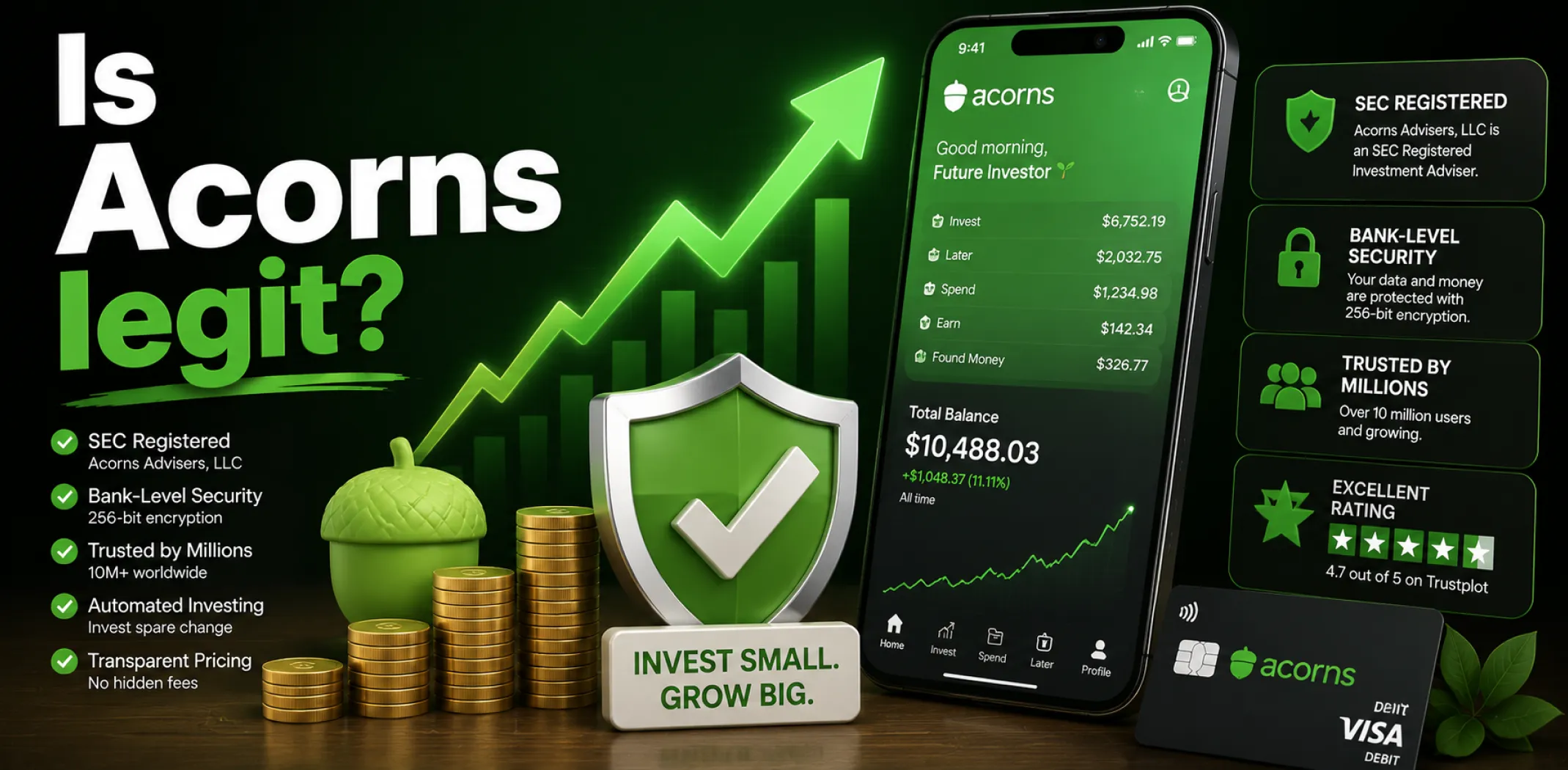
Acorns has been around long enough that the legitimacy question should be settled – but the fee structure trips up enough users that the skepticism keeps resurfacing. If you have landed here wondering whether Acorns is legit, the direct answer is yes. It is a properly regulated, SEC-registered investment platform with over 15 million people served and 26 billion dollars in assets managed.
But being legitimate does not automatically mean it is the right platform for you, and there is one specific financial risk that most positive reviews gloss over: the flat monthly fee can quietly consume a significant portion of your returns on a small portfolio. That distinction is worth understanding before you sign up.
Quick verdict
Acorns is a legitimate, SEC-registered, SIPC-insured micro-investing platform founded in 2012 with 15.5 million users and 26 billion dollars in managed assets. It is well-suited to complete beginners and hands-off investors who want automated Round-Up investing. The key caveat is that its flat monthly fee of 3 to 12 dollars can represent a very high annual cost rate on small balances – a financial reality most reviewers understate.
Key takeaways
- Acorns Advisers LLC is SEC-registered and Acorns Securities LLC is a FINRA and SIPC member – both registrations are publicly verifiable.
- The platform has served over 15.5 million people and helped them save and invest more than 26 billion dollars since its 2014 app launch.
- Monthly plans run from 3 dollars (Bronze) to 6 dollars (Silver) to 12 dollars (Gold) – and at a 500-dollar portfolio balance the top tier costs 28.8% of assets per year in fees alone.
- Acorns acquired EarlyBird in May 2025 and Zeta in June 2025, expanding its platform into family finance and couples money management.
- The most common complaints on Reddit and BBB center on cancellation difficulty and slow customer support – not fraud or missing funds.
What is Acorns and how does it work?
Acorns is an Irvine, California-based micro-investing platform founded in 2012 by Walter and Jeffrey Cruttenden, with its mobile app launching in 2014. The company is currently led by CEO Noah Kerner. In 2026, Acorns describes itself as a financial wellness system for the whole family – covering automated investing, retirement accounts, banking, and custodial accounts for children within a single app.
The signature feature is Round-Ups: every time you make a purchase on a linked debit or credit card, Acorns rounds up the transaction to the nearest dollar and holds the difference. Once accumulated round-ups reach five dollars, the amount is automatically swept into your investment portfolio.
You do not choose individual stocks or ETFs – Acorns builds and manages a diversified portfolio of low-cost ETFs based on your risk tolerance from five preset options ranging from conservative to aggressive. The Gold tier adds individual stock access, but for most users the experience is entirely hands-off.
Is Acorns legitimate? What the regulatory record shows
In 2026, Acorns has a decade-plus regulatory track record with no major enforcement actions on file. The platform operates through two distinct entities. Acorns Advisers LLC is the SEC-registered investment adviser responsible for the automated portfolio management.
Acorns Securities LLC is the SEC-registered broker-dealer and FINRA member that handles the brokerage operations. Both are searchable on public government databases today – adviserinfo.sec.gov for the adviser and FINRA BrokerCheck for the broker-dealer.
Your investment assets are held by a third party – Apex Clearing Corporation – and carry SIPC protection up to 500,000 dollars per account, including up to 250,000 dollars for cash. Cash in the Acorns Checking account is FDIC-insured up to 250,000 dollars through Lincoln Savings Bank.
The custody separation is the critical structural protection: even if Acorns as a company encountered severe financial trouble, your securities would be held by an independent custodian and returned to you, not absorbed into Acorns company assets.
The institutional backing is worth noting from a legitimacy standpoint. Acorns has raised 637 million dollars from investors including BlackRock, Wellington Management, and TPG – some of the largest and most rigorous institutional investors in the world. These firms conduct extensive due diligence before writing checks.
In 2025, Acorns also made two significant acquisitions – personal finance platform Zeta in June and family wealth app EarlyBird in May – signaling active product investment rather than a company in decline. A traditional Nasdaq IPO is also on the horizon, which would add a further layer of public financial disclosure and regulatory scrutiny. None of this is the profile of a platform cutting corners or heading toward shutdown.
What are the common complaints and red flags?
Legitimate platforms can still have real problems, and Acorns is no exception. Two recurring issues show up consistently across review platforms and are worth examining honestly before you open an account.
Common misconception:
✕ Acorns is not worth it because the returns are too small.
✓ Returns from Round-Ups alone will be modest because spare change amounts are modest. But Round-Ups are a gateway behavior, not the main engine. Users who add recurring deposits of even 25 to 50 dollars per week alongside Round-Ups see their portfolios grow meaningfully over 12 to 24 months. The expectation that spare change alone will build wealth quickly is the mismatch – not the platform.
The first documented issue is the fee structure on small balances. A Reddit user captured it bluntly in 2026: “I was paying 3 dollars a month, but my balance was only around 400 dollars. That is more than 9% annually just in fees.” That math is accurate. On a 400-dollar portfolio paying the Bronze plan, the annual fee rate is 9%.
On a 500-dollar portfolio on the Gold plan at 12 dollars per month, the annual fee rate hits 28.8%. Betterment, by contrast, charges 0.25% annually regardless of balance. Acorns discloses its fees clearly, so this is not deception – but it is a structural disadvantage for very small balances that many users do not calculate before signing up.
Important: The flat fee only makes financial sense once your balance is large enough that the monthly charge represents a reasonable annual percentage. At 3 dollars per month, that break-even point – where fees equal 1% per year – is a portfolio of 3,600 dollars. Below that level, Acorns costs proportionally more per dollar invested than percentage-fee alternatives.
The second complaint category involves cancellation and customer support. Reddit threads and BBB filings document users who found the cancellation process unclear, experienced delays in withdrawing funds after closing their account, or received slow and unhelpful support responses when something went wrong.
Acorns holds a BBB rating of A- – notably not a failure grade – and the complaints on file include company responses, which is not the behavior of a company trying to disappear. But the support quality gap is real: when things go wrong, the resolution path is slower and less transparent than users expect.
What do real users say about Acorns?
Across Trustpilot, Reddit, and the App Store, Acorns user sentiment divides cleanly. People who use it as a long-term habit-formation tool and build their balance consistently tend to be satisfied. People who expect meaningful returns on a small balance, or who need responsive support when something goes wrong, tend to be frustrated. Here are two representative scenarios from the documented user experience.
How does Acorns compare to its alternatives?
In 2026, Acorns occupies a specific niche: fully automated micro-investing with a Round-Up mechanism that no major competitor replicates as cleanly. Where it wins and where it loses depends almost entirely on your balance size and how hands-on you want to be.
The honest takeaway from the comparison: Acorns wins on automation and simplicity. It is genuinely the easiest way to start investing without making any decisions yourself. It loses on fee efficiency for small balances, tax tools, and portfolio customization.
If you want to invest spare change and never think about it, Acorns is the category leader. If you want the lowest cost route to automated investing, Betterment costs less at almost every balance below 14,400 dollars per year.
Is Acorns worth it – honest verdict
Acorns is unambiguously legitimate. It is SEC-registered, SIPC-insured, backed by 637 million dollars of institutional capital including BlackRock and Wellington, and has served over 15 million people.
The platform is actively expanding – two acquisitions in 2025 alone – and is working toward a traditional Nasdaq IPO. It has been named one of TIME magazine’s World Best Brands and consistently appears on best-app lists for 2025 and 2026. None of those things describe a platform that is cutting corners on its users.
The question worth asking is not whether Acorns is legitimate, but whether it is right for your situation. If you are a complete beginner who wants to start investing with literally spare change, has never invested before, and would not invest at all without automation making it invisible, Acorns may be the push you need.
The Round-Up mechanism genuinely works as a habit-formation tool – and once your balance climbs past a few thousand dollars with regular recurring deposits, the flat fee becomes a proportionally small cost.
If you already know you can commit to investing regularly, or if your balance will stay small for the foreseeable future, a percentage-fee platform like Betterment is almost certainly cheaper. And if you need portfolio customization, individual stock picking, or tax-loss harvesting, Acorns is not built for you at any price.
Legitimate and purpose-built for beginners – but the fee math matters
Acorns is a properly regulated, SIPC-insured platform with a decade of operation, 15.5 million users, and 26 billion dollars in managed assets. It is the most automated micro-investing experience available and genuinely useful for complete beginners who need a hands-off starting point. The single most important thing to know before signing up: the flat monthly fee of 3 to 12 dollars is disproportionately expensive on small balances – check whether your planned balance makes the fee reasonable before choosing a plan, and start with Bronze unless your portfolio is already in the thousands.
A free ecommerce store and Amazon channel – both ready from one signup
AliDropship builds your online store and delivers a full Amazon Seller Kit. No monthly subscription fee on a zero balance. No inventory, no coding, no experience needed. Start generating sales income while your investment portfolio builds.
Want to build an income stream that does not charge you monthly before you earn a cent?
One of the core frustrations with platforms like Acorns is that the fee clock starts on day one, regardless of your balance or returns. For people who are at the stage where they want to build income rather than wait for investment returns, ecommerce offers a fundamentally different model – your costs come from action, not from sitting still. AliDropship removes the infrastructure barriers so you can focus on selling from day one.
Free turnkey store – built, designed, and filled with products
Your store arrives professionally designed, pre-loaded with 50 bestselling products, and fully optimized to convert. No setup fees, no coding, no design time. You start at the product-testing stage – not the store-building stage. Hosting, SSL, and payment gateway are all included.
Winning products, one-click import
Browse trending and niche items from AliDropship’s catalog – including brand-name and digital products – and import them to your store in one click. The catalog updates regularly so your store always has fresh, competitive inventory without manual research.
Automated fulfillment and real-time tracking
Orders are processed automatically through global supplier connections. Customers receive real-time tracking updates – building trust and reducing support volume. You do not touch the shipping logistics; the platform handles it end-to-end.
Built-in marketing and promotion tools
Email campaigns, discount management, abandoned-cart recovery, live countdown timers, and social media integration are all included or available as add-ons. No prior marketing experience required – the tools guide you through each campaign type.
Beginner-friendly – no coding, no learning curve
An intuitive dashboard walks you through every step. Adding products, running campaigns, and scaling your catalog require no technical knowledge. As your business grows, the platform scales with you – adding features without adding complexity.
AliExpress integration – one-click imports, synced inventory
AliDropship connects directly to AliExpress for one-click product imports, automated order processing, and synced tracking. Inventory stays current with the latest products and prices. Combined with the turnkey store and automated fulfillment, this integration makes the entire operation manageable for one person.
Free ecommerce store – ready to sell today
Built, stocked, and launched for you. Digital and physical products included. Automated fulfillment so you never touch inventory.
Full Amazon Seller Kit – 300M buyers waiting
Product import file ready to upload. Step-by-step Amazon setup guide included. Tap into a $514B marketplace from the same free signup.
Is Acorns a legitimate investing app?
Is Acorns safe to use in 2026?
Acorns is safe from a regulatory and security standpoint. Investment accounts are SIPC-protected up to 500,000 dollars through Apex Clearing Corporation. The Acorns Checking account is FDIC-insured up to 250,000 dollars through Lincoln Savings Bank. The platform uses 256-bit encryption, two-factor authentication, and biometric login. There have been no major reported security breaches since its 2014 launch. The practical risk to be aware of is not regulatory but financial: the flat monthly fee is disproportionately expensive on small balances, and the cancellation process has generated user complaints about unclear steps and billing delays.
How does Acorns make money?
Acorns earns revenue primarily through monthly subscription fees – 3 dollars per month for Bronze, 6 dollars for Silver, and 12 dollars for Gold. These fees are charged regardless of account activity, portfolio size, or market performance. Additional revenue comes from debit card interchange fees when users spend with the Mighty Oak card, cash-back partnerships with over 450 retailers, and bank partnership fees. The subscription model is transparent but disadvantages small investors because the fee is a flat amount rather than a percentage of assets.
What are the biggest downsides of Acorns?
The two most significant downsides of Acorns are the flat monthly fee on small balances and the lack of tax-loss harvesting. On a 400-dollar portfolio, the 3-dollar monthly Bronze plan equals roughly 9% per year in fees – far above what percentage-fee competitors like Betterment charge for similar automated investing. Acorns also does not offer tax-loss harvesting on any plan, meaning users cannot offset capital gains taxes the way Betterment and Wealthfront users can. There is no human financial advisor access, and portfolio customization is extremely limited outside the Gold tier.
What are the best alternatives to Acorns?
For tax-efficient automated investing, Betterment charges 0.25% annually and includes tax-loss harvesting – significantly cheaper than Acorns for balances below 14,400 dollars. Wealthfront is a similar alternative with a 0.25% fee and stronger tax tools. For investors who want no monthly fee and a full-featured platform, Fidelity and Charles Schwab offer commission-free investing with no minimums. Stash is a close micro-investing competitor at 3 dollars per month and allows more investment choice, though it has a 75-dollar exit fee. For those looking to build active income rather than invest existing savings, the AliDropship ecommerce platform offers a free store and Amazon Seller Kit with no recurring fee on an empty account.