Get your FREE store + Amazon business!
Side hustle starter pack with a $100 welcome gift inside
Claim a free store with a head-start gift today!
Get for free

36 Years Of Watercolors In A Closet: How A Retired Mailman Turned His Hobby Into $1,420/Mo

how to sell watercolor paintings

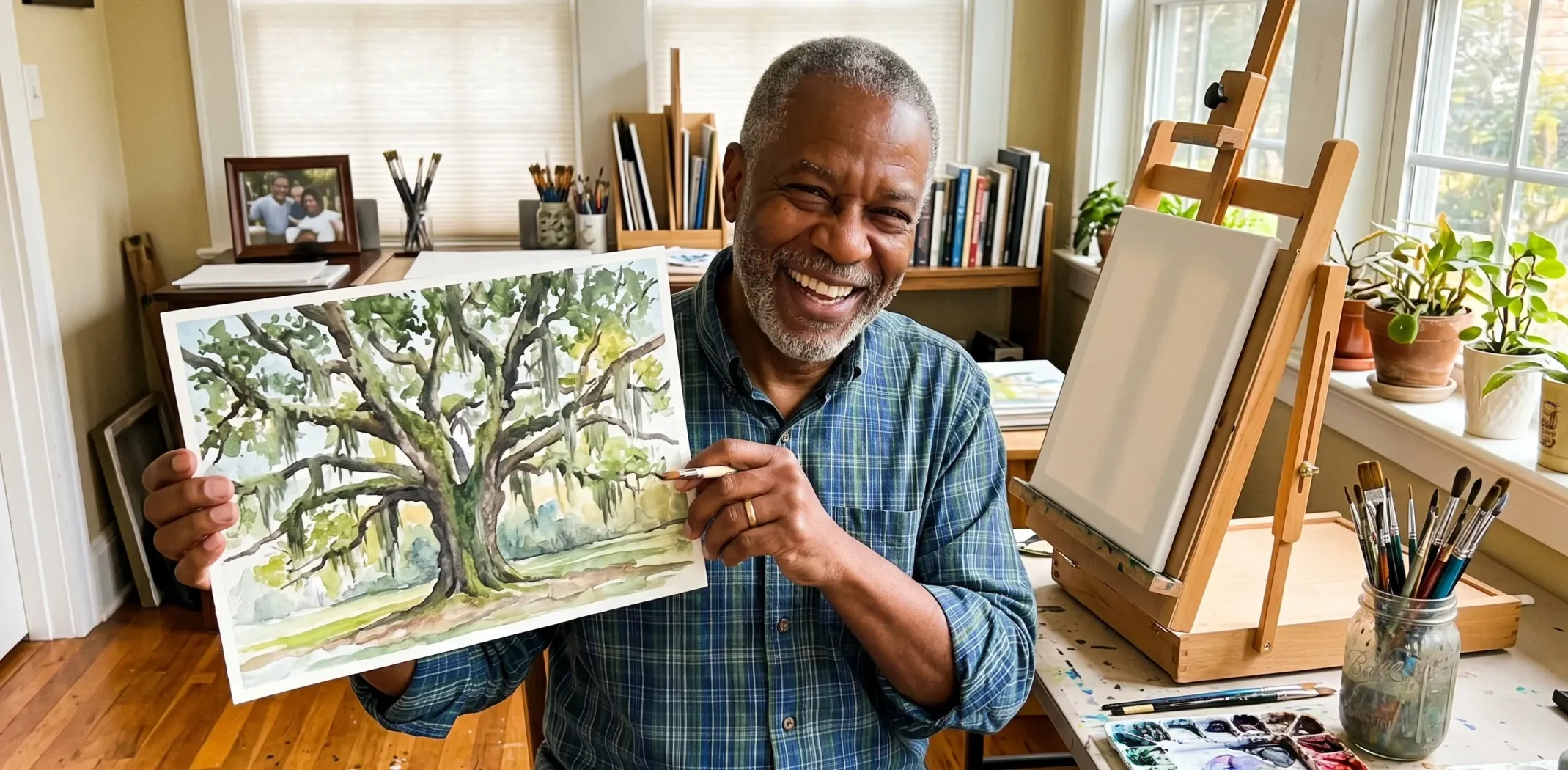
Otis Whitfield painted his first watercolor in 1988 — a Mavis-bought starter set, a Sunday afternoon, a small dogwood. He painted nearly every Sunday for the next 36 years. Two hundred and forty finished pieces ended up in a spare-room closet because his wife’s friends kept saying “you should sell these” and he kept saying he was a postal carrier, not an artist. Last September his daughter Janelle drove down from Charlotte, opened the closet, and paid $24 for the Roadmap before he could finish saying no. Six months later $1,420 lands in his checking every month, and his eight-year-old granddaughter’s piano lessons are paid for by southern oak trees.

Most articles on how to sell watercolor paintings assume you are a 32-year-old illustrator with an Instagram following. Otis is 67, retired from a Decatur postal route after 38 years, and his version of “online” is video-calling Janelle on Sunday nights. The Roadmap had to start with what he actually had — the closet, the Saturdays, the sunroom — or it wasn’t going to start.

Mavis bought him the starter set for his 31st birthday. She painted in oils — her work still hangs in the dining room. Otis painted in watercolor on Sunday afternoons after church, then Saturdays too after retirement in 2022. The two of them turned the spare bedroom into a studio in 1991 and never stopped. After Mavis passed eighteen months ago, Otis kept painting because it was the room she was in. The Roadmap turned out to be the way to honor that.

Why most retiree-hobby income guides skip the part Otis actually needed

The internet has plenty of advice for “starting an art business.” Most of it assumes you are 28, have a studio in Brooklyn, and own a ring light. Otis is 67, has a sunroom, owns a 1956 craftsman, and has never opened TikTok in his life. The mismatch is why three Saturdays of his life had gotten spent trying to set up a website that he abandoned at the password reset.

42%
of US retirees say they have a hobby that could earn money but never have (AARP 2024)
$1,180
median monthly earnings from a hobby business among retirees over 60 (Etsy seller data, 2023)
240+
average number of finished pieces a 30-year hobbyist has stored at home, unsold (Craft Industry Alliance, 2024)

Those numbers describe the whole retiree-craft economy. The third one is the one that does Otis’s talking: he had 240 finished pieces in a closet. He did not need a new skill. He needed someone to look at his closet and rank what was in it.

Expert tips:
The mistake most hobby-to-income articles make is starting with a website. The starting point is your inventory and your Saturdays. The Roadmap audits both first, then ranks 3–5 channels by which one pays back fastest with the energy you actually have. Hobby-to-Income Roadmap gave Otis a market booth before it ever mentioned the word "website."

Otis did not need a new skill. He needed permission to look at his closet as a small business that already existed.

sell art at farmers market

Otis is 67. He drove a Decatur USPS route for 38 years — the same loop, every weekday, until December 2022. He knew which mailbox flag was always flipped wrong on Glenwood Avenue. He retired with the pension, paid off the mortgage in 2019, and figured the next twenty years would be Saturdays at the easel. He had not figured out the Saturdays were a business.

Janelle drove down the second Saturday in September. She is 38, an ICU nurse in Charlotte, married to David, mother to Imani (8) who started piano lessons in August. Janelle opened the studio closet, counted out loud to forty-two before she stopped, and said “Daddy. This is a small business in a closet.” She showed him the Roadmap on her phone over coffee Sunday morning. He said no — he was a postal carrier, not an artist. She paid the $24 anyway and emailed him the link before she got back on I-85.

What Otis tried first — and why none of it worked

Before the Roadmap, here is what was sitting in Otis’s “I should sell those” bookmark folder:

2023

Etsy attempt — abandoned

Otis uploaded four prints with vague titles (“watercolor painting medium size”), no keywords, no shop banner. Sold one to his neighbor. Closed the shop after Mavis passed.

2024

Three Saturdays building a website

Wix, then WordPress, then back to Wix. He abandoned the third Saturday at the password-reset screen and never went back. Spent $87 on a domain that still points to nowhere.

2024

Three friends saying “just sell them”

Helpful as a hug, useless as a plan. None of them knew the difference between a $20 print, a $120 framed original, or a $340 custom commission. The advice stopped at the bookmark folder.

Every option assumed he was someone he wasn’t — someone with the patience for a Shopify setup, someone with a Saturday to spare for a webinar, someone with an audience already waiting. None of it said: the 240 pieces in your closet are inventory, your sunroom is a workshop space, and your Saturdays already have a Decatur farmers’ market two miles from your house.

watercolor workshop pricing

That gap is where Otis sat the Monday after Janelle drove home. He opened her email, paid the $24 himself this time (Janelle had paid, but he wanted to start over), and clicked through the right hobby-to-income map with a cup of coffee at 8:14 a.m.

The Roadmap asked me eight questions. Three of them I’d never been asked by anybody. How many finished pieces do you have on hand? How many hours can you give it in a week? Are you comfortable selling face to face or only online? Those three turned my closet into a list of options I could actually rank.

The 4 channels the Roadmap returned for Otis’s real life

Fourteen minutes later, Otis had a ranked list of four channels — not advice, not options, an order. Each channel came with a projected monthly range, a setup cost, and the first thing to do this Saturday.

Hobby-to-Income Roadmap · Otis’s 4-Channel MapRanked by effort-to-income

CHANNEL01
Decatur farmers’ market booth

3 hours a Saturday, $20 booth fee, 240 prints already framed and matted from the closet. Bring 30 prints + one easel + one folding table. Cash plus Square.

$320–$680/mo

CHANNEL02
Etsy print shop with the right keywords

Roadmap pulled real Etsy search data: “southern oak watercolor,” “Atlanta church painting,” “Spanish moss art print.” Otis listed 26 of his strongest prints with the keyword-optimized titles.

$180–$520/mo

CHANNEL03
Custom-commission backlog

People who knew Otis painted had been quietly asking for years. The Roadmap gave him a pricing calculator (size, complexity, framing) and a one-page intake form. Three commissions waiting before he even announced he was open.

$400–$1,200/mo

CHANNEL04
Saturday watercolor workshops

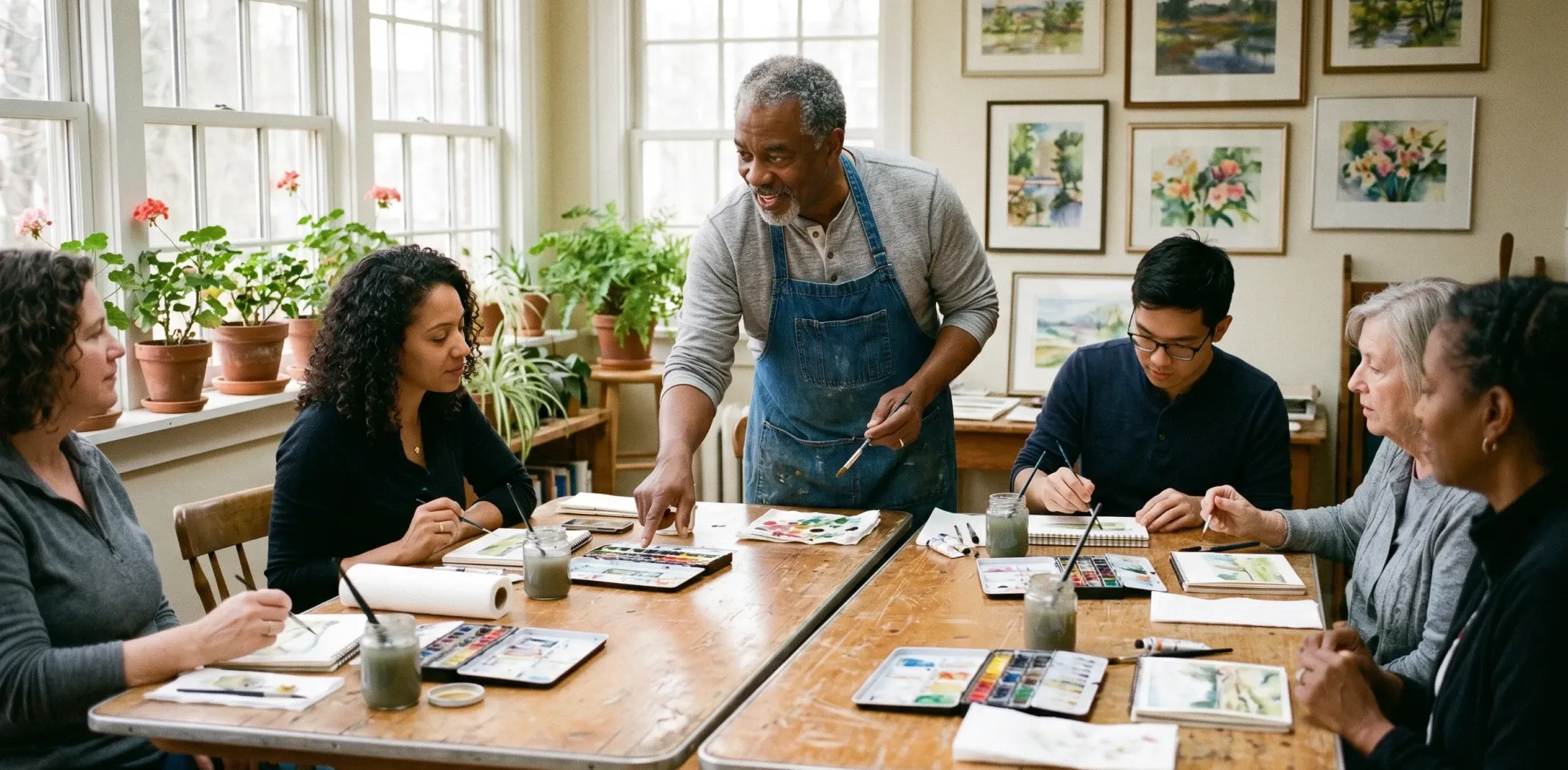
4 students per session, $75 each, in his sunroom. Quarterly cadence so it stays an event, not a chore. Roadmap included the syllabus skeleton from 14 other artists’ workshops.

$300/mo

The thing I needed wasn’t energy. I had Saturdays. I needed somebody to tell me which Saturday went where. The Roadmap put the market booth first because that’s where my inventory could move tomorrow, not in three months after I learned a website. Mavis would have said the same thing.

Hobby-to-Income Roadmap
42% of retirees say a hobby could earn money but never have. Usually because nobody told them which Saturday to start.

The closet is a small business. The Roadmap tells you which channel ships first.

Answer eight short questions about your hobby, your finished inventory, your Saturdays, and your comfort with online vs in-person. Get 3–5 ranked channels with setup cost, payback projection, and a 6-month sequence.

An art-business coach charges $180+/hr

$24

Map My Channels →

One-time · Instant access · 30-day refund · Unlimited re-runs

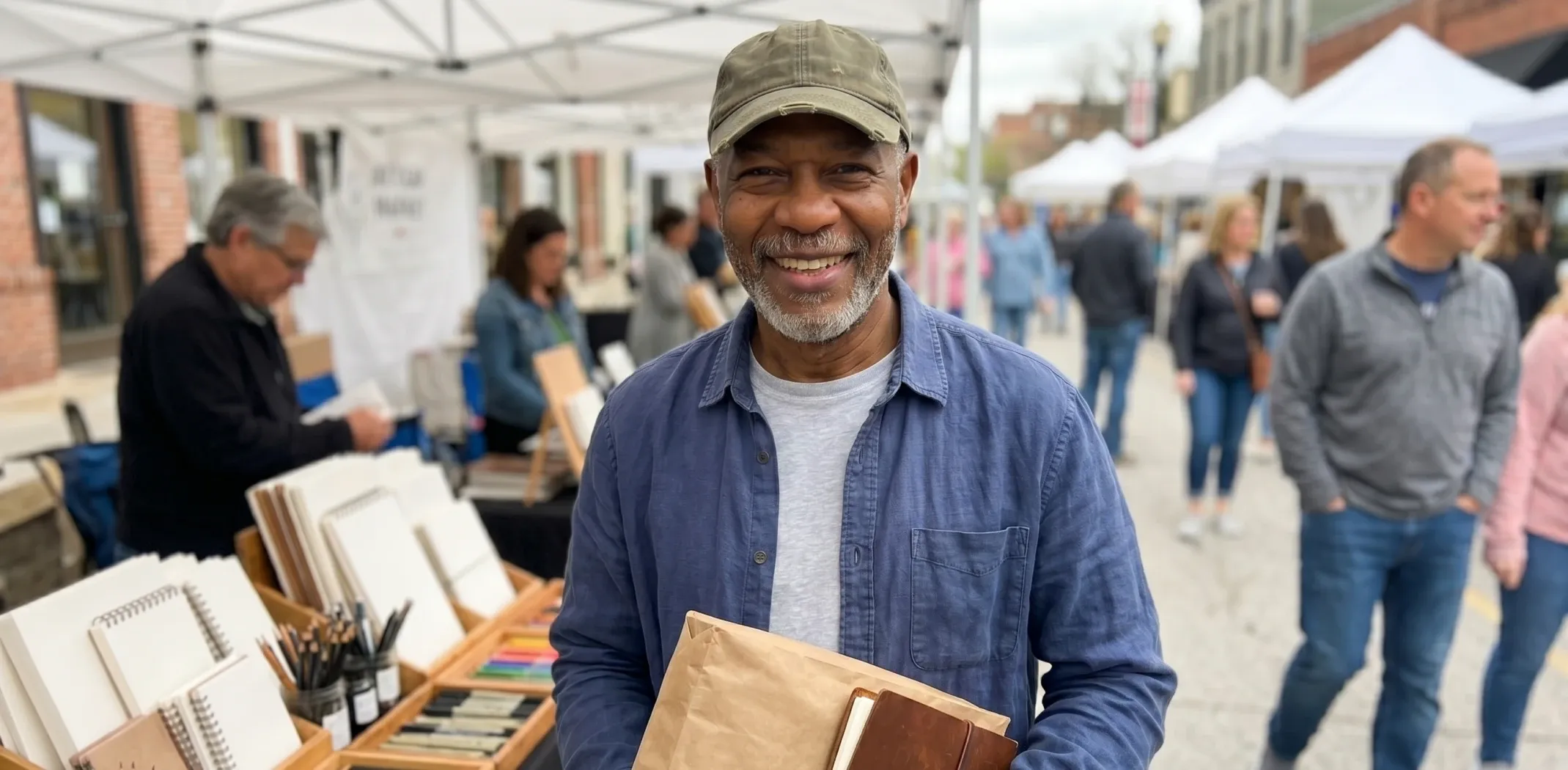
Saturday morning, two weeks after Janelle’s visit, Otis set up his first booth at the Decatur Square farmers’ market. He brought thirty prints, one folding table, two easels he made in his garage, and a coffee. He sold $187 by 1 p.m. The Spanish-moss church print went first to a woman from Inman Park who said her mother had grown up next to that church.

The 6-month timeline: $187 first Saturday to $1,420/mo

Otis launched the four channels in order, one at a time, the way the Roadmap sequenced them. Here is the actual ribbon — six months from his first Saturday booth.

MONTHLY TOTAL · 6-MONTH RIBBON

Month 1
$320
market booth only

Month 2
$610
Etsy live (Day 21)

Month 3
$890
first commission

Month 4
$1,140
first workshop

Month 5
$1,310
3 commissions queued

Month 6
$1,420
all 4 channels live

Imani’s piano lessons ($168/mo) paid from Channel 1 alone by Month 2.

The Coast trip Otis booked in Month 5 was paid from Channel 3.

Otis did not keep the Roadmap to himself either. In month two he told his neighbor Earl, a retired auto mechanic whose garage is full of hand-restored bicycle frames. Earl ran the Roadmap on his bicycle inventory and now sells two restorations a month at a Doraville flea market. In month four Janelle put the link in her nurses’ Facebook group; an oncology nurse named Patrice ran it on her quilting hobby and made $1,100 in her first quarter at three Charlotte craft fairs.

The Saturday I booked the coast trip, I sat at the kitchen table and told Mavis. Out loud. The dog gave me a look. I said yes, I know how that sounds. But she would have liked this.

Why most retirees never turn a hobby into income — and what fixes it

Forty-two percent of US retirees say they have a hobby that could earn money but never have. It is not laziness, and it is not the hobby. The advice on the internet is written for 28-year-old illustrators, not 67-year-old letter carriers. The Roadmap fixes the mismatch by starting where the retiree already is — with the inventory and the Saturdays they already own.

Option
Cost
Time to first $
Uses your inventory?
Art-business coach
$180+/hr
Weeks of sessions
Sometimes
DIY Shopify site setup
$29/mo + Otis’s 3 lost Saturdays
Never (he gave up)
Could, never did
Generic “art business” Skillshare course
$32/mo
6 weeks of video
No – teaches generic
Hobby-to-Income Roadmap
$24
~14 minutes → first Saturday
✔ Yes – audits your inventory first

The free options are not bad. They just assume a younger, more online-fluent person with no inventory and a clean Saturday. Otis had the opposite of all three.

🤔

What if my hobby is brand-new — I only have a few finished pieces?

The Roadmap re-ranks based on inventory size. If you have under 30 finished pieces, it pushes you toward commission-first or workshop-first channels (where you build to order) and parks the market-booth strategy until you have inventory. If you have 240 finished pieces like Otis, it does the opposite. The point is the audit fits the inventory, not the other way around.

How other retired hobbyists used the same Roadmap

Otis is not unusual. Retired hobbyists across crafts are quietly running the same channel audit and walking out of their first paying Saturday.

retired ceramics hobby income

Linda C.

retired schoolteacher · Phoenix AZ · pottery 30 years

★★★★★

“I stopped counting at 380 mugs. The Roadmap was the first thing that asked me how many finished pieces I had. Three channels – spring festival booth, Etsy, monthly throw-along workshops at the local clay co-op. First quarter total: $890/month. From mugs that had been on a shelf since the Bush administration.”

retired woodworking hobby income

Tom B.

retired engineer · Milwaukee WI · woodworking 25 years

★★★★★

“A neighbor told me to put bowls on Etsy. The Roadmap looked at my numbers and said no – high-margin commissions plus one quarterly workshop. The workshop alone (one Saturday a quarter, six people, $150 each) covers my property tax. Month six total: $2,100. From a garage I had been calling ‘the shop’ for twenty-five years.”

ALSO INCLUDED

Beyond the channel-ranking – Hobby-to-Income Roadmap also includes a custom-commission pricing calculator (size + complexity + framing), the platform tool-stack list per channel, a starter content templates pack for Etsy listings, a 6-month launch sequence, and unlimited re-runs as your inventory and capacity change.

Whether your hobby is 240 watercolors like Otis, 380 ceramic mugs like Linda, or 25 years of hand-turned bowls like Tom – the audit applies the same way. Inventory first. Channels second. Saturdays slot in third. Your hobby was already a small business; the Roadmap is the spreadsheet that proves it.

Your 5-step weekend playbook — the order that actually works

If you are where Otis was last September – a closet full of finished work, three friends saying “you should sell those,” and no clear next move – here is the playbook the Roadmap walks you through:

1

Count the closet before opening the laptop

How many finished, sellable pieces do you actually have? Otis had 240. Linda had 380. Tom had 60 bowls plus a backlog of slabs. The inventory is the input the Roadmap weights every other decision against.

2

Be honest about your Saturdays

A market booth needs 3–5 hours of standing. A workshop needs 4 hours of teaching. Etsy needs 2 hours a week of admin. The Roadmap matches channels to the energy you actually have, not the energy a 28-year-old has.

3

Pick one channel, not three

The biggest mistake retired hobbyists make is launching three channels in week one. Otis launched only the farmers’ market in month one. Etsy in month two. Commissions in month three. The order is the product.

4

Price your commissions with a formula, not a guess

Otis’s commission calculator: base size price + complexity multiplier + framing fee. His first commission was a 16×20 backyard scene at $340. The formula stopped the under-pricing reflex retirees fall into.

5

Re-run the Roadmap every quarter

Your inventory shifts. Your energy shifts. New marketplaces emerge. Otis re-ran it on day 90 and added the workshop. The re-run is what turned $610/mo into $1,420/mo.

Otis did not have any of the typical advantages – no instagram following, no graphic design degree, no studio in Brooklyn. He had a sunroom, a closet, a Saturday, and the willingness to count what was already in front of him. That was enough.

⚠ Most retiree hobbyists have a small business in a closet and don’t know it

The closet is the inventory. The Roadmap is the order.

Map the four channels your Saturdays can already carry.

Eight short questions. 3–5 ranked channels. Setup cost, payback projection, and the first thing to do this Saturday.

An art-business coach charges $180+/hr

$24

Map My Channels →

One-time payment · Unlimited re-runs · Instant access

✔ 30-day money-back guarantee

Map your own hobby into paying channels – the same Roadmap Otis used to turn 36 years of closet inventory into $1,420/mo across four Saturdays.

MAP MY CHANNELS

FAQ

How to sell watercolor paintings as a beginner?

Start with the inventory you already have, not a brand-new piece. List 10–30 of your strongest finished watercolors with keyword-optimized Etsy titles (location + subject + medium), book one farmers’-market booth for $20, and price prints at $20 and originals at $80–$240 by size. The Hobby-to-Income Roadmap audits your real inventory and ranks the channels you should launch in order.

What are the best ways to make money from a hobby in retirement?

Three reliably work: in-person markets (lowest barrier, fastest cash), Etsy/Creative Market shops (slowest start, best long-term passive), and custom commissions priced with a formula. Workshops slot in after you have at least one channel live. The Roadmap ranks them against your specific inventory size, your hours per week, and your comfort with online vs in-person selling.

Can you sell art at farmers markets without a license?

Most farmers’ markets require a $15–$45 booth fee and a state sales-tax registration, but no formal artist license. Some require a craft-fair vendor permit. Otis paid Georgia’s $10 sales-tax registration and $20 per Saturday for the Decatur Square booth. The Roadmap pulls your state’s specific requirements and the closest 3 markets to your zip code.

How do you price custom watercolor commissions?

A reliable formula: base price by size (8x10 = $80, 11x14 = $140, 16x20 = $260, 18x24 = $380) + complexity multiplier (1.0 simple, 1.3 medium, 1.6 complex multi-figure) + framing fee ($45 standard, $90 premium). Otis’s first commission was a 16x20 backyard scene at $340 after the formula. The Roadmap includes the calculator with your local-market price benchmarks.

Is Etsy still worth it for selling watercolors in 2026?

Yes, with caveats. Etsy is more crowded than 2021, but niche keywords still rank reliably – especially location-specific ones ("Atlanta watercolor," "Charleston church print," "Sonoma vineyard art"). Generic "watercolor flowers" listings disappear under saturation. The Roadmap pulls real Etsy search-data and matches your inventory to under-served keyword niches.

Why do most retired artists never sell their work?

Three reasons: (1) the inventory feels too personal to price, (2) the online platforms feel built for someone twenty years younger, (3) friends and family say "just sell them" without ever showing the order. The Roadmap was built around exactly those three friction points – the audit reframes inventory as catalog, ranks low-tech channels first, and gives you the order your friends could not.
avatar
By Addison Mitchell
With a background in advertising and PR, Adisson has a sharp eye for what makes a story land and how people actually make decisions. She specializes in turning real customer experiences into articles that show readers what's possible when they find the right tool at the right time.
×