How To Make Money With AI: A Complete Practical Guide


Artificial intelligence, or AI, is everywhere now. It’s not just a science-fiction idea anymore. From tools that help you write emails faster to software that can generate images, videos, or even code, AI is already changing how people work. But here’s the real question: how to make money with AI?
Many people think AI is just for big companies or tech experts. That’s not true. In fact, everyday people like freelancers, creators, and small business owners are already using AI to earn money. The trick is knowing how to use it smartly, not just letting it “do everything.”

The wide range of opportunities given by AI
AI isn’t just a buzzword – it’s a game-changing business tool that’s transforming industries everywhere. According to Fortune Business Insights, the global AI market is projected to reach $1,771.62 billion by 2032, growing at a strong CAGR of 29.2%.
This rapid growth shows that businesses of all sizes are increasingly adopting AI to save time, cut costs, and improve outcomes. For individuals who understand how to make money with AI, this expanding market presents real opportunities to create value – and build scalable income streams in 2026 and beyond.
For example, AI is being used in marketing, design, content creation, customer support, and ecommerce. Each of these areas offers opportunities for individuals to monetize their skills. You might help a small business automate their social media, create AI-generated artwork for a client, or build tools that save companies hours of work each week.
Importantly, AI doesn’t just replace human effort – it amplifies it. If you’re already skilled in writing, design, or business, AI can help you produce more work faster, handle repetitive tasks, and scale your income. Even beginners can start small with low-risk AI tools. Later in this article, we’ll explore both beginner-friendly and advanced strategies, so you can pick the approach that fits your goals.
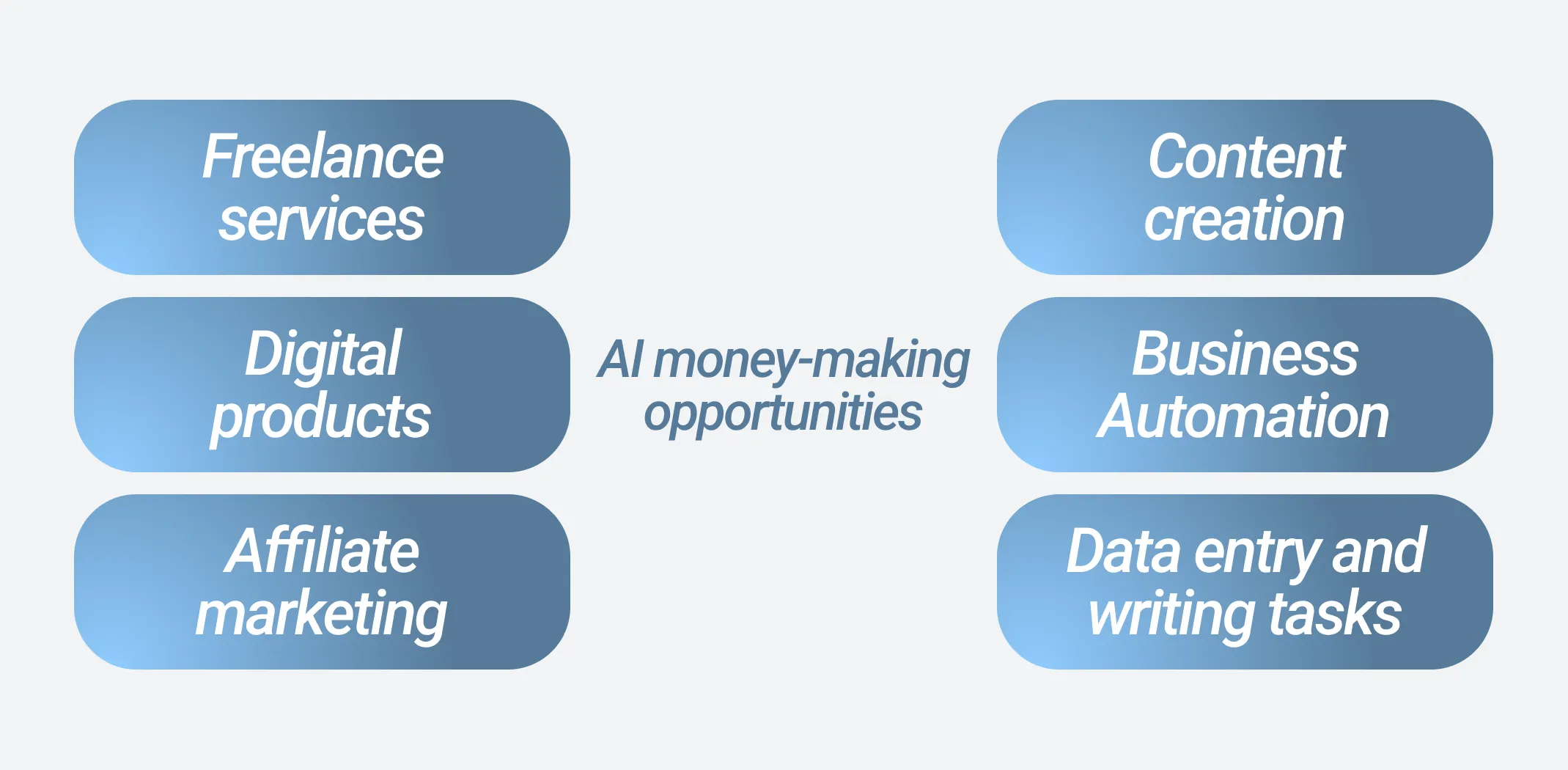
Common AI money-making paths
There are many approaches to how to make money with AI, but most successful strategies fall into a few clear categories. These include AI-enhanced freelance services, content creation, digital products, and business automation – all of which allow you to earn more by working smarter, not longer.
Freelance services enhanced by AI
Freelance services enhanced by AI are ideal for people who already have a skill – or are willing to develop one – and want to increase their income without working more hours. This path sits between beginner task-based work and full-scale entrepreneurship. You still sell your time and expertise, but AI allows you to deliver results faster, handle more clients, and offer higher-value services.
Instead of replacing your role, AI acts as a productivity multiplier. It takes care of repetitive or time-consuming steps, so you can focus on strategy, creativity, and client relationships.
What AI changes in freelancing
Traditional freelancing often limits income because time is fixed. You can only work so many hours per day. AI changes this by speeding up research, drafting, design, and analysis. As a result, tasks that once took hours can now be completed in minutes.
This efficiency lets you:
- Take on more clients without burnout
- Increase project speed and turnaround time
- Move up the value chain by offering strategy, consulting, or optimization
Over time, freelancers who use AI effectively become more competitive and can justify higher rates.
Practical examples
Here are common freelance services where AI adds immediate value:
- AI-assisted graphic design
Tools like Canva AI, DALL·E, and MidJourney help you generate design concepts, visuals, and social media assets quickly. Instead of starting from a blank canvas, you refine AI-generated ideas, which significantly shortens project timelines.
- Copywriting and content creation
Platforms such as ChatGPT, Jasper, and Writesonic help draft blog posts, landing pages, emails, and ad copy. You guide the tone and structure, while AI handles the initial draft. This allows you to focus on messaging, persuasion, and brand voice. - Social media management
AI-powered tools like Lately.ai or Buffer’s AI Assistant help with caption generation, scheduling, and performance analysis. You can manage multiple accounts efficiently while still providing tailored content strategies for each client.
These examples show how AI supports different creative and marketing skills without removing the human element clients value.
Workflow tips
To get the most out of AI in freelancing, structure your workflow carefully.
Use AI for first drafts, research, and variations, then apply your expertise during review and refinement. Batch similar tasks – such as writing multiple posts or designing several visuals at once – to maximize efficiency. Keep learning new AI features and tools, as staying updated allows you to offer more advanced solutions and stand out from competitors.
Clear communication with clients is also essential. Explain how AI improves speed and quality while assuring them that you maintain full oversight and responsibility.
Potential earnings
AI-enhanced freelancers often earn more by working smarter, not longer. Beginners can realistically make $500–$2,000 per month with part-time freelance work. As you gain experience and specialize, monthly income can grow to $5,000–$10,000 or more, especially if you offer high-value services like strategy, optimization, or consulting.
Freelancing with AI gives you flexibility, scalability, and faster growth compared to traditional freelancing. However, it’s still time-based. For those who want to reduce time dependency further, the next path – content creation – shows how AI can help you build assets that earn beyond individual client projects.
Content creation (YouTube, blogs, socials)
Content creation is one of the most popular ways to make money with AI because it combines creativity, scalability, and multiple income streams. Unlike freelancing, where you’re paid per project or hour, content creation allows you to build assets – videos, articles, or posts – that can continue generating income over time. AI makes this process faster and more manageable, even if you’re starting from scratch.
Instead of spending hours planning, writing, and editing, AI helps you focus on ideas, consistency, and audience growth. Over time, this creates a foundation for long-term monetization.
Why AI works so well for content creation
Creating content consistently is one of the biggest challenges for creators. AI reduces this friction by handling research, drafting, and optimization. This means you can publish more often without sacrificing quality.
AI also helps you adapt content for different platforms. One idea can become a YouTube video, a blog post, and several social media updates. This multiplies your reach while keeping your workload under control.
Core content formats and how AI supports them
To understand how content creation turns into income, it helps to look at each major format and the role AI plays.
YouTube
AI can support nearly every stage of video creation. It can generate structured scripts, suggest engaging titles, and write SEO-friendly descriptions. AI tools also help create captions and subtitles, improving accessibility and watch time.
Some tools, such as Pictory, turn text into edited videos with visuals and music, while others like Synthesia allow you to create AI voiceovers or presenters. These tools lower the technical barrier, making YouTube accessible even to beginners.
Blogs
AI simplifies writing by drafting articles, suggesting topics based on search demand, and optimizing headlines and structure for SEO. Tools like ChatGPT or Jasper can generate long-form drafts quickly, which you then refine with personal insights and examples.
AI can also help with internal linking, meta descriptions, and keyword placement, improving the chances of ranking in search engines. Over time, blog content can bring consistent traffic and passive income.
Social media
Managing multiple platforms manually is time-consuming. AI helps by generating post ideas, captions, hashtags, and even full content calendars. Some tools analyze engagement data and suggest optimal posting times.

By automating planning and drafting, you can focus on interacting with your audience and testing new formats instead of constantly creating from scratch.
How content creation actually makes money
Content itself doesn’t pay – you monetize the audience it attracts. AI helps you grow that audience faster, but income comes from clear monetization paths:
- Ads: YouTube ads or display ads on blogs generate revenue as traffic grows.
- Affiliate marketing: Promote relevant products within your content and earn commissions.
- Sponsorships: Brands pay creators with engaged audiences to feature products or services.
- Product sales: Sell digital products, courses, or services directly to your audience.
Many creators combine these methods, starting with ads or affiliates and later adding their own products for higher margins.
Workflow tips
To stay consistent, batch content creation whenever possible. Use AI to draft multiple scripts or posts at once. Repurpose content across platforms to maximize reach – for example, turn a blog post into short social videos.
Track performance using analytics tools. AI insights can help identify what topics and formats perform best, allowing you to refine your strategy over time.
Potential earnings
Income from content creation varies widely. Beginners may earn $100–$500 per month at first. As audiences grow, creators often reach $2,000–$10,000+ per month through combined monetization strategies. Because content compounds over time, earnings often increase without a matching increase in workload.
Content creation sits between freelancing and product-based income. Once your audience is established, the next logical step is creating digital products or automated systems that further scale your income – topics we’ll explore in the next section.
Product and automation ideas
Creating products or automating business processes is another way AI can generate income. Unlike freelance work, this path can create passive or semi-passive income, which scales beyond the hours you put in.
AI-generated digital products
AI-generated digital products are one of the most scalable ways to make money with AI. Unlike freelancing, where income is tied to time, digital products can be created once and sold repeatedly. AI significantly reduces the effort required to create, design, and package these products, making this path accessible even to beginners.
Instead of manually producing every asset, AI helps you focus on identifying demand, refining quality, and scaling distribution. Over time, this creates semi-passive income streams that grow without proportional increases in workload.
Why AI is ideal for digital products
Digital products succeed when they solve specific problems efficiently. AI excels at content generation, variation, and iteration – three key factors in building products quickly and testing what sells.
AI also allows you to produce multiple product versions for different niches or audiences. This flexibility helps you validate ideas faster and expand your product catalog without starting from zero each time.
Common types of AI-generated digital products
AI can support many product formats, but the most profitable ones usually fall into these categories:
Ebooks, guides, and templates
AI tools like ChatGPT or Jasper can draft structured ebooks, step-by-step guides, and reusable templates in a fraction of the usual time. Whether it’s a niche how-to guide, business checklist, or productivity template, AI handles the bulk creation while you refine tone, accuracy, and personalization.
This allows you to publish consistently and respond quickly to trends or audience needs without sacrificing quality.
AI-generated art, music, and stock media
Visual and audio assets are in constant demand. Tools like DALL·E, MidJourney, or Soundraw enable you to create unique images, illustrations, background music, or stock assets.
These products perform well on marketplaces where buyers want ready-to-use content for marketing, websites, or social media. By focusing on specific styles or niches, you can stand out even in competitive marketplaces.
Custom AI chatbots and tools
Beyond static products, AI enables interactive digital solutions. Custom chatbots for customer support, lead generation, or internal business use can be packaged and sold as standalone products or subscription-based services.
This approach works especially well when combined with ongoing support, updates, or customization, creating recurring revenue instead of one-time sales.
Where to sell your AI-generated products
Choosing the right platform is critical for visibility and sales:
- Etsy & Creative Market: Best for templates, digital art, and creative assets with built-in buyer demand.
- Gumroad: Ideal for ebooks, guides, and educational content with flexible pricing and simple setup.
- Patreon: Suited for creators offering ongoing access to exclusive AI-generated content or tools.
Rather than trying to sell everywhere, it’s often better to start with one platform, validate demand, and expand once you see traction.
Positioning and monetization tips
Focus on clear niches with specific pain points. Buyers don’t pay for “AI-generated content” – they pay for solutions that save time or improve results. Emphasize usability, clarity, and outcomes rather than the technology itself.
Bundle products, offer tiered pricing, or provide bonuses to increase average order value. Over time, this turns simple products into reliable income streams.
Potential earnings
Beginners can realistically earn $200–$2,000 per month with a small but focused product catalog. Creators who consistently release niche products and refine their positioning often scale to $10,000+ per month. Because delivery is automated, income can grow without increasing workload.
Automation for businesses
While digital products scale through repeat sales, automation for businesses generates income by delivering direct, measurable value. Instead of selling assets, you sell outcomes – time saved, leads generated, and processes optimized. AI-powered automation is especially attractive to businesses because it reduces costs while improving efficiency.
This path works well for individuals who enjoy problem-solving and working with clients, without needing advanced programming skills.
Why businesses pay for AI automation
Most small and medium-sized businesses know AI can help – but they lack the time or expertise to implement it. This gap creates opportunity. By setting up and managing AI-driven workflows, you become the bridge between technology and real-world results.
Businesses are often willing to pay monthly retainers because automation delivers ongoing benefits rather than one-time fixes.
Common automation use cases
AI automation usually focuses on repetitive, high-impact business processes:
Email marketing and campaign automation
AI tools like HubSpot, Mailchimp, or ActiveCampaign can generate personalized emails, segment audiences, and optimize send times. By setting up these systems, you help businesses maintain consistent communication without manual effort.
You can charge for setup, optimization, and ongoing management.
Sales funnels and workflow automation
Tools like Zapier, Make, and ClickFunnels allow you to automate lead capture, follow-ups, and conversions. These workflows guide prospects from first contact to purchase without constant human involvement.
Businesses value this because it directly impacts revenue, making it easier to justify premium pricing.
Customer support and chatbots
AI chatbots such as ManyChat or Tidio provide instant responses to customer inquiries, reducing wait times and support workload. You can design, deploy, and maintain these bots, offering updates and analytics as part of a monthly service.
Platforms that power automation services
Each tool plays a specific role in the automation ecosystem:
- Zapier & Make: Connect apps and automate backend workflows.
- HubSpot & ActiveCampaign: Manage CRM, email marketing, and lead nurturing.
- ManyChat & Tidio: Handle AI-driven customer communication and engagement.
Using the right tools allows you to deliver professional, scalable solutions without building systems from scratch.
Positioning and client acquisition tips
Focus on small and medium-sized businesses that don’t have internal automation teams. Position your services around outcomes – hours saved, response times reduced, or leads increased – rather than technical features.
Bundling automation with other services like AI-generated content or analytics increases perceived value and monthly retainers.
Potential earnings
Automation services typically command higher pricing. You can charge $500–$2,000 per client per month, depending on complexity. With just a few long-term clients, this model can generate stable, predictable income while AI handles most of the execution.
Low-skill/beginner-friendly routes
Not everyone wants to start with complex systems or advanced tools. Fortunately, learning how to make money with AI doesn’t require technical expertise. Many beginner-friendly paths use simple AI tools to increase productivity and generate income with minimal setup.
AI-assisted affiliate marketing
AI-assisted affiliate marketing is one of the easiest and safest ways for beginners to start making money with AI. You don’t need to create your own products, handle customer support, or manage deliveries. Instead, you promote existing products or services and earn a commission every time someone makes a purchase through your unique affiliate link.
In simple terms, affiliate marketing works like this: a company gives you a special link, you share that link through content, and when someone buys, you get paid. AI makes this process faster, smarter, and much easier to scale, even if you have no prior marketing experience.
What AI-assisted affiliate marketing looks like in practice
Without AI, affiliate marketing can feel slow and overwhelming. You have to research products, write content, optimize for search engines, and test what works. With AI, many of these steps are simplified or automated.
For example, AI can help you research profitable niches by analyzing search trends and audience interests. It can also generate blog posts, product reviews, comparison articles, and social media captions in minutes instead of hours. AI tools can even help personalize content so it matches what different audiences are searching for, which increases the chances of earning commissions.
Because of this, affiliate marketing becomes less about manual work and more about smart strategy and consistency.
Practical examples
There are many ways beginners use AI to support affiliate marketing:
- AI-generated blogs and review articles
Tools like ChatGPT or Jasper can draft product reviews, “best of” lists, and comparison posts. You then add your affiliate links, adjust the tone, and optimize the content for SEO. Over time, these articles can bring in passive traffic from search engines. - YouTube scripts and video descriptions
AI can write video scripts, outline talking points, and generate SEO-friendly descriptions. This allows you to create product review videos or tutorials faster, even if you’re new to video content. - Email marketing campaigns
Platforms like Mailchimp or ConvertKit use AI to write email sequences, subject lines, and calls to action. These emails can promote affiliate products to your audience in a natural, helpful way.
- Social media promotions
AI tools generate captions, hashtags, and posting ideas for platforms like Instagram, TikTok, or Pinterest. This helps you stay consistent without constantly brainstorming new content.
Each of these methods works on its own, but many successful affiliates combine several channels to increase reach and income.
Common affiliate platforms and networks
Once you understand how affiliate marketing works, the next step is choosing where to find products to promote. Many platforms are beginner-friendly and free to join.
- Amazon Associates
One of the most popular affiliate programs. You can promote almost any physical product, making it ideal for beginners. Commissions are smaller, but conversion rates are often high.
- Awin
A large network offering products across many niches, including software, fashion, and online services. It’s useful if you want more variety and higher commission options. - ClickBank
Best known for digital products like courses and ebooks. Commissions are often higher, but product quality varies, so research is important. - SaaS and AI tools
Many AI platforms offer affiliate programs with recurring commissions. Promoting tools you already use can feel more authentic and profitable over time.
Choosing the right platform depends on your niche, audience, and preferred content format.
Workflow tips for beginners
To make affiliate marketing work long-term, structure and consistency matter.
Use AI to research trending products and keywords before creating content. This increases your chances of ranking and converting. Automate repetitive tasks such as publishing schedules, email campaigns, or social posts, so you can focus on strategy instead of manual work.
Track performance regularly using analytics tools. AI insights can show which content converts best, allowing you to improve future campaigns. Most importantly, always review and refine AI-generated content. Authenticity builds trust, and trust drives commissions.
Potential earnings
Affiliate marketing income varies widely. Beginners often earn $50–$500 per month as they learn and build content. With consistent effort and AI-powered workflows, many marketers reach $1,000–$3,000 per month within a year. Some niche-focused affiliates scale well beyond that by combining SEO, email marketing, and social platforms.
Because affiliate content can continue earning long after it’s published, AI-assisted affiliate marketing is one of the most scalable beginner-friendly ways to make money with AI.
Simple data and writing tasks
Simple data and writing tasks are one of the fastest ways to start earning with AI, especially if you want predictable income without building an audience or long-term assets. Unlike affiliate marketing or content creation, which take time to grow, this path focuses on completing short, repeatable tasks for clients who need results quickly.
This route is ideal if you prefer clear instructions, steady work, and getting paid for your time. AI doesn’t replace your role here – it helps you work faster, handle more tasks, and increase your effective hourly rate.
What these tasks involve
Most data and writing tasks are task-based or hourly jobs. Clients pay you to process information, clean data, summarize content, or produce short written outputs. With AI tools, you can complete these tasks more efficiently while still delivering accurate, human-reviewed results.
The key difference is that you stay responsible for quality, while AI handles speed and structure. This balance is exactly why businesses are happy to pay for AI-assisted help.
Practical examples
Here are common examples of AI-assisted data and writing tasks beginners can start with:
- Data entry and basic analysis
AI can organize spreadsheets, clean messy data, and identify patterns quickly. You review the output, make adjustments, and deliver polished results to clients.
- Report and summary creation
Tools like ChatGPT can generate executive summaries, research notes, or internal reports based on raw data or long documents. This is especially useful for business or academic clients who need clear, concise insights. - Transcription and summarization
AI can convert audio or video into text and summarize long conversations, interviews, or meetings. Your role is to check accuracy, formatting, and clarity before delivery. - Content rewriting and editing
Clients often need existing content rewritten for clarity, tone, or platform-specific use. AI speeds up rewriting, while you ensure it sounds natural and accurate.
These tasks may seem simple, but businesses value reliability and speed, which makes them consistently in demand.
Where to find these jobs
To get started, focus on platforms that regularly offer task-based and beginner-friendly work:
- Upwork and Freelancer
Great for data entry, writing assistance, and AI-supported tasks. Many clients openly look for workers who use AI efficiently. - Fiverr
Ideal for offering packaged services such as “AI-assisted summaries,” “report generation,” or “transcription with human review.”
- PeoplePerHour
Useful for short-term projects and hourly work, especially in writing and data processing.
When creating your profile, be transparent about using AI as a productivity tool. Clients care about results, not whether you typed every word manually.
Workflow tips
To succeed with simple tasks, focus on speed, consistency, and accuracy.
Always review AI-generated outputs carefully. Small errors can damage trust, especially in data-related work. Use templates and prompts to standardize your process, which saves time and improves quality across tasks.
Track how long tasks take you. As AI improves your speed, your effective hourly rate increases – even if your listed price stays the same. Over time, you can raise rates or take on more work without increasing hours.
Potential earnings
Beginners often start earning $10–$20 per hour. With AI-assisted efficiency, many workers complete tasks faster and earn $500–$1,500 per month part-time. Consistent workers who specialize in high-volume tasks can increase income by handling multiple clients simultaneously.
While this path isn’t fully passive, it provides a reliable income stream and valuable experience working with AI tools. Many people use it as a stepping stone while building more scalable AI projects like affiliate marketing, digital products, or automation services.
Making money with AI dropshipping: Turnkey success with AliDropship
One of the fastest ways to start earning with AI in 2026 is through AI-powered dropshipping. This approach combines automation, AI tools, and preloaded products to create a business that can scale without demanding hours of manual work.
For many beginners, managing multiple AI tools, automations, and integrations can feel overwhelming. That’s where AliDropship stands out.
Instead of piecing together plugins, apps, and workflows yourself, AliDropship delivers a fully built, AI-powered turnkey store ready to sell from day one – for just $39/month, with a 14-day free trial to get started.
Plug-and-play store setup
You don’t need coding skills, design experience, or technical know-how. AliDropship provides a professionally designed store that follows current ecommerce trends and best practices. Layouts, product pages, and basic SEO are already handled – you just plug in your store and start selling.
For beginners, this is a massive time saver. What used to take days or even weeks can now be live in just a few hours, letting you concentrate on marketing, growth, and strategy rather than setup headaches.
Preloaded, high-demand products
AliDropship stores aren’t empty shells – they come stocked with top-selling products across popular niches like fashion, tech gadgets, footwear, accessories, and even luxury items.
Through partnerships with premium brands such as Gucci, Levi’s, Tommy Hilfiger, and Calvin Klein, your store gains instant credibility. Curated product packages also put you ahead of trends, so you don’t just get a functional store – you gain a competitive advantage from day one.
Built-in AI automation tools
AliDropship takes care of repetitive tasks so you can focus on growth:
- Automatic order fulfillment: No manual processing needed;
- Real-time inventory updates: Avoid stockouts or overselling;
- Dynamic price syncing: Protect margins effortlessly;
- AI-driven promotions: Generate bundles, discounts, and campaigns automatically;
- Customer notifications: Buyers stay informed without any effort from you.
The AI runs quietly in the background, letting you focus on marketing and strategy instead of day-to-day operations.
AI-powered automated promotions
One of AliDropship’s standout features is its fully automated promotion system. Unlike standard tools that require constant oversight, AliDropship’s AI generates conversion-focused campaigns across platforms like Amazon, Google Shopping, Facebook, Instagram, and TikTok.
These campaigns are designed to reach buyers ready to purchase, not just general traffic. Customers report an average of $200–$400 in sales for every $100 spent, making the AI-driven system a powerful profit engine for both beginners and experienced sellers.
24/7 support and learning resources
Even with automation, questions and challenges arise. AliDropship provides dedicated support, live chat, tutorials, and guides, helping you with everything from niche selection and product optimization to adjusting store settings. This ensures you always have help when needed, which is especially valuable for newcomers.
Perfect for beginners and quick starters
For anyone who wants to launch fast and reduce risk, AliDropship is the ideal solution. With preloaded products, AI automation, and professional setup, you can focus on marketing, branding, and customer experience rather than technical hurdles.
Wrapping up
Now that you know how to make money with AI, it’s clear that opportunities exist for everyone – from beginners handling simple tasks to experienced entrepreneurs creating automated businesses. Whether you choose freelancing, content creation, digital products, or AI dropshipping, the key is leveraging AI to save time, increase output, and scale income.
Experiment and focus on strategies that fit your skills and interests. AI isn’t a replacement for human effort – it’s a powerful tool to help you work smarter and earn more. The sooner you take action, the sooner AI can become your income multiplier.
Ready to start your AI dropshipping journey? With AliDropship, you can launch a profitable, AI-powered ecommerce store in 2026 without the stress of building everything from scratch.
How do I start making money with AI?
How much money can I earn from AI?
What AI skills are most profitable?
What is the 30 percent rule for AI?
What are the 3 best AI stocks to buy?