

Wholesale VS Dropshipping

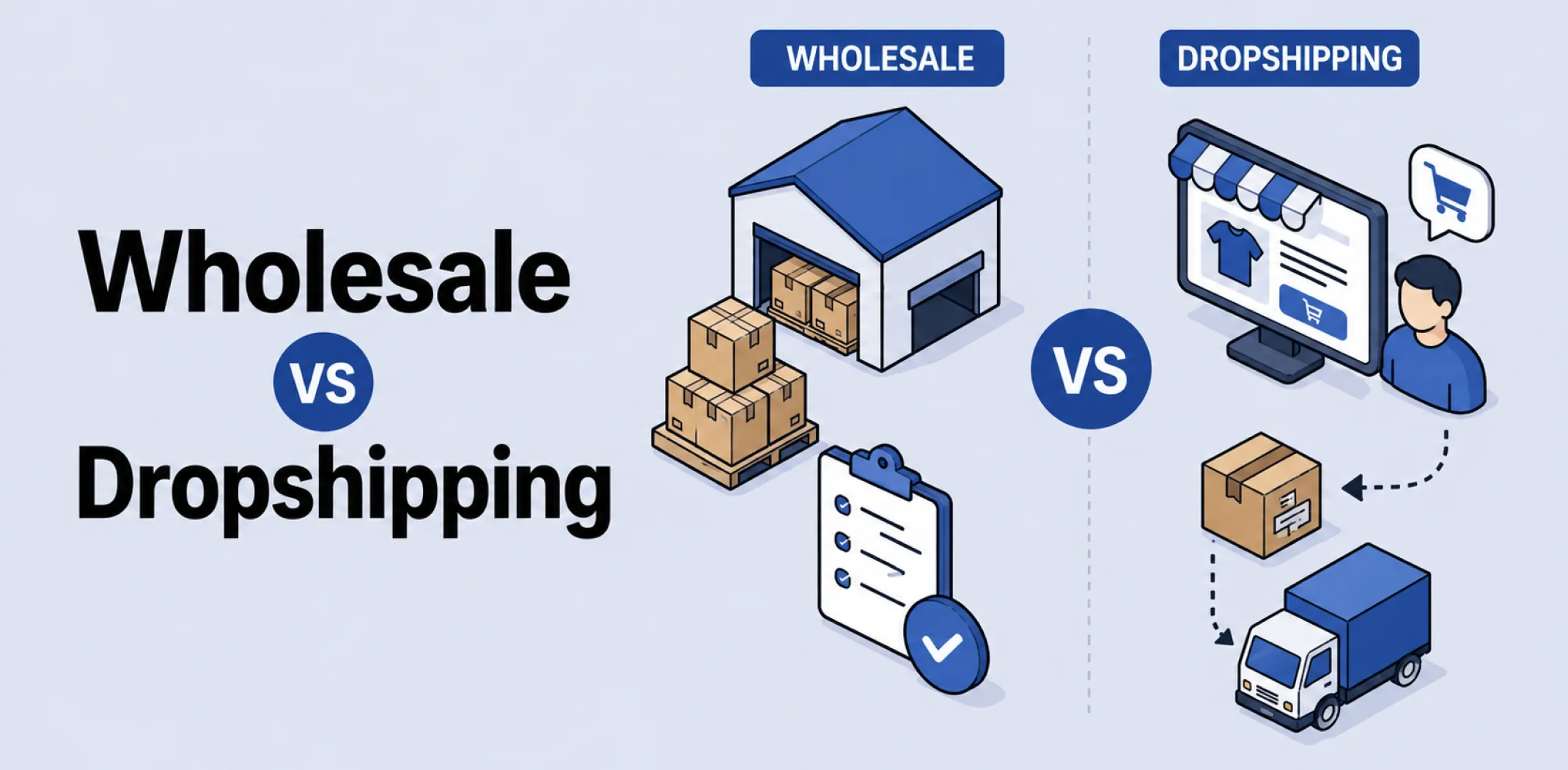
Wholesale vs dropshipping is the comparison between two distinct retail fulfillment models: wholesale requiring upfront inventory purchase and storage, and dropshipping forwarding customer orders directly to suppliers for shipment. The choice between them determines a business’s capital requirements, operational complexity, and profit structure.
In the wholesale model, a retailer buys products in bulk from a manufacturer or distributor at a discounted per-unit price, stores those products in a warehouse or home, and ships them to customers after a sale. The retailer assumes all inventory risk but captures the full margin between wholesale cost and retail price.
In dropshipping, the retailer never holds stock. Instead, customer orders are transmitted to a supplier who picks, packs, and ships directly to the buyer. The retailer pays the supplier per-order and keeps the difference, but pays higher per-unit costs.
Neither model is universally better. Wholesale works well for established products with predictable demand, while dropshipping suits testing new niches or operating with low startup capital. Many successful ecommerce businesses start with dropshipping to validate product demand, then transition to wholesale purchasing for their best-selling items to improve margins.
Key characteristics
- Inventory ownership: Wholesale requires the retailer to purchase and own all stock before any sale occurs. Dropshipping requires no inventory purchase until a customer has already paid the retailer.
- Per-unit cost structure: Wholesale offers low per-unit costs due to bulk purchasing, typically 30-50% of retail price. Dropshipping has higher per-unit costs, often 60-80% of retail price, because items are bought and shipped individually.
- Shipping control: Wholesale retailers control packaging, branding (including blind dropshipping equivalent), and carrier selection. Dropshipping retailers delegate all fulfillment decisions to the supplier, including shipping speed and packaging quality.
- Cash flow timing: Wholesale cash flows out when inventory is purchased – weeks or months before corresponding sales revenue arrives. Dropshipping cash flows in when the customer pays, then out when the retailer pays the supplier, creating positive working capital cycles.
Example
A retailer wants to sell yoga mats. Under wholesale, they buy 500 mats at $8 each ($4,000 total), store them in a rented garage, and sell them for $25. After shipping costs of $5 per mat, gross profit per mat is $12. Under dropshipping, they list the same mat for $30, pay a supplier $18 per mat plus $3 shipping, and earn $9 per mat. The dropshipping model requires zero upfront inventory investment, but the wholesale model earns $3 more per unit after covering storage. If demand is only 100 mats, the wholesale model loses money on unsold inventory; the dropshipping model simply stops listing the product.
How to choose: Wholesale vs dropshipping
- Assess available capital: If total startup budget is under $1,000, dropshipping is the only viable choice because wholesale requires inventory purchasing before any revenue.
- Evaluate product characteristics: Custom or branded products favor wholesale (since you control packaging and inserts). Commodity products with many identical listings favor dropshipping (since customers don’t differentiate).
- Test demand with dropshipping first: The common hybrid strategy is to validate product-market fit using dropshipping for 2-3 months, then switch the winning products to wholesale purchasing to increase margins.
- Consider fulfillment complexity: If your niche includes fragile, large, or high-return items, wholesale gives you quality control. If items are small and durable, dropshipping’s reduced control is acceptable.
Related terms
- Dropshipping – the order-forwarding fulfillment model where the retailer never holds inventory, contrasted directly with wholesale purchasing.
- Wholesale – he practice of buying goods in bulk from manufacturers or distributors at discounted rates, typically requiring inventory storage.
- Warehousing – the physical storage of inventory, a cost center that wholesale retailers must manage but dropshipping businesses avoid entirely.
- Overhead costs – the fixed expenses such as storage rent and insurance that wholesale operations incur but dropshipping operations generally do not.
- Order fulfillment – the process of receiving, packing, and shipping orders, which is self-managed in wholesale but outsourced to suppliers in dropshipping.
Frequently asked questions
Which is more profitable: Wholesale or dropshipping?
Wholesale has higher per-unit profit potential because bulk purchasing lowers the cost of goods sold. However, dropshipping can be more profitable overall for businesses with limited capital, since wholesale’s inventory carrying costs (storage, insurance, unsold stock) can erase margin advantages. The most profitable approach is often hybrid: dropship to test, then wholesale to scale winners.
Can you do both wholesale and dropshipping in the same store?
Yes, many successful stores operate a hybrid model. Best-selling products are purchased wholesale and stored for faster shipping and higher margins. Niche or seasonal test products are dropshipped to avoid inventory risk. The store presents both types identically to customers, who are unaware of which fulfillment method applies to their specific order.
Is wholesale or dropshipping better for beginners?
Dropshipping is generally better for absolute beginners because it requires less startup capital and carries no inventory risk if products fail to sell. Wholesale requires upfront cash for stock, space to store it, and systems to track inventory – operational complexity that new business owners often underestimate. However, once basic ecommerce skills are established, adding wholesale for top products is a natural progression.
Do customers know the difference between wholesale and dropshipping?
Customers typically do not know or care which fulfillment model a store uses. They care about price, shipping time, and product quality. Wholesale gives the retailer more control over shipping speed and packaging quality. Dropshipping can match wholesale on these dimensions if the retailer selects high-quality suppliers who offer fast shipping and blind packaging.
AliDropship: An all-in-one platform for starting dropshipping in 2026
AliDropship is a dropshipping platform that covers store creation, product imports, order automation, and marketing within a single system. It is designed for users with no prior ecommerce experience, though it also supports scaling for more established stores.
🛍️ Free turnkey store
New users receive a free pre-built store – set up, designed, and stocked with products. The store includes a ready-to-use product catalogue and a standard storefront design. It also comes with hosting, a domain, SSL, and payment systems already set up and included.
📦 Products
The platform provides access to a product catalogue covering both trending and niche items, with one-click import to your store. The catalogue is updated regularly to reflect current market availability. Products can be browsed, filtered, and added without leaving the platform.
🚚 Shipping & fulfillment
AliDropship provides access to a vast catalogue of products from global suppliers and handles order fulfillment automatically once a purchase is made. Customers receive tracking information directly, and orders are processed without manual intervention from the store owner.
📣 Marketing & promotion tools
The platform includes built-in marketing tools covering email campaigns, discount management, SEO settings, and social media integration. These are available within the dashboard and do not require third-party subscriptions for basic use.
👌 Ease of use
AliDropship requires no coding knowledge. The dashboard contains all the necessary tools for managing your store, products, and orders in one place. Additional features and products can be added as the store grows without rebuilding the existing setup.
Which is more profitable: Wholesale or dropshipping?
Can you do both wholesale and dropshipping in the same store?
Is wholesale or dropshipping better for beginners?
Do customers know the difference between wholesale and dropshipping?
Are you ready to become an owner
of a profitable online business?
Free Dropshipping Guide