


RMA

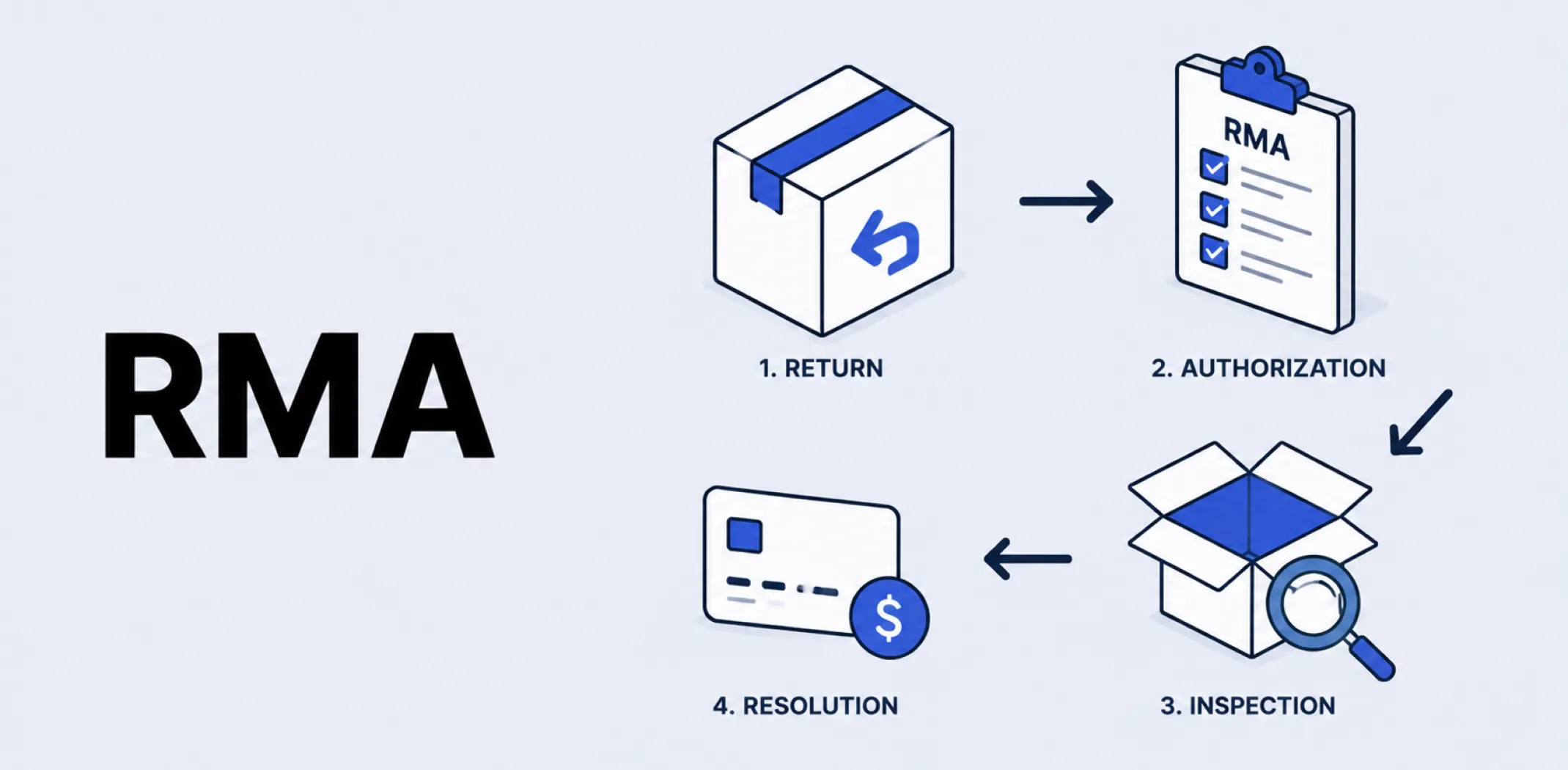
RMA stands for Return Merchandise Authorization, the formal approval a seller or manufacturer issues before a customer sends a product back for a refund, exchange, repair, or replacement, paired with a unique RMA number that tracks the item from request through final resolution.
The term is used interchangeably across industries with Return Authorization (RA), Return Goods Authorization (RGA), and Return Material Authorization, all describing the same underlying step: a seller approving a return before it happens rather than accepting items back unannounced.
An RMA functions similarly to a purchase order in reverse, signaling to a warehouse what item is expected back, what condition it should be in, and what resolution has already been agreed, so staff don’t need to make case-by-case decisions when the package arrives.
How it works
A standard RMA process follows a consistent sequence regardless of platform or industry.
Request initiation: the customer submits a return request through a self-service portal, email, or support ticket, providing the order number, reason for return, and preferred resolution such as refund, exchange, or store credit.
Policy review and approval: the seller checks the request against return policy criteria, such as the return window or item condition requirements, and approves or denies it.
RMA number issuance: once approved, a unique RMA number is generated and sent to the customer with return instructions and, commonly, a prepaid shipping label.
Return shipment and receiving: the customer ships the item back with the RMA number visible on the package, letting the warehouse scan and match it to the original request immediately rather than routing it into a manual queue.
Inspection and resolution: the returned item is inspected against the stated reason, and the agreed refund, exchange, repair, or replacement is processed and the customer notified.
Example
A customer orders a laptop case that doesn’t fit their device and contacts the seller’s support team to request a return. The seller reviews the request, confirms it falls within the return window, and issues an RMA number along with a prepaid return label by email. The customer ships the case back with the RMA number on the package, the warehouse scans it on arrival and immediately matches it to the original order, and a refund is issued once the item passes inspection, with the customer notified at each step.
Key characteristics
- Approval comes before the return ships: An RMA is issued before the item is sent back, distinguishing it from simply accepting unannounced returns, which leaves staff matching packages to orders manually on arrival.
- Tracked through a unique number: The RMA number ties the return to the original order, the stated reason, and the agreed resolution, letting every step of the process be monitored and audited.
- Used across industries beyond ecommerce: RMA is common terminology in electronics and PC hardware retail, manufacturing, and B2B contexts, not exclusively in direct-to-consumer ecommerce.
- Often integrated with broader systems: Many businesses connect RMA functionality to a Returns Management System (RMS), warehouse management system, or ERP platform rather than handling it manually.
- Self-service portals reduce processing cost: Letting customers initiate and track an RMA online without contacting support directly is associated with both faster processing and meaningfully lower support workload.
Related terms
- Order fulfillment – the forward process of getting a product to a customer, of which RMA forms the reverse counterpart once a return is requested.
- Dropship – a fulfillment model in which an RMA request is frequently routed to the original supplier rather than handled by the seller’s own warehouse, since the seller never held the inventory directly.
- 3PL – a logistics provider that may handle RMA receiving and inspection on a business’s behalf when returns are processed through an outsourced fulfillment center.
- Tracking number – a comparable unique identifier used for outbound shipments, serving a similar tracking role to an RMA number on the return side.
- Ecommerce – the broader category of online commercial activity in which a clear RMA process is strongly linked to customer trust and repeat purchase behavior.
Frequently asked questions
What is the difference between an RMA and an RMA number?
RMA refers to the overall approval and process for handling a product return, while an RMA number is the specific unique identifier issued once that approval is granted. The RMA number is what allows the return to be tracked and matched to the original order throughout shipping, receiving, and resolution.
Is RMA the same thing as RA or RGA?
Yes, Return Authorization (RA) and Return Goods Authorization (RGA) are used interchangeably with RMA across different industries to describe the same underlying process: a seller’s formal approval before a customer returns an item.
How does RMA work for dropshipping businesses?
Since a dropshipper typically never holds inventory directly, an RMA request is often forwarded to the original supplier rather than processed at the seller’s own warehouse. The supplier then handles inspection and the agreed resolution, with the dropshipper coordinating communication with the end customer throughout.
Why do businesses require an RMA number before accepting a return?
Requiring an RMA number before a return ships lets a business verify the return is valid, matches it automatically to the original order on arrival, and reduces the manual work and delays caused by unannounced or unidentified packages arriving at a warehouse.
AliDropship: An all-in-one platform for starting dropshipping in 2026
AliDropship is a dropshipping platform that covers store creation, product imports, order automation, and marketing within a single system. It is designed for users with no prior ecommerce experience, though it also supports scaling for more established stores.
🛍️ Free turnkey store
New users receive a free pre-built store – set up, designed, and stocked with products. The store includes a ready-to-use product catalogue and a standard storefront design. It also comes with hosting, a domain, SSL, and payment systems already set up and included.
📦 Products
The platform provides access to a product catalogue covering both trending and niche items, with one-click import to your store. The catalogue is updated regularly to reflect current market availability. Products can be browsed, filtered, and added without leaving the platform.
🚚 Shipping & fulfillment
AliDropship provides access to a vast catalogue of products from global suppliers and handles order fulfillment automatically once a purchase is made. Customers receive tracking information directly, and orders are processed without manual intervention from the store owner.
📣 Marketing & promotion tools
The platform includes built-in marketing tools covering email campaigns, discount management, SEO settings, and social media integration. These are available within the dashboard and do not require third-party subscriptions for basic use.
👌 Ease of use
AliDropship requires no coding knowledge. The dashboard contains all the necessary tools for managing your store, products, and orders in one place. Additional features and products can be added as the store grows without rebuilding the existing setup.
What is the difference between an RMA and an RMA number?
Is RMA the same thing as RA or RGA?
How does RMA work for dropshipping businesses?
Why do businesses require an RMA number before accepting a return?
Are you ready to become an owner
of a profitable online business?
Free Dropshipping Guide