


Real-Time Shipping Rates

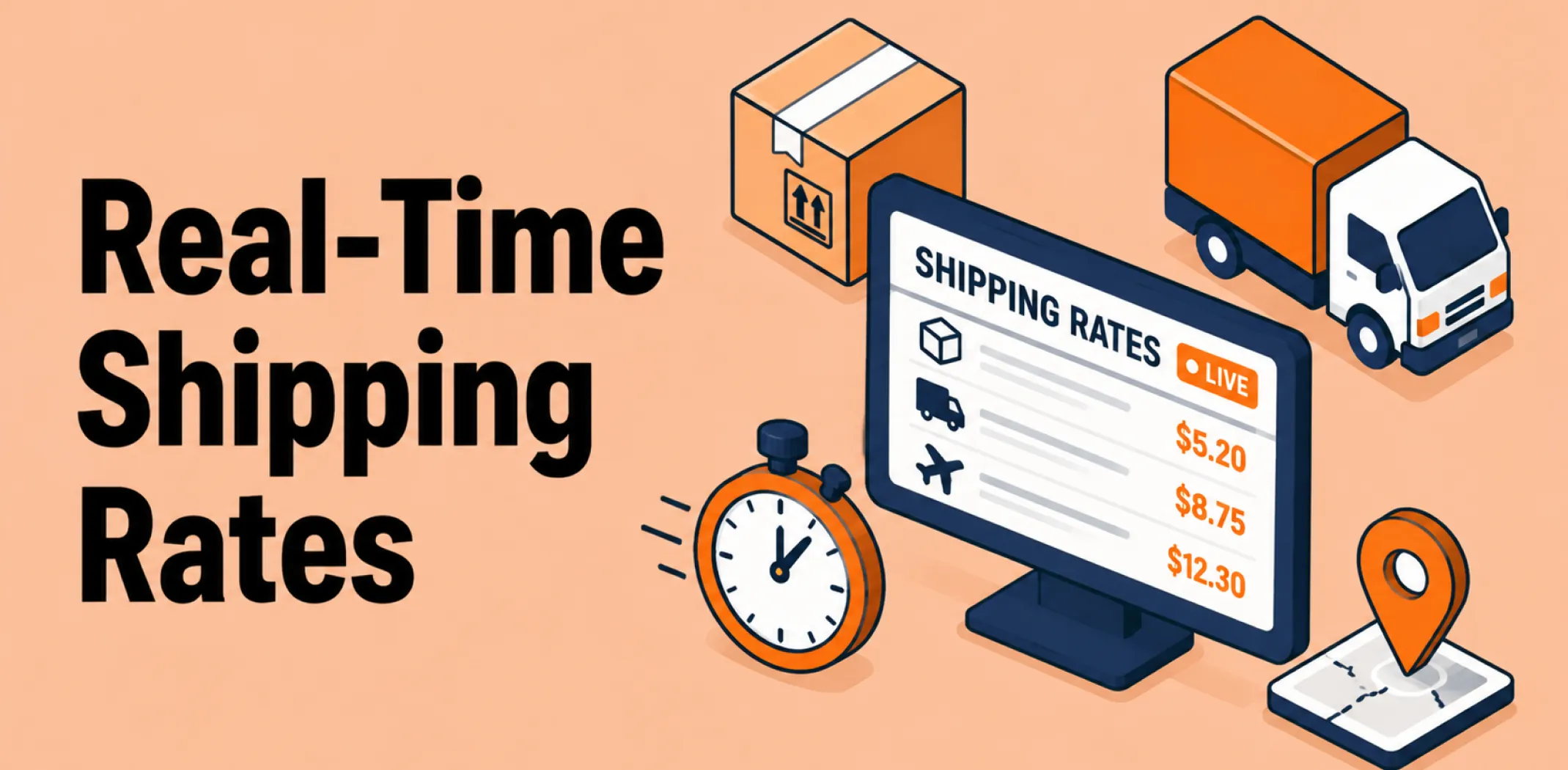
Real-time shipping rates, also called live rates or carrier-calculated rates, are delivery prices generated by querying a carrier’s pricing system directly at the moment of checkout, returning the exact cost for that specific order’s weight, dimensions, and destination rather than a single fixed flat rate.
Technically, real-time rates work through a connection between a store’s checkout system and one or more carrier APIs. When a customer reaches checkout, the platform packages the relevant order details, total weight, package dimensions, origin, and destination, into a request, sends it to the connected carrier or carriers, and receives a response containing the available service levels and their exact prices within seconds.
Because this request happens live, most platforms implement a short-term caching layer to avoid re-querying carrier APIs on every page load, alongside a configured fallback rate, either a default flat rate or the most recently cached result, in case a carrier’s API is temporarily slow or unavailable.
Many stores connect to multiple carriers simultaneously and display several real-time options side by side, letting the customer choose between a slower, cheaper service and a faster, more expensive one for the same order.
Real-time rates offer clear advantages for businesses with a varied product catalogue or significant shipping zone variation, since the displayed price always reflects the order’s actual cost rather than an averaged estimate that may run a profit or loss depending on the shipment.
The trade-off is conversion-related: live, variable pricing has been linked to meaningfully higher cart abandonment than a fixed flat rate, largely because the final number is unknown to the customer until late in the checkout process, which can register as an unwelcome surprise even when the price is technically accurate.
For this reason, many businesses adopt a hybrid approach, showing real-time rates for certain product categories or order types while defaulting to flat rate or free shipping elsewhere.
Example
An online furniture retailer sells items ranging from small lamps to large bookshelves, making a single flat rate impractical without significant under- or over-charging on many orders. The store connects its checkout to UPS and FedEx APIs, and when a customer adds a bookshelf to their cart, the system automatically calculates the package’s dimensional weight, queries both carriers, and displays the real, order-specific shipping cost for ground and expedited delivery, letting the customer choose the option that fits their budget and timeline.
Key characteristics
- Generated through live API queries: Rates are calculated by sending order-specific details directly to a carrier’s pricing system at checkout, rather than relying on a pre-set or averaged number.
- Reflects exact order details: Weight, dimensions, origin, and destination are all factored into the result, giving an accurate, order-specific price rather than an estimate.
- Requires caching and fallback handling: Most implementations cache recent results briefly and configure a fallback rate to maintain checkout functionality if a carrier’s API responds slowly or fails.
- Multi-carrier comparison is common: Many platforms query several carriers at once and present multiple real-time options, letting customers weigh cost against delivery speed for their specific order.
- Trades accuracy for some conversion friction: Real-time rates are more precise than flat-rate pricing but are generally associated with higher cart abandonment, since the price is unknown until checkout.
Related terms
- Flat-rate shipping – an alternative pricing model that charges one fixed price instead of querying a carrier for an order-specific rate.
- Shipping rate – the broader concept of the customer-facing delivery price, of which real-time rates are one specific, dynamically generated form.
- Shipping carrier – the company whose API is queried directly to generate a real-time rate for a specific shipment.
- Shipping zone – a distance-based factor that real-time rates account for precisely, in contrast to flat-rate pricing which generally ignores it within a set range.
- 3PL – a logistics provider whose systems are sometimes the source of real-time rate data, particularly for businesses using outsourced fulfillment.
Frequently asked questions
What is the difference between real-time rates and flat-rate shipping?
Real-time rates query a carrier’s API at checkout to calculate the exact cost for a specific order’s weight, dimensions, and destination. Flat-rate shipping instead charges one fixed price regardless of those factors, trading pricing accuracy for checkout simplicity and predictability.
What happens if a carrier’s API is unavailable during checkout?
Most platforms configure a fallback rate, either a default flat rate or a recently cached result, to ensure checkout can still proceed if a carrier’s API responds slowly or goes down temporarily. Without this safeguard, an API outage could otherwise block customers from completing a purchase.
Do real-time rates hurt conversion rates?
Live, variable shipping prices are generally associated with higher cart abandonment than flat-rate pricing, largely because the final cost is unknown to the customer until late in checkout. Many businesses offset this by combining real-time rates with a free shipping threshold or showing estimated costs earlier in the shopping journey.
Can I use real-time rates for some products and flat rates for others?
Yes, a hybrid approach is common, where a business uses real-time, carrier-calculated rates for bulky or highly variable items while defaulting to flat-rate or free shipping for smaller, more consistently sized products.
AliDropship: An all-in-one platform for starting dropshipping in 2026
AliDropship is a dropshipping platform that covers store creation, product imports, order automation, and marketing within a single system. It is designed for users with no prior ecommerce experience, though it also supports scaling for more established stores.
🛍️ Free turnkey store
New users receive a free pre-built store – set up, designed, and stocked with products. The store includes a ready-to-use product catalogue and a standard storefront design. It also comes with hosting, a domain, SSL, and payment systems already set up and included.
📦 Products
The platform provides access to a product catalogue covering both trending and niche items, with one-click import to your store. The catalogue is updated regularly to reflect current market availability. Products can be browsed, filtered, and added without leaving the platform.
🚚 Shipping & fulfillment
AliDropship provides access to a vast catalogue of products from global suppliers and handles order fulfillment automatically once a purchase is made. Customers receive tracking information directly, and orders are processed without manual intervention from the store owner.
📣 Marketing & promotion tools
The platform includes built-in marketing tools covering email campaigns, discount management, SEO settings, and social media integration. These are available within the dashboard and do not require third-party subscriptions for basic use.
👌 Ease of use
AliDropship requires no coding knowledge. The dashboard contains all the necessary tools for managing your store, products, and orders in one place. Additional features and products can be added as the store grows without rebuilding the existing setup.
What is the difference between real-time rates and flat-rate shipping?
What happens if an API of the carrier is unavailable during checkout?
Do real-time rates hurt conversion rates?
Can I use real-time rates for some products and flat rates for others?
Are you ready to become an owner
of a profitable online business?
Free Dropshipping Guide