

Profit Margin

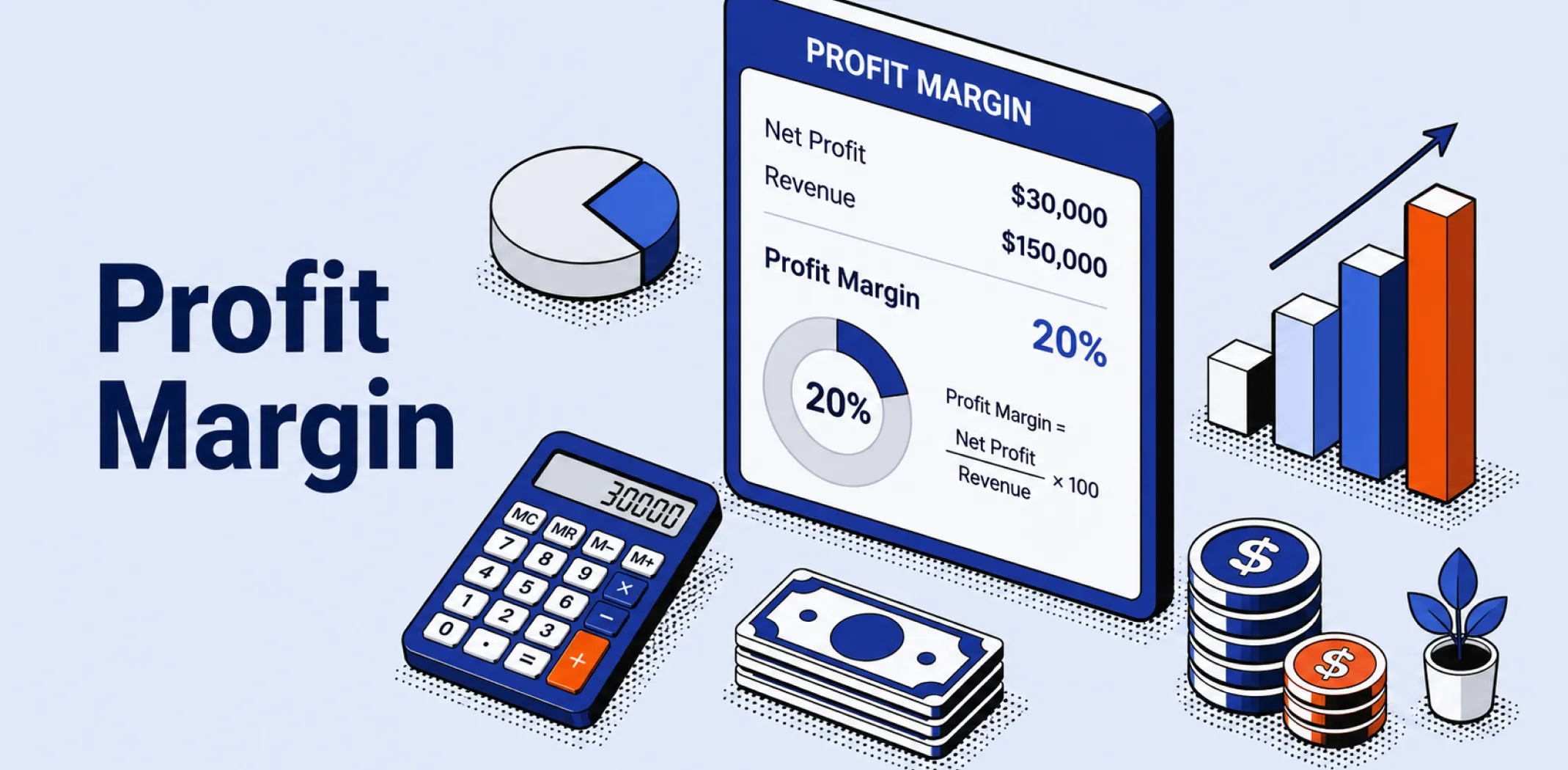
Profit margin is a percentage that shows how much of a business’s revenue remains as profit after subtracting costs, used to measure how efficiently a sale or business converts revenue into profit rather than measuring profit as a fixed dollar amount.
Profit margin comes in different forms depending on which costs are subtracted. Gross profit margin divides gross profit by revenue, reflecting only the cost of goods sold, while net profit margin divides net profit by revenue, reflecting every business expense including overhead costs.
Because margin is a percentage rather than a dollar figure, it allows comparison between products or businesses of very different sizes; a small store and a large store can have the same profit margin even if their total profit dollars are far apart.
For dropshipping sellers, profit margin is often used alongside dollar-based profit figures to judge whether a product’s pricing leaves enough room to cover advertising and other variable costs.
Key characteristics
- Expressed as a percentage: Profit margin is calculated by dividing profit by revenue and is shown as a percentage rather than a fixed dollar amount.
- Gross versus net margin: Gross profit margin reflects only the cost of goods sold, while net profit margin accounts for every business expense.
- Size-independent comparison: Margin allows fair comparison between businesses or products of different revenue sizes, unlike comparing raw profit dollars.
- Varies widely by category: Typical margin ranges differ significantly between product categories, with low-cost commodity items often carrying thinner margins than specialty or branded products.
Example
A store sells a phone case for 30 dollars with a 22 dollar gross profit after subtracting the supplier’s cost. Dividing the 22 dollar gross profit by the 30 dollar revenue gives a gross profit margin of roughly 73 percent. After also subtracting advertising and other overhead, the store’s net profit on that same sale falls to 8 dollars, giving a net profit margin of about 27 percent, a much lower figure than the gross margin despite describing the same single sale.
Related terms
- Gross profit – the dollar figure used to calculate gross profit margin.
- Net profit – the dollar figure used to calculate net profit margin.
- Overhead costs – the broader expenses that separate gross margin from net margin.
- Return on investment – a related performance measure that compares profit to the cost of an investment rather than to revenue.
Frequently asked questions
How is profit margin different from profit itself?
Profit is a fixed dollar amount, while profit margin expresses that profit as a percentage of revenue. Two businesses can earn the same dollar profit while having very different profit margins if their revenue levels differ.
What is the difference between gross margin and net margin?
Gross profit margin divides gross profit by revenue and reflects only the direct cost of goods sold, while net profit margin divides net profit by revenue and accounts for every business expense. Net margin is almost always lower than gross margin for the same business.
What counts as a good profit margin for a dropshipping store?
What counts as a good profit margin varies widely by product category, advertising cost, and business model, so there is no single universal benchmark. Store owners typically compare their own margins against industry norms for their specific niche rather than a fixed target.
Why might two products with the same profit margin perform differently?
Two products with the same profit margin can still perform differently because margin does not account for total sales volume or order frequency. A product with a high margin but very few sales can generate less total profit than a lower-margin product that sells in much higher volume.
AliDropship: An all-in-one platform for starting dropshipping in 2026
AliDropship is a dropshipping platform that covers store creation, product imports, order automation, and marketing within a single system. It is designed for users with no prior ecommerce experience, though it also supports scaling for more established stores.
🛍️ Free turnkey store
New users receive a free pre-built store – set up, designed, and stocked with products. The store includes a ready-to-use product catalogue and a standard storefront design. It also comes with hosting, a domain, SSL, and payment systems already set up and included.
📦 Products
The platform provides access to a product catalogue covering both trending and niche items, with one-click import to your store. The catalogue is updated regularly to reflect current market availability. Products can be browsed, filtered, and added without leaving the platform.
🚚 Shipping & fulfillment
AliDropship provides access to a vast catalogue of products from global suppliers and handles order fulfillment automatically once a purchase is made. Customers receive tracking information directly, and orders are processed without manual intervention from the store owner.
📣 Marketing & promotion tools
The platform includes built-in marketing tools covering email campaigns, discount management, SEO settings, and social media integration. These are available within the dashboard and do not require third-party subscriptions for basic use.
👌 Ease of use
AliDropship requires no coding knowledge. The dashboard contains all the necessary tools for managing your store, products, and orders in one place. Additional features and products can be added as the store grows without rebuilding the existing setup.
How is profit margin different from profit itself?
What is the difference between gross margin and net margin?
What counts as a good profit margin for dropshipping?
Can profit margin be negative?
Does a higher profit margin always mean more total profit?
Are you ready to become an owner
of a profitable online business?
Free Dropshipping Guide