

Product Sourcing

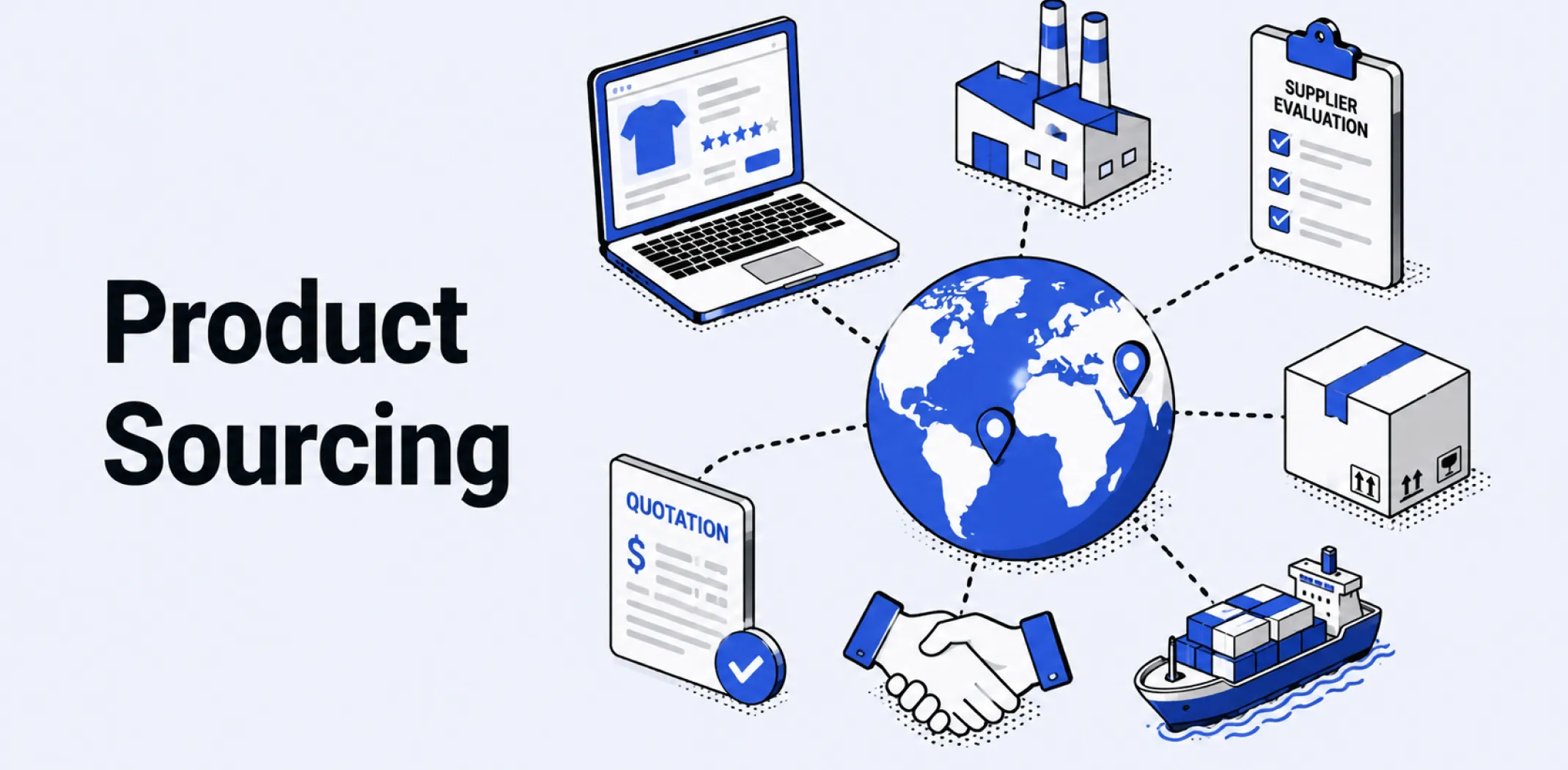
Product sourcing is the process of identifying, evaluating, and securing suppliers or supply channels for the products a seller intends to list and sell, with the aim of establishing reliable access to inventory at a cost that supports a viable profit margin.
Sourcing sits between product research and active selling: once a product has been identified as commercially viable, sourcing determines where it will come from, at what cost, and under what fulfillment conditions.
The sourcing decision directly shapes a store’s unit economics – the relationship between what a seller pays for a product and what they can charge for it. A poor sourcing arrangement can make an otherwise well-researched product unprofitable.
Sourcing methods vary by business model. In traditional ecommerce, sellers may purchase inventory in bulk from wholesale suppliers or manufacturers. In dropshipping, the seller never holds stock; instead, orders are forwarded to a supplier who ships directly to the customer, making supplier selection and vetting the central concern of the sourcing process.
Marketplaces such as AliExpress and Alibaba are commonly used sourcing channels for dropshipping stores, with guidance on their use covered in resources such as how to use AliExpress for dropshipping.
How product sourcing works
- The seller defines the product requirements – category, specifications, target price range, and any quality or compliance standards – based on the output of the product research phase.
- Potential suppliers are identified through marketplace directories, trade platforms, supplier databases, or direct outreach to manufacturers and distributors.
- Suppliers are evaluated against criteria including unit cost, minimum order quantities, product quality, shipping options, lead times, and communication responsiveness.
- Sample orders are placed where applicable to verify product quality, packaging condition, and actual shipping duration before committing to full-scale listings.
- A sourcing arrangement is confirmed – either a dropshipping agreement where the supplier fulfills orders directly, or a purchase agreement for bulk inventory – and pricing terms are finalized.
- The sourcing arrangement is monitored on an ongoing basis; supplier performance is tracked against fulfillment speed, defect rates, and stock availability, with alternatives identified in case of disruption.
Example
A seller planning to list kitchen organizers identifies a shortlist of three suppliers on AliExpress after product research confirms strong demand in the category. Each supplier is evaluated on unit cost, shipping time to the target market, and review scores from existing buyers. The seller places a sample order from two of the three to assess packaging quality and actual delivery time. One supplier ships in nine days with intact packaging; the other takes three weeks and delivers with minor damage. The seller proceeds with the faster supplier, negotiates a slightly lower per-unit cost based on projected order volume, and monitors the arrangement over the first month of live sales before treating it as a confirmed sourcing channel.
Key characteristics
- Cost centrality: The unit cost obtained through sourcing is the primary input to margin calculations; sourcing decisions made without margin modelling carry significant profitability risk.
- Supplier dependency: In dropshipping especially, the seller’s reputation with customers depends entirely on the supplier’s fulfillment accuracy, packaging quality, and shipping speed.
- Ongoing management: Sourcing is not a one-time task; supplier performance must be monitored continuously and alternative suppliers identified as contingencies against stock shortages or quality declines.
- Model variation: The sourcing process differs substantially between bulk purchasing, dropshipping, print-on-demand, and private label models – each involves different supplier types, cost structures, and lead time expectations.
- Verification requirement: Supplier claims about product quality and shipping times should be tested through sample orders before committing to live listings, as stated specifications do not always reflect actual performance.
Related terms
- Supplier – the party located and evaluated during the sourcing process, responsible for fulfilling orders on the seller’s behalf in a dropshipping arrangement.
- Product research – the preceding stage in which product viability is assessed before sourcing begins; research defines what to source, sourcing determines where to get it.
- Wholesale – a sourcing model in which products are purchased in bulk at below-retail prices, used in inventory-holding ecommerce businesses as an alternative to dropshipping.
- AliExpress – a consumer and business marketplace commonly used as a sourcing channel for dropshipping stores seeking individual-unit supplier relationships.
- Order fulfillment – the downstream process that depends on sourcing quality; a reliable sourcing arrangement is a prerequisite for consistent fulfillment performance.
- Overhead costs – the fixed and variable expenses that, alongside sourcing costs, determine whether a product can be sold at a viable margin.
Frequently asked questions
What is the difference between product sourcing and product research?
Product research determines whether a product is worth selling – assessing demand, competition, and margin potential. Product sourcing determines where that product will come from – identifying and vetting suppliers, confirming unit costs, and establishing a fulfillment arrangement. Research precedes sourcing: a product must first be validated as commercially viable before a sourcing channel is sought.
Where do dropshipping sellers typically source their products?
The most widely used sourcing channels for dropshipping are marketplace platforms such as AliExpress and Alibaba, which connect sellers with suppliers offering individual-unit fulfillment.
Dedicated dropshipping supplier directories and integrated platforms that link product catalogues directly to store backends are also commonly used. The appropriate channel depends on the product category, target shipping region, and required lead times.
How do sellers evaluate a supplier during the sourcing process?
Key evaluation criteria include unit price relative to the target retail margin, stated and actual shipping times to the destination market, product quality as verified through sample orders, supplier review history and order volume on the relevant platform, and responsiveness to pre-sale enquiries.
No single criterion is sufficient; a low-cost supplier with slow shipping or inconsistent quality can generate customer service costs that erode the margin advantage.
Is product sourcing a one-time process?
Sourcing is ongoing rather than one-time. Supplier performance must be monitored across fulfillment speed, defect rates, and stock availability throughout the life of a product listing.
External factors – exchange rate shifts, supply chain disruptions, or a supplier discontinuing a product – can require sourcing decisions to be revisited at short notice. Experienced sellers maintain a shortlist of alternative suppliers for their key products as a standard risk management practice.
AliDropship: An all-in-one platform for starting dropshipping in 2026
AliDropship is a dropshipping platform that covers store creation, product imports, order automation, and marketing within a single system. It is designed for users with no prior ecommerce experience, though it also supports scaling for more established stores.
🛍️ Free turnkey store
New users receive a free pre-built store – set up, designed, and stocked with products. The store includes a ready-to-use product catalogue and a standard storefront design. It also comes with hosting, a domain, SSL, and payment systems already set up and included.
📦 Products
The platform provides access to a product catalogue covering both trending and niche items, with one-click import to your store. The catalogue is updated regularly to reflect current market availability. Products can be browsed, filtered, and added without leaving the platform.
🚚 Shipping & fulfillment
AliDropship provides access to a vast catalogue of products from global suppliers and handles order fulfillment automatically once a purchase is made. Customers receive tracking information directly, and orders are processed without manual intervention from the store owner.
📣 Marketing & promotion tools
The platform includes built-in marketing tools covering email campaigns, discount management, SEO settings, and social media integration. These are available within the dashboard and do not require third-party subscriptions for basic use.
👌 Ease of use
AliDropship requires no coding knowledge. The dashboard contains all the necessary tools for managing your store, products, and orders in one place. Additional features and products can be added as the store grows without rebuilding the existing setup.
What is the difference between product sourcing and product research?
Where do dropshipping sellers typically source their products?
How do sellers evaluate a supplier during the sourcing process?
Is product sourcing a one-time process?
Are you ready to become an owner
of a profitable online business?
Free Dropshipping Guide