

Markup

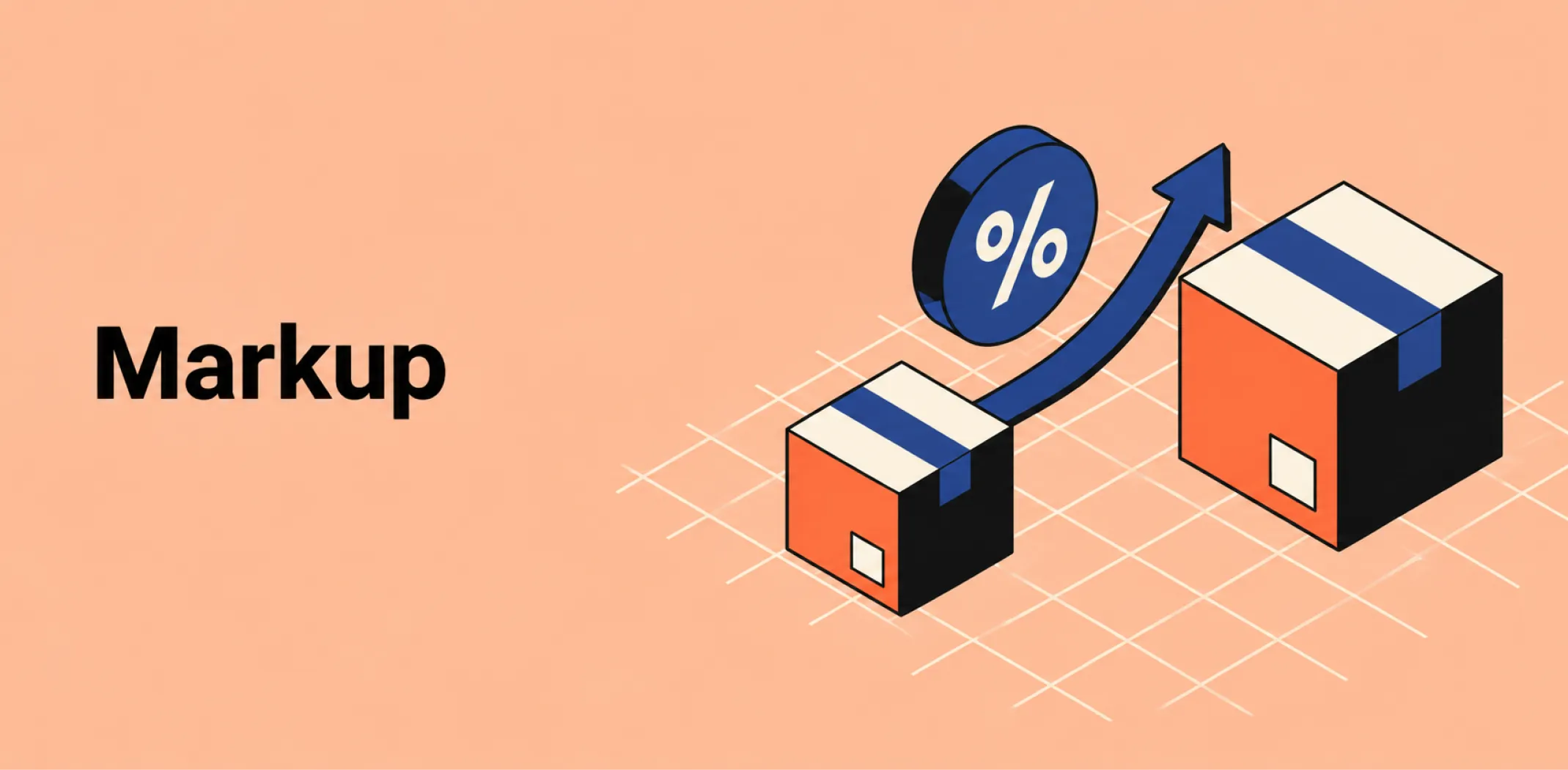
Markup is the amount added to a product’s cost price to arrive at its selling price, usually expressed as a percentage of that cost rather than as a percentage of the final sale price.
Markup is frequently confused with profit margin, but the two are calculated differently. Markup is profit divided by cost, while margin is profit divided by revenue, so the same dollar amount of profit produces a higher markup percentage than margin percentage.
A product costing 10 dollars and selling for 20 dollars has a 100 percent markup, since the 10 dollar profit equals the full cost, but only a 50 percent margin, since that same 10 dollars equals half of the 20 dollar selling price.
Key characteristics
- Based on cost, not revenue: Markup is calculated by dividing profit by the cost of the product, not by the final selling price.
- Always higher than margin: For the same product, the markup percentage is always higher than the margin percentage, since the divisor used for markup is smaller.
- Used to set initial pricing: Markup is commonly used as a starting formula for setting a retail price before other factors are layered in.
Example
A store buys a kitchen tool from a supplier for 10 dollars. To price the product, the store applies a 150 percent markup, adding 15 dollars to the 10 dollar cost, resulting in a final selling price of 25 dollars. The 15 dollar profit represents a 150 percent markup on the original cost, even though it represents only a 60 percent profit margin on the 25 dollar selling price.
Related terms
- Profit margin – a related but distinct calculation that divides profit by revenue instead of by cost.
- Gross profit – the dollar amount of profit that markup is calculated from.
- Wholesale – the supplier-side cost price that markup is added on top of.
Frequently asked questions
How is markup different from profit margin?
Markup divides profit by the product’s cost, while profit margin divides profit by the selling price. For the same product, markup is always a higher percentage than margin.
How do you calculate the selling price from a markup percentage?
To calculate a selling price from a markup percentage, multiply the cost by the markup percentage and add that amount to the original cost. A 10 dollar product with a 50 percent markup sells for 15 dollars.
Why might two products have the same markup but different margins?
Two products with the same markup percentage have different margins if their cost prices are different, since margin depends on the final selling price rather than only on cost. This is why markup and margin should not be used interchangeably when comparing pricing.
AliDropship: An all-in-one platform for starting an online business in 2026
AliDropship is an online business platform that gives customers a ready-made store, a digital products catalogue, and built-in, one-click advertising within a single system. Founded in 2015 and based in Irvine, California, it has helped launch more than 1,500,000 stores and holds a 4.7-star rating on Trustpilot. It is built for people with no prior experience and no technical skills.
🆓 Free 14-day trial
New users get full platform access for 14 days, including a ready-made store, hosting, a domain, an SSL certificate, and access to the digital products catalogue. The trial also includes a $40 ad coupon to test the advertising system. Order fees apply only when a sale is made.
📦 Digital products
Customers choose from AliDropship’s catalogue of digital products – guides, courses, checklists, tools, and AI-powered toolkits – and keep up to 70% of every sale. Delivery is instant and automated, so there is no inventory, shipping, or manual fulfillment involved.
📣 One-click advertising
AliDropship includes built-in advertising that customers can turn on for as little as $10 a day. The system handles targeting, creatives, and optimization, and many customers see their first orders the same day they launch ads.
👌 Ease of use
AliDropship requires no coding or marketing experience. The store, products, and ads are managed from a single dashboard that works on a phone as well as a desktop, and a personal growth manager is available to help by chat.
💳 Monthly plan
After the trial, continued access is $39 a month, covering the store, the digital products catalogue, and ongoing support. There is no long-term contract, and the plan can be cancelled at any time.
How is markup different from profit margin?
How do you calculate selling price from markup?
Why is markup always higher than margin?
What markup is commonly used in dropshipping?
Does a higher markup always mean more profit?
Are you ready to become an owner
of a profitable online business?
Free Dropshipping Guide