

Creator Economy

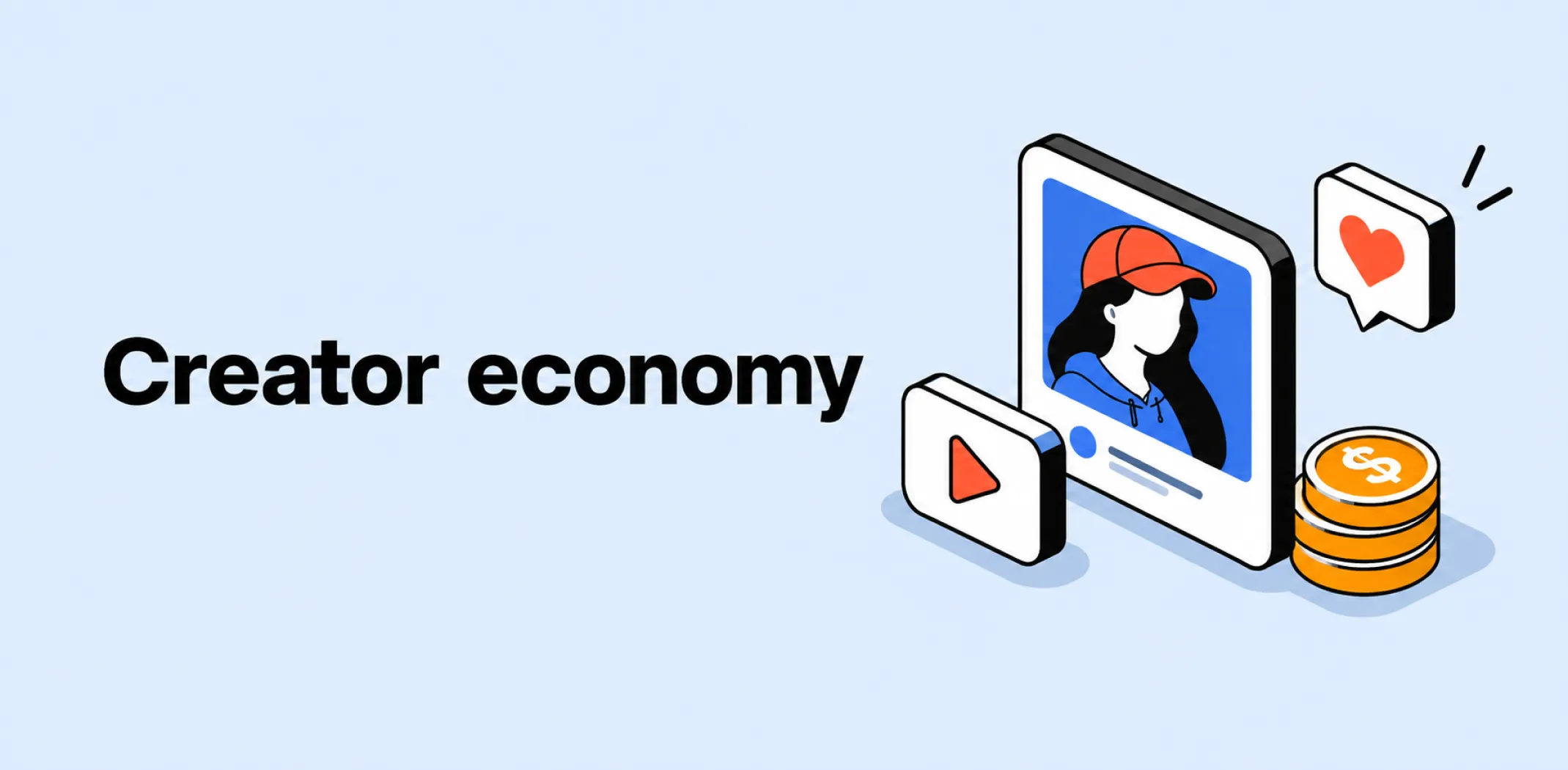
The creator economy is an economic system in which individuals build audiences on digital platforms and earn income directly from that audience through content, products, and brand partnerships rather than traditional employment.
The concept differs from traditional media and employment models because creators typically operate as independent operators or small teams rather than employees of a media company. Platforms such as YouTube, Instagram, TikTok, and Patreon provide the infrastructure – audience reach, payment processing, and analytics – that creators rely on to convert attention into revenue.
Multiple income streams are common within a single creator’s business, including advertising revenue share, paid subscriptions, brand partnerships, digital product sales, and platform-specific creator funds.
Creator economy is broader than influencer marketing, which refers specifically to brands paying creators to promote products. It also extends beyond user-generated content, since creator economy participants often produce content as their primary occupation rather than incidentally.
Within ecommerce, the creator economy intersects with social commerce when creators sell products directly to their audience through shoppable posts, affiliate links, or their own online stores.
Example
A fitness content creator posts workout videos on Instagram and builds an audience of 40,000 followers. She earns a share of platform ad revenue, sells a downloadable workout guide directly to followers, and partners with a dropshipping store selling resistance bands, earning a commission on each sale generated through her affiliate link. Combined, these income streams make up her full-time earnings, illustrating how a single creator can participate in several parts of the creator economy at once.
Key characteristics
- Diversified income streams: Creators typically combine several revenue sources – advertising splits, subscriptions, sponsorships, and product sales – rather than relying on a single paycheck.
- Platform dependency: Income and audience reach are shaped by the algorithms, policies, and monetization tools of the platforms creators build on.
- Direct audience relationship: Creators communicate with and sell to their audience directly, reducing reliance on traditional advertising or retail intermediaries.
- Low entry barrier, high competition: Anyone with a device and an account can begin publishing content, but only a small share of creators earn a full-time income from it.
Related terms
- Influencer – an individual who promotes products or brands to an audience in exchange for compensation, a common role within the creator economy.
- Micro-influencer – a creator with a smaller but highly engaged audience, often used by brands for cost-effective partnerships.
- User-generated content (UGC) – content produced by creators or customers rather than a brand, frequently monetized within the creator economy.
- Social commerce – the practice of selling products directly through social media platforms, a common monetization path for creators.
- Social proof – the influence creators exert on purchase decisions by demonstrating product use to their audience.
Frequently asked questions
What is the difference between the creator economy and influencer marketing?
Influencer marketing is a subset of the creator economy limited to brands paying creators for promotion. The creator economy also includes subscriptions, digital product sales, and platform ad revenue that do not involve a brand partnership.
How do creators in the creator economy make money?
Creators combine several income sources, including advertising revenue share, paid subscriptions, brand sponsorships, affiliate commissions, and sales of their own digital or physical products. Most established creators rely on more than one stream rather than a single source.
Is the creator economy the same as the gig economy?
The two overlap but are not identical. The gig economy centers on task-based or freelance labor coordinated through platforms, while the creator economy centers on audience-building and content monetization, though many creators also take on gig-style freelance work.
AliDropship: An all-in-one platform for starting an online business in 2026
AliDropship is an online business platform that gives customers a ready-made store, a digital products catalogue, and built-in, one-click advertising within a single system. Founded in 2015 and based in Irvine, California, it has helped launch more than 1,500,000 stores and holds a 4.7-star rating on Trustpilot. It is built for people with no prior experience and no technical skills.
🆓 Free 14-day trial
New users get full platform access for 14 days, including a ready-made store, hosting, a domain, an SSL certificate, and access to the digital products catalogue. The trial also includes a $40 ad coupon to test the advertising system. Order fees apply only when a sale is made.
📦 Digital products
Customers choose from AliDropship’s catalogue of digital products – guides, courses, checklists, tools, and AI-powered toolkits – and keep up to 70% of every sale. Delivery is instant and automated, so there is no inventory, shipping, or manual fulfillment involved.
📣 One-click advertising
AliDropship includes built-in advertising that customers can turn on for as little as $10 a day. The system handles targeting, creatives, and optimization, and many customers see their first orders the same day they launch ads.
👌 Ease of use
AliDropship requires no coding or marketing experience. The store, products, and ads are managed from a single dashboard that works on a phone as well as a desktop, and a personal growth manager is available to help by chat.
💳 Monthly plan
After the trial, continued access is $39 a month, covering the store, the digital products catalogue, and ongoing support. There is no long-term contract, and the plan can be cancelled at any time.
What percentage of creators in the creator economy earn a full-time income?
How many people participate in the creator economy worldwide?
What platforms are most associated with the creator economy?
Do creators in the creator economy need a large following to earn money?
How is the creator economy different from traditional media?
Are you ready to become an owner
of a profitable online business?
Free Dropshipping Guide