

Social Commerce

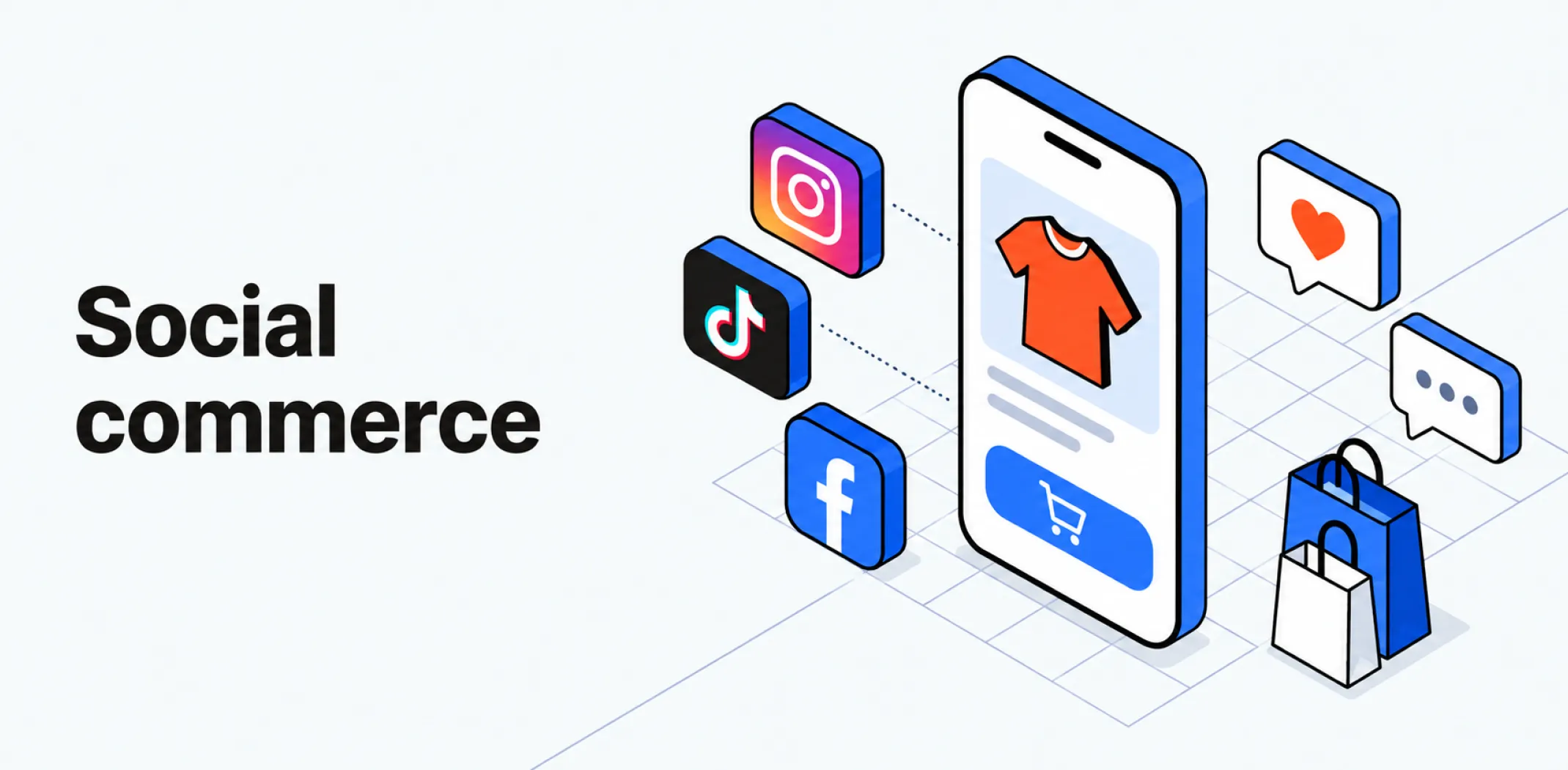
Social commerce is the practice of researching, browsing, and completing a purchase directly within a social media platform, rather than being redirected to a separate ecommerce website.
Social commerce covers native shopping features built into platforms such as Instagram, TikTok, Facebook, and Pinterest, including shoppable posts, in-app product tags, and live-stream shopping events. It differs from conversational commerce, which focuses on chat- or voice-based interactions, by centering on the browsing and checkout experience embedded in a social feed rather than a one-on-one conversation.
The term also overlaps with personalization, since social platforms use engagement data and browsing history to surface products a user is likely to buy. Social commerce can end with checkout completed entirely on the platform, or with a link that forwards the shopper to a brand’s own website.
How social commerce works
- A brand tags products directly in a post, video, or live stream on a social media platform.
- A user browsing their feed sees the tagged product and taps it to view details.
- The platform displays product information such as price, size, and available variants.
- The user adds the item to a cart, either within the app or on a linked store page.
- Payment is completed using the platform’s built-in checkout or a redirect to the brand’s website.
- The platform confirms the order and may allow the user to track it within the app.
Example
A shopper scrolling through a video app sees a creator wearing a jacket in a short video. Tapping the tagged product opens a product card showing price and sizing, and the shopper completes checkout without leaving the app. The order confirmation appears in the app within seconds of the purchase.
Key characteristics
- In-app checkout: Many platforms let shoppers complete a purchase without ever leaving the social app.
- Content-driven discovery: Products surface through posts, videos, and live streams rather than search or category browsing.
- Creator influence: Purchases are often prompted by influencer or creator content rather than a brand’s own marketing.
- Platform dependency: Available features and checkout options vary by platform and are controlled by the platform, not the seller.
Related terms
- Conversational commerce – shopping conducted through chat or messaging interfaces, which some social platforms combine with shoppable posts.
- Personalization – the practice of tailoring product suggestions, which powers what appears in a shopper’s social feed.
- Recommendation engine – the underlying system that determines which products a platform surfaces to a given user.
- Chatbot – automated software some brands use to answer questions or process orders within a social messaging thread.
Frequently asked questions
Which platforms support social commerce?
Instagram, TikTok, Facebook, and Pinterest all offer native shopping features, though the specific tools, such as in-app checkout or live shopping, vary by platform and region.
Does social commerce always involve in-app checkout?
No. Some platforms complete the purchase entirely within the app, while others use product tags only to link out to a brand’s own website for checkout.
Is social commerce only relevant to large brands?
No. Small and independent sellers can use the same shoppable post and product tagging features as larger brands, since most platforms make these tools available to any business account.
AliDropship: An all-in-one platform for starting an online business in 2026
AliDropship is an online business platform that gives customers a ready-made store, a digital products catalogue, and built-in, one-click advertising within a single system. Founded in 2015 and based in Irvine, California, it has helped launch more than 1,500,000 stores and holds a 4.7-star rating on Trustpilot. It is built for people with no prior experience and no technical skills.
🆓 Free 14-day trial
New users get full platform access for 14 days, including a ready-made store, hosting, a domain, an SSL certificate, and access to the digital products catalogue. The trial also includes a $40 ad coupon to test the advertising system. Order fees apply only when a sale is made.
📦 Digital products
Customers choose from AliDropship’s catalogue of digital products – guides, courses, checklists, tools, and AI-powered toolkits – and keep up to 70% of every sale. Delivery is instant and automated, so there is no inventory, shipping, or manual fulfillment involved.
📣 One-click advertising
AliDropship includes built-in advertising that customers can turn on for as little as $10 a day. The system handles targeting, creatives, and optimization, and many customers see their first orders the same day they launch ads.
👌 Ease of use
AliDropship requires no coding or marketing experience. The store, products, and ads are managed from a single dashboard that works on a phone as well as a desktop, and a personal growth manager is available to help by chat.
💳 Monthly plan
After the trial, continued access is $39 a month, covering the store, the digital products catalogue, and ongoing support. There is no long-term contract, and the plan can be cancelled at any time.
What is social commerce?
How is social commerce different from ecommerce?
Is social commerce growing?
What products sell well through social commerce?
What are the risks of social commerce for sellers?
Are you ready to become an owner
of a profitable online business?
Free Dropshipping Guide