

A/B Testing

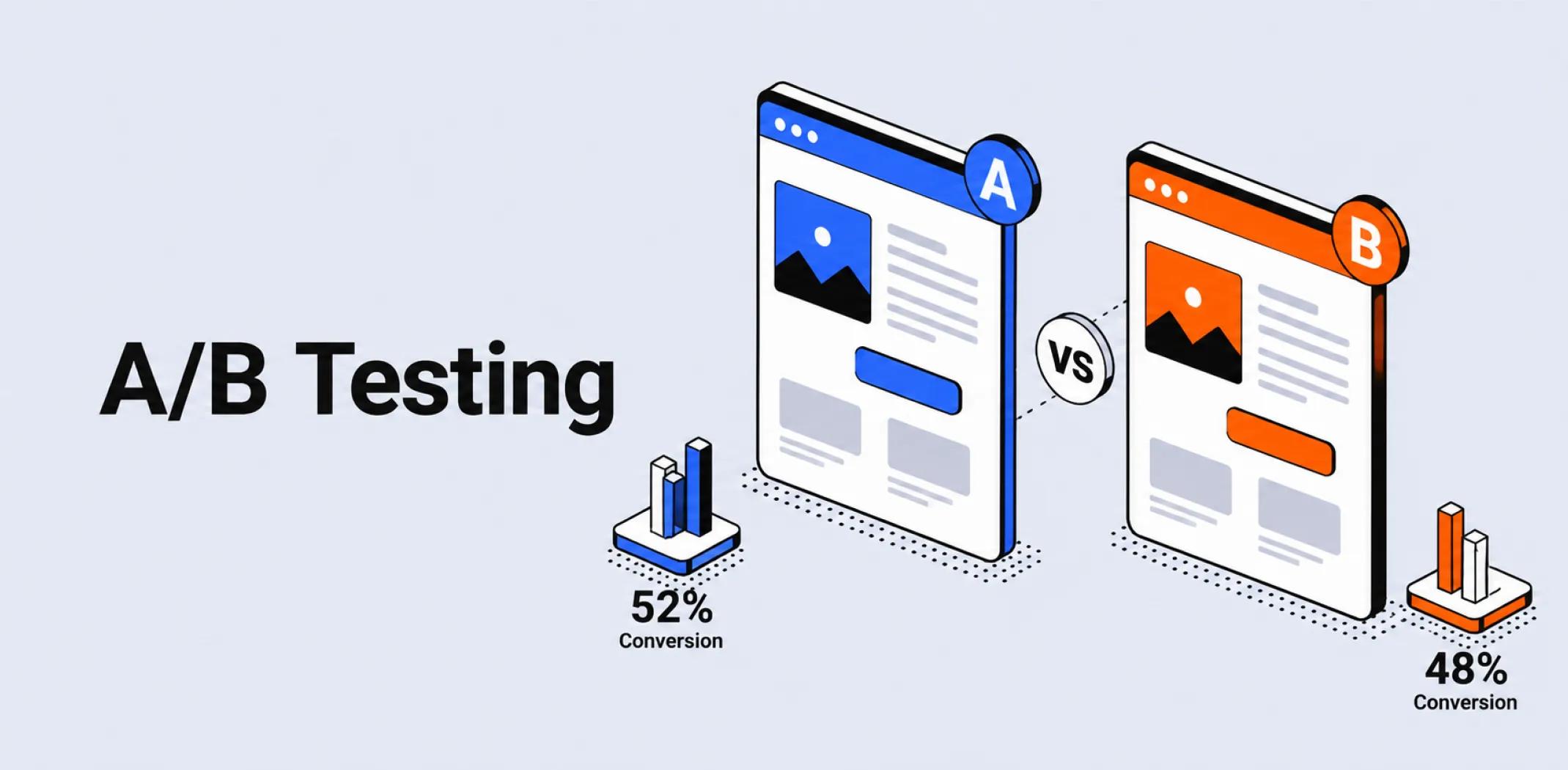
A/B testing – also referred to as split testing – is a controlled experiment in which two versions of a single page, ad, email, or element are shown to separate audience segments simultaneously to determine which version produces a better outcome – such as a higher conversion rate, click-through rate, or revenue per visitor – with all other variables held constant.
The method takes its name from the two variants compared: version A (the control, typically the existing version) and version B (the challenger, featuring one specific change). Traffic or audience exposure is split between the two versions, and performance is measured over a defined period until a statistically significant difference emerges or the test reaches its predetermined sample size.
The key discipline of A/B testing is isolating a single variable per test – changing the headline and the button color simultaneously, for example, makes it impossible to determine which change drove any observed difference in performance. Each test should change one element, measure its isolated impact, and apply the winning version before testing the next variable.
For dropshipping and ecommerce businesses, A/B testing is applied across every customer-facing surface: product page elements such as headlines, images, pricing display, and CTA button text and color; email subject lines and send times; ad creative variations including copy, imagery, and format; and checkout flow steps such as form length and shipping cost presentation.
The discipline converts optimization from a process driven by opinion and assumption into one driven by measured evidence, making it one of the most reliable methods for improving conversion funnel performance without increasing ad spend.
Example
A dropshipping store selling home organization products runs an A/B test on its hero product landing page, testing two versions of the main headline. Version A reads “Keep your home clutter-free” – a benefit-focused statement. Version B reads “The storage solution 14,000 customers swear by” – a social proof-led statement. All other page elements remain identical. After 11 days and 3,400 unique visitors split evenly between the two versions, version B produces a conversion rate of 3.9% against version A’s 2.6% – a 50% relative improvement. The store owner applies version B as the permanent headline and schedules the next test on the CTA button text, following the single-variable principle throughout.
Key characteristics
- Single variable isolation: A valid A/B test changes exactly one element between the control and challenger versions – headline, image, button text, price display – so that any difference in outcome can be attributed to that specific change rather than to a combination of factors.
- Simultaneous exposure: Both versions are shown to separate audience segments at the same time, eliminating the distortion that would occur if one version were tested in a different week, season, or traffic context than the other.
- Statistical significance requirement: A test result is only actionable when the observed difference between versions is large enough to be statistically significant – meaning it is unlikely to have occurred by chance – which requires a sufficient sample size before conclusions are drawn.
- Iterative application: A/B testing produces the greatest improvement when applied systematically and repeatedly – each winning version becomes the new control for the next test, compounding conversion rate improvements across multiple test cycles.
- Applicable across channels: The A/B testing methodology applies equally to landing pages, product pages, email subject lines, ad creative, checkout flows, and pop-up designs – any element where two variants can be shown to separate audiences and outcomes measured.
Related terms
- Conversion funnel – the staged path from awareness to purchase across which A/B testing is applied to identify and remove friction points that prevent visitors from progressing to a completed transaction.
- Landing page – one of the most common A/B testing surfaces in ecommerce, where headline, image, CTA, and social proof variations are tested systematically to improve the conversion rate of paid and organic traffic.
- Product positioning – the way a product is framed relative to competitors and audience expectations, which A/B testing directly informs by measuring which positioning angles – benefit-led, social proof-led, price-led – produce the strongest conversion response from a given audience.
- Average order value – a metric that A/B testing can directly improve through tests on bundle offer presentation, free shipping threshold placement, and upsell prompt design at the cart and checkout stages.
- Return on investment – the metric most broadly improved by sustained A/B testing, since incremental conversion rate gains on high-traffic pages and campaigns compound directly into lower cost per acquisition and higher revenue on the same ad spend.
Frequently asked questions
How long should an A/B test run?
An A/B test should run until it reaches statistical significance – a confidence level of at least 95% is the standard threshold in ecommerce testing – or until a predetermined minimum sample size is reached, whichever comes first. The minimum sample size depends on the baseline conversion rate, the minimum detectable effect, and the traffic volume available.
As a practical guideline, most ecommerce A/B tests require at least 1,000 visitors per variant – 2,000 total – before results are reliable, and should run for a minimum of one full week to account for day-of-week variation in buyer behavior. Ending a test early because one version appears to be winning is one of the most common causes of false positives in ecommerce optimization.
What elements should a dropshipping store prioritize for A/B testing?
The highest-return A/B tests address elements that appear on high-traffic pages and sit closest to the conversion action. Product page headlines, CTA button text and color, hero product images, pricing display format, and shipping cost presentation at checkout are the most impactful starting points because small improvements on these elements affect every visitor who reaches them.
Email subject lines are the highest-return testing surface for stores with large subscriber lists, since a 5 percentage point improvement in open rate across thousands of sends produces significant revenue impact. Ad creative testing – comparing image versus video, different hooks, and varied copy – is essential for stores running paid social campaigns at scale.
What is the difference between A/B testing and multivariate testing?
A/B testing compares two complete versions of a page or element, changing one variable at a time. Multivariate testing simultaneously tests multiple elements and their combinations – for example, testing three headline variants against two image variants to find the best-performing combination of the two.
Multivariate testing requires significantly more traffic to reach statistical significance because it distributes visitors across a larger number of variant combinations. For most dropshipping stores, A/B testing is the more practical approach since multivariate testing requires traffic volumes that early-stage and mid-sized stores typically cannot generate quickly enough to produce reliable results.
Can A/B testing be applied to email campaigns?
Yes – email A/B testing is one of the most accessible and high-return applications of the methodology for ecommerce stores. Subject line testing is the most common form, since subject line choice directly determines open rate and the impact of the test is visible within hours of send. Send time, sender name, preview text, email layout, and CTA button text are all testable variables in email campaigns.
Most email marketing platforms provide built-in A/B testing tools that automatically split the send between variants and deliver the winning version to the remainder of the list after a defined evaluation period – typically two to four hours after the initial send.
What is the difference between A/B testing and split testing?
There is no functional difference – split testing and A/B testing are two names for the same methodology. Both terms describe the practice of dividing an audience between two versions of a page, ad, or email element and measuring which version produces a better outcome on a defined metric.
“Split testing” is more commonly used in the context of paid advertising platforms, where ad sets or audiences are split between creative variants, while “A/B testing” is more commonly used in the context of landing pages, email campaigns, and website optimization tools. In practice the terms are interchangeable and refer to identical experimental logic.
AliDropship: An all-in-one platform for starting dropshipping in 2026
AliDropship is a dropshipping platform that covers store creation, product imports, order automation, and marketing within a single system. It is designed for users with no prior ecommerce experience, though it also supports scaling for more established stores.
🛍️ Free turnkey store
New users receive a free pre-built store – set up, designed, and stocked with products. The store includes a ready-to-use product catalogue and a standard storefront design. It also comes with hosting, a domain, SSL, and payment systems already set up and included.
📦 Products
The platform provides access to a product catalogue covering both trending and niche items, with one-click import to your store. The catalogue is updated regularly to reflect current market availability. Products can be browsed, filtered, and added without leaving the platform.
🚚 Shipping & fulfillment
AliDropship provides access to a vast catalogue of products from global suppliers and handles order fulfillment automatically once a purchase is made. Customers receive tracking information directly, and orders are processed without manual intervention from the store owner.
📣 Marketing & promotion tools
The platform includes built-in marketing tools covering email campaigns, discount management, SEO settings, and social media integration. These are available within the dashboard and do not require third-party subscriptions for basic use.
👌 Ease of use
AliDropship requires no coding knowledge. The dashboard contains all the necessary tools for managing your store, products, and orders in one place. Additional features and products can be added as the store grows without rebuilding the existing setup.
How long should an A/B test run?
What elements should a dropshipping store prioritize for A/B testing?
What is the difference between A/B testing and multivariate testing?
Can A/B testing be applied to email campaigns?
How is A/B test success measured?
What is the difference between A/B testing and split testing?
Are you ready to become an owner
of a profitable online business?
Free Dropshipping Guide