Brand Building: How To Grow A Business People Trust

Most businesses that fail in their first year have the same problem – they sell products, but they never build a brand. There is a difference, and it matters more in 2026 than it ever has. Brand building is the process of shaping how people feel about your business: what it stands for, why they should trust it, and why they should come back.
If you are selling online and wondering why traffic does not convert or why customers do not return, your brand strategy – or the lack of one – is almost certainly part of the answer.
Quick Answer: Brand building is the ongoing process of defining your business identity, communicating your values consistently, and creating recognizable experiences that earn customer trust and loyalty over time.
This guide covers what brand building actually involves, how it applies to an ecommerce or dropshipping brand specifically, and what practical steps you can take right now – whether you are starting from zero or trying to sharpen a store that already exists.

What is brand building?
Brand building is the deliberate work of creating and strengthening the perception people have of your business. It covers everything from your store name and logo to your tone of voice, your packaging, your customer service style, and the kind of content you put out. None of it is accidental in a well-run business – every touchpoint is a decision.
In practical terms, brand building means answering three questions clearly: Who are you? Who are you for? Why should anyone care? Once you can answer those consistently, every other marketing and sales decision gets easier. Your ads, your product descriptions, your social posts – they all pull in the same direction.
For an ecommerce or dropshipping brand in 2026, the stakes are higher than they were five years ago. Ad costs have risen, competition has intensified, and consumers have become more skeptical. A faceless store with no clear identity struggles to convert cold traffic. A store with a defined brand identity – even a simple one – builds familiarity and trust much faster.
Why this works in 2026: Shoppers now research before they buy. A consistent brand across your store, social media, and ads reassures them that your business is legitimate and worth their money.
How much can you realistically earn from a strong brand?
Brand building does not generate income directly – it is the infrastructure that makes everything else perform better. But the financial difference between a branded and unbranded store is significant and measurable. Here is a realistic breakdown of what different approaches look like in practice.
The numbers above reflect realistic ranges for ecommerce stores at different stages of brand development. A store with no defined identity relies almost entirely on paid traffic and one-time buyers. A store with a strong, consistent dropshipping brand benefits from word-of-mouth, repeat purchases, and better ad performance – because warm audiences convert more cheaply than cold ones.
One note on the top figures: Reaching $100–$300/day consistently takes 6–12 months of focused effort on both brand building and product selection. These are not overnight results – they reflect what is achievable with sustained, intentional work.
The clearest way to think about it: brand building reduces your customer acquisition cost over time. You spend less on ads per sale as your store becomes recognizable and trusted. That is the compounding return that makes brand strategy worth investing in from day one.
The core elements of brand building for ecommerce
Brand building is not one single task – it is a set of interconnected decisions that build on each other. For an ecommerce store or dropshipping brand, the following elements are the ones that matter most.
Building your brand identity
Your store name and domain
Your name is the first impression your brand makes. It needs to be easy to spell, easy to remember, and ideally something that hints at your niche or values without being so literal that it locks you in.
Generic names like “Best Deals Store” do almost no brand work. A name like “Kova Home” or “Norda Supply” is neutral enough to grow with you but specific enough to feel deliberate. Register a matching .com domain from day one – inconsistency here signals an unserious business.
Earning potential: A memorable brand name can improve direct traffic and repeat purchases significantly – stores with strong names report 20–35% higher return visitor rates over 12 months.
Logo, colors, and visual language
Your visual brand identity does not need to be elaborate, but it does need to be consistent. Pick two or three brand colors and use them everywhere – your store header, your email templates, your social posts, your packaging inserts if you use them.
A consistent color palette alone creates recognition faster than most people expect. Your logo does not need to cost $500 – a clean wordmark in a well-chosen font is often more professional than an overcomplicated icon.
Important: Consistency matters more than polish. A simple identity applied consistently outperforms a beautiful identity applied randomly.
Tone of voice
Tone of voice is the personality of your brand in written form. Are you warm and friendly? Direct and no-nonsense? Playful and witty? Whatever you choose, write it down and apply it everywhere – product descriptions, email subject lines, social captions, customer service replies.
Customers notice inconsistency even when they cannot name it. A store that sounds corporate in emails and casual on Instagram feels untrustworthy without anyone being able to explain why.
Brand awareness and how to build it
Content marketing
Content is the most cost-effective brand awareness tool available to an ecommerce store. A blog, a YouTube channel, a Pinterest account, or a TikTok presence built around your niche puts your brand in front of people who are not yet shopping – but who will be.
This kind of brand building compounds over time: a blog post written today can drive organic traffic for years. The key is to create content that genuinely helps your target customer, not just content that promotes your products.
Social media presence
You do not need to be on every platform. Pick one or two where your target customer actually spends time and show up consistently. For most ecommerce niches, Instagram and TikTok work well for visual products; Pinterest works well for home, fashion, and lifestyle niches; Facebook still drives results for older demographics.
Post with a consistent look and feel – your visual brand identity should be immediately recognizable across every post.
Earning potential: Stores with an active social presence convert 15–25% better on paid ads because warm audiences (people who have seen your brand before) cost less to reach and convert at higher rates.
Email list building
Your email list is the one marketing channel you actually own. Social algorithms change, ad costs rise, platforms disappear – but your email list stays yours. From day one, give visitors a reason to subscribe: a welcome discount, a free guide, early access to new products.
A list of 1,000 engaged subscribers is often worth more in monthly revenue than 10,000 social media followers you have no direct access to.
Brand strategy: Positioning your store in the market
Niche focus
One of the most common brand strategy mistakes in ecommerce is trying to sell everything to everyone. A general store has no brand – it is just a catalogue. A store focused on, say, minimalist home office accessories or sustainable pet products has a clear identity, a specific audience, and a reason for customers to choose it over Amazon.
Narrowing your niche feels risky but almost always improves conversion rates and customer loyalty.
Why this works in 2026: Search and social algorithms reward specificity. A niche store gets discovered by the right people more easily and builds a loyal community faster than a generalist store.
Pricing and positioning
Where your store sits in the market is a brand decision, not just a pricing decision. A budget-positioned dropshipping brand competes on value and volume. A premium-positioned brand competes on quality, curation, and experience. Most new stores try to compete on price and end up in a race to the bottom.
If you can position yourself as the trusted expert in a specific niche – even at slightly higher prices – you will attract better customers who return more often and complain less.
Customer experience as brand
Every interaction a customer has with your store is a brand building moment. The speed of your site, the clarity of your product descriptions, the speed of your email replies, the quality of your packaging – all of it shapes how they feel about your brand and whether they come back.
Studies consistently show that 60–70% of customers who have a great experience will buy again, while a single bad experience drives 33% of customers to a competitor permanently.
Legal and ethical considerations in brand building
Brand building has a few legal and ethical pitfalls worth knowing about – especially for new store owners who might not realize where the lines are.
Key principle: Your brand must be honest about what it is, what it sells, and what customers can expect – always.
What to avoid
- Fake reviews: Buying or fabricating customer reviews is against the terms of service of every major platform and, in many jurisdictions, illegal under consumer protection law. It also destroys trust permanently if discovered. Reddit and Trustpilot communities are quick to call out stores caught doing this.
- Misleading claims: Do not claim your products are “the best,” “the only,” or “#1” without evidence. Vague superlatives frustrate customers and can attract regulatory attention in some markets.
- Copying competitor branding: Using a name, logo, or color scheme that is confusingly similar to an established brand is trademark infringement. Even if you do it accidentally, the legal and reputational cost is not worth it.
- Spam and aggressive retargeting: Bombarding customers with emails or ads after a single visit damages your brand perception. Permission-based marketing – where customers have opted in – performs better and protects your sender reputation.
What to do instead
- Encourage genuine reviews by making it easy – follow-up emails, simple review links, and excellent service do this naturally.
- Be specific and honest in all claims: “ships within 3–7 business days” is more trustworthy than “fast shipping.”
- Run your brand name through trademark databases before launching to avoid conflicts.
- Build an email list with clear opt-ins and give subscribers easy ways to manage their preferences.
How to choose your brand building approach by reader profile
There is no single brand strategy that works for every stage of business. Here is how to think about it depending on where you are right now.
Complete beginner
If you are starting from scratch, do not overthink brand building in the early days. Pick a niche you understand, choose a clean name, set up a consistent visual identity (name, logo, two colors), and write a one-sentence brand positioning statement: “We sell [product type] for [specific customer].”
That clarity alone puts you ahead of most new stores. Focus on getting your first 10 sales before refining anything else. Aim for 60–90 days before evaluating whether your brand positioning is working.
Intermediate / part-time
If you have a store running but growth has stalled, brand strategy is often the missing lever. Audit your store for consistency: does your visual identity match across your homepage, product pages, emails, and social accounts? Is your tone of voice consistent?
If not, tighten these up before spending more on ads. At this stage, adding a blog or content series around your niche can start building organic brand awareness that compounds month over month.
Advanced / full-time goal
If your goal is a full-time income from ecommerce, brand building is non-negotiable. At this level you need a defined brand identity, an active content and email strategy, a social presence, and a consistent customer experience across every touchpoint.
The stores that reach $200–$500/day and sustain it are almost always the ones that have invested in brand – they have audiences, repeat buyers, and word-of-mouth working for them. Tools like AliDropship can support this growth with built-in marketing features that reduce the operational load.
The forward-looking reality is encouraging: as AI-generated stores become more common, authentic brand identity becomes a stronger differentiator. The ecommerce stores that win in the next few years will be the ones with a genuine voice, a specific audience, and a consistent experience – not just the ones with the lowest prices.
AliDropship: Your complete all-in-one solution for starting dropshipping in 2026
If you want the simplest possible way to start dropshipping – especially if you’re brand new – AliDropship remains one of the most beginner-friendly tools available in 2026. It brings together store creation, product imports, automation, and marketing into a single streamlined system designed to help you launch quickly and grow confidently.
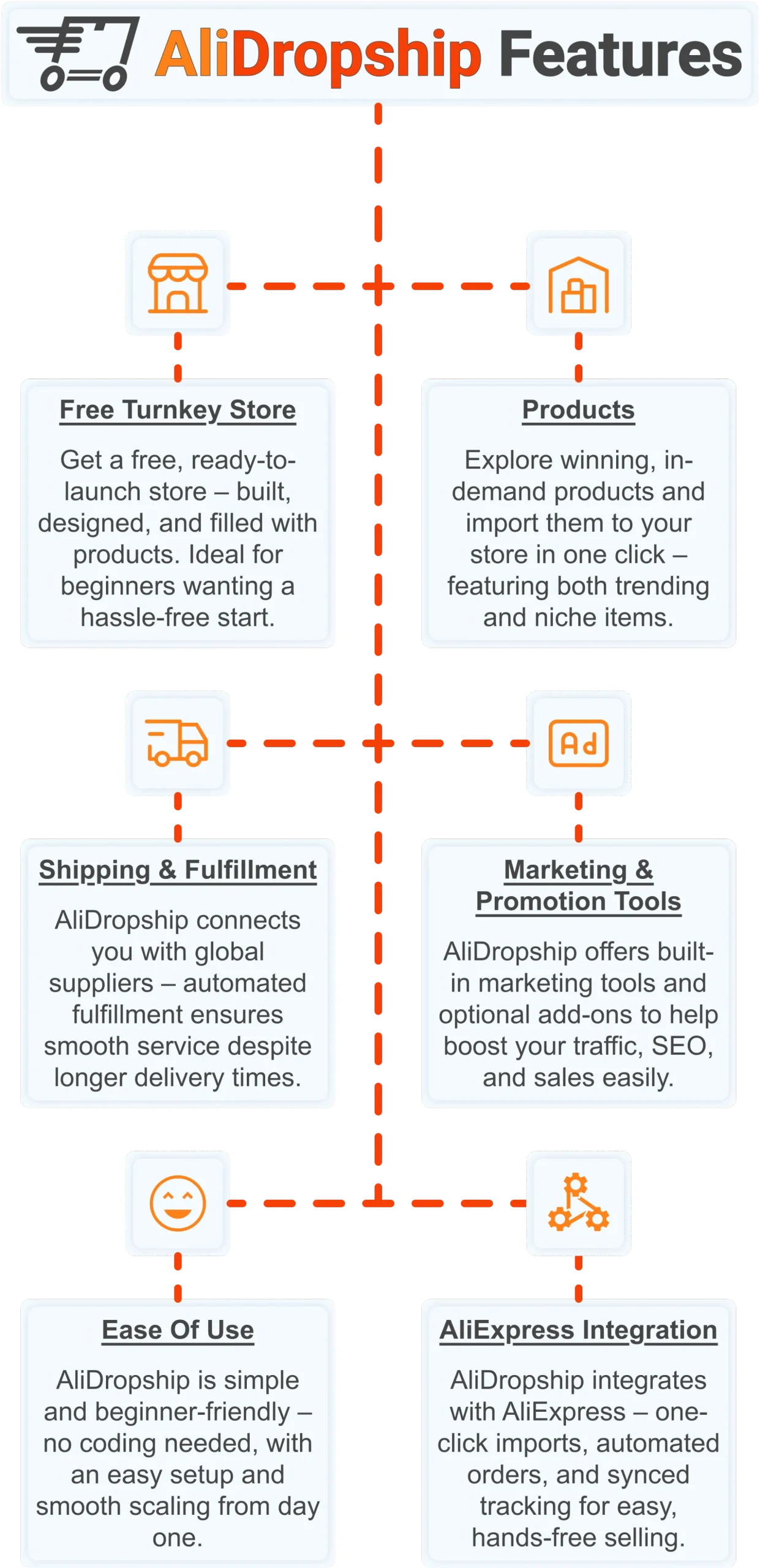
Free turnkey store 🛍️
Get a free turnkey store – built, designed, and filled with products. Ideal for beginners wanting a hassle-free start, the store comes fully optimized to attract customers right away, saving you time on setup. Plus, it includes professional design elements to give your business a polished, trustworthy look from day one. This ready-made foundation makes it easy to move seamlessly into product selection.
Products 📦
Once your store is set up, you can explore winning, in-demand products and import them in one click – featuring both trending and niche items. This wide selection lets you cater to diverse customer interests and test what works best. Regular updates ensure you always have fresh products, keeping your store competitive and relevant. With great products in place, smooth shipping becomes the next essential step.
Shipping & fulfillment 🚚
AliDropship connects you with global suppliers, and automated fulfillment ensures seamless order processing despite international delivery times. Customers receive real-time tracking updates, which builds confidence and trust in your store. Once shipping is handled reliably, you can focus on promoting your store and attracting traffic.
Marketing & promotion tools 📣
To maximize sales, AliDropship offers built-in marketing tools and optional add-ons that help boost traffic, SEO, and conversions. From email campaigns and discounts to social media integration, these tools empower you to reach and retain customers without needing prior marketing experience. With promotion strategies in place, managing your business becomes simpler and more efficient.
Ease of use 👌
AliDropship is beginner-friendly – no coding needed, with an intuitive dashboard that guides you through every step. Easy setup and smooth scaling let you expand your store without stress. As your business grows, adding new features, products, and marketing campaigns remains hassle-free, giving you more time to focus on sales.
AliExpress integration 🛒
Finally, AliDropship integrates seamlessly with AliExpress, enabling one-click imports, automated orders, and synced tracking. Your inventory stays up-to-date with the latest products and prices, while automated order processing frees you from manual tasks. Combined with the turnkey setup, reliable shipping, and built-in marketing tools, this integration ensures your dropshipping business is fully equipped for growth and success.
Brand building is what turns a store into a business people return to – and AliDropship gives you the platform to build that brand from day one. Get your free turnkey store and start building a brand that lasts.
What is brand building in ecommerce?
How long does brand building take to show results?
Most ecommerce store owners start seeing meaningful brand recognition results within 60 to 90 days of consistent effort. This includes maintaining a cohesive visual identity, posting regularly on one or two social platforms, and delivering a reliable customer experience. Building a loyal audience that drives repeat purchases and word-of-mouth referrals typically takes 6 to 12 months of sustained brand strategy work. The businesses that see the fastest results are the ones that commit to a specific niche and communicate it clearly from day one.
What makes a strong dropshipping brand identity?
A strong dropshipping brand identity has four core components: a clear niche focus, a consistent visual language (name, logo, colors), a defined tone of voice, and a reliable customer experience. The visual and verbal elements should match across every platform the brand appears on, from the store homepage to email campaigns to social media posts. Niche specificity is particularly important in dropshipping because it differentiates a store from generic competitors and makes it easier for the right customers to find and remember it. Brands that are honest about delivery times and product details build trust far faster than those that overpromise.
What is a brand strategy and why does it matter?
A brand strategy is the plan that defines how your business is positioned in the market and how it communicates with its target customer. It covers your target audience, your key differentiators, your pricing position, and your content and marketing approach. Without a brand strategy, marketing spend tends to be scattered and inconsistent, making it harder to build recognition or loyalty. Stores with a clear brand strategy spend less per customer acquisition over time because their audience grows through repeat buyers and referrals rather than relying entirely on paid traffic.
How much does brand building cost for a new store?
Brand building does not require a large budget. A domain name costs 10 to 15 dollars per year. A basic logo can be created for free using tools like Canva or for 20 to 50 dollars on freelance platforms. The biggest investment is time – writing consistent content, showing up on social media, and delivering a great customer experience cost more in hours than in money. The most impactful brand building activities for a new store, such as content marketing and email list building, can be done at almost no cost and produce compounding returns over 6 to 12 months.