AI VS Manual: What Still Requires Human Judgment In Dropshipping

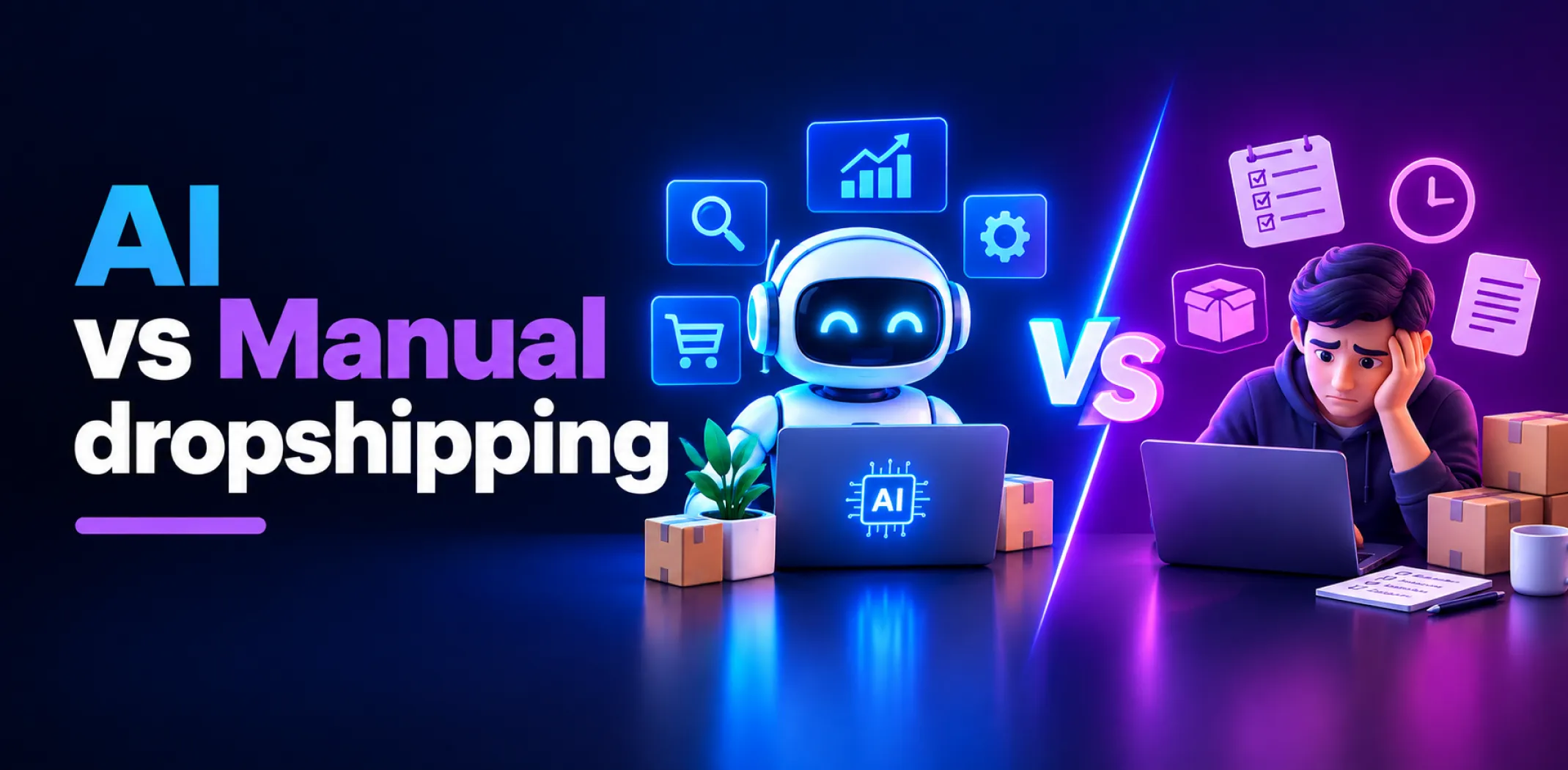
You have probably heard two loud opinions about running an online business in 2026. One says AI will do the whole job while you sit back. The other says real business owners do every task by hand. If you are about to open your first store, neither opinion helps much, because both skip the question that actually matters: which jobs can you hand off safely, and which ones still need you?
This guide gives you the honest split. It is not the hype version and it is not the fear version. You will see what each approach really involves, where manual work still wins, and the four judgment calls that stay with you no matter how good the software gets.
A quick note on where we are coming from. AliDropship is an online business platform that gives beginners a ready-made store, a loaded catalog of digital products, and one-click ads, with no experience or tech skills needed. That setup makes it a useful working example for the AI-versus-manual question, so you will see it mentioned along the way.
AI vs manual: What each approach really means
Let us start with plain definitions, because both words get stretched in every direction online. Manual means you personally do each task in your business. You design the store, create your own products, learn the ad tools, write the copy, and handle every routine step yourself.
AI-powered means software takes over the repeatable, rule-based work while you supervise. The store may arrive already built, digital products may deliver on their own, and ads may be set up with one click. If you want the full definition first, this plain-English guide to AI-powered stores covers it. Either way, remember that AI-powered tools are still tools. They do the jobs you point them at, and they do not decide what your business is for.
Why does this matter for you? Because the choice is rarely all or nothing. Even the most automated setup leaves real decisions on your desk, and even the most hands-on setup can borrow automation for the boring parts. The useful question is not which side wins. It is which tasks belong on which side.
It also helps to see where the wider category stands. AI tools have improved quickly, and the honest picture is more nuanced than either camp admits. Our look at how AI is reshaping online business in 2026 tracks that bigger picture, while this article zooms in on the day-to-day work of running a store.
Side by side: Manual work and AI-powered work
Here is the comparison in its simplest form. The rows below focus on the parts of the job a beginner feels most: setting up, choosing products, promoting the store, and keeping up with daily work.
Notice that neither column is all good or all bad. Manual work teaches you how every piece fits together, and some people genuinely enjoy that. The catch is time. Every task you do by hand is a task that is not spent talking with customers or improving your offer.
Picture two beginners who each have about five hours a week to spare. The first builds the store by hand, writes every product page, and learns the ad tools from scratch, so a good share of the early weeks can disappear into setup.
The second starts with a built store and loaded products, so the same five hours go toward choosing products and reading early results. This is a made-up illustration, not a customer story, and real timelines vary, but it shows where the hours tend to go.
The AI-powered column removes much of that setup weight, which is why it suits beginners with a full-time job or a busy home. Still, the last row of each card tells the real story. Even when the routine work is handled, the important decisions do not disappear. They simply become the main job.
What AI does well
Give AI a repeatable job with clear rules and it shines. It does not get tired, it does not forget a step, and it works at the same pace on your fifth product as on your first. That is a real advantage for anyone who has stared at a blank store dashboard wondering where to begin.
In practice, three areas benefit most. The first is setup. A store that arrives built and stocked, with 60+ digital products already loaded, removes a long list of design and coding decisions that used to block beginners.
The second is delivery. Digital products reach the buyer the moment they pay, so there is no manual step on your side.
The third is promotion. With one-click ads, the system handles targeting, creatives, and optimization once you pick a daily budget, so you do not need to learn Google Ads or Facebook Ads first.
There is also a newer kind of AI product you can sell. AI Toolkits ask the buyer a few simple questions, then instantly generate a tailored plan, script, or guide built around those answers instead of handing over a static file.
The catalog covers 100+ toolkits across productivity, wellness, and sales, including the AI Productivity Toolkit, the AI Wellness Toolkit, and the AI Sales Toolkit. If you are curious how they work from the buyer perspective, this explainer on AI Toolkits walks through it.
Automation reaches further than this list, of course, and it keeps spreading into areas like email and reporting. For a broader view of what automated store work looks like, read how store automation works, and see this overview of AI in ecommerce for the wider tool landscape. As you read them, keep one thing in mind: every tool on those lists still needs a person to point it at the right goal.
What still requires a human
Here is the part the hype leaves out. AI is very good at doing a task and much less good at knowing whether the task is worth doing. It can produce a confident answer that is wrong, and it has no stake in your business. Someone has to look at the output and say yes, no, or not yet. That someone is you.
Here is a simple example.
An AI tool can write a friendly product description in seconds, yet it cannot tell whether the promise inside that description is accurate, fair, or a good fit for your buyers. Checking claims, tone, and fit is a human job, and it protects your reputation as well as your customers. The same goes for anything that reaches the public under your store name.
Our companion piece on what AI can and cannot do goes deeper on the technical limits. For now, these four judgment calls are the ones worth protecting, because each one shapes everything that comes after it.
Choosing what fits your audience
The catalog gives you 60+ digital products to start with, but no tool can tell you which ones suit the people you want to reach. You know the needs of your audience far better than software does, so this call stays yours.
Setting your daily ad budget
One-click ads handle targeting, creatives, and optimization, but the amount you spend each day is your decision. The range runs from $10 to $50 per day, and only you know what feels comfortable for your situation.
Reading what the results mean
Data shows what happened, such as which products got attention and which got skipped. It does not explain why. Turning those numbers into a sensible next step takes context that only you have about your offer and audience.
Knowing when to change course
Software can flag a pattern, but deciding to swap a product, pause spending, or try a new angle is a judgment call. It also means accepting that a first idea sometimes needs to change.
None of these four calls needs a degree or a tech background. They need attention, patience, and a willingness to look at what is actually happening in your store instead of what you hoped would happen. That is a very human skill, and it is one a beginner can build with practice.
It is also worth saying plainly that good judgment improves your odds but does not settle them. Sales depend on your audience, your offer, and plenty of things nobody controls, and results vary from one store owner to the next. Treat every decision as a small experiment rather than a verdict.
Who leads on each task: AI or you
If you like to see everything in one place, this table sums up the split. Read it as a rule of thumb rather than a law, because every business is a little different.
Think of the table as a handoff list. The first three rows are jobs you can usually hand to the platform once and then check now and then. The last three rows are jobs you return to again and again, because they change as your store and your audience change. Nobody can hand those off for good.
A pattern shows up when you scan the middle column. Anything repeatable, rule-based, and low-stakes leans toward automation. Anything that depends on your audience, your budget, or your read of the situation leans toward you. If a task feels like following a recipe, hand it off. If it feels like tasting the soup, keep it.
This is also why the phrase AI-powered can mislead. The AI does not run your business. It runs pieces of the work, and you run the business. Keeping that straight will save you from both blind trust and needless worry.
Where manual work still wins
It would be dishonest to say automation wins everywhere. Some parts of an online business get better when a person does them by hand, at least for a while.
Customer conversations come first. When someone writes with a question, a reply in your own voice builds trust that no template can copy.
Learning by doing is the second area. If you have done a task once yourself, you understand what the automated version is doing, and you can spot it when something looks off.
Original ideas are the third. Software tends to lean toward the average answer, while your particular angle, story, or niche is what can make a store feel like yours. Use automation to clear the routine, then spend the time you save on the parts only you can bring.
A useful rule is to go manual on purpose when the stakes are personal or when you are still learning, and to automate once a task repeats every week. Do a new task by hand one time, note what you did, and then decide whether a tool can take it over. That order keeps you in charge instead of following the tool.
How to split the work in your first month
Here is a simple way to put all this into practice without overthinking it. Let the platform take care of setup, then spend your own time on the four judgment calls.
In week one, look through the catalog and pick a small set of products you could explain to a friend in one sentence. In week two, turn on one-click ads at a daily budget you feel comfortable with. The range is $10 to $50 per day, so starting at the low end is a perfectly reasonable way to learn. In weeks three and four, read the results, keep what gets attention, and swap out what does not.
Two practical notes so nothing surprises you. The free trial runs for 14 days, then the plan is $39/month, and a small order fee applies to each completed sale. Ad spend is separate and set by you. Knowing these numbers up front is part of good judgment too.
One habit is worth building early: a short weekly check-in. Ten minutes on the same day each week is enough. Look at which products got attention, how your ad budget felt, and what you want to change next, then write down one decision and one question. Over a few weeks, those notes become a record of your own judgment, and that record is worth more than any single result.
Treat the first month as a learning period, not a scoreboard. Your store can be ready to sell the day you turn ads on, but how quickly sales arrive depends on many things, and results vary. The goal of month one is to learn how your store and your audience behave.
Where AliDropship fits in the AI vs manual picture
AliDropship is built around the split this article describes. The store, the loaded products, and the one-click ads cover the routine parts, and the four judgment calls stay with you. If you want a place to try that balance on a real store, this is what you would be working with.
No experience? No problem. If you want the simplest way to start an online business in 2026, AliDropship is one of the most beginner-friendly platforms out there. It brings your store, your products, and your marketing together in one place, so you can launch fast and grow with confidence. Over 1,500,000 stores have already been built on AliDropship, and the platform has been featured by Forbes, Entrepreneur, Inc., NBC, Business, and Fox News.
Numbers like these describe the platform as a whole over time. They are not a forecast for any single store, and results vary from one owner to the next. What the platform can do is remove the setup work, so more of your attention goes to the decisions that matter.
Back to the question this article started with. AI vs manual is not a contest you have to pick a side in. Let automation carry the repeatable work, keep the four judgment calls for yourself, and revisit the split as you learn what your store needs. For the wider view of where all this is heading, continue with our full look at where AI-powered online business stands.
When you are ready to test it on a real store, the trial gives you a low-pressure way to begin. Turn on your ads at a budget you choose, watch what happens, and decide what to change next. The software handles the routine steps, and the judgment stays with you, right where it belongs.
What is the difference between AI and manual dropshipping?
Can AI run a dropshipping business without a human?
Is AI dropshipping better than manual dropshipping for beginners?
Do I need technical skills to start AI dropshipping?