How Does AI-Powered Pricing Work In Dropshipping?

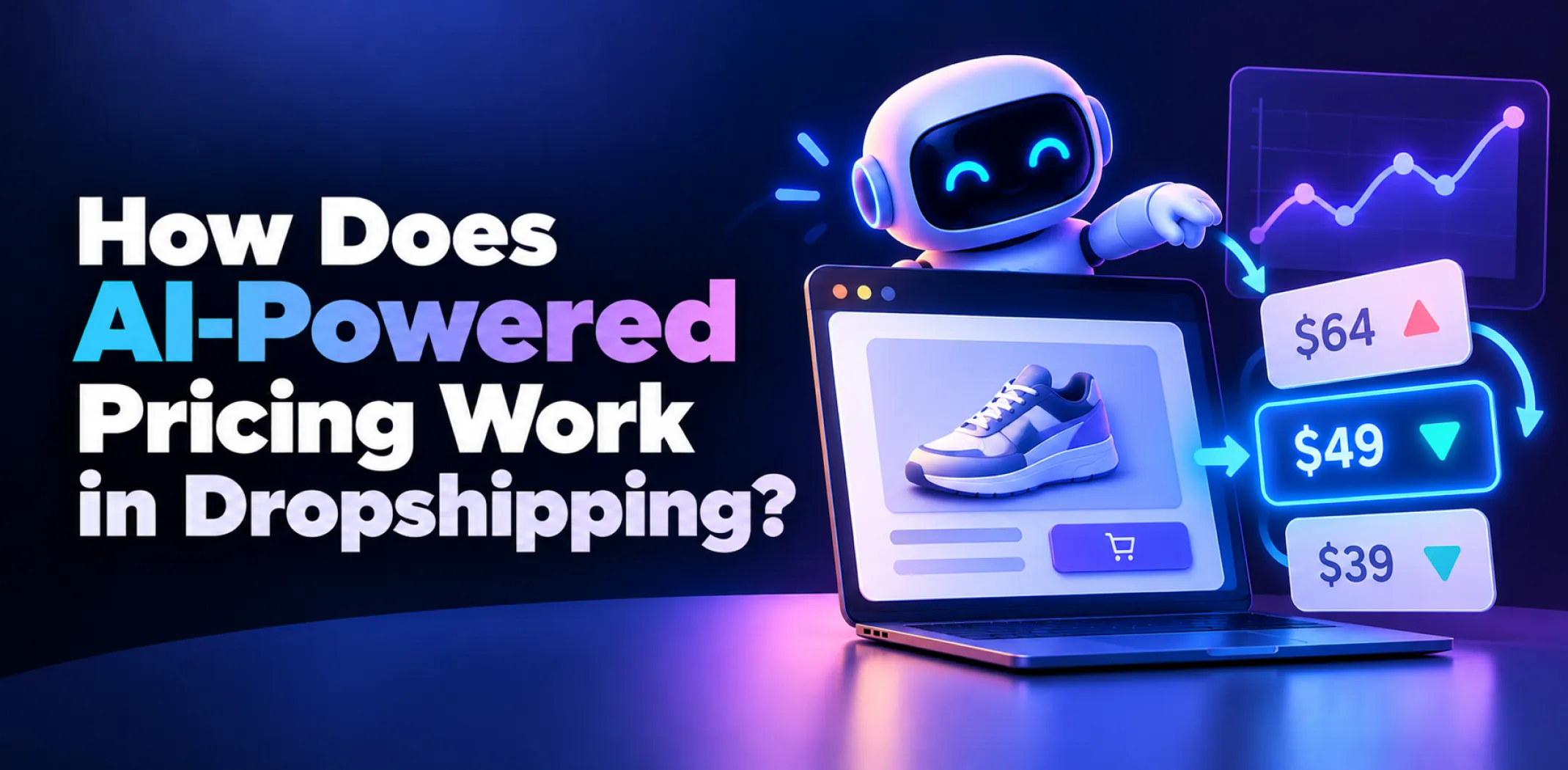
Yes, AI can set prices on its own, and some AI tools for online stores are built around exactly that. Dynamic pricing means a price that changes automatically when conditions change, such as demand, stock levels, or what competing stores charge. AI makes the process faster, because software can watch those signals all day and adjust prices without anyone editing a product page by hand.
If the term is new to you, our guide to what AI dropshipping is and how it works covers the big picture first. This article stays on one narrow question: how AI-powered pricing really works, where it helps, where it creates problems, and what it means if you plan to sell digital products such as guides, courses, checklists, and AI toolkits.
Pricing software gets a lot of attention, so it helps to separate what it actually does from what it is said to do. By the end, you will know the working parts, the limits, and a simpler way to think about pricing that does not depend on any special tool.
What dynamic pricing means for an online store
Dynamic pricing is a price that moves. Instead of staying at one number until you change it, the price rises or falls when something measurable changes. You already see it in everyday life: ride fares that climb at busy times, flight tickets that change with the season, and hotel rooms that cost more when a city fills up.
In an online store, the signals are usually the same few. Demand is one, meaning how many people are viewing or buying. Stock levels are another, since a nearly sold-out item can justify a higher price. The third is competitor pricing, because a shopper comparing two stores will often pick the cheaper one. Time of day, season, and promotions can feed in as well.
A pricing rule connects those signals to a price. A simple rule might read: if a rival lowers its price, lower ours by the same amount, but never go below a set floor. That is dynamic pricing without any AI at all, and basic versions are common.
How AI changes the way prices get set
The difference between rule-based and AI-driven pricing is who does the thinking. With rules, a person decides every if-then step in advance. With AI, a model studies past sales and market data, estimates how buyers react when a price moves, and then suggests or applies a new price on its own. A well-run setup still has limits that you set, such as a price floor and a price ceiling.
In practice, an AI pricing tool tends to work in four stages. It collects signals, estimates how sensitive buyers are to price, picks a price inside your limits, and then checks what happened so it can adjust next time. That last stage is what makes it feel like AI, because the tool keeps learning from results instead of following a fixed script.
Our guide to ecommerce pricing strategies compares the older cost-based, competitor-based, and value-based methods these tools build on.
So, does AI dropshipping really use dynamic pricing?
It depends on the tool, because AI dropshipping is a broad label for several kinds of software rather than one product. Pricing is only one job a tool might take on, next to jobs like product research, writing descriptions, and answering customer questions. Shopify’s guide to AI dropshipping lists price optimization among the tasks AI can help with, and some tool makers advertise features that watch competitor stores and adjust your prices to match.
Still, setting prices by hand remains a valid choice, and for good reason. A tool only knows what you feed it. It does not know your costs, your audience, or how your brand should feel unless you set those limits yourself. A tool told to match the lowest competitor can quietly drag a price down until almost no margin is left, which is why the limits you choose matter more than the AI itself.
The honest takeaway is simple. Treat automatic pricing as one optional feature to evaluate, not as proof that a platform is using AI well. When you compare tools, ask what signals each one reads, what limits you control, and whether you can see why a price changed.
Why digital products change the pricing question
Most of the signals that move prices in a typical online store do not exist for digital products. A guide, course, checklist, online tool, or AI toolkit has no stock to run out and no delivery delay to price around. Delivery is instant and automatic, so a busy day and a quiet day look the same on the supply side.
That leaves two main inputs: what the product is worth to the buyer, and what similar products cost. Both change slowly, so a person can review them every few weeks instead of every few minutes. For a beginner, a simple and steady price is also easier to test and easier for buyers to trust than one that keeps moving.
It also helps to know how the money works around a price. On AliDropship, digital product sales carry a 50 to 70 percent margin on each sale after order fees, and your monthly plan and any ad spend are separate costs on top. Our guide to how your margin works on each sale walks through the math, and the difference between revenue and profit is worth reading before you judge any price by sales alone.
Risks to know before you automate prices
Automatic pricing can backfire in quiet ways. Frequent swings can confuse shoppers who saw one price yesterday and a different one today. A tool set to match rivals can pull a price down until little margin is left. And when a tool uses personal details about each shopper, such as location or browsing history, you move into more sensitive territory.
That last point is not only about trust. Since November 2025, New York has required a clear notice when an algorithm uses a shopper’s personal data to set a price. The law does not ban dynamic pricing, but it shows where regulators are looking, and other states have considered similar bills. This is general information rather than legal advice, so check the rules where your buyers live before you personalize prices.
How to price a digital product without dynamic pricing
You do not need software to price well. You need a clear view of what the product does for the buyer, a floor you will not go below, and a habit of changing one thing at a time. Even when a product arrives with a price already set, understanding what a good price rests on makes every later decision easier.
Think of it as a slow version of dynamic pricing that you run yourself. You gather the same kinds of signals, such as orders, questions from buyers, and what similar products cost, but you act on them every few weeks instead of every few minutes. Our guide to digital product pricing goes deeper on common price points and a simple testing plan.
Price the result, not the file
Buyers pay for what a guide, checklist, or toolkit helps them do, not for how many pages it has. Ask what that result is worth to your audience, then compare it with similar products. Start there before you test anything.
Change one price at a time
Pick one product, change only its price, and leave everything else alone for a set stretch of time. If you change the price, the title, and the ads together, you cannot tell which change made the difference.
Bundle before you discount
If a product is slow, adding a related checklist or guide to the same offer can add value without cutting the price. Discounts can teach buyers to wait for the next sale, while a bundle adds value instead of removing it.
Know your lowest workable price
List what comes out of each sale: ad spend, your monthly plan, and any order fee. A price floor keeps a sale from costing you more than it brings in, which matters most when you run ads.
What these four ideas share is that they keep you in control. A pricing tool can be a useful second opinion later, once you have real sales data to learn from. Without that data, even a very advanced model has little to work with.
A short test log helps. Write down the date, the old price, the new price, and the number of orders in each window. After a few rounds, you will see which changes mattered and which were noise, and your next decision will rest on facts instead of guesses.
Before you decide anything about pricing, it helps to know what you would actually be pricing. Inside an AliDropship store, that means guides, courses, checklists, online tools, and AI toolkits, and our walkthrough of what you actually sell in an AliDropship store shows the full catalog and how a single sale works. Once you can picture the products, pricing choices get much easier to reason about.
Where AliDropship fits if you sell digital products
No experience? No problem. If you want the simplest way to start an online business in 2026, AliDropship is one of the most beginner-friendly platforms out there. It brings your store, your products, your instant delivery, and your marketing together in one place, so you can launch fast and grow with confidence.
Over 1,500,000 stores have already been built on AliDropship, and the platform has been featured by Forbes, Entrepreneur, Inc., NBC, Business, and Fox News.
Pricing is one place where the platform does some of the work up front. Products in the catalog come with descriptions, pricing, and positioning already in place, so you are not building a price list from a blank page.
The place AI shows up most clearly is the AI toolkit catalog: a buyer answers a few simple questions, and the toolkit instantly generates a plan, script, or guide built around those answers. The catalog includes 100+ toolkits across productivity, wellness, and sales.
The $1.5B+ figure above is the combined total earned by all store owners, not what any single store earns, and individual results vary with the products you choose, the audience you reach, and the effort you put in.
You can try the whole setup free for 14 days, with a $40 ad coupon included to test the built-in ads. After the trial, the plan is $39/month, and you can cancel before the trial ends to avoid being charged. An order fee applies only when you make a sale, so the main costs to plan around are the monthly plan, the daily ad budget you choose, and that fee.
If you are still weighing whether to try it, a useful test is to look at the store itself. Open the free trial, look through the products already loaded, and see whether you can picture your audience wanting them. That is a better first step than any pricing tool, and the trial lets you look around before the $39/month plan begins.
So, does AI dropshipping use dynamic pricing? Sometimes, and only when a tool is built for it. For digital products, a steady price, a clear floor, and a simple testing habit take you most of the way. Everything else is a refinement you can add once you have real orders to learn from.
Whatever you choose, treat pricing as something you learn from real orders rather than something you settle on day one. Start with one product, keep simple notes, and let each small test show you what your audience values. That habit will serve you well whether a tool ever joins in or not.
Does AI dropshipping use dynamic pricing?
How does AI dynamic pricing work in an online store?
Is dynamic pricing useful for digital products?
What are the risks of automatic pricing for an online store?