Ecommerce Pricing Strategies That Actually Grow Your Business

Most ecommerce stores that fail do not fail because of bad products. They fail because of bad pricing. Set your prices too high and you lose customers to competitors. Set them too low and you stay busy but never actually build wealth. Getting pricing right is the single lever that separates stores grinding at break-even from stores scaling with real margin.
This guide covers the ecommerce pricing strategies that work in 2026 – from foundational frameworks to advanced psychological tactics – and explains exactly how each one affects both revenue and profit. Whether you are just launching or trying to fix a margin problem on an existing store, you will find a clear, actionable path forward here.
Quick Answer: The most effective ecommerce pricing strategies in 2026 combine cost-plus pricing as a floor, competitive research as a reality check, and value-based pricing as the ceiling. Layering in psychological pricing and bundle tactics on top of that framework is what drives both ecommerce growth and sustainable profit margins.
Pricing is not a one-time decision. It is one of the most dynamic, high-leverage parts of running an online store. Even small adjustments – a 10% price increase on your best-selling product, or a well-structured bundle – can shift your monthly revenue vs profit ratio dramatically without adding a single new customer.
That is why understanding the full range of ecommerce pricing strategies is so important before you touch a single price tag.

What are ecommerce pricing strategies?
An ecommerce pricing strategy is a structured method for deciding what to charge for your products. It goes beyond guessing or copying competitors. A real strategy accounts for your costs, your target customer, the perceived value of what you sell, and the competitive landscape – and then uses that data to set prices that are both attractive to buyers and profitable for your business.
In 2026, pricing strategy matters more than it did even five years ago. Ad costs have risen. Consumer price sensitivity is higher. Marketplace competition from AliExpress, Amazon, and Temu has compressed margins in many categories. Stores that treat pricing as an afterthought are constantly fighting uphill. Stores that build pricing into their growth strategy from day one have a structural advantage that compounds over time.
There are roughly a dozen distinct pricing models used in ecommerce, and most successful stores use a combination of two or three depending on the product category, customer segment, and stage of business. We will cover the most important ones – what they are, how to implement them, and where each one fits in a broader ecommerce growth plan.
Revenue vs profit: Why the difference defines your pricing decisions
Before diving into specific strategies, it is worth anchoring the entire conversation around one of the most misunderstood concepts in ecommerce: the difference between revenue and profit. Revenue is the total amount customers pay you.
Profit is what remains after every cost – product, shipping, platform fees, ads, refunds – has been subtracted. A store doing $50,000 a month in revenue with 8% net margins is making $4,000. A store doing $20,000 a month with 30% margins is making $6,000. The smaller store is actually winning.
This distinction shapes every pricing decision you make. Pricing strategies aimed purely at volume – racing to the lowest price, heavy discounting, competing on cost alone – can grow revenue while actively destroying profit. The goal of a smart ecommerce pricing strategy is to optimize for profit margin at a price point the market will bear, not to maximize order count at any cost.
The table above shows clearly that chasing revenue at the expense of margin is a losing game over time. Value-based and bundle pricing are the two strategies most consistently associated with strong ecommerce growth – not because they are complex, but because they align price with what the customer actually perceives they are getting.
One note on ceiling figures: Margins of 40–70% are achievable in the right niches – accessories, beauty, pet products, home decor – but require deliberate product selection and brand positioning. Commodity products in saturated categories will naturally compress toward lower margins regardless of strategy. Niche selection and pricing strategy work together.
The core ecommerce pricing strategies explained
The following sections break down each major pricing model – what it is, how to implement it, who it works best for, and what kind of earning potential it unlocks when applied correctly. Most successful stores combine two or three of these depending on the product and the customer.
Cost-based pricing strategies
Cost-plus pricing
Cost-plus pricing is the most common starting point for new ecommerce sellers. You add up every cost associated with the product – the unit cost, shipping, packaging, platform fees, and a proportion of your ad spend – and then add a fixed markup percentage on top. If a product costs you $12 all-in and you apply a 3x markup, you sell it for $36.
The strength of cost-plus pricing is that it guarantees you never sell at a loss. The weakness is that it says nothing about what the customer is willing to pay. If the market would happily pay $65 for that same product, cost-plus pricing leaves $29 on the table on every single transaction.
Use cost-plus pricing as a floor – the absolute minimum you can charge while remaining profitable – not as the final answer. Many dropshippers make the mistake of treating their markup as a pricing strategy. It is not. It is a safety net.
Earning potential: Margins of 15–30% are typical with cost-plus alone. Functional, but limited for ecommerce growth at scale.
Break-even pricing
Break-even pricing calculates the exact unit price at which your total revenue equals your total costs at a given sales volume. It is most useful when you are entering a new market and want to understand the minimum viable price before you start testing higher price points.
In practice, ecommerce sellers use break-even analysis to answer the question: “If I run ads at $X CPA, what do I need to charge to stay profitable?” This is an essential calculation, especially in paid traffic channels where customer acquisition cost (CAC) is a major variable in your margin equation.
Why this works in 2026: With Meta and Google ad CPMs rising year over year, knowing your exact break-even price point before launching a campaign prevents the all-too-common scenario of scaling a campaign that is actually losing money on every order.
Competitive pricing
Competitive pricing means researching what similar products sell for across other stores and marketplaces, then positioning your price in relation to those benchmarks. You can price at parity (same as competitors), slightly above (if you offer better quality or experience), or slightly below (to capture price-sensitive buyers).
Competitive pricing is useful as a calibration tool but dangerous as a primary strategy. If you are always reacting to what others charge, you are letting competitors define your margin. Use competitive research to understand the pricing range in your niche – the floor, the midpoint, and the premium ceiling – then use other strategies to decide where within that range you want to sit.
Earning potential: Highly variable. Margins of 10–40% depending on where you land in the competitive range and how well you differentiate.
Value-based and psychological pricing strategies
Value-based pricing
Value-based pricing is the most powerful ecommerce pricing strategy available to independent store owners – and the most underused. Instead of starting from cost and adding a markup, value-based pricing starts from the customer’s perspective: what is this product worth to the person buying it? What problem does it solve, what outcome does it deliver, and what would they pay for that outcome?
A reusable water bottle that costs $4 to source might sell for $9.99 using cost-plus pricing. The same bottle, positioned as a premium hydration product with a clean brand, compelling imagery, and a strong value narrative, can command $34.99 – and sell faster. The product did not change. The value communication did.
Value-based pricing requires investment in branding, product photography, copy, and customer understanding. But the payoff – margins of 50–70% on mid-range products – is unmatched by any other strategy.
To implement value-based pricing: research customer language (reviews, Reddit threads, product questions) to understand what people actually value about the product, then build your listing and price around those outcomes rather than the product’s features.
Earning potential: $50–$150 profit per order is realistic in well-positioned niches. At 30 orders per month, that is $1,500–$4,500 from a single product.
Psychological pricing
Psychological pricing uses the way human brains process numbers to make prices feel lower, fairer, or more attractive without actually changing the value delivered. The most well-known example is charm pricing – $29.99 instead of $30 – but the field goes much deeper than that.
In ecommerce, the most effective psychological pricing tactics include:
- Charm pricing: Prices ending in .99 or .97 consistently outperform round numbers in A/B tests. The effect is strongest in the $10–$100 range.
- Price anchoring: Display a higher “original” or “compare at” price next to your selling price. The higher anchor makes the selling price feel like a deal even if no discount has been applied.
- Decoy pricing: Offer three pricing tiers or bundle options where the middle option is clearly the best value. Most buyers choose the middle – it is called the “compromise effect” and it is well-documented in consumer psychology research.
- Price framing: A $120 product framed as “less than $4 per day” feels dramatically more accessible. This works especially well for products with a clear daily use case.
None of these tactics require lowering your actual price. They all work by changing how the price is perceived – which means they are entirely margin-neutral while improving conversion rate.
Earning potential: Psychological pricing alone typically lifts conversion rates by 5–15%, which translates directly to more revenue at the same margin.
Premium and prestige pricing
Some products actually sell better at higher prices. This is not a paradox – it is a well-established phenomenon in consumer psychology called the Veblen effect. For certain categories (luxury goods, professional tools, health and wellness products, artisan items), a higher price signals higher quality, exclusivity, or trustworthiness.
If you are operating in a niche where quality perception matters – and most ecommerce niches are in this category to some degree – test pricing 20–30% above the median competitive price with strong visual branding and see what happens to your conversion rate. Many sellers are surprised to find that the higher price does not hurt conversions and dramatically improves margins.
Important note: Prestige pricing only works when the rest of the customer experience – store design, product photography, copy, packaging – matches the premium price point. Charge $80 for a product in a poorly designed store and conversions collapse. Charge $80 in a polished, trustworthy store and it can outperform a $45 listing in a generic one.
Growth-focused pricing strategies
Bundle pricing
Bundle pricing combines two or more products into a single offer at a price that feels like a discount to the buyer but increases the average order value (AOV) for the seller. It is one of the highest-leverage ecommerce pricing strategies for growing revenue without growing your customer count.
A simple example: a skincare seller offers a cleanser at $24 and a moisturizer at $28 separately. Bundled as a “starter routine” at $44, the customer perceives a saving of $8 while the seller has increased their revenue per transaction by 57% compared to a single-item sale. The unit economics almost always favor bundles because shipping and fulfillment costs are spread across more items.
For dropshippers, bundle pricing is especially powerful because it differentiates your offer from single-product listings on AliExpress and Amazon that are harder to compare directly on price.
Earning potential: Bundles typically increase AOV by 20–40%. On a store averaging $35 per order, a strong bundling strategy can push AOV to $45–$50 with minimal additional effort.
Tiered and volume pricing
Tiered pricing offers different price points for different quantities or versions of a product. Volume pricing rewards buyers who purchase more by reducing the per-unit price at higher quantities. Both strategies increase AOV and can significantly boost ecommerce growth by encouraging customers to commit to larger purchases upfront.
For consumable products – supplements, coffee, cleaning supplies, skincare – a “buy 2 get 10% off, buy 3 get 20% off” structure consistently increases average order size. For product lines with multiple variants, offering a basic, standard, and premium tier gives buyers a clear upgrade path and moves revenue toward higher-margin options.
The key to implementing tiered pricing well is making the middle or upper tier clearly feel like the better deal. Use the decoy pricing principle: price the entry tier high enough relative to the mid tier that upgrading feels rational, not indulgent.
Why this works in 2026: With repeat purchase rates declining across many ecommerce categories due to rising competition, capturing more revenue per transaction at the point of first purchase is more important than ever.
Dynamic pricing
Dynamic pricing means adjusting your prices in real time or regularly based on demand signals, competitor price changes, inventory levels, or time of day. It is standard practice on Amazon and large marketplaces. For independent ecommerce stores, it is becoming more accessible through third-party repricing tools.
At a basic level, dynamic pricing for smaller stores might mean increasing prices during peak demand periods (Q4, product launches, trending news cycles) and offering promotional pricing during slow periods. At a more sophisticated level, it means monitoring competitor pricing daily and adjusting accordingly.
Important: Dynamic pricing works best on products with relatively inelastic demand – where buyers are motivated enough by need or desire that moderate price increases do not kill conversion. On highly commoditized products, dynamic pricing that moves upward can send customers straight to a competitor.
Penetration pricing and price skimming
Penetration pricing means launching a product at a lower-than-sustainable price to capture market share quickly, build reviews, and establish ranking – then gradually raising the price once the product has traction. Price skimming is the reverse: launch at a premium price to capture high-value early adopters, then reduce the price over time as competition increases.
Penetration pricing is commonly used by dropshippers entering a new niche or testing a new product. The goal is not to make margin in week one – it is to generate enough orders and reviews to validate the product and build the social proof that justifies a higher price later.
Price skimming is more relevant for truly novel or trend-driven products where demand is high and competition is low – a window that can last anywhere from a few weeks to several months before the market catches up. If you spot a trending product early, entering at $59.99 before competitors flood in at $29.99 can be highly profitable for a short period.
Earning potential: Penetration pricing typically yields thin margins (5–15%) during the launch phase. The payoff comes after price increases – sellers who execute this well often end up at 35–50% margins on products they initially sold near break-even.
How to price products for ecommerce growth: A practical framework
Understanding individual pricing strategies is useful. Building a repeatable framework that combines them is what actually drives ecommerce growth. Here is a five-step process you can apply to any product in any niche.
Step 1: Calculate your true floor price
Add up every cost associated with a single sale: product cost, shipping to customer, return rate (apply as a percentage), platform/transaction fees, and a proportion of your monthly fixed costs (store subscription, apps, etc.). This is your break-even price – the hard floor below which every sale loses money. Never price below this number, even temporarily, unless you have a specific and time-bounded acquisition strategy.
Step 2: Research the competitive price range
Search for your product across AliExpress, Amazon, and at least two competitor stores in your niche. Note the lowest price, the median price, and the highest price you find for a comparable product. This gives you the floor, midpoint, and ceiling of the competitive landscape. Your goal is usually to be at or above the midpoint – below midpoint signals low quality to many buyers.
Step 3: Determine perceived value
Read reviews of similar products – yours and competitors’ – paying close attention to the language customers use to describe what they love about it. What outcome did it deliver? What problem did it solve? What surprised them positively?
This language tells you what customers actually value, which tells you how high you can realistically price. If customers consistently describe a product as “life-changing” or “exactly what I needed,” the ceiling is higher than cost-plus math would suggest.
Step 4: Set your price and apply psychological framing
Based on steps 1–3, set a price that sits between your floor and your perceived value ceiling. Then apply psychological framing: end the price in .99 or .97, add a compare-at price if your platform supports it, and frame the price in context (per day, per use, versus the cost of the alternative). These adjustments cost nothing but consistently improve conversion rate.
Step 5: Test, measure, and iterate
Pricing is not set-and-forget. Run price tests by changing your price by 10–15% (up or down) and measuring the impact on conversion rate, AOV, and net profit – not just revenue. A price increase that reduces order volume by 5% but improves margin by 20% is a win. Most ecommerce platforms support A/B testing for prices, or you can test sequentially over two-week windows with consistent traffic levels.
The key metric to watch is not revenue. It is revenue minus all costs, divided by orders – your net profit per order. Optimizing for that number, not for volume, is what separates stores that scale profitably from stores that grow themselves into a cash flow crisis.
Find your profit-optimizing price in seconds
Enter your product cost, shipping expenses, ad spend per sale, and target net margin, and the calculator will instantly show your recommended price – along with a full economic breakdown and a verdict on whether that price meets your goals.
| Under 1.5× | Loss-prone — barely covers costs, no cushion for refunds or ad cost shifts |
| 1.5–2× | Tight — below the typical dropshipping band, risky on paid traffic |
| 2–2.5× | Standard — bottom of the typical dropshipping range |
| 2.5–3.5× | Healthy — the dropshipping sweet spot, the classic 2–3× rule |
| 3.5×+ | Premium — requires strong differentiation, brand story, or unique value |
Legal and ethical considerations in ecommerce pricing
Pricing strategy operates within a legal and ethical framework that every ecommerce seller needs to understand. Certain practices that might seem like smart tactics are actually deceptive, potentially illegal, and consistently punished by platforms and regulators.
What to avoid absolutely
Fake “original” prices – inflating a compare-at price that was never a real selling price – constitute deceptive advertising in most jurisdictions, including under FTC guidelines in the US and Consumer Rights legislation in the EU and UK. Platforms including Shopify and Amazon actively monitor for inflated reference prices and can suspend accounts for the practice.
Bait-and-switch pricing – advertising a low price to attract clicks, then presenting a higher price at checkout – is both a legal liability and a conversion killer. Customers who feel misled do not buy and they leave negative reviews.
Price-fixing or coordinating prices with competitors is illegal under competition law in virtually every major market. This is relevant if you participate in seller groups or communities where pricing is discussed – even informal coordination can create legal exposure.
Key principle: Any price you display must be one you genuinely offer. Any comparison price must reflect an actual historical selling price, not an invented anchor.
What to do instead
Legitimate price anchoring uses your own real historical prices or clearly labeled manufacturer suggested retail prices (MSRP). Real urgency – a sale that actually ends, a genuine limited stock situation – converts better than fake urgency and carries no legal risk. Transparent pricing with no hidden fees at checkout builds the trust that drives repeat purchases, which is where the real long-term revenue in ecommerce lives.
How to choose the right pricing strategy for your situation
Not every pricing strategy works for every seller. The right approach depends on your stage, your niche, and how much time you can invest in positioning and testing. Here is a breakdown by reader profile.
Complete beginner
If you are just launching your first ecommerce store, start with cost-plus pricing to establish your floor, then do competitive research to understand where the market sits. Do not overthink it at this stage.
Get to your first 20–30 sales, collect real data on conversion rates, and use that baseline to make smarter pricing decisions in month two and three. Apply charm pricing (.99 endings) from day one – it costs nothing and consistently helps conversion.
Intermediate / part-time seller
Once you have a product with proven demand, your primary focus should be moving toward value-based pricing. Study your customer reviews in depth, refine your product copy and imagery to emphasize outcomes over features, and test a 15–25% price increase.
If conversion rate holds within 3–5 percentage points and your margin improvement more than compensates, you have found a more profitable price point. Also implement bundle pricing – pair your best-seller with one complementary product and measure the AOV impact.
Advanced / full-time goal
At the advanced level, pricing strategy becomes a system rather than a decision. Build a pricing review cadence – monthly competitive checks, quarterly value-based price tests, ongoing bundle optimization.
Explore dynamic pricing tools if your category is competitive and fast-moving. Focus heavily on AOV through tiered bundles and post-purchase upsells. Your target should be a net margin of 25–40% or higher, achieved through a combination of value positioning, bundle architecture, and disciplined cost management.
Regardless of your stage, the trajectory is the same: establish your floor with cost-plus, calibrate with competitive research, then consistently push toward value-based pricing as your branding and customer understanding develop. Ecommerce growth that is built on margin, not just volume, is the only kind that compounds over time and builds a real asset rather than a treadmill.
AliDropship: Your complete all-in-one solution for starting dropshipping in 2026
If you want the simplest possible way to start dropshipping – especially if you are brand new – AliDropship remains one of the most beginner-friendly tools available in 2026. It brings together store creation, product imports, automation, and marketing into a single streamlined system designed to help you launch quickly and grow confidently.
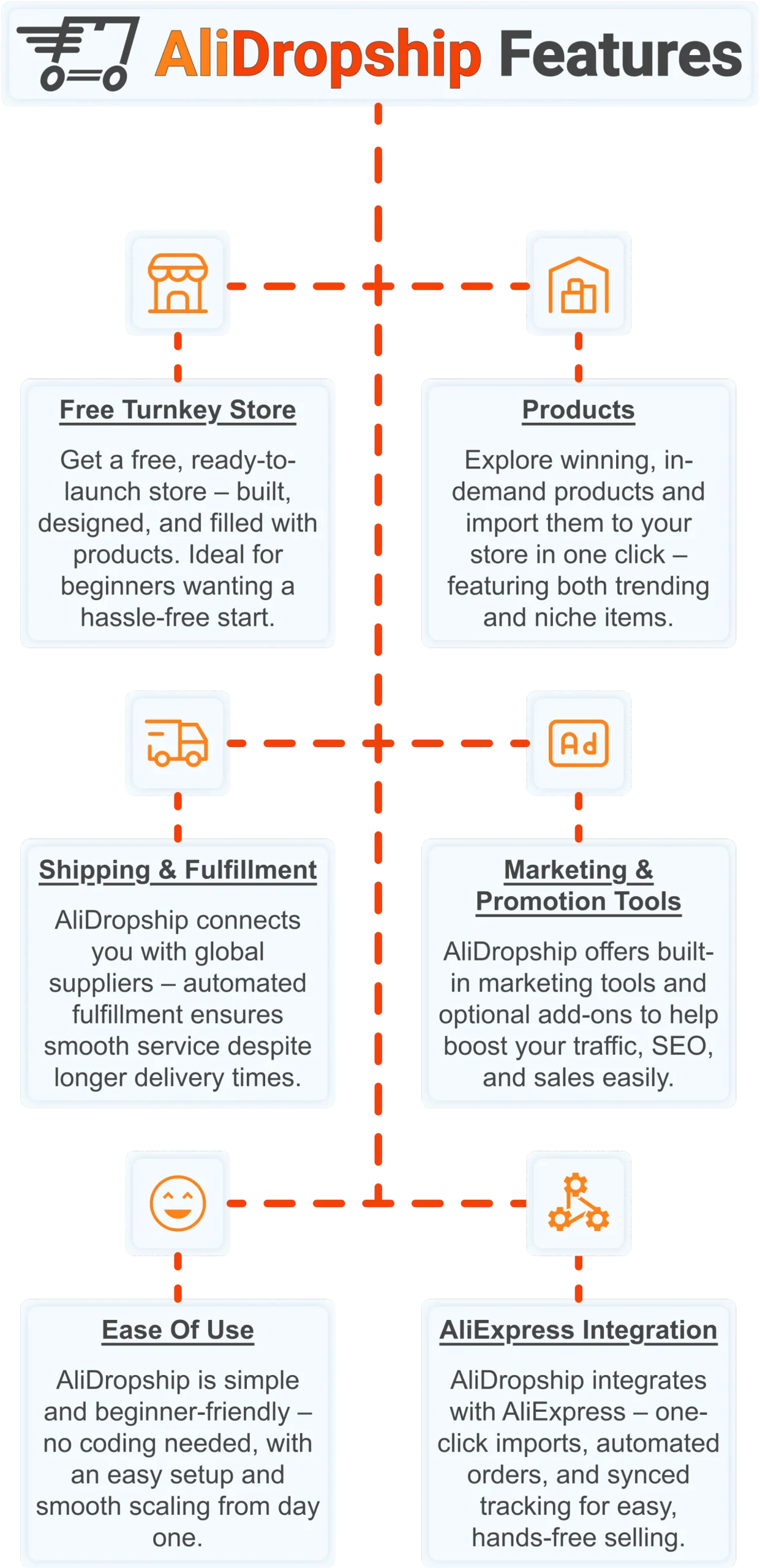
Free turnkey store 🛍️
Get a free turnkey store – built, designed, and filled with products. Ideal for beginners wanting a hassle-free start, the store comes fully optimized to attract customers right away, saving you time on setup. Plus, it includes professional design elements to give your business a polished, trustworthy look from day one. This ready-made foundation makes it easy to move seamlessly into product selection.
Products 📦
Once your store is set up, you can explore winning, in-demand products and import them in one click – featuring both trending and niche items. This wide selection lets you cater to diverse customer interests and test what works best. Regular updates ensure you always have fresh products, keeping your store competitive and relevant. With great products in place, smooth shipping becomes the next essential step.
Shipping & fulfillment 🚚
AliDropship connects you with global suppliers, and automated fulfillment ensures seamless order processing despite international delivery times. Customers receive real-time tracking updates, which builds confidence and trust in your store. Once shipping is handled reliably, you can focus on promoting your store and attracting traffic.
Marketing & promotion tools 📣
To maximize sales, AliDropship offers built-in marketing tools and optional add-ons that help boost traffic, SEO, and conversions. From email campaigns and discounts to social media integration, these tools empower you to reach and retain customers without needing prior marketing experience. With promotion strategies in place, managing your business becomes simpler and more efficient.
Ease of use 👌
AliDropship is beginner-friendly – no coding needed, with an intuitive dashboard that guides you through every step. Easy setup and smooth scaling let you expand your store without stress. As your business grows, adding new features, products, and marketing campaigns remains hassle-free, giving you more time to focus on sales.
AliExpress integration 🛒
Finally, AliDropship integrates seamlessly with AliExpress, enabling one-click imports, automated orders, and synced tracking. Your inventory stays up-to-date with the latest products and prices, while automated order processing frees you from manual tasks. Combined with the turnkey setup, reliable shipping, and built-in marketing tools, this integration ensures your dropshipping business is fully equipped for growth and success.
Every ecommerce pricing strategy in this guide becomes more powerful when it is running on a store that is already built, stocked, and optimized to convert. Claim your free AliDropship store and start putting these strategies to work today.
What are the best ecommerce pricing strategies for beginners?
How do ecommerce pricing strategies affect revenue vs profit?
Ecommerce pricing strategies directly determine whether growing revenue actually builds wealth or just creates busier operations with thin returns. A store doing 50,000 dollars a month at 8 percent net margins earns 4,000 dollars in profit, while a store doing 20,000 dollars at 30 percent margins earns 6,000 dollars – the smaller store wins. Strategies like race-to-bottom pricing can push revenue higher while compressing margins below 5 percent, making scaling actively harmful. Value-based and bundle pricing are the two strategies most consistently associated with improving both revenue and profit at the same time.
What is value-based pricing in ecommerce and how does it work?
Value-based pricing sets product prices based on what the outcome is worth to the buyer rather than what the product costs to source. The process starts with researching customer language – reviews, forums, product questions – to understand what buyers actually value, then building product listings and pricing around those specific outcomes. A product that costs 5 dollars to source might command 35 dollars when positioned around a clear result that matters to the buyer. In well-suited niches such as beauty, wellness, and home decor, value-based pricing can deliver margins of 50 to 70 percent compared to the 15 to 25 percent typical of cost-plus approaches.
How much profit margin should an ecommerce store target?
A healthy ecommerce profit margin target depends on the niche and pricing model, but most successful independent stores aim for a net margin of 25 to 40 percent after all costs including ads, fees, and returns. Commodity categories facing heavy marketplace competition often see net margins of 8 to 15 percent, which is why niche selection and value positioning matter so much. Stores using bundle pricing and value-based frameworks in less commoditized niches regularly achieve margins above 40 percent. Tracking net profit per order – not just total revenue – is the most reliable way to know whether your pricing strategy is actually working.
Can ecommerce pricing strategies alone drive long-term growth?
Pricing strategies are one of the highest-leverage tools in ecommerce, but they work best as part of a broader system that includes strong product selection, compelling branding, and reliable fulfillment. A well-priced product in a poorly designed store will still underperform a moderately priced product in a polished, trustworthy one. Bundle pricing, value-based positioning, and psychological framing all depend on a store experience that matches the price point being asked. Sellers who treat pricing as an isolated variable rather than part of an integrated store strategy typically see smaller and less consistent gains than those who optimize the full customer journey.