AI Dropshipping VS Print-On-Demand: How Do They Compare?

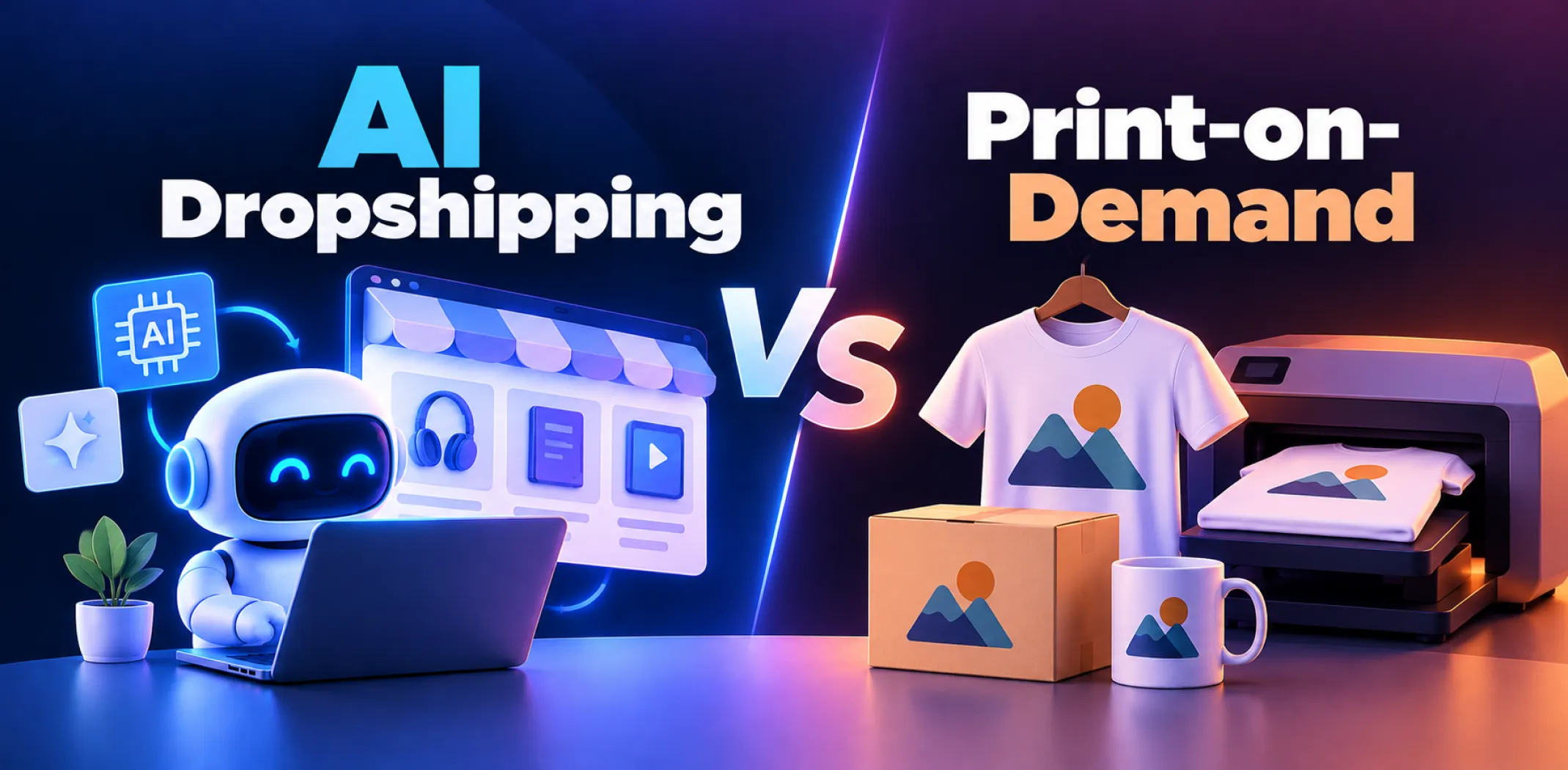
Print on demand and AI dropshipping both let you open an online store without buying a pile of stock first. That is why people compare them, and why the comparison is so easy to get wrong. Underneath, they are two very different businesses, with different daily work, different waiting times, and a very different first week.
Print on demand is a way to sell custom-printed items, like shirts and mugs, that a partner makes only after someone orders. AI dropshipping is the use of AI tools to automate parts of running an online store. On AliDropship, that store sells digital products only: guides, courses, checklists, online tools, and AI-powered toolkits that arrive the moment someone pays.
AliDropship is an online business platform for people who are just starting out – it makes digital product sales possible with no experience and no tech skills needed. It launched in 2015, it is based in Irvine, California, and more than 1,500,000 stores have been launched on it. Since this guide comes from AliDropship, we will say plainly where print on demand is the better fit.
What print on demand actually involves
Print on demand, often shortened to POD, lets you sell custom-printed items without keeping stock. You upload a design, connect a print partner such as Printify or Printful to your storefront, and the partner makes each item only after someone orders it. Then it prints, packs, and sends the finished product to your buyer. If you want the full background, our guide to what print on demand is covers it step by step.
It is a real way to sell, but the work does not disappear. You still need designs people want to buy, whether you create them, license them, or pay someone to make them. You also need a storefront, such as Shopify or Etsy, and you are the one who brings shoppers to it. Printify’s own guide says as much: sellers set up their own storefront and handle their own marketing and order processing.
A typical first week shows how much sits on your side. You pick a niche and a style, create or buy a set of designs, choose products and a print partner, build mockups, order samples to check quality, set up a storefront, write the listings, and only then start working out how shoppers will find you. Each step is doable, but together they add up to a real project, and none of it brings in a sale until shoppers can find you.
Timing is the other thing to plan for. Because every item is made after the order comes in, buyers can wait several days or more before it arrives, and when something is late or looks wrong, the question usually lands with you first. That is why both Shopify’s and Printify’s own guides tell sellers to order samples before listing a product.
How AI dropshipping works on AliDropship
On AliDropship, AI dropshipping starts from a different place than print on demand. You do not create the products. They come from AliDropship’s catalog, and your store opens with 60+ digital products already loaded. Our guide to what AI dropshipping is explains the whole category; here is how it plays out for a single sale.
The newest part of that catalog is AI-powered toolkits, with 100+ available. A buyer answers a few simple questions, and the toolkit instantly builds a tailored plan, script, or guide from those answers. The product is made for the buyer on the spot, so there is nothing to print and nothing to wait for.
Notice what is missing: no design software, no print partner, and no production queue. The store is built for you, and once you set a daily ad budget, the one-click ads handle targeting, creatives, and optimization. You keep 50–70% of each digital sale, which is your margin before ad spend, your monthly plan, and order fees.
A fair question is how much of this is really AI. The AI-powered part is the toolkits, which build a personalized result for each buyer. The store and the one-click ads are done for you and automated, but you still choose your ad budget, decide which products to add, and keep an eye on results. No tool can promise sales, and AI does not replace your own judgment.
AI dropshipping vs print on demand: Side by side
Both models take the heavy lifting off your plate, and that overlap is why they get compared. The key difference is the product itself: print on demand needs a partner to make each item after an order, while AI dropshipping on AliDropship has no production step at all, since the product is digital.
Here is how they compare on the things beginners ask about most: where the products come from, how quickly buyers get them, and how much setup is done when you start.
Neither column wins for everyone. Print on demand gives you creative control and a product people can hold, which matters if your idea is built around original artwork. A digital store gives up some of that freedom in exchange for speed, since you pick from a ready catalog instead of building a product line. If you are weighing that trade, our piece on why digital products suit beginners goes deeper.
Where beginners usually struggle is the gap between launching and getting the first buyer. With print on demand, that gap is yours to fill: you need designs, a storefront, and a way to reach shoppers before anything sells. With AliDropship, the store and the ad system are part of the starting kit, though results vary and still depend on the time you put in.
Print on demand or AI dropshipping: Which should you pick?
Start with what you want your days to look like. If you enjoy creating artwork, slogans, or a brand look, print on demand lets that creativity be the product, and some buyers love holding something with your design on it. A print partner handles production, and you can put your energy into design and your audience.
If you have no design background, no audience yet, and a small budget, the picture changes. A done-for-you digital store removes three of the biggest hurdles at once: finding or making products, building the store, and learning ad tools. These four questions can help you decide.
Do you want to design?
Print on demand rewards people who enjoy creating artwork, slogans, or brand ideas, because the design is the product. If that sounds fun, it is a real strength. If it sounds like homework, a ready-made catalog removes that step.
How fast should buyers get it?
Printed items are made after each order, so buyers wait for production and delivery. Digital products arrive the moment someone pays, so there is no production wait and no package to track.
Who handles your marketing?
With print on demand, you pick a storefront and bring in your own shoppers. AliDropship includes one-click ads that handle targeting, creatives, and optimization, so you set a daily budget instead of learning ad tools.
What will starting cost?
Print on demand costs vary by storefront plan, print partner, and sample orders. AliDropship is simpler to price: a 14-day free trial, then a monthly plan, plus your ad budget and a small order fee on completed sales.
If you want to design and already have people to sell to, print on demand is likely the stronger fit. If fast delivery, built-in marketing, and a simple monthly cost matter more, a ready-made digital store is built for exactly that situation. Once you answer honestly, you will likely lean clearly one way.
One thing both routes share: neither one makes sales happen on its own. Shoppers still have to find your store, and what you learn from early results shapes what you do next. The difference is where your effort goes. With print on demand it goes into designs and setup; with a ready-made digital store it goes into choosing products and watching your ads.
Whichever way you lean, test before you commit. Order a sample from a print partner, or open the free trial and look at a store that is already built for you. If Printify is on your shortlist, our AliDropship vs Printify comparison lays out the differences. Either way, you will learn more from the real thing than from any article.
That is the case for starting with a ready-made digital store. Here is what an AliDropship signup actually includes, so you can judge it on its own terms.
What you get with an AliDropship store
No experience? No problem. If you want the simplest way to start an online business in 2026, AliDropship is one of the most beginner-friendly platforms out there. It brings your store, your products, your fulfillment, and your marketing together in one place, so you can launch fast and grow with confidence.
Over 1,500,000 stores have already been built on AliDropship, and the platform has been featured by Forbes, Entrepreneur, Inc., NBC, Business, and Fox News.
The trade-off is control. You choose from AliDropship’s catalog rather than building your own product line, so if original designs and your own brand are the whole point, print on demand fits that goal better. If your goal is to start selling with the least setup, the done-for-you route fits better.
It also helps to know the costs up front. The trial is free for 14 days, then the monthly plan is $39 a month, about $1.30 a day. Ads run when you turn them on, on a daily budget you choose, from $10 to $50, and a $40 ad coupon is included with the trial. A small order fee applies to each completed sale, and results vary from store to store.
If you are still deciding whether to start an online business at all, our complete guide on how to start an online business is a good place to begin. It covers the bigger picture before you commit to either path.
Print on demand and AI dropshipping can both be a way in. The real question is which one matches the work you want to do, the speed you want, and the setup you want done for you. Answer that honestly, and the choice usually gets much clearer.
What is the difference between AI dropshipping and print on demand?
Which is better for beginners, AI dropshipping or print on demand?
How much does AI dropshipping cost compared with print on demand?
Do you need to print or store anything with AI dropshipping?