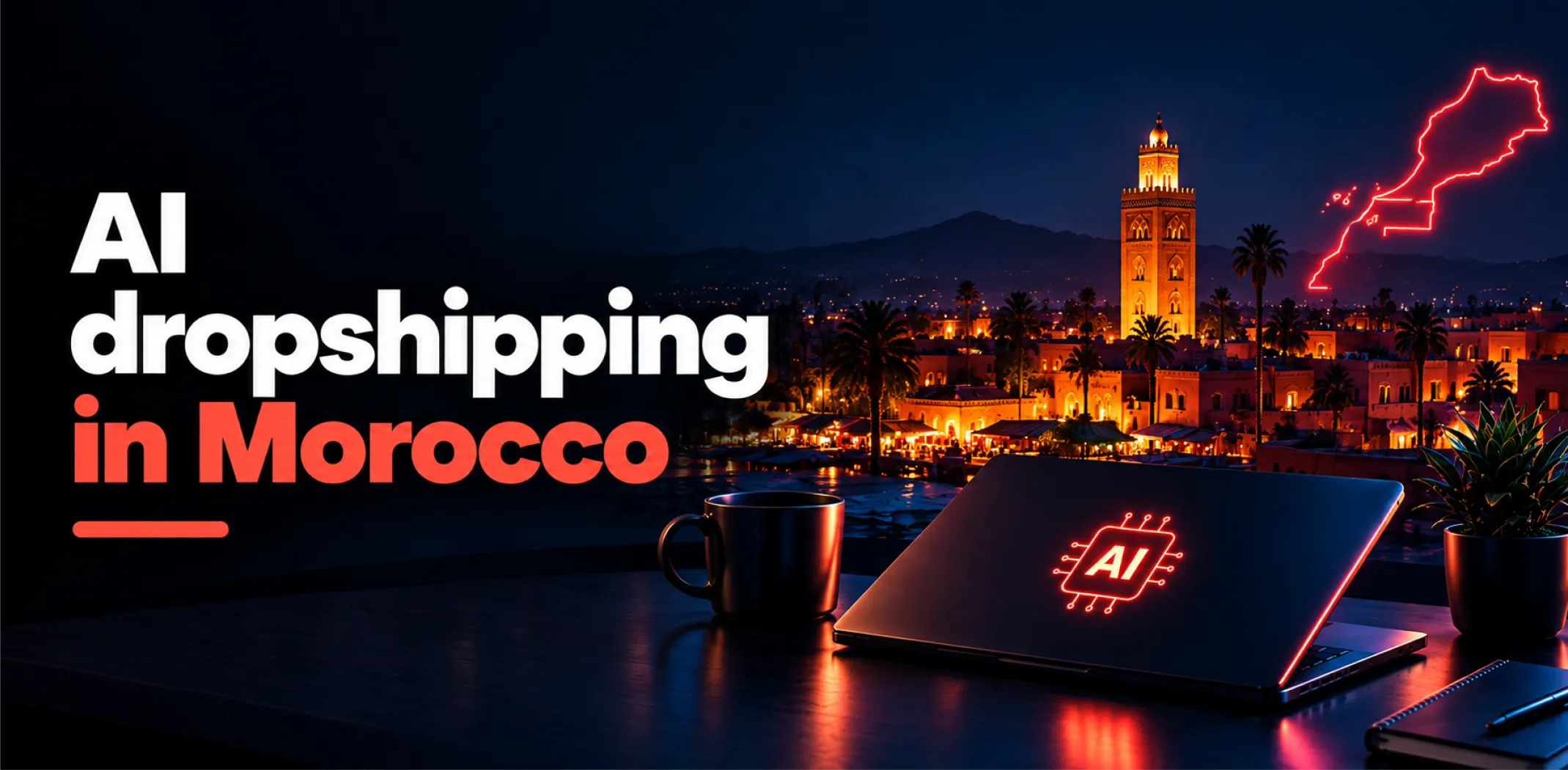
AI Dropshipping In Morocco: How To Start And Get Paid
Yes, you can run an AI-powered dropshipping business from Morocco. PayPal withdraws straight to a Moroccan dirham bank account, and registering as an auto-entrepreneur is free. Getting started costs about MAD 1,065 for the first month. The business sells digital products only: guides, courses, and other content delivered the moment a customer pays, wherever in the world they happen to be.
The conditions are on the spending side, not the payout side: Moroccan cards pay foreign sites only through a yearly foreign-exchange allowance, and Meta, TikTok, and Google now add 20 percent Moroccan VAT to ad spend. Last verified: September 29, 2026.
Selling digital products from Morocco means your store never touches inventory, shipping, or customs paperwork. AI configures the storefront, stocks it with tested products, and manages the ad campaigns, so the parts of this business that actually depend on where you live are foreign-currency rules, taxes, and the registration steps covered below.
Here is what changes, and does not change, when you run AI dropshipping in Morocco specifically.
Who your customers will be
Selling digital products means your customers are wherever your ads run: typically the US, UK, Canada, and Australia, not necessarily Morocco. Morocco’s own market size, payment habits, and ecommerce maturity do not limit this business.
Morocco is on UTC+1 all year, shifting back an hour during Ramadan. That puts you one hour ahead of the UK in winter and level with it in summer, and five to six hours ahead of the US East Coast, so campaigns keep running through your evening while your main customers are in their working day.
Arabic and French are the languages of business, and English proficiency is low: Morocco ranked 68th of 123 countries in the EF English Proficiency Index 2025, with a score of 492, up 13 points on the year before. AI writes your English ad copy and product descriptions, while registration and tax paperwork happens in French or Arabic.
Can you run AI dropshipping from Morocco?
AI dropshipping in Morocco works on the payout side, since PayPal withdraws directly to a Moroccan bank account. The conditions are on the spending side: Moroccan cards can pay foreign sites only within a yearly allowance, and ad platforms now add 20 percent VAT to what you spend.
How you get paid in Morocco
PayPal operates in Morocco, so you can get paid online by receiving payments into a PayPal balance and withdrawing them to a Moroccan dirham bank account. The withdrawal is free when the amount is above MAD 2,000 and costs MAD 30 when it is below, so withdrawing in larger batches keeps the fee small. Payoneer is a second route, and its fee is shown before you confirm each withdrawal.
The receiving fee is the standard one. PayPal charges 4.4 percent plus a fixed 0.30 dollars to receive an international commercial payment in Morocco, and converting a dollar balance to dirhams costs about 3 percent more. The dirham is managed against a basket of currencies, and it has moved between about 9.1 and 9.6 per dollar since May 2026, so timing a withdrawal matters a little.
On a $39 digital product sale at a 60% margin, a seller in Morocco receives approximately MAD 205 after payout and conversion fees through PayPal.
Foreign currency earned from customers abroad is expected to come back into Morocco through an authorized bank, and a PayPal withdrawal to your own Moroccan account does exactly that. Ask your bank whether it needs any supporting documents for regular incoming transfers.
How AI dropshipping works
AI dropshipping in Morocco runs on the same three layers as anywhere else: AI configures your store, AI stocks it with digital products from AliDropship’s catalog, and AI manages the ad campaigns that bring in customers.
For a Morocco-based seller, the catalog needs no adaptation, since digital guides and courses sell the same way regardless of where the seller lives. The local adjustment is funding: Meta, TikTok, and Google can be paid for from a Moroccan international card, but every dirham spent counts against your yearly foreign-payment allowance. Read more about how the whole system fits together on the AI dropshipping hub.
Because the products are digital, there is no shipping from Morocco, no customs, no stock, and no failed deliveries. Orders are fulfilled the moment they are placed, wherever the customer is.
What it costs to start in Morocco
These figures use a conversion rate of 1 USD to approximately MAD 9.6, as of September 29, 2026; check the current rate before you budget. A Moroccan individual has an ecommerce allowance of MAD 20,000 a year, about 2,080 dollars, and the $39 plan uses about 470 dollars of it over twelve months. That leaves roughly 1,600 dollars a year, VAT included, for ad spend, which is about 130 dollars a month.
The month-one total covers the subscription and a test ad budget with VAT; registration is free and payout fees come out of your sales rather than your pocket. An auto-entrepreneur is not registered for VAT, so the 20 percent on ad spend is a plain cost of about MAD 115 on a $60 test budget. Health and pension contributions are also due once you register, and they scale with your turnover.
Tax and legal requirements in Morocco
Most solo sellers start as an auto-entrepreneur, a status created by Law 114-13 that replaces the ordinary income tax with a flat percentage of the money you collect. The rate is 0.5 percent of turnover for commercial activities and 1 percent for services, with no deduction for expenses and no tax at all in a month with no sales.
The status has a ceiling: annual turnover must stay under MAD 500,000 for commercial activities or MAD 200,000 for services, and above that you move to another regime. Whether a digital product store counts as commerce or as a service sets both your rate and your ceiling, so choose the activity category carefully at registration and confirm it with an accountant.
Registration is free and online through the auto-entrepreneur portal. Health coverage under AMO and a pension are now mandatory for auto-entrepreneurs, so you register with social security at the same time. While you stay under your ceiling you are exempt from VAT, which also means you have no VAT number to give ad platforms.
Morocco has taxed cross-border digital services since June 11, 2026. Foreign platforms that sell to Moroccan customers who are not VAT-registered must charge 20 percent Moroccan VAT, and this covers online advertising, subscriptions, and online courses. Meta starts adding it on October 1, 2026, and TikTok already does, unless a valid Moroccan tax ID is on the account.
The other Moroccan rule to plan around is foreign exchange. Individuals can spend MAD 20,000 a year online abroad, up from MAD 15,000 before 2026, and companies have higher allowances. Whether ad payments for an auto-entrepreneur count against the personal allowance or a professional one is worth confirming with your bank.
Destination VAT is the point most often missed. Because you are based outside the EU, sales to EU consumers fall under the EU Non-Union OSS scheme with no threshold, so VAT at the buyer’s country rate applies from the first sale, and the UK likewise requires VAT registration from the first sale to a UK consumer.
Check the auto-entrepreneur portal before you register, since your rate and ceiling depend on the activity category you choose. This is general information, not tax advice, and rules change, so confirm the current figures with a Moroccan accountant before you rely on them.
What AI does and does not solve for Morocco sellers
AI handles the parts of this business that scale the same way everywhere: setting up your store, selecting which digital products to list, writing ad copy and creative, optimizing campaigns once they are live, writing product descriptions, and email follow-up.
AI does not handle three things that are genuinely yours to manage as a Morocco-based seller. It will not register you as an auto-entrepreneur, pick the right activity category, or handle your social security enrollment. It will not activate your card allowance or tell you how much of it you have left. And it will not settle your VAT position, including how the 20 percent on ad spend is treated once your tax details are on each ad account.
These are mostly one-time setup tasks, but the allowance in particular needs watching, since a store that spends past it will find its card declined mid-campaign.
Getting started from Morocco
Three steps take you from a standing start to a live AI dropshipping business in Morocco.
Step 1. Register as an auto-entrepreneur online for free, choosing your activity category with care, and enroll in social security. Foreign residents need a valid residence card first.
Step 2. Ask your bank to activate the international ecommerce allowance on your card, then start your 14-day free trial. AI configures your store, stocks it with digital products, and you link PayPal to your Moroccan dirham account, with Payoneer as the alternative.
Step 3. Turn on your 40 dollar ad credit, add your tax details to each ad account, and test Meta, TikTok, or Google ads. Budget for 20 percent VAT on anything you spend beyond the credit, and track your spending against the yearly allowance.
None of these three steps depends on a large upfront fee or a long waiting period, which is what makes it realistic to start an online business in Morocco this way. PayPal already pays out straight to a local bank, registration is free, and the AI side of the store is ready before your first coffee gets cold.
If you are comparing markets with their own currency rules, the Egypt and Nigeria pages cover countries with different payout and foreign-payment limits.
Can I do AI dropshipping from Morocco?
How do I get paid as a dropshipper in Morocco?
Do I need to register a business in Morocco to sell digital products?
Do I pay tax on digital product sales in Morocco?
Can I sell to customers outside Morocco?


Recommended for You