What Are The Top Products To Sell Online Right Now In 2026?

If you’ve been searching for the top products to sell online, here’s the honest answer: the market in 2026 is bigger than ever – but it also moves faster. Products that were trending 18 months ago may already be saturated, while entirely new niches are quietly pulling in thousands of orders a week. Getting this choice right at the start can be the difference between a store that earns and a store that stalls.
Quick answer: The top products to sell online in 2026 include health and wellness items, home improvement tools, pet accessories, eco-friendly goods, smart home devices, and beauty products. These categories consistently show high search volume, strong repeat purchase rates, and solid margins for independent sellers.
This guide breaks down exactly which product categories are trending right now, why demand is holding strong, and how to evaluate whether a product is actually worth adding to your store.

What does “top products to sell online” actually mean?
Not every product with a lot of Google searches is a good product to sell. “Top” means different things depending on who you ask – and being clear on this upfront will save you from chasing trends that look exciting but don’t convert.
When we talk about the top products to sell online, we mean products that check several boxes at once: steady or growing search demand, a reasonable number of buyers actively looking to purchase (not just browse), profit margins that make the math work after shipping and platform fees, and a supplier base reliable enough to fulfill orders without constant headaches.
In 2026, the strongest-performing product categories also tend to share one more trait – they solve a real problem or tap into an identity (pet owner, fitness enthusiast, eco-conscious consumer). Products with an emotional hook outperform generic commodities almost every time in independent ecommerce stores.
How much can you realistically earn selling products online?
This is the question everyone wants answered, and the range is genuinely wide. A beginner running their first dropshipping store in a trending niche might clear $30–$80 per day within their first 60–90 days if they’re consistent with marketing. Someone who’s been operating for a year, has refined their product selection, and runs paid ads intelligently can pull $300–$800 per day. Full-time ecommerce entrepreneurs with optimized stores in proven categories regularly report $5,000–$20,000 per month in revenue – though profit margins on that figure vary.
One note on these figures: Revenue and profit are different numbers. A store doing $500/day in revenue might net $100–$150 after product cost, ads, and platform fees. The ceiling figures above are achievable, but they reflect sellers who treat their store as a real business – not a side project they check twice a week.
The most reliable path to the higher end of these ranges is product selection. Sellers who spend real time choosing trending, problem-solving products consistently outperform those who grab whatever looks popular on the surface.
Top products to sell online in 2026: trending categories with strong demand
These are the product categories driving the most consistent ecommerce volume right now – backed by search trend data, community conversations on Reddit and niche forums, and supplier order volume patterns. Within each category, you’ll find specific product types that are performing well, along with what makes them worth pursuing.
Health, wellness, and fitness products
This category has been growing steadily for years, but 2026 has pushed it into overdrive. Consumers are spending more on at-home health monitoring, recovery tools, and preventive wellness products than ever before – and they’re buying online because the physical retail selection is still limited in many areas.
Massage guns and recovery devices
Recovery tools – particularly percussive massage guns – remain one of the best-selling online products globally. The category has matured past its initial hype but shows no signs of slowing. Affordable mid-range models priced between $35–$80 are the sweet spot: high enough to suggest quality, accessible enough to convert impulsively. Margins on unbranded or white-label versions can reach 40–60%.
Why this works in 2026: Work-from-home culture and increased gym participation have driven demand for at-home muscle recovery. Buyers are motivated and spend-ready.
Posture correctors and back support gear
Desk workers searching for solutions to neck and back pain represent a huge and constantly refreshed audience. Posture braces, lumbar supports, and ergonomic cushions sell consistently year-round with almost no seasonal drop-off. Average order values sit at $20–$45, which makes them easy impulse buys with solid repeat purchase potential.
Earning potential: $40–$120/day with a focused content strategy or lightweight paid ads targeting remote workers.
Fitness accessories and resistance training tools
Resistance bands, ab rollers, pull-up bars, and jump ropes continue to perform strongly. The gym-at-home trend has matured into a stable buyer segment with active online communities. These are low-cost products to source, easy to ship (lightweight), and simple to market with before-and-after style content on social platforms.
Home improvement and smart living products
The home improvement market online has exploded in the past three years, and product trends in this space now move nearly as fast as fashion. Buyers in this category tend to have higher disposable incomes, which means larger average order values and a greater tolerance for premium positioning.
LED lighting strips and ambient lighting
Decorative LED lighting – specifically smart RGB strips, neon signs, and color-changing bulbs – is one of the most reliably trending product types across TikTok, Pinterest, and Google Shopping. They’re inexpensive to source, photograph beautifully, and appeal to teens, gamers, and home décor enthusiasts alike. A single lighting product with strong visual content can generate thousands of organic impressions without paid promotion.
Why this works in 2026: Short-form video content showing lighting transformations continues to drive viral discovery – which makes this product category almost self-marketing when paired with the right platform.
Compact and multifunctional kitchen gadgets
Innovative kitchen tools – air fryer accessories, compact food processors, multi-use silicone organizers – attract buyers who are actively searching for solutions. These products benefit from strong how-to and demonstration content, and they convert well from YouTube and Pinterest traffic. Average ticket prices range from $15–$50 depending on product type.
Smart home accessories
Smart plugs, mini security cameras, door sensors, and wireless charging stations are among the fastest-growing product searches in the home category. The buyer intent is high – these are people actively looking to buy, not just browse. Product costs are competitive from Asian suppliers, and the perceived value allows for healthy markups.
Earning potential: $80–$200/day for a focused smart home store with a curated product selection of 20–40 SKUs.
Pet products – one of the most profitable online niches
Pet owners are among the most loyal and emotionally invested buyers in any market. They buy frequently, they upgrade willingly, and they respond strongly to products that promise better quality of life for their animals. The global pet care market continues to grow in double digits annually, and online sales now represent a major share of that.
Pet grooming tools
Deshedding brushes, nail grinders, pet hair removers, and grooming gloves are perennial bestsellers with strong year-round demand. These products are easy to demonstrate with video content, have high perceived value relative to sourcing cost, and generate genuine enthusiasm in pet owner communities online. Margins of 50–70% are common.
Elevated and orthopedic pet beds
Premium pet bedding – especially orthopedic foam beds marketed for older dogs and elevated cots for summer cooling – represents the higher-ticket end of the pet niche. Average order values of $35–$90 are achievable, and buyers in this segment actively seek quality over lowest price. This is a great product type for building a brand rather than competing purely on cost.
Interactive pet toys and enrichment products
Puzzle feeders, treat dispensers, automatic laser toys, and snuffle mats are growing fast as pet owners become more aware of mental enrichment for animals. This is a relatively underserved niche with growing search volume and strong community discussion on pet subreddits and Facebook groups. Low sourcing costs and high engagement content make this an excellent starting point for a new store.
Eco-friendly and sustainable products
Consumer demand for sustainable alternatives has moved from a fringe preference to a mainstream purchasing driver. Buyers in this segment actively seek out eco-friendly options and are willing to pay a modest premium for them – which helps margins. Importantly, this category benefits from strong organic search demand and loyal repeat buyer behavior.
Reusable household products
Beeswax wraps, silicone food bags, reusable produce bags, bamboo toothbrushes, and stainless steel straws are steady performers with broad demographic appeal. These are low-cost products with a clear value proposition – reduce waste, save money over time – that practically writes its own marketing copy. Starter bundles priced at $20–$35 perform particularly well.
Why this works in 2026: Regulatory pressure on single-use plastics in multiple markets is actively driving buyers to search for alternatives – giving this category genuine tailwind beyond trend cycles.
Solar-powered and energy-saving gadgets
Portable solar chargers, solar garden lights, and energy-monitoring smart plugs appeal to both eco-conscious buyers and practical-minded savers. Search volume for portable solar products has grown consistently for three years running. These products tend to have strong AOV (average order values of $25–$60) and good media for content creation.
Beauty, skincare, and personal care
Beauty is one of the most resilient ecommerce categories regardless of economic conditions – and in 2026, it’s more product-driven than ever. Buyers in this space are highly research-active online, which creates real opportunity for stores that produce helpful content alongside their product listings.
Skincare tools and devices
Facial rollers, gua sha stones, LED face masks, microneedling rollers, and pore vacuums are all actively trending product types with strong social proof dynamics. One viral video of a product demonstration can drive thousands of searches and direct buyers to your store. Margins on these tools tend to be strong – often 60–80% when sourced directly from manufacturers.
Hair care accessories and styling tools
Heatless curling sets, satin bonnets, scalp massagers, and detangling brushes are among the most shared and reviewed products in beauty communities. The hair care niche is massive, active, and constantly generating new product discovery through user-generated content. Sourcing costs are low, shipping weight is manageable, and the target buyer spends frequently.
Earning potential: $60–$180/day for a beauty-focused store running a modest social content strategy alongside organic search traffic.
How to evaluate whether a product is actually worth selling
Knowing the top categories is a starting point – but the sellers who actually build sustainable income go one layer deeper. They validate products before committing, rather than simply copying what’s popular on a surface level.
Here’s a practical framework for evaluating any product you’re considering:
- Search trend direction: Use Google Trends to check whether interest is growing, flat, or declining. A product with rising 12-month trend data is significantly lower risk than one that spiked and fell.
- Competitor review volume: Check Amazon and AliExpress for existing listings. High review counts confirm demand. Look at the 3-star reviews specifically – they reveal real buyer complaints that you can address in your product page.
- Margin math: Sourcing cost + shipping + platform fees should leave at least 30% margin before ad spend. Below that, you’re working for very thin returns that disappear quickly with any ad budget.
- Shipping profile: Products under 2kg and small enough to ship in a standard poly bag dramatically lower fulfillment risk and cost. Heavy or fragile items require more supplier vetting.
- Content potential: Can you demonstrate this product in 30 seconds on video? Products with strong visual demos have a significant organic marketing advantage.
Pro Tip: Reddit and niche Facebook groups are often more honest about what’s actually selling than any trend report. Search the product in these communities and read the genuine buyer conversations before you commit.
Crunch your per-unit profit potential
Enter your product price, supplier cost, shipping fee, monthly sales, and estimated ad spend per unit – the calculator will instantly show your net profit per sale, your profit margin percentage, and a quick verdict on whether that product is worth pushing.
| Under 10% | Tight — hard to sustain on paid traffic |
| 10–15% | Marginal — slim cushion for refunds and ad cost shifts |
| 15–20% | Healthy — cohort median sits at 19.2% |
| 20–25% | Strong — outperforming the median operator |
| 25%+ | Excellent — top-tier product economics |
What to avoid when choosing products to sell online
The wrong product choice doesn’t just fail to earn – it actively costs you time and money. These are the patterns that trip up new sellers consistently.
Key principle: If a product requires you to make claims you cannot verify or depends on a buyer misunderstanding what they’re getting, it will create returns, disputes, and account suspensions – not income.
Avoid products where the niche is already dominated by established brands with strong paid ad presence and tens of thousands of reviews. You won’t out-spend them, and you won’t out-rank them quickly enough to justify the effort. Instead, target sub-niches within the same broad categories – for example, rather than “fitness products,” focus on “kettlebell accessories for home gyms” or “resistance band sets for seniors.”
Avoid products with unpredictable quality consistency. If supplier reviews mention frequent defects or widely varying quality between batches, customer complaints and returns will drain your profits and your time. Order samples before you commit to selling at scale.
Avoid ultra-low-margin commodity products where your only competitive lever is price. If you’re selling the same product as 200 other stores and the only differentiator is a 50-cent price difference, you’re in a race to the bottom that you can’t win sustainably.
Important: Never source products with fake reviews or manufactured social proof. Platforms detect these patterns, and the short-term traffic boost is never worth the long-term risk to your account.
Which approach is right for you?
The top products to sell online in 2026 span several categories, and the right starting point depends less on which category is trending and more on where you are as a seller right now.
Complete beginner
Start with a single niche rather than a general store. Choose a category from the health, pet, or eco-friendly segments – these have the lowest barrier to content creation and the most accessible buyer communities. Focus on products in the $20–$50 range where impulse purchases are common and returns are manageable. Your first 60 days should be about understanding your buyer, not maximizing revenue.
Intermediate seller (part-time, some experience)
You likely already have a store and a product mix. The opportunity at this stage is to audit your catalog against current trend data and replace underperformers. If you’re not yet in the home improvement or smart home category, this is a strong moment to test it – demand is high and competition from small independent stores is still manageable. Consider expanding your average order value by adding complementary products to existing bestsellers.
Advanced seller (full-time goal)
At this level, product selection needs to be driven by data, not intuition. Use tools like Google Trends, Amazon BSR tracking, and supplier sales data to identify products before they peak rather than after. The beauty and skincare category in particular offers strong margin opportunities for sellers willing to invest in quality content and build a recognizable brand rather than a generic listing.
Regardless of where you are in your journey, one principle holds: the sellers who win in 2026 are the ones who treat their store as a real business. That means consistent product research, honest marketing, and a willingness to iterate based on what buyers actually want – not just what looked good in a YouTube thumbnail.
AliDropship: Your complete all-in-one solution for starting dropshipping in 2026
If you want the simplest possible way to start dropshipping – especially if you’re brand new – AliDropship remains one of the most beginner-friendly tools available in 2026. It brings together store creation, product imports, automation, and marketing into a single streamlined system designed to help you launch quickly and grow confidently.
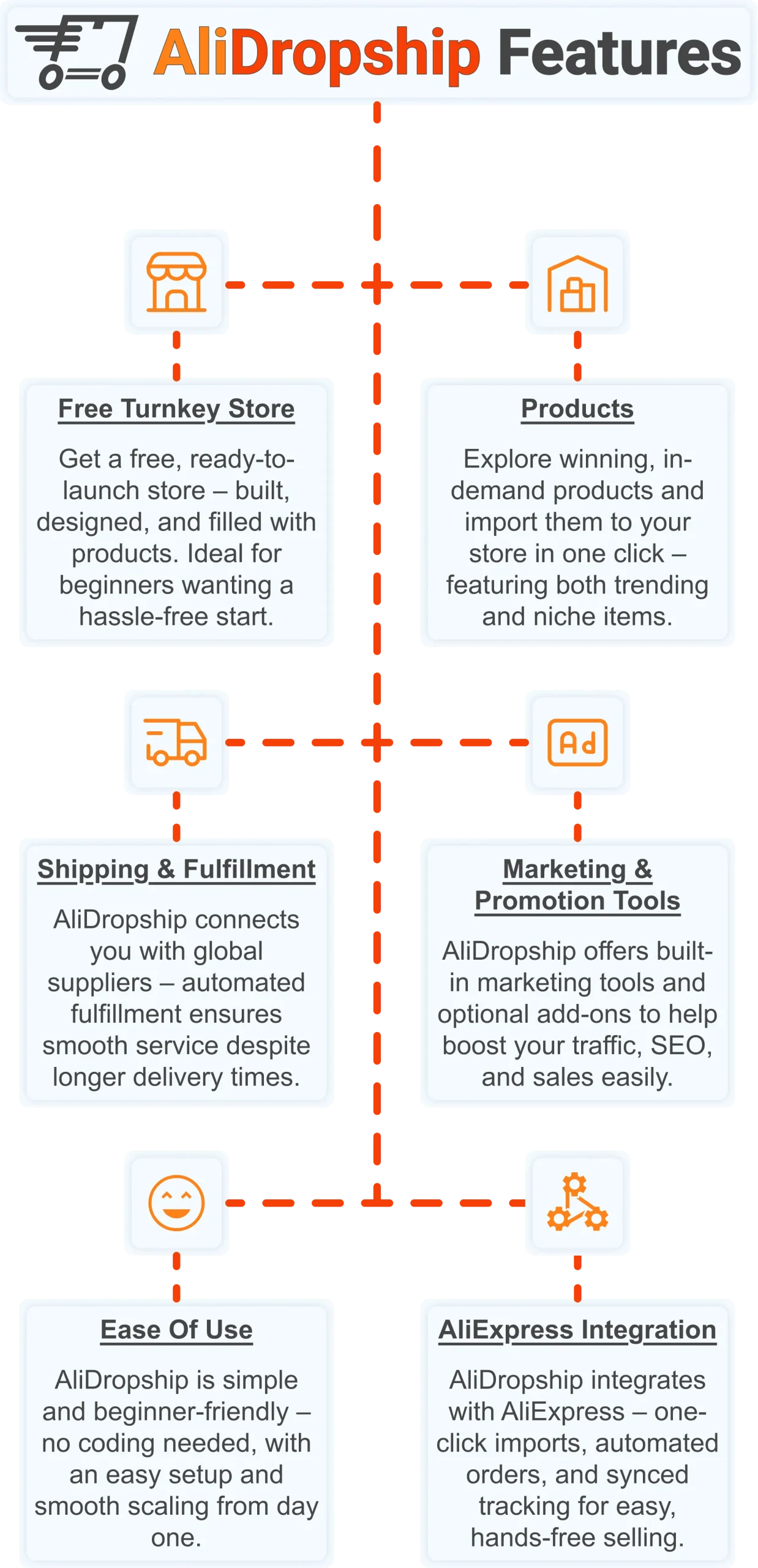
Free turnkey store 🛍️
Get a free turnkey store – built, designed, and filled with products. Ideal for beginners wanting a hassle-free start, the store comes fully optimized to attract customers right away, saving you time on setup. Plus, it includes professional design elements to give your business a polished, trustworthy look from day one. This ready-made foundation makes it easy to move seamlessly into product selection.
Products 📦
Once your store is set up, you can explore winning, in-demand products and import them in one click – featuring both trending and niche items. This wide selection lets you cater to diverse customer interests and test what works best. Regular updates ensure you always have fresh products, keeping your store competitive and relevant. With great products in place, smooth shipping becomes the next essential step.
Shipping & fulfillment 🚚
AliDropship connects you with global suppliers, and automated fulfillment ensures seamless order processing despite international delivery times. Customers receive real-time tracking updates, which builds confidence and trust in your store. Once shipping is handled reliably, you can focus on promoting your store and attracting traffic.
Marketing & promotion tools 📣
To maximize sales, AliDropship offers built-in marketing tools and optional add-ons that help boost traffic, SEO, and conversions. From email campaigns and discounts to social media integration, these tools empower you to reach and retain customers without needing prior marketing experience. With promotion strategies in place, managing your business becomes simpler and more efficient.
Ease of use 👌
AliDropship is beginner-friendly – no coding needed, with an intuitive dashboard that guides you through every step. Easy setup and smooth scaling let you expand your store without stress. As your business grows, adding new features, products, and marketing campaigns remains hassle-free, giving you more time to focus on sales.
AliExpress integration 🛒
Finally, AliDropship integrates seamlessly with AliExpress, enabling one-click imports, automated orders, and synced tracking. Your inventory stays up-to-date with the latest products and prices, while automated order processing frees you from manual tasks. Combined with the turnkey setup, reliable shipping, and built-in marketing tools, this integration ensures your dropshipping business is fully equipped for growth and success.
The top products to sell online in 2026 are already out there – the missing piece is a store built to convert them into real revenue. Get your free turnkey store today and start selling the products buyers are already searching for.
What are the top products to sell online in 2026?
What products to sell online to make money fast?
How do I find trending products to sell online?
What is the most profitable product to sell online?
How much can you make selling products online?