Switching From Shopify To AliDropship: Is It Worth It?

If you have been running a dropshipping store on Shopify for a while, you have probably done the math more than once. Monthly subscription fees, app costs stacking up, transaction fees eating into margins – it adds up fast. Plenty of store owners reach a point where they start wondering whether there is a better way to run the same business for less.
Switching from Shopify to AliDropship is one of the most searched moves in the dropshipping space right now, and for good reason. AliDropship gives you a ready-built turnkey store, a built-in system for sourcing and automating orders from AliExpress, and a streamlined all-in-one setup designed to get you selling faster – without the complexity and mounting app costs that come with managing Shopify.
Quick Answer: Switching from Shopify to AliDropship makes financial sense for most dropshippers frustrated by mounting app costs, complex setups, and slow growth. AliDropship provides a free turnkey store built, designed, and filled with products – at $39/month – with native AliExpress integration, automated fulfillment, and built-in marketing tools included from day one.

What does switching from Shopify to AliDropship actually mean?
At its core, this switch means moving from a build-it-yourself Shopify setup – where you piece together apps, pay for each one separately, and manage everything manually – to an all-in-one system where AliDropship handles store creation, product sourcing, fulfillment automation, and marketing in a single streamlined package. Instead of stitching tools together, you get everything working from the start.
The practical difference is significant. On Shopify, you are paying for the base platform, then paying again for apps to add features the platform does not include by default, and managing each integration separately.
AliDropship brings store creation, AliExpress product imports, automated order processing, and built-in marketing tools under one roof – with no patchwork of subscriptions required to make it functional.
The AliDropship system integrates directly with AliExpress, letting you import products in one click, automate order fulfillment, and sync pricing and inventory automatically. The workflow covers everything Shopify dropshippers do with Oberlo or DSers – but within a unified platform built specifically for this purpose, not assembled from third-party apps.
Why this works in 2026: Shopify has raised its base plan prices and tightened app ecosystems in recent years, pushing more mid-level dropshippers to look for all-in-one alternatives where store setup, product sourcing, and automation are handled together rather than assembled piece by piece.
How much can you realistically save – and earn – after switching?
The savings case for switching platforms is straightforward. The earning potential after the switch depends more on your products and marketing than on the platform itself – but removing the cost drag gives you more margin to work with from day one.
Here is how typical setups compare across three operator profiles:
These figures reflect typical Shopify total costs across plan and app stack, compared against AliDropship’s $39/month turnkey store plan. The gap widens significantly at the intermediate and advanced levels, where Shopify app stacks tend to grow alongside store complexity.
One note on earning potential: Switching platforms does not automatically increase revenue. Your income after the switch depends on the same factors it did before – product selection, pricing, traffic, and conversion rate. What changes is how much of each sale you keep. Most dropshippers report earnings of $30–$150/day within 60–90 days of a well-executed store launch, whether on Shopify or AliDropship. The difference is margin.
The real financial upside of switching from Shopify to AliDropship is what you stop spending on apps you no longer need. Store creation, product imports, automation, and built-in marketing tools are all part of the AliDropship package – meaning many of the recurring app fees that inflated your Shopify bill simply disappear from the moment you switch.
Key differences between Shopify and AliDropship
Before you migrate, it helps to understand exactly what you are moving between. These are not just two different price points – they are two different models of owning and running an online store. Knowing the differences helps you plan the switch without surprises.
Ownership and platform model
Shopify: hosted and rented
Shopify is a fully hosted SaaS platform. That means Shopify owns the infrastructure, controls the features, and charges you monthly to use it. Your store exists on Shopify’s servers. If you stop paying, your store goes offline. You do not own the software – you rent access to it. This is convenient but expensive over time, and it puts a third party between you and your business.
AliDropship: built, launched, and ready to sell
AliDropship takes the opposite approach. Instead of handing you a blank canvas and a list of apps to install, AliDropship builds your store for you – designed, stocked with products, and optimised to convert from day one.
The system handles store creation, AliExpress integration, order automation, and marketing tools as a single connected package. You are not assembling a dropshipping setup; you are stepping into one that is already running.
Cost structure
Monthly fees on Shopify
Shopify’s Basic plan starts at $39/month (billed annually) and goes up to $399/month for the Advanced tier. On top of the base plan, most dropshipping stores add apps for product reviews, upsells, abandoned cart recovery, email marketing, currency converters, and more.
Each app carries its own monthly fee – commonly $10–$50 per app. A lean Shopify dropshipping store typically costs $80–$150/month minimum once the essential apps are running.
Important: Shopify also charges a transaction fee of 0.5–2% on every sale if you use a payment processor other than Shopify Payments – which is not available in all countries.
AliDropship at $39/month – store, tools, and products included
AliDropship’s turnkey store comes in at $39/month – and that price includes the store itself, built and filled with products, along with automation tools, marketing features, and AliExpress integration.
There is no separate app stack to assemble, no additional subscriptions for abandoned cart recovery or product reviews, and no platform fee eating into your transaction margins. What you pay is what you get: a complete, operational dropshipping store.
AliExpress integration
Shopify + DSers or Oberlo
To source from AliExpress on Shopify, most dropshippers use DSers (the successor to Oberlo, which Shopify shut down in 2022). DSers has a free tier with limitations and paid plans starting at $19.90/month. It works, but it adds another subscription layer and another third-party dependency to manage.
AliDropship’s native integration
AliDropship was built specifically for AliExpress dropshipping. The integration is native – not bolted on through a third-party app. You import products directly from AliExpress, automated orders are placed with suppliers when customers buy, and tracking numbers sync back to your store automatically. There is no additional app to pay for and no intermediary platform to worry about.
Simplicity vs. complexity
Shopify’s growing complexity
Shopify gives you a polished interface with thousands of apps, but the more you customise and extend it, the more complex – and expensive – it becomes. Adding functionality means adding apps. Adding apps means adding monthly fees, managing integrations, and troubleshooting conflicts between tools.
By the time most intermediate dropshippers have a fully functional store, they are managing 6–10 separate subscriptions just to keep everything working together.
AliDropship’s all-in-one approach
AliDropship is designed to remove that complexity entirely. Store creation, product imports, order automation, and marketing tools are built into the same system – so there is nothing to integrate and nothing to break.
The dashboard guides you through each stage of running your store without requiring you to coordinate between multiple platforms. As your store grows, the same system scales with you without adding new layers of cost or management overhead.
How to migrate from Shopify to AliDropship: A practical overview
Switching platforms sounds more daunting than it actually is. Most dropshipping stores can complete a migration in a weekend with the right approach. Here is how to think through the process step by step.
Step 1 – Export your Shopify data
Before anything else, export everything you can from Shopify. Go to your Shopify admin and export your products (as a CSV), your customer list, and your order history. Shopify allows full data exports for all of these. Store them locally – you will use the product data as a reference when re-importing to AliDropship, and the customer list for any email marketing continuity.
Step 2 – Get your AliDropship turnkey store
Rather than setting up hosting and installing software manually, AliDropship handles the store creation for you. The turnkey store comes built, designed, and stocked with products – so instead of spending days configuring a blank WordPress installation, you receive a store that is ready to customise and launch. Use your Shopify branding, colour scheme, and niche focus as the brief for how you want your new store positioned.
Step 3 – Customise your store and import your products
With your AliDropship store live, use your Shopify product export as a reference list for what to bring across.
AliDropship’s one-click import pulls products directly from AliExpress – and this is a good opportunity to upgrade your supplier selection, check for better-rated listings, or switch to suppliers with faster shipping options. Most store owners find they improve their product mix during migration rather than simply replicating it.
Step 4 – Re-import your products from AliExpress
Use your Shopify product export as a reference list of what to bring across. In AliDropship, you will import these products directly from AliExpress using the Chrome extension. This is actually an opportunity: you can check for better-priced suppliers, newer product variations, or higher-rated listings compared to the ones you were using before. Most store owners find they improve their supplier mix during migration.
Step 4 – Configure payments, shipping, and taxes
AliDropship integrates with all major payment gateways – PayPal, Stripe, and others. Set up your payment processor, configure your shipping zones and rules, and review your tax settings for the regions you sell to. If you were already using Stripe or PayPal on Shopify, the credentials transfer directly – there is no new account to create.
Step 5 – Redirect your domain and run a test order
Point your existing domain to your new WordPress host using your domain registrar’s DNS settings. This usually propagates within a few hours. Once live, run a test order end-to-end: place an order, confirm it processes correctly in AliDropship, verify the fulfillment automation kicks in, and check that the order confirmation email reaches the test inbox. If all steps pass, your store is ready to go live.
Important note: Keep your Shopify store on pause (not cancelled) for the first 2–4 weeks after migrating. This gives you time to catch any traffic or SEO issues before permanently closing the old setup.
What you should know before you switch
Switching from Shopify to AliDropship is not the right move for every store owner in every situation. Here is an honest look at the considerations worth thinking through before you commit.
The transition from Shopify’s interface
If you have only ever used Shopify, AliDropship’s dashboard will feel different at first – not more complicated, just different. Shopify is built around a very specific ecommerce workflow that you have likely internalised over time.
AliDropship covers the same ground but organises it differently, with store management, product imports, and fulfillment automation in one place rather than split across apps. Most people adapt within a few days of using the platform regularly.
SEO continuity during migration
Any platform migration carries SEO risk if it is not handled carefully. Your Shopify store’s URLs likely follow a pattern like /products/product-name. WordPress and WooCommerce-style URLs are configurable, but they may differ.
Set up 301 redirects from your old Shopify URLs to the matching new pages before you switch the domain over. Google Search Console will show you any crawl errors in the days following the migration so you can address them quickly.
When Shopify might still make sense
If you are running a high-volume store on Shopify Payments and benefiting from the lower transaction fees at the Advanced tier, the math may be closer than it looks. Similarly, if your business depends on a highly custom Shopify app built specifically for your workflow, factor in the time to replicate that functionality. For most standard AliExpress dropshipping setups, the switch makes clear practical sense – but it is worth mapping your specific setup before deciding.
Legal and ethical considerations when switching platforms
Migrating your store raises a few practical and legal points that are worth addressing directly so you do not run into issues after the switch.
Key principle: Transparency with your customers during a platform migration builds trust – not the opposite. A short email explaining that you have upgraded your store is a positive signal, not a red flag.
- Customer data handling: When you export customer emails and order data from Shopify, you are responsible for handling that data in compliance with applicable privacy laws (GDPR in Europe, CCPA in California, etc.). Do not use exported customer data for new marketing without a valid consent basis. Use it only to maintain order records and service existing customers.
- Outstanding Shopify obligations: Do not cancel your Shopify plan mid-billing cycle if you have open orders being fulfilled. Complete all pending fulfillments, resolve any open disputes, and let your billing cycle end naturally before closing the account.
- Fake reviews and social proof: Some dropshippers consider importing or fabricating product reviews during migration to quickly populate a new store. Avoid this entirely. It violates platform terms, breaches consumer protection laws in most jurisdictions, and creates refund exposure if customers feel misled. AliDropship includes a legitimate review import feature that pulls verified reviews from AliExpress product listings – use that instead.
- Domain and branding: If your domain and brand name are already established, carry them across. Do not create confusion by switching your brand identity at the same time as your platform – pick one change at a time.
Which type of store owner should switch – and who should wait?
Not every dropshipping profile is in the same situation. Here is a straightforward breakdown by operator type to help you decide where you fall.
Complete beginner with no existing store
If you have not launched yet, starting directly on AliDropship is simpler than starting on Shopify and migrating later. You skip the migration step entirely, get a store that is already built and stocked, and start from a position where the product sourcing and fulfillment automation are already set up.
AliDropship’s free turnkey store offer – which comes with a professionally built store and a $100 welcome gift – is one of the lowest-barrier entry points in dropshipping right now.
Intermediate dropshipper paying $100–$250/month on Shopify
This is the sweet spot for switching. You are established enough to know your products and audience, which means migration is a structured process rather than a guess. Your Shopify fees at this level represent $1,200–$3,000/year – money that stops leaving your business the moment you move. With an existing product catalog and customer base, you can be fully operational on AliDropship within a weekend.
Advanced operator scaling toward full-time income
At the advanced level – running multiple stores, processing hundreds of orders a month, investing heavily in paid ads – the operational advantages of switching are largest but the migration is also the most complex.
The recommendation here is to migrate one store first, run it in parallel for 30 days, and verify that every automation and workflow performs as expected before migrating the rest. AliDropship’s all-in-one system is built to handle scaling without requiring you to add new tools as order volume grows.
Store owner primarily using Shopify-specific features
If your store depends on the Shopify POS system (for physical retail), specific Shopify Markets multi-currency infrastructure, or a custom Shopify app built by an agency for your particular workflow, your migration has more complexity. These are niche cases. For the vast majority of standard AliExpress dropshipping stores, none of these apply – and the switch is straightforward.
AliDropship: Your complete all-in-one solution for starting dropshipping in 2026
If you want the simplest possible way to start dropshipping – especially if you’re brand new – AliDropship remains one of the most beginner-friendly tools available in 2026. It brings together store creation, product imports, automation, and marketing into a single streamlined system designed to help you launch quickly and grow confidently.
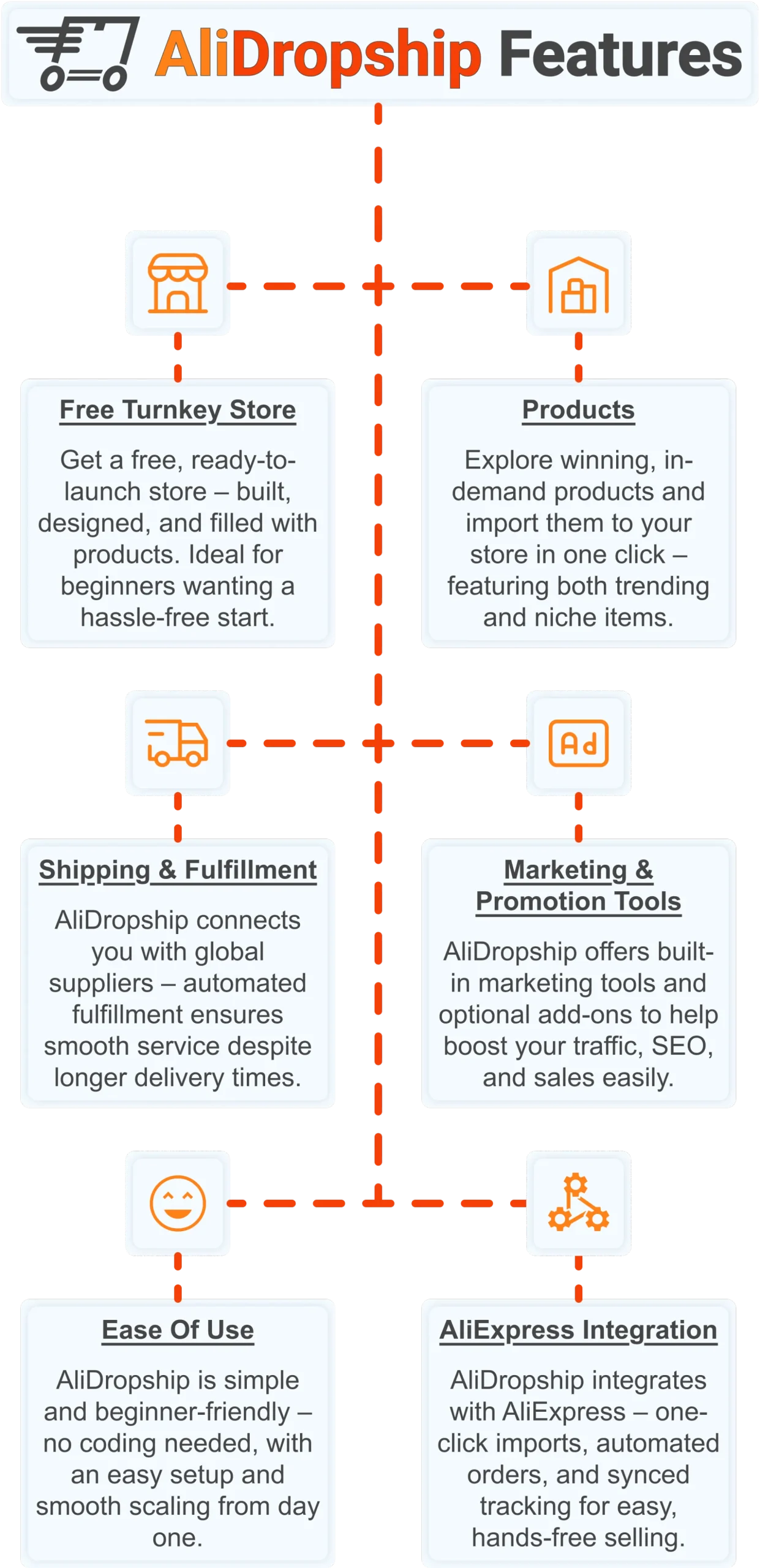
Free turnkey store 🛍️
Get a free turnkey store – built, designed, and filled with products. Ideal for beginners wanting a hassle-free start, the store comes fully optimized to attract customers right away, saving you time on setup. Plus, it includes professional design elements to give your business a polished, trustworthy look from day one. This ready-made foundation makes it easy to move seamlessly into product selection.
Products 📦
Once your store is set up, you can explore winning, in-demand products and import them in one click – featuring both trending and niche items. This wide selection lets you cater to diverse customer interests and test what works best. Regular updates ensure you always have fresh products, keeping your store competitive and relevant. With great products in place, smooth shipping becomes the next essential step.
Shipping & fulfillment 🚚
AliDropship connects you with global suppliers, and automated fulfillment ensures seamless order processing despite international delivery times. Customers receive real-time tracking updates, which builds confidence and trust in your store. Once shipping is handled reliably, you can focus on promoting your store and attracting traffic.
Marketing & promotion tools 📣
To maximize sales, AliDropship offers built-in marketing tools and optional add-ons that help boost traffic, SEO, and conversions. From email campaigns and discounts to social media integration, these tools empower you to reach and retain customers without needing prior marketing experience. With promotion strategies in place, managing your business becomes simpler and more efficient.
Ease of use 👌
AliDropship is beginner-friendly – no coding needed, with an intuitive dashboard that guides you through every step. Easy setup and smooth scaling let you expand your store without stress. As your business grows, adding new features, products, and marketing campaigns remains hassle-free, giving you more time to focus on sales.
AliExpress integration 🛒
Finally, AliDropship integrates seamlessly with AliExpress, enabling one-click imports, automated orders, and synced tracking. Your inventory stays up-to-date with the latest products and prices, while automated order processing frees you from manual tasks. Combined with the turnkey setup, reliable shipping, and built-in marketing tools, this integration ensures your dropshipping business is fully equipped for growth and success.
Switching from Shopify to AliDropship means stepping into a system that handles everything – store creation, product sourcing, fulfillment automation, and marketing – so you can focus on selling. Get your free turnkey store and start with everything already in place.
Is switching from Shopify to AliDropship difficult?
Will I lose my SEO rankings when I migrate from Shopify to AliDropship?
SEO rankings can be maintained during a platform migration if you handle the transition carefully. The key step is setting up 301 redirects from your old Shopify URLs to the corresponding pages on your new AliDropship store before switching the domain over. Without redirects, Google treats the new URLs as entirely new pages and the ranking history is lost. With redirects in place and consistent content, most stores see minimal SEO disruption. Monitoring Google Search Console in the weeks after migration helps catch any crawl issues quickly.
How much does AliDropship cost compared to Shopify?
AliDropship costs 39 dollars per month for a complete turnkey store that includes the store itself, AliExpress integration, automated fulfillment, and built-in marketing tools. Shopify charges a monthly subscription starting at 39 dollars per month on the Basic plan and rising to 399 dollars per month on the Advanced tier, but most dropshipping stores also pay for multiple apps to add functionality, bringing the real monthly total to between 80 and 300 dollars or more. The key difference is that AliDropship includes store creation, product imports, and core automation in that single monthly cost, while Shopify requires additional app subscriptions on top of the base plan to reach the same level of functionality.
Can I keep my domain name when switching from Shopify to AliDropship?
Yes, your domain name transfers with you when you switch from Shopify to AliDropship. Domain names are registered independently of any ecommerce platform. You simply update your DNS settings at your domain registrar to point to your new store. The process typically takes a few hours to propagate fully. Keeping the same domain is important for maintaining brand recognition and any existing SEO value your domain has built up.
Is AliDropship better than Shopify for dropshipping in 2026?
For AliExpress-based dropshipping specifically, AliDropship offers clear advantages in 2026. The native AliExpress integration, built-in automation, and all-in-one approach remove the need for a patchwork of separate apps that Shopify requires to reach the same functionality. Shopify has advantages in name recognition and a larger third-party app ecosystem for non-dropshipping ecommerce use cases. For store owners whose primary model is sourcing from AliExpress and selling internationally, AliDropship is the more streamlined and cost-efficient option in 2026.