Shopify Vs Etsy: Which Platform Is Right For You In 2026

Choosing between Shopify and Etsy is one of the most common decisions new sellers face in 2026. Both platforms let you sell products online – but they work in fundamentally different ways, attract different types of buyers, and come with very different cost structures. If you have been trying to figure out which one actually makes you more money, you are in the right place.
Quick Answer: Shopify gives you full control over your own branded store – better for scaling and dropshipping. Etsy is a built-in marketplace with ready traffic – ideal for handmade and niche product sellers. The best platform depends on your product type, budget, and where you want to be in 12 months.
This guide breaks down the Shopify vs Etsy comparison across fees, setup, audience, and real earning potential – so you can make a confident decision without wasting months on the wrong platform.
Before jumping into the specifics, it helps to understand what each platform was actually built for. Shopify and Etsy serve very different kinds of sellers – and once that distinction is clear, choosing between them becomes a much easier call.

What is the Shopify vs Etsy debate really about?
Shopify is a standalone ecommerce platform. When you sign up, you get your own website – your own domain, your own storefront, your own branding. No other sellers compete on your store pages. Shopify gives you complete control over the customer experience, from the homepage layout all the way through to checkout and post-purchase follow-ups. It is a tool for building a real, independent online business.
Etsy, on the other hand, is a marketplace. When you open an Etsy shop, you become one of millions of sellers inside an existing ecosystem. Customers visit Etsy.com, search for products, and may find your listing – right next to listings from dozens of competitors selling something similar. You do not own the store. You rent space inside Etsy’s platform and operate within their rules.
The core tension in the selling on Etsy vs Shopify debate is this: do you want to build your own audience from scratch with full creative control, or do you want immediate access to a marketplace of ready buyers with less setup but more competition? Neither answer is wrong – it depends entirely on what you are selling, how much time you can invest upfront, and where you want your business to be 12 months from now.
For most sellers, understanding this distinction is the single most important first step. Both platforms are legitimate paths to real income – but they reward very different skills and long-term strategies.
The good news is that whichever direction you choose, you can start right now – and the setup process for both platforms is faster than most people expect. The decision is less about difficulty and more about which business model genuinely fits your goals.
How much can you realistically earn on each platform?
Earning potential varies significantly between Shopify and Etsy – and even more so depending on what you sell and how much effort you put in. The table below gives a realistic overview of what sellers across different models are actually achieving in 2026.
These figures reflect sellers who treat their store as a business, not a side experiment. Etsy tends to reward patience and niche specialization, while Shopify rewards volume, marketing investment, and product-market fit. Most sellers reach consistent monthly income after 60–90 days of active effort.
One note on the upper figures: Monthly earnings above $3,000 consistently require either a strong paid advertising strategy, an established audience, or a high-demand niche with low competition. For most new sellers, a realistic first target is $30–$80 per day in gross sales during the first 30–60 days. Full-time effort over 6–12 months is what separates sellers who reach consistent income from those who stop too early.
The platform fee structure has a direct impact on how much revenue you actually keep. Shopify’s flat monthly subscription means your per-sale overhead drops as volume grows. Etsy’s percentage-based fees compound with every sale – which is why many successful Etsy sellers eventually migrate to, or add, a Shopify store once they cross the $1,000/month threshold.
With the earnings picture clear, it is time to get into the specifics – because the right platform for you depends on more than just the income ceiling. Fees, ease of use, traffic, and product compatibility all play a real role.
Shopify vs Etsy: the differences that actually matter
Here is how the two platforms compare across the factors that affect your day-to-day selling experience and long-term profitability.
Fees and cost structure
Shopify fees explained
Shopify runs on a monthly subscription model. In 2026, plans start at $39/month for the Basic plan, which covers a fully functional store with unlimited products, a custom domain connection, and access to Shopify’s app marketplace. If you use Shopify Payments (its built-in payment gateway), there are no additional transaction fees beyond standard card processing – around 2.9% plus $0.30 per transaction on the Basic plan.
There are no listing fees on Shopify. Whether you have 5 products or 5,000, your monthly platform cost stays the same. This structure strongly favors sellers who are scaling volume over time, since your effective cost per sale drops continuously as revenue grows.
Earning potential: At $1,000/month in Shopify revenue using Shopify Payments, your total platform cost is roughly $39 (subscription) plus $32 (card processing) – around 7% of revenue in overhead.
Etsy fees explained
Etsy charges in layers. Every listing costs $0.20 and renews every four months. On top of that, Etsy takes a 6.5% transaction fee on every sale – applied to both the item price and the shipping cost you charge. There is also a payment processing fee of approximately 3% plus $0.25 per transaction. Some sellers in certain countries also pay a regulatory operating fee of 0.25–0.4% per transaction.
On a $50 sale, Etsy takes roughly $3.25 (transaction fee) plus $1.75 (processing) – about 10% of revenue before any advertising spend. And advertising is often necessary in competitive Etsy categories just to maintain search visibility, which pushes the real cost of selling higher still.
Earning potential: At $1,000/month in Etsy revenue, expect $65–$100 in platform fees before ad spend – and rising sharply if your category requires paid promotion to stay visible.
Setup and ease of use
Getting started with Shopify
Shopify is designed to get you selling within a day or two. The setup wizard walks you through adding products, choosing a theme, and connecting a payment method. No coding knowledge is required – nearly all customization is handled through a visual editor. For anyone weighing Shopify vs Etsy for beginners, the Shopify learning curve is moderate: more to configure upfront, but the interface is clean and the documentation is thorough.
The main challenge for new Shopify sellers is traffic. Unlike Etsy, Shopify does not bring customers to your store. You need to drive visitors through SEO content, social media, email marketing, or paid ads – which takes time and strategy to build from zero.
Getting started with Etsy
Opening an Etsy shop takes about 30 minutes. You create an account, choose a shop name, upload product photos, write your descriptions, set shipping options, and you are live. Etsy handles payments, fraud detection, and most customer service routing automatically. For pure speed of launch, Etsy wins easily.
The trade-off is control. Etsy owns the platform – which means your shop can be suspended for policy violations without appeal. Algorithm updates can tank your search visibility overnight. You also have no direct access to your buyer email list, which makes building long-term customer relationships significantly harder than on a standalone store.
Audience and traffic
Shopify – you build your own audience
Shopify gives you zero built-in traffic. Your store is a standalone website, and visibility depends entirely on your own marketing. That sounds like a disadvantage – and at first, it is. But over 12–24 months, building your own audience means building an asset that no algorithm can take away. You own your email list, your customer data, and your brand reputation. That ownership compounds over time in ways marketplace traffic never can.
Etsy – built-in marketplace traffic
Etsy attracts roughly 90 million active buyers to the platform. When a buyer searches for your type of product, your listing can surface without any ad spend – a genuine advantage no standalone store can replicate early on. For new sellers with niche, handmade, or vintage products, this discovery potential is one of Etsy’s most compelling selling points.
The caveat is competition. Popular Etsy categories are heavily saturated, and reaching page-one visibility typically requires a combination of strong keyword optimization, positive review history, sales momentum, and often Etsy Ads investment. The traffic is real – but in competitive categories, it is rarely truly free.
Shopify vs Etsy dropshipping
If dropshipping is your intended business model, the answer is clear: Shopify wins by a wide margin. Here is why this comparison is not even close.
Etsy prohibits the resale of mass-produced goods unless you fully disclose production partners – and even then, standard dropshipping typically violates its handmade and original-goods policy. Some sellers use Etsy for print-on-demand dropshipping (where a supplier prints your design and ships it), but this carries its own compliance risks and listing restrictions. Building a scalable dropshipping business on Etsy is not a viable long-term path.
Shopify, by contrast, was built for exactly this. It integrates with tools like AliDropship, DSers, and AutoDS that automate product imports, order fulfillment, inventory syncing, and pricing updates. There are no restrictions on product type or supplier origin. For Shopify vs Etsy dropshipping, it is not a close comparison – it is the right tool versus the wrong one.
Why this works in 2026: Shopify’s automation ecosystem has matured significantly. Product research, order routing, and customer tracking can all be handled with minimal manual input – making it realistic to run a profitable dropshipping store part-time.
The contrast between the two platforms is sharpest here: Shopify gives you flexibility, lower long-term costs, and the right infrastructure for dropshipping at scale. Etsy offers marketplace discovery – but with policies that make the most scalable ecommerce model effectively off the table.
Shopify vs Etsy fees: side-by-side breakdown
Here is a direct comparison of the main fee types on each platform, so you can see exactly where your money goes at different stages of growth.
The fee structure gap matters most as you scale. At $500/month or less in sales, Etsy can be cheaper since there is no subscription fee to cover. Once you cross $1,000/month, Shopify’s fixed cost model becomes considerably more efficient. At $3,000–$5,000/month, the difference in retained profit between the two platforms is substantial.
How to get the most from whichever platform you choose
Prioritize product photography
On both Shopify and Etsy, product photos are the single biggest driver of click-through rates. On Etsy, your thumbnail competes directly with dozens of similar listings in the same search result. On Shopify, your product page is often the first impression a new visitor forms of your brand. Clean, well-lit photography – even from a smartphone with good natural light – consistently outperforms studio-quality shots with cluttered or distracting backgrounds.
Build your SEO from week one
Etsy has its own internal search algorithm, and using the right keywords in your listing title, tags, and description directly impacts how often your item surfaces in results. On Shopify, you are optimizing for Google – which takes longer to pay off but compounds more powerfully over time. Use tools like Google Search Console or Ubersuggest to find what your target buyer is actually searching for before you write a single product description.
Start email marketing as early as possible
This is where Shopify has a structural advantage Etsy cannot match. From day one, you can collect buyer email addresses on your Shopify store and build a list you own permanently. Email marketing consistently delivers among the highest ROI of any digital channel – often cited around $36 return for every $1 spent. Etsy sellers do not get direct access to buyer email addresses, which makes building repeat customer relationships significantly harder.
Price for margin, not just for sales
Underpricing is one of the most common mistakes new sellers make on both platforms. On Etsy especially, the instinct is to undercut competitors – but competing purely on price in a crowded marketplace is a race with no good ending. Focus on product quality, presentation, your brand story, and customer experience. Buyers on both Etsy and Shopify will pay a premium for a product that feels right, and a modest price increase typically has less impact on conversion rate than sellers expect.
Review your analytics every week
Both platforms provide built-in dashboards. Shopify tracks conversion rate, average order value, traffic sources, and top-performing products. Etsy’s Shop Manager shows listing views, click-through rate, and revenue by product. Spending 15–20 minutes per week reviewing these numbers helps you spot what is working faster and stop putting effort into channels that are not converting.
Which platform fits your situation best?
If you are a complete beginner
If you are brand new to selling online and have a handmade, vintage, or niche physical product ready to go, Etsy is a reasonable first step. Setup takes around 30 minutes, fees are minimal until sales begin, and the built-in marketplace audience gives you a realistic shot at early sales without paid advertising or an existing social following. It is a solid place to validate your product and pricing before investing further.
If you are a beginner interested in dropshipping
Skip Etsy and go straight to a Shopify-based dropshipping solution. Etsy is not a viable home for standard dropshipping, and setting up on the wrong platform will cost you time, create compliance risk, and ultimately force you to start over. A dedicated dropshipping platform like AliDropship gives you a Shopify-powered store already built for this model – with products loaded, automation in place, and none of the policy risk.
If you are scaling past your first Etsy sales
If you are already making consistent sales on Etsy but hitting a ceiling – through rising ad costs, algorithm changes, or the inability to market directly to existing buyers – it is a natural time to open a Shopify store. Many successful sellers run both simultaneously: Etsy for marketplace discovery and new customer acquisition, Shopify for brand building, email marketing, and direct repeat sales. The two platforms are not mutually exclusive.
If your goal is full-time ecommerce income
If you are targeting consistent income of $3,000+/month, Shopify is the right long-term foundation. No transaction fees on your own payment gateway, full ownership of your customer data, and compatibility with powerful dropshipping and automation tools give Shopify sellers a structural advantage as volume increases. Getting there requires 6–12 months of consistent work on the right niche and marketing channels – but the ceiling is meaningfully higher than what most Etsy sellers can realistically achieve.
Legal and ethical considerations for both platforms
What to avoid absolutely
On Etsy, the most common and serious policy violations involve misrepresenting the origin of products. Listing a mass-produced or resold item as “handmade” violates Etsy’s core seller policy and can result in permanent shop suspension. Dropshipping without disclosing production partners is explicitly against the rules – regardless of what other sellers appear to be doing in your category.
On Shopify, the most common legal risks involve intellectual property: using brand names, logos, or copyrighted imagery in product listings or marketing materials without explicit permission. False advertising claims – unverifiable health benefits, exaggerated performance results, misleading comparisons – are a legal liability in most jurisdictions, not just a platform policy issue.
Key principle: Transparency with customers and compliance with platform rules are not optional – they are the foundation of a business with any real longevity.
What to do instead
If you want to sell popular products through Etsy, work with verified print-on-demand partners and disclose them as your listing policies require. If you want to build a dropshipping business, use a compliant platform like AliDropship that connects you with legitimate suppliers and handles fulfillment end-to-end.
Build reviews through genuine customer service – not by incentivizing positive feedback. Keep your return and refund policies clearly visible. Respond to negative reviews professionally rather than defensively. None of these habits cost money to build, and collectively they make a real difference to your long-term conversion rate and reputation.
With the right platform, the right products, and a straightforward approach to compliance, ecommerce in 2026 offers more legitimate earning opportunity than at almost any point before. The question is not whether you can build real income online – it is which path gets you there.
AliDropship: Your complete all-in-one solution for starting dropshipping in 2026
If you want the simplest possible way to start dropshipping – especially if you’re brand new – AliDropship remains one of the most beginner-friendly tools available in 2026. It brings together store creation, product imports, automation, and marketing into a single streamlined system designed to help you launch quickly and grow confidently.
Free turnkey store 🛔
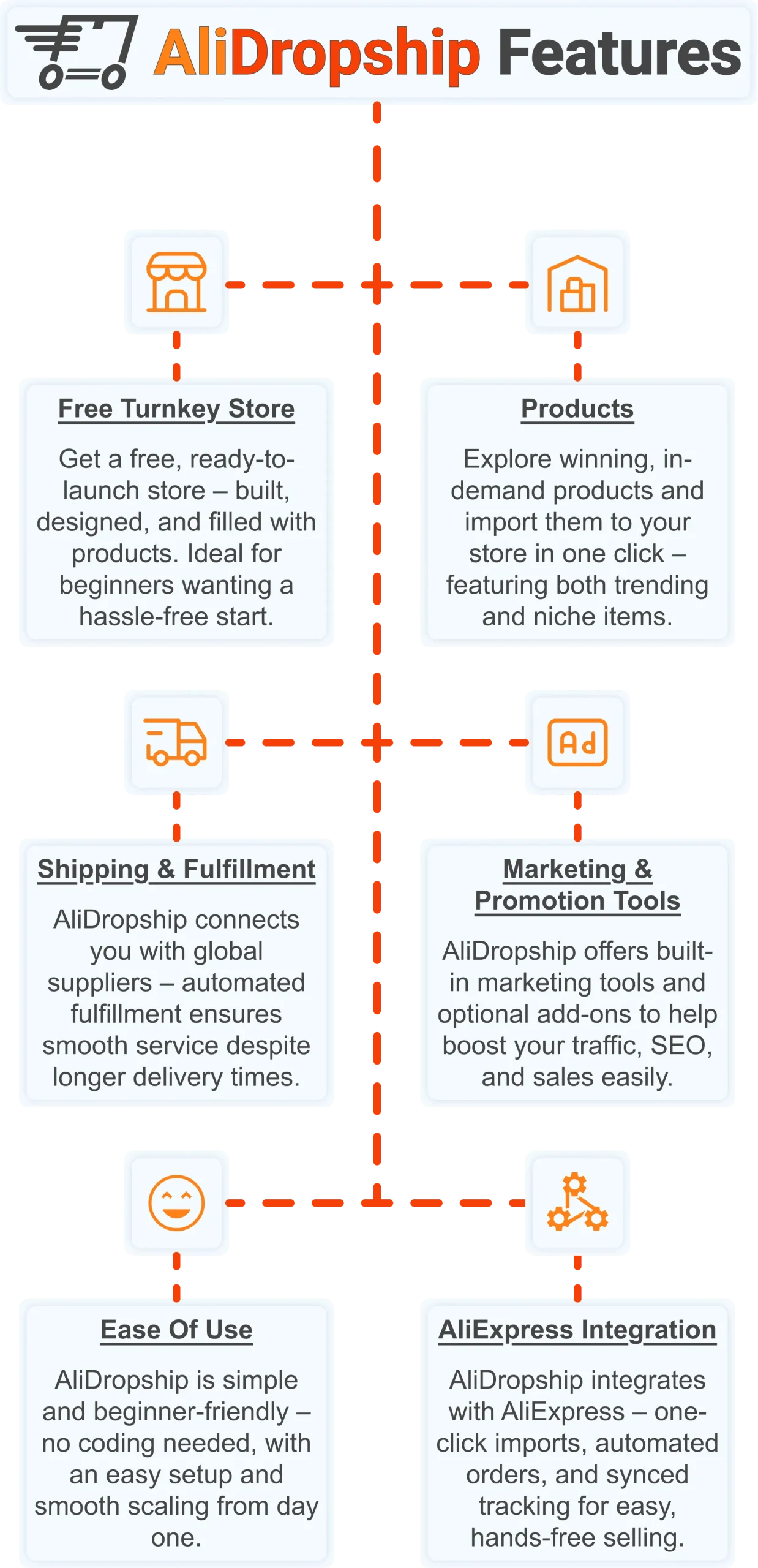
Get a free turnkey store – built, designed, and filled with products. Ideal for beginners wanting a hassle-free start, the store comes fully optimized to attract customers right away, saving you time on setup. Plus, it includes professional design elements to give your business a polished, trustworthy look from day one. This ready-made foundation makes it easy to move seamlessly into product selection.
Products 📦
Once your store is set up, you can explore winning, in-demand products and import them in one click – featuring both trending and niche items. This wide selection lets you cater to diverse customer interests and test what works best. Regular updates ensure you always have fresh products, keeping your store competitive and relevant. With great products in place, smooth shipping becomes the next essential step.
Shipping & fulfillment 🚚
AliDropship connects you with global suppliers, and automated fulfillment ensures seamless order processing despite international delivery times. Customers receive real-time tracking updates, which builds confidence and trust in your store. Once shipping is handled reliably, you can focus on promoting your store and attracting traffic.
Marketing & promotion tools 📣
To maximize sales, AliDropship offers built-in marketing tools and optional add-ons that help boost traffic, SEO, and conversions. From email campaigns and discounts to social media integration, these tools empower you to reach and retain customers without needing prior marketing experience. With promotion strategies in place, managing your business becomes simpler and more efficient.
Ease of use 👌
AliDropship is beginner-friendly – no coding needed, with an intuitive dashboard that guides you through every step. Easy setup and smooth scaling let you expand your store without stress. As your business grows, adding new features, products, and marketing campaigns remains hassle-free, giving you more time to focus on sales.
AliExpress integration 🛒
Finally, AliDropship integrates seamlessly with AliExpress, enabling one-click imports, automated orders, and synced tracking. Your inventory stays up-to-date with the latest products and prices, while automated order processing frees you from manual tasks. Combined with the turnkey setup, reliable shipping, and built-in marketing tools, this integration ensures your dropshipping business is fully equipped for growth and success.
Between Shopify and Etsy, most sellers eventually discover that owning your own store is what makes the real difference. Get your free AliDropship store and start selling with full control today.
What is the main difference between Shopify and Etsy?
Which platform is better for beginners, Shopify or Etsy?
How do Shopify vs Etsy fees compare for small sellers?
Can you run a Shopify store and an Etsy shop at the same time?
Is Shopify or Etsy better for dropshipping?