Shopify SEO Tips: How To Rank Your Shopify Store In 2026

Most Shopify stores are invisible on Google, and the reason is almost never the products. It is the SEO. Shopify gives you a capable ecommerce platform with solid baseline functionality, but those defaults are not enough to rank in a competitive niche in 2026. Paid traffic costs have climbed sharply across Google Ads, Meta, and TikTok – and the stores quietly building market share are the ones treating organic search as a long-term business asset, not a side project.
Quick Answer: Effective Shopify SEO tips in 2026 address four interconnected layers – technical SEO (speed, structure, and crawlability), on-page SEO (product and collection pages), content strategy (keyword research and blogging), and off-page authority (backlinks). Working through all four layers systematically gives your store a durable, compounding traffic advantage that paid ads cannot replicate.
If competitors with smaller catalogs and tighter budgets are outranking you, the gap almost always comes down to faster-loading pages, better-structured product content, and stronger external links pointing to their site. This guide covers every layer with actionable, Shopify-specific advice – no filler, no recycled tips you have already read elsewhere.
Understanding Shopify SEO is one thing. Having a store worth optimizing is another. A properly structured ecommerce site turns every ranking gain into real revenue – and the combination of good SEO with a solid product offer is what separates sustainable stores from ones that plateau after their first traffic spike.

What is Shopify SEO and why it matters in 2026
Shopify SEO is the process of optimizing your Shopify store so that Google ranks your pages higher for searches your customers are already making. It is not one tactic but a system of overlapping disciplines that, when applied together, compound into a durable traffic engine covering how fast your site loads, how your pages are structured, what content lives on them, and how many credible sites link to them.
Shopify handles some fundamentals automatically. It generates and submits an XML sitemap, applies canonical tags to limit duplicate content from product variant URLs, and produces relatively clean page structures by default. However, it also creates challenges you need to fix manually: tag pages that generate near-duplicate content, paginated collection pages that split link equity, and default meta fields that often pull unoptimized copy directly from product titles.
In 2026, Google’s AI-generated summaries have changed how some informational queries display, but commercial and transactional searches – the ones with purchase intent that ecommerce stores depend on – still drive meaningful click-through traffic to well-optimized product and collection pages. Ranking on page one for a buyer-intent keyword like “organic cotton baby onesie” or “ergonomic footrest for standing desk” can deliver free, consistent traffic for months after a single well-executed optimization.
Important note: Shopify SEO is not a one-time project. Stores that hold top rankings are the ones maintaining technical health, refreshing content, and steadily earning new backlinks over time. The good news is that the compounding nature of SEO means your investment grows in value the longer you sustain it.
How much organic traffic can Shopify SEO realistically drive?
The honest answer depends on your niche, your domain authority, and how consistently you execute across all four SEO layers. There is no single figure that applies to every store – but there are realistic benchmarks that help you set expectations and plan your timeline.
These ranges reflect what stores in low-to-medium competition niches typically achieve with consistent effort. High-competition categories – fashion, supplements, consumer electronics – require considerably more domain authority before rankings move meaningfully.
One note on timeline: Most Shopify stores start seeing meaningful ranking improvements 3–4 months after implementing technical and on-page fixes. Blog content targeting long-tail keywords can begin ranking in 60–90 days. Full compounding effects, where consistent publishing and link building produce a sustained traffic lift, typically take 6–12 months of continued effort.
Full-time SEO effort – building backlinks, publishing 2–4 blog posts per month, and continuously refining product pages – is what separates stores pulling 10,000-plus organic visits monthly from ones stuck at a few hundred. Treat SEO like a channel with a ramp-up period and a long payoff window, and you build something competitors cannot replicate with ad spend alone.
No matter where you land in those benchmarks, the underlying principle is the same: the stores that win in organic search treat it as infrastructure, not a campaign. That means starting with a properly built store and a product selection worth ranking for.
Technical SEO – the foundation your Shopify store needs
Technical SEO is not the most visible part of your store, but it determines whether Google can crawl, understand, and index your pages at all. Without a solid technical foundation, every other optimization you make has a ceiling. Think of it as the infrastructure layer – everything else builds on top of it, and problems here cascade into every other SEO area.
Site speed and Core Web Vitals
Google uses Core Web Vitals as direct ranking signals. The three metrics that matter for Shopify stores are Largest Contentful Paint (LCP), which measures how quickly the main content loads; Interaction to Next Paint (INP), which measures responsiveness; and Cumulative Layout Shift (CLS), which measures visual stability. Slow stores rank lower – this is no longer a soft recommendation but a confirmed part of Google’s ranking algorithm.
Compress and convert product images to WebP
Images are typically the largest contributor to slow LCP scores on Shopify stores. Shopify serves WebP images automatically when the browser supports them, but you still need to upload properly sized source files – oversized originals slow down server-side processing. Aim for product images under 200KB at their largest display size. Apps like TinyIMG or Crush.pics handle bulk compression without measurable quality loss and pay for themselves in ranking gains within weeks.
Audit and remove unused apps
Every Shopify app – even inactive ones – can inject JavaScript or CSS into your storefront. These scripts increase page weight and delay First Contentful Paint. Run a Google PageSpeed Insights audit on your homepage and top-selling product pages to identify render-blocking scripts. Then uninstall any app you are not actively using and verify its code has been fully removed from your theme files. Some apps leave orphaned scripts behind even after uninstallation – check your theme’s Assets folder to confirm.
Enable lazy loading for below-the-fold images
Lazy loading defers the loading of images not immediately visible in the user’s viewport. Most modern Shopify themes include native lazy loading, but it is worth confirming in your theme settings or Liquid templates. On collection pages with large product grids – where dozens of images load at once – enabling lazy loading consistently improves LCP scores by 20–40% in PageSpeed Insights tests.
URL structure and crawlability
Shopify enforces fixed URL path prefixes – /products/, /collections/, /pages/ – and you cannot change these. What you can control is the slug that follows. Clean, keyword-relevant slugs help both Google and users understand what a page is about before clicking, and they are one of the simplest on-site wins available to any Shopify store.
Write keyword-informed slugs for every product and collection
Shopify generates URL slugs automatically from your product or collection title. These are often usable, but filler words sometimes slip in. Edit slugs to include your primary keyword, keep them under 60 characters, and use hyphens between words rather than underscores. One important rule: never change the slug of a page that already has ranking history without setting up a 301 redirect from the old URL to the new one. Losing those rankings is far costlier than any slug cleanup is worth.
Submit your sitemap to Google Search Console
Shopify generates a sitemap automatically at yourdomain.com/sitemap.xml. Submit this URL in Google Search Console under Sitemaps – it is a one-time step that significantly accelerates crawling and indexing for new stores and freshly added products. Return to the sitemap report monthly to catch any pages Google is failing to crawl or index, and investigate Coverage errors promptly before they affect ranking.
Fix redirect chains and broken internal links
Redirect chains – where URL A redirects to B, which then redirects to C – dilute link equity and slow crawls. Use a tool like Screaming Frog (free for up to 500 URLs) or Ahrefs Site Audit to map redirect chains and broken links across your store. Fix them by updating internal links to point directly to the final destination URL and consolidating outdated redirects in your Shopify admin. Redirect maintenance is an ongoing task, not a one-time fix.
With your technical foundations in place, Google can now reliably crawl and understand your store. The next step is making sure what it finds on each page is optimized to rank.
On-page SEO for Shopify product and collection pages
Technical SEO gets you indexed. On-page SEO gets you ranked. Your product and collection pages are the commercial core of your store – and they are where most Shopify SEO effort falls apart. Generic supplier descriptions, empty meta fields, and missing structured data are leaving rankings and revenue on the table every day.
Product page SEO
Write unique, keyword-rich product descriptions
Copying supplier descriptions verbatim is one of the most common Shopify SEO mistakes. If dozens of stores carry identical copy for the same product, Google has no reason to rank yours above theirs. Write original descriptions of at least 150–300 words per product, incorporating your primary keyword naturally within the first 100 words. Lead with benefits and specific use cases rather than generic feature lists – Google in 2026 rewards content that helps the searcher decide, not content that reads like a spec sheet.
Optimize title tags and meta descriptions
Shopify uses your product title as the default page title tag, but you can override this in the “Search engine listing preview” section of each product. Write unique title tags of 50–60 characters with the primary keyword positioned near the front. Meta descriptions do not directly influence rankings, but they are your organic ad copy – a well-written 140–150 character description that addresses the buyer’s core question will outperform a keyword dump every time in terms of click-through rate.
Add structured data for products
Product schema markup tells Google precisely what your page is about – including price, availability, brand, and review ratings. Most modern Shopify themes include basic product schema automatically, but you should verify yours in Google’s Rich Results Test. If it is missing or incomplete, apps like Schema Plus for SEO implement it reliably. Correct product schema can unlock rich result features like star ratings in search results, which have been shown to increase click-through rates by 15–30% compared to standard blue links.
Optimize product image alt text
Alt text serves dual purposes: accessibility for screen readers and keyword signals to Google Image Search. Shopify lets you add alt text to each product image individually. Write descriptive, specific alt text that includes your product keyword and describes what the image shows – “walnut adjustable laptop stand on white desk” rather than “laptop stand” or “img_0042.” Image search can drive significant supplemental traffic for visual product categories like furniture, fashion, and home decor.
Collection page SEO
Collection pages are among the highest-value SEO targets on a Shopify store. They typically target broad category keywords – terms like “non-toxic cookware” or “women’s linen trousers” – with high monthly search volumes and strong commercial intent. Yet most stores leave them completely unoptimized, with nothing but a product grid and a generic category name at the top.
Add introductory copy above the product grid
A collection page with no body text has nothing for Google to index beyond product titles. Add 100–200 words of keyword-informed introductory copy at the top of each collection page. This copy should describe the category, address what a buyer looks for when shopping in this category, and incorporate your target keyword and natural variations. Shopify’s collection editor lets you add this in the “Collection description” field, which most themes display above or below the product grid.
Optimize collection URLs and internal linking
Apply the same URL principles to collections as to products. Use clear, keyword-rich slugs like /collections/organic-baby-clothes rather than /collections/cat-123 or /collections/new-in. Additionally, use your collection pages as internal linking hubs – link to them from blog posts, your homepage, and other related collections. This flow of link equity from new content to commercial category pages is one of the most underrated levers in Shopify SEO and costs nothing beyond the time it takes to add internal links.
With your product and collection pages dialed in, you have covered the core commercial SEO layer. The next step is expanding your reach with keyword research and content that pulls in traffic at every stage of the buyer journey.
Shopify keyword research and content SEO
On-page SEO only works if you are targeting the right keywords. Choosing terms without data is guesswork, and guesswork in SEO means months of effort pointed at queries with no real purchase intent or too much competition to crack. Shopify keyword research follows ecommerce SEO principles with a strong focus on product-intent and category-intent queries rather than purely informational ones.
How to find the right keywords for your Shopify store
If your store is already live, start with Google Search Console. The Performance report shows exactly which queries your pages are appearing for – including pages ranking on page two and three that are close to breaking through with a focused optimization push. Filter by positions 8–20 and look for keywords where a targeted content update or title tag revision could move you into the top five.
For new stores or new categories, use Google Suggest and the “People also ask” and “Related searches” sections at the bottom of any search results page. These surfaces reflect real user queries drawn from actual search behavior. Tools like Ubersuggest (free tier), Semrush, or Ahrefs add search volume and keyword difficulty data to help you prioritize which terms are worth targeting first and which are too competitive to start with.
Important: Prioritize long-tail, product-intent keywords over broad head terms when starting out. “Ergonomic memory foam seat cushion for office chair” has far less competition and much higher purchase intent than “seat cushion” – and it is considerably more achievable for a newer store to rank for without an extensive backlink profile.
Using the Shopify blog to build authority and drive traffic
The Shopify blog is one of the most consistently underused SEO assets in ecommerce. A well-planned blog content strategy does two things at once: it pulls in informational and comparison traffic from readers who are still researching before buying, and it builds topical authority that strengthens your product and collection page rankings over time – because Google rewards sites that demonstrate genuine expertise across a topic.
Structure your blog content around the buyer journey. Informational posts – “how to choose the right yoga mat thickness” or “what to look for in a portable camping stove” – capture readers in the research phase and introduce them to your product range naturally. Comparison posts – “memory foam vs. gel seat cushion: which is better for long hours?” – target readers much closer to making a purchase. Both types should link internally to your most relevant product and collection pages.
Publish consistently rather than in bursts. Two well-researched, thoroughly written posts per month outperform eight thin posts every time. Aim for 1,000–2,000 words per article, target a single primary keyword per post, and include at least two internal links from each new post to your product or collection pages. Google’s crawlers follow internal links, and directing that link equity toward your commercial pages is one of the highest-return content strategies available to a Shopify store.
Strong on-page and content SEO establishes what Google thinks your store is relevant for. But relevance alone is not enough to outrank more authoritative competitors. That is where off-page SEO comes in.
Off-page SEO – building authority for your Shopify store
On-page and technical SEO control what you can see on your own site. Off-page SEO is about what the rest of the internet says about you. Backlinks – links from other websites pointing to your pages – remain one of the strongest ranking signals in Google’s algorithm. A store with a solid backlink profile will consistently outrank a technically identical competitor with few external links, particularly for competitive keywords where every ranking factor matters.
How to earn backlinks for a Shopify store
The most reliable source of early backlinks for a new store is your supplier relationships. Many manufacturers and wholesale suppliers maintain “where to buy” or “authorized retailer” pages. Contact yours and ask to be listed – these links are highly relevant, carry genuine editorial authority, and are often overlooked by competing stores that use the same suppliers.
Product roundups and gift guides are another high-value opportunity. Publications, bloggers, and comparison sites in your niche publish articles like “best eco-friendly kitchenware 2026” or “top home office accessories for remote workers” on a regular basis. Reach out to the writers of these posts with a concise pitch about your product and why it fits their readership. A single placement in a well-read roundup can drive both referral traffic and lasting SEO authority.
Creating genuinely useful resources – a sizing guide, a care and maintenance page, a data-driven infographic about your niche – gives other websites a reason to link to you organically over time. These link assets tend to accumulate backlinks passively once indexed, delivering compounding value with no ongoing outreach required.
Earning potential: Stores with 50–100 quality backlinks from relevant, authoritative sources typically see 30–60% improvement in rankings for their target keywords within 3–6 months of consistent link building effort.
Off-page SEO is the layer that makes all your other work compound. A fast, well-structured store with strong on-page content and a growing backlink profile is one of the most defensible positions in ecommerce – and one that becomes harder for competitors to catch up with the longer you maintain it.
Legal and ethical considerations in Shopify SEO
Not all Shopify SEO tips are created equal. Some tactics that promise fast results carry serious risks – from Google penalties that erase rankings overnight to reputational damage that takes far longer to recover from than any algorithm hit.
Key principle: Google’s guidelines are explicit – any tactic designed to manipulate rankings artificially rather than earn them through quality and relevance is a policy violation. Consequences range from manual penalties requiring a formal reconsideration request to full deindexing of your store.
What to avoid absolutely
Buying backlinks from link farms or private blog networks is one of the fastest ways to destroy a store’s SEO. These links are frequently detected during algorithm updates, and the penalties that follow can take months to reverse – if reversal is possible at all. Keyword stuffing carries similar risks: forcing a keyword into every sentence of a product description not only reads poorly but is actively penalized by Google’s natural language systems, which are sophisticated enough in 2026 to detect and discount over-optimization patterns.
Duplicate content is a structural vulnerability specific to Shopify. When product descriptions are identical across multiple pages – or copied wholesale from a supplier feed – Google filters out the duplicate versions, meaning only one version ranks. Always write unique copy for each page, and use canonical tags to designate the authoritative version when true duplicates genuinely cannot be avoided.
What to do instead
Build backlinks through genuine outreach, high-quality content, and supplier relationships. Earn rankings by publishing thoroughly researched, user-focused content that genuinely addresses search intent. Run your store on honest product claims and authentic customer reviews. These approaches are slower than shortcuts, but they accumulate equity that compounds over time rather than collapsing at the next algorithm update.
Playing the long game in Shopify SEO is not just safer – it is more profitable. Sustainable rankings built on quality compound in value, while shortcut-driven gains disappear with the next core update.
How to approach Shopify SEO based on your experience level
The right Shopify SEO strategy depends entirely on where you are starting from. A brand-new store has different priorities than one with six months of traffic history and an established product catalog. Here is how to sequence your efforts based on your current position.
Complete beginner
If you are launching your first Shopify store, your priority is getting the technical foundation right before anything else. Connect Google Search Console and Google Analytics, submit your sitemap, run a PageSpeed Insights audit on your homepage and top collection pages, and fix the most significant speed issues – usually oversized images and third-party app scripts. Then write unique, keyword-informed copy for your top 10–20 product and collection pages. These two steps put you structurally ahead of the majority of new Shopify stores competing in the same niche.
Intermediate – established store with some organic traffic
If you have been live for 6–12 months and are seeing impressions in Search Console, shift focus to keyword gap analysis and on-page refinement. Identify which pages are ranking in positions 8–20 and optimize them with stronger title tags, expanded descriptions, and internal links from blog posts. Start a consistent blogging schedule targeting long-tail informational keywords directly related to your product categories – these posts funnel authority back to your collection pages over time.
Advanced – scaling toward full-time organic traffic
At the advanced stage, off-page SEO and content velocity become the dominant growth levers. Build a systematic backlink outreach process, publish 2–4 blog posts per month organized into topical clusters, and run technical audits quarterly to catch crawl issues before they compound. At this level, stores in moderately competitive niches can realistically target 10,000–50,000 organic visits per month with consistent execution across all four SEO layers.
Whichever stage you are at, the core principle holds: Shopify SEO rewards depth and consistency over shortcuts and bursts. Every month of disciplined effort builds an asset that becomes harder for ad-spend-dependent competitors to displace.
AliDropship: Your complete all-in-one solution for starting dropshipping in 2026
All the Shopify SEO knowledge in this guide is most effective when it is applied to a store that is already properly built, stocked with winning products, and ready to convert the organic traffic you earn. If you want the simplest possible way to start dropshipping – especially if you are brand new – AliDropship remains one of the most beginner-friendly tools available in 2026. It brings together store creation, product imports, automation, and marketing into a single streamlined system designed to help you launch quickly and grow confidently.
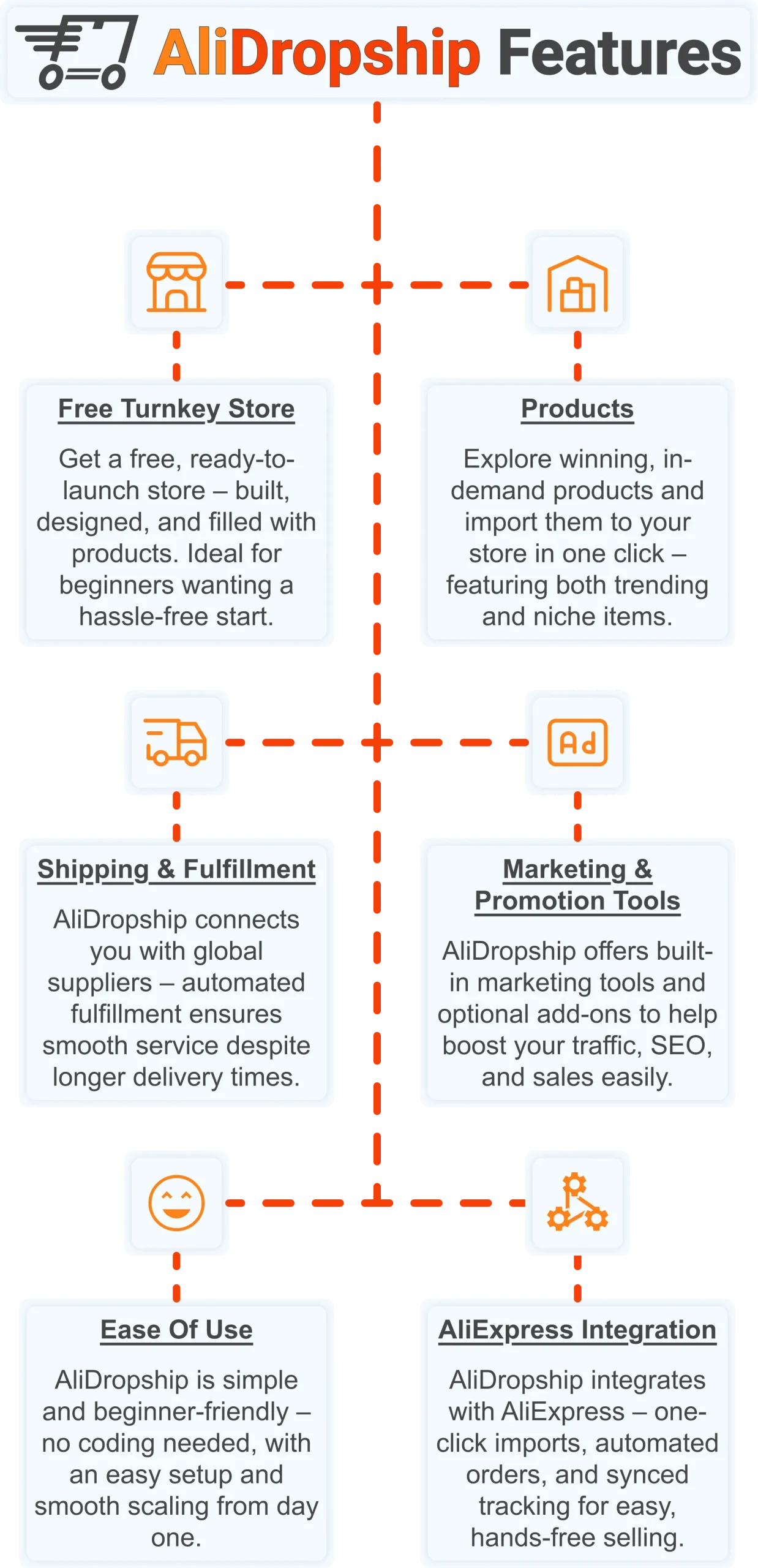
Free turnkey store 🛍️
Get a free turnkey store – built, designed, and filled with products. Ideal for beginners wanting a hassle-free start, the store comes fully optimized to attract customers right away, saving you time on setup. Plus, it includes professional design elements to give your business a polished, trustworthy look from day one. This ready-made foundation makes it easy to move seamlessly into product selection.
Products 📦
Once your store is set up, you can explore winning, in-demand products and import them in one click – featuring both trending and niche items. This wide selection lets you cater to diverse customer interests and test what works best. Regular updates ensure you always have fresh products, keeping your store competitive and relevant. With great products in place, smooth shipping becomes the next essential step.
Shipping & fulfillment 🚚
AliDropship connects you with global suppliers, and automated fulfillment ensures seamless order processing despite international delivery times. Customers receive real-time tracking updates, which builds confidence and trust in your store. Once shipping is handled reliably, you can focus on promoting your store and attracting traffic.
Marketing & promotion tools 📣
To maximize sales, AliDropship offers built-in marketing tools and optional add-ons that help boost traffic, SEO, and conversions. From email campaigns and discounts to social media integration, these tools empower you to reach and retain customers without needing prior marketing experience. With promotion strategies in place, managing your business becomes simpler and more efficient.
Ease of use 👌
AliDropship is beginner-friendly – no coding needed, with an intuitive dashboard that guides you through every step. Easy setup and smooth scaling let you expand your store without stress. As your business grows, adding new features, products, and marketing campaigns remains hassle-free, giving you more time to focus on sales.
AliExpress integration 🛒
Finally, AliDropship integrates seamlessly with AliExpress, enabling one-click imports, automated orders, and synced tracking. Your inventory stays up-to-date with the latest products and prices, while automated order processing frees you from manual tasks. Combined with the turnkey setup, reliable shipping, and built-in marketing tools, this integration ensures your dropshipping business is fully equipped for growth and success.
All the Shopify SEO strategy in this guide is most powerful when it is applied to a store that is already built, stocked, and ready to convert. Get your free AliDropship store today and start turning your SEO efforts into real ecommerce revenue.
What are the most important Shopify SEO tips for beginners?
How long does Shopify SEO take to show results?
Does Shopify have good built-in SEO tools?
How do I do keyword research for my Shopify store?
What is the difference between on-page and off-page SEO for Shopify?