SEO For Shopify: The Complete 2026 Guide

Organic search is still the highest-value traffic channel in ecommerce – and it costs nothing to maintain. Stores that master SEO for Shopify consistently pull in thousands of visitors every month without spending a cent on ads. But here is the honest part: most Shopify store owners either ignore SEO entirely or apply a surface-level checklist and wonder why nothing changes.
This guide covers everything that actually matters in 2026 – from product page optimization and technical fixes to the best Shopify SEO apps and a realistic look at the revenue you can earn from organic traffic. The strategies below apply whether you are launching your first store or trying to fix one that has stalled on page three of Google.
Quick Answer: SEO for Shopify means optimizing your store pages, product descriptions, and technical setup so Google ranks your products for shoppers actively searching for them. Done consistently, it can drive $500–$5,000+ per month in additional revenue without paid ads – but meaningful results typically take 60–90 days to appear.

Whether you are just getting started or looking to push past your current traffic ceiling, the sections below break down exactly what to prioritize and in what order.
What is SEO for Shopify?
SEO for Shopify is the practice of optimizing your online store so that search engines – primarily Google – rank your pages higher in organic (unpaid) search results. When someone types “buy leather wallet online” or “best wireless earbuds under $50,” the stores that appear on page one collect the vast majority of clicks. Position one captures around 28% of all clicks for a given search query, while results beyond page two receive almost none.
Shopify powers over 4 million active stores globally as of 2026. The platform includes several SEO features out of the box – auto-generated XML sitemaps, canonical tags, and mobile-responsive themes – but these defaults only take you so far. To consistently outrank competitors, you need a deliberate strategy that covers three interconnected areas: on-page content, technical health, and off-site authority.
The good news is that Shopify is genuinely one of the more SEO-friendly ecommerce platforms available. Its clean URL structure, automatic sitemap generation, and mature theme ecosystem give you a solid starting point. The challenge is knowing which improvements to prioritize – and avoiding the common mistake of spending months on low-impact tasks while higher-value fixes go untouched.
How much revenue can Shopify SEO realistically drive?
Most guides either skip the earnings question entirely or quote headline figures without context. Here is an honest breakdown of what different SEO approaches tend to produce for a Shopify store with an average order value of $40–$80:
These figures assume a standard product store in a moderately competitive niche. Higher-ticket items or lower-competition categories can push results well above these ranges, while highly competitive verticals like fashion or electronics typically sit closer to the lower end until domain authority is built up over time.
The most important thing to understand about Shopify SEO is that it is cumulative. A product page you optimize today may not rank for 30–60 days. A blog post may take 90–120 days to reach page one. The biggest traffic and revenue gains come from 6 or more months of consistent work – which is exactly why most competitors quit before the results arrive.
One note on the ceiling figures: The $3,000–$10,000+/month range requires 9–12+ months of consistent effort, a well-defined niche, and either quality link-building or a strong content strategy. For most store owners putting in part-time effort, $500–$1,500/month in additional organic-driven revenue is a realistic 6-month target.
Let us walk through exactly how to reach those numbers, starting with the on-page fundamentals where most early gains live.
On-page SEO for Shopify: where the biggest early wins are
On-page SEO refers to everything you can control directly on your store pages – titles, descriptions, content, headings, images, and internal links. For most Shopify stores, this is where the biggest early improvements come from because the baseline is often surprisingly weak.
Product page optimization
Each product page is an opportunity to rank for a specific keyword and capture high-intent shoppers who are close to a purchase decision. The following elements drive the most impact on how Google evaluates and ranks your product pages.
Title tags and product names
Your product title doubles as the on-page H1 heading and feeds directly into the SEO title tag. Shopify generates the meta title from the product name and appends your store name – which means what you call your product matters enormously for search visibility. Include the primary keyword naturally: “Men’s Slim-Fit RFID Leather Wallet” beats “Wallet – Brown” for every relevant query. Keep meta titles to 50–60 characters so they display in full on the search results page without truncation.
Why this works in 2026: Google continues to weight exact-match and close-match keywords in title tags heavily for product-level queries. Getting this right is still one of the fastest ways to move up in rankings for commercial search terms.
Meta descriptions
Meta descriptions do not directly influence rankings, but they strongly influence click-through rate – which does. Write 140–160 character descriptions that include your target keyword, highlight a key benefit, and finish with a light call to action. The most common meta description mistake on Shopify stores is using the same templated text across dozens of product pages. Google downgrades pages with duplicate metadata, and shoppers skip descriptions that read like boilerplate.
Earning potential: A well-optimized product page targeting a keyword with 1,000–5,000 monthly searches can realistically generate $200–$800/month in additional revenue once it reaches page one.
Product descriptions and keyword depth
Thin product descriptions – a single sentence or a copied supplier blurb – are one of the most damaging SEO mistakes on Shopify stores. Google needs sufficient text to understand what your product is, who it is for, and why it is worth ranking. Aim for 150–300 words per key product, weaving in your primary keyword and two to three related terms naturally. One well-placed keyword mention in the opening paragraph and one or two uses further down is plenty – never force it.
Important: Never copy descriptions directly from AliExpress or manufacturer pages. Duplicate content suppresses your rankings. Always rewrite supplier copy in your own voice before publishing.
Collection page SEO
Collection pages – Shopify’s version of category pages – are chronically underused from an SEO perspective. These pages can rank for broader category keywords such as “men’s leather wallets” or “wireless earbuds under $50,” which typically carry higher search volume than individual product terms. Add a short 100–150 word introductory paragraph at the top of each collection page that includes the target keyword naturally. This gives Google meaningful text to index while providing shoppers with useful context about what they will find.
Image SEO and alt text
Shopify stores are image-heavy by nature, which makes image SEO a consistently missed opportunity. Every product image should have a descriptive, keyword-informed filename – not “IMG_4892.jpg” – and a completed alt text field. Alt text helps Google understand what an image shows and contributes to ranking in Google Images, a secondary traffic source that most store owners overlook entirely.
Keep alt text concise and specific: “men’s slim RFID blocking leather wallet in brown” outperforms both an empty field and a keyword-stuffed sentence. Compress all images before uploading – oversized images are among the most common causes of slow Shopify page speed, which directly hurts both rankings and conversion rates.
Technical SEO for Shopify: the foundation everything else relies on
Technical SEO covers the behind-the-scenes elements that determine whether Google can properly crawl, index, and evaluate your store. Shopify handles several of these automatically, but there are specific areas where manual attention is required – and where ignoring problems can quietly undermine months of content work.
Site speed and Core Web Vitals
Google officially uses Core Web Vitals – Largest Contentful Paint (LCP), Interaction to Next Paint (INP), and Cumulative Layout Shift (CLS) – as ranking signals. For Shopify stores, the most common speed bottlenecks are uncompressed images, too many third-party apps loading JavaScript, and heavy theme files. Use Google PageSpeed Insights to identify your specific issues. A target LCP under 2.5 seconds is the standard benchmark to aim for.
Why this works in 2026: Faster stores rank better and convert better. A 1-second improvement in load time has been associated with a 7% lift in conversions, according to data cited by Portent – a meaningful gain for any ecommerce store operating on tight margins.
URL handles and structure
Shopify auto-generates URLs from product and collection names and uses fixed subfolder structures (/products/, /collections/) that cannot be removed. What you can control is the “handle” – the editable slug at the end of each URL. Keep handles short, keyword-focused, and hyphen-separated. For example: yourstore.com/products/rfid-leather-wallet-men reads better and ranks more cleanly than yourstore.com/products/mens-slim-fit-rfid-blocking-leather-wallet-brown-2024.
Canonical tags and duplicate content
Shopify automatically adds canonical tags to product pages, preventing the most common duplicate content issues when the same product appears under multiple collection URLs. However, it does not resolve every scenario. If you sell variants – colors, sizes, materials – that generate unique URLs, check whether Google is indexing low-value variant pages. Consolidating them keeps ranking signals concentrated on the primary product URL rather than split across dozens of near-identical pages.
XML sitemap and Google Search Console
Every Shopify store automatically generates an XML sitemap at yourstore.com/sitemap.xml. Submit this to Google Search Console as soon as your store goes live. This signals to Google that your store exists and accelerates the indexing of your pages. Check Search Console weekly during your first 90 days to catch crawl errors, indexing issues, or manual actions before they compound into larger ranking problems that take months to recover from.
The best Shopify SEO apps in 2026
Shopify’s app ecosystem includes dozens of SEO tools, ranging from free on-page auditors to advanced keyword trackers. Some are genuinely useful; others duplicate features Shopify already handles natively. Here is an honest comparison of the most widely used options:
For most store owners starting out, combining Plug In SEO with TinyIMG covers around 80% of what you need without meaningful monthly cost. Paid tools like SEO Manager become worthwhile once you have 100 or more products and need bulk editing capabilities that manual optimization cannot efficiently handle at scale.
Five Shopify SEO tips that make a measurable difference
Beyond the fundamentals, a handful of practices consistently separate high-performing Shopify stores from those that plateau at mediocre traffic levels. These are not shortcuts – they are strategic habits that compound significantly over 6–12 months of consistent application.
1. Target long-tail keywords before going after head terms
Head terms like “men’s shoes” or “wireless earbuds” have enormous search volume but are dominated by established brands with years of domain authority. As a newer or growing store, targeting long-tail keywords – three to five-word phrases like “men’s waterproof hiking boots size 12” – gives you a realistic path to page one within 60–90 days. Long-tail keywords also convert better because shoppers using specific queries are further along in the buying process and closer to a purchase decision.
2. Build a content strategy around your niche
Shopify includes a built-in blog that most store owners barely use. A content strategy built around informational keywords related to your products – “how to care for a leather wallet,” “best budget wireless earbuds for commuting” – builds topical authority over time, attracts organic backlinks, and drives top-of-funnel traffic you can convert through smart internal linking to product and collection pages. Even two to four posts per month adds up significantly within a year.
3. Use internal linking deliberately
Every blog post you publish should link to at least one relevant product or collection page. Every collection page should cross-link to related collections. Internal linking passes authority through your store and helps Google understand its structure and content hierarchy. Most Shopify store owners treat internal links as an afterthought – making it a core step in your publishing workflow produces measurable ranking improvements within 60 days of consistent application.
4. Earn backlinks through genuine outreach
Backlinks – links from other websites pointing to your store – remain one of Google’s most significant ranking signals. Realistic link-building tactics for ecommerce stores include getting featured in niche product roundup posts, reaching out to bloggers who review products in your category, and submitting to relevant industry directories. Avoid paid link schemes. Google’s spam policies became significantly more aggressive through 2025–2026, and algorithmic penalties from link manipulation can erase months of SEO progress in a single update.
5. Track results and iterate monthly
Set up Google Search Console and Google Analytics 4 from day one. Monitor which pages are gaining impressions, which keywords are climbing, and where competitors are consistently outranking you. A monthly audit – checking for crawl errors, content gaps, and page speed regressions – keeps your store’s SEO health in good shape and ensures that algorithm updates do not quietly erode your rankings without you noticing. Ecommerce SEO is not a one-time task.
Pro Tip: Export your Google Search Console data monthly and save it. Tracking keyword position trends over 6–12 months gives you the clearest possible picture of what is actually moving the needle in your specific niche.
How to approach Shopify SEO based on where you are now
The right shopify seo checklist depends entirely on your current situation. Here is a clear breakdown by starting point to help you choose where to focus first – and what realistic timelines to expect.
Complete beginner
If you are brand new to ecommerce and SEO, focus on the fundamentals: optimize your product titles, write original descriptions for your top 20 products, compress your images, and submit your sitemap to Google Search Console. Do not try to tackle everything at once. This foundation alone can generate your first organic traffic within 60–90 days without any paid tools or advanced tactics required.
Intermediate / part-time store owner
If your store is already live but not generating consistent organic traffic, run a free audit using Plug In SEO or Google Search Console. Fix the highest-priority on-page errors – missing meta descriptions, duplicate titles, slow page speed – before adding new content. Then build a simple blog plan: two to four informational posts per month targeting long-tail keywords in your niche. Expect meaningful ranking traction within 3–4 months at this pace.
Advanced / full-time income goal
If you are targeting $3,000–$5,000+/month in organic-driven revenue, you need a comprehensive system: a full keyword map across all product and collection pages, a consistent content publishing schedule of 8–12 posts per month, an active link-building outreach program, and monthly technical audits. At this level, investing in paid tools like SEO Manager alongside Google Search Console is well worth the cost. Expect 9–12 months to reach this revenue tier from a standing start with consistent, disciplined execution.
Ethical and legal considerations
Regardless of your experience level, there are a handful of practices worth avoiding entirely. Black-hat tactics have always been tempting in ecommerce because some show short-term results – but in 2026, Google’s spam policies have never been more sophisticated or aggressive.
Key principle: Build for the user first. Every SEO decision that prioritizes a real shopper’s experience over a temporary algorithmic shortcut will hold its value through updates. Tactics that do the opposite will not.
What to avoid absolutely: buying links from private blog networks, keyword stuffing product titles or descriptions, generating fake reviews on Google or Trustpilot, cloaking pages to show different content to Google than to users, and publishing unedited AI-generated product descriptions at scale. What to do instead: earn links through genuine partnerships, ask real customers for honest reviews via post-purchase emails, write original descriptions using AI tools only as a first draft you rewrite, and focus on content that genuinely answers questions your shoppers are searching for.
AliDropship: Your complete all-in-one solution for starting dropshipping in 2026
If you want the simplest possible way to start dropshipping – especially if you’re brand new – AliDropship remains one of the most beginner-friendly tools available in 2026. It brings together store creation, product imports, automation, and marketing into a single streamlined system designed to help you launch quickly and grow confidently.
While mastering ecommerce SEO tips takes time to execute, AliDropship gives you a head start by handling the technical foundation – leaving you free to focus on the optimization strategies covered in this guide. Here is what you get:
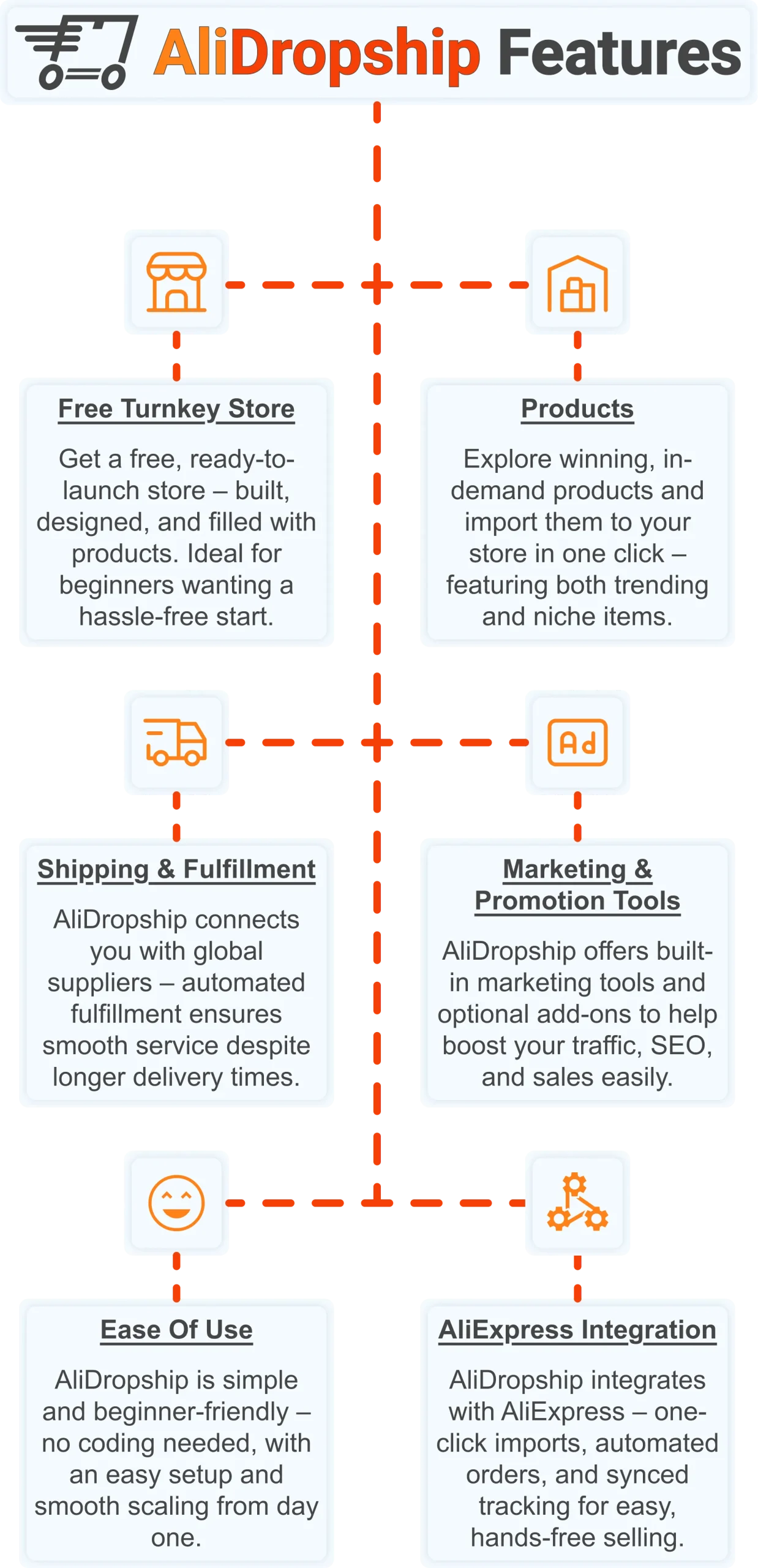
Free turnkey store 🛍️
Get a free turnkey store – built, designed, and filled with products. Ideal for beginners wanting a hassle-free start, the store comes fully optimized to attract customers right away, saving you time on setup. Plus, it includes professional design elements to give your business a polished, trustworthy look from day one. This ready-made foundation makes it easy to move seamlessly into product selection.
Products 📦
Once your store is set up, you can explore winning, in-demand products and import them in one click – featuring both trending and niche items. This wide selection lets you cater to diverse customer interests and test what works best. Regular updates ensure you always have fresh products, keeping your store competitive and relevant. With great products in place, smooth shipping becomes the next essential step.
Shipping & fulfillment 🚚
AliDropship connects you with global suppliers, and automated fulfillment ensures seamless order processing despite international delivery times. Customers receive real-time tracking updates, which builds confidence and trust in your store. Once shipping is handled reliably, you can focus on promoting your store and attracting traffic.
Marketing & promotion tools 📣
To maximize sales, AliDropship offers built-in marketing tools and optional add-ons that help boost traffic, SEO, and conversions. From email campaigns and discounts to social media integration, these tools empower you to reach and retain customers without needing prior marketing experience. With promotion strategies in place, managing your business becomes simpler and more efficient.
Ease of use 👌
AliDropship is beginner-friendly – no coding needed, with an intuitive dashboard that guides you through every step. Easy setup and smooth scaling let you expand your store without stress. As your business grows, adding new features, products, and marketing campaigns remains hassle-free, giving you more time to focus on sales.
AliExpress integration 🛒
Finally, AliDropship integrates seamlessly with AliExpress, enabling one-click imports, automated orders, and synced tracking. Your inventory stays up-to-date with the latest products and prices, while automated order processing frees you from manual tasks. Combined with the turnkey setup, reliable shipping, and built-in marketing tools, this integration ensures your dropshipping business is fully equipped for growth and success.
Everything you have learned about SEO for Shopify applies even more powerfully when your store is already built, stocked, and optimized from the start. Get your free turnkey store from AliDropship and start ranking from day one.
What is SEO for Shopify and why does it matter?
How long does SEO for Shopify take to show results?
What are the most important Shopify SEO tips for beginners?
Do I need paid apps for Shopify SEO optimization?
How much organic traffic can SEO for Shopify realistically generate?