15 Real Online Business Examples That Actually Make Money

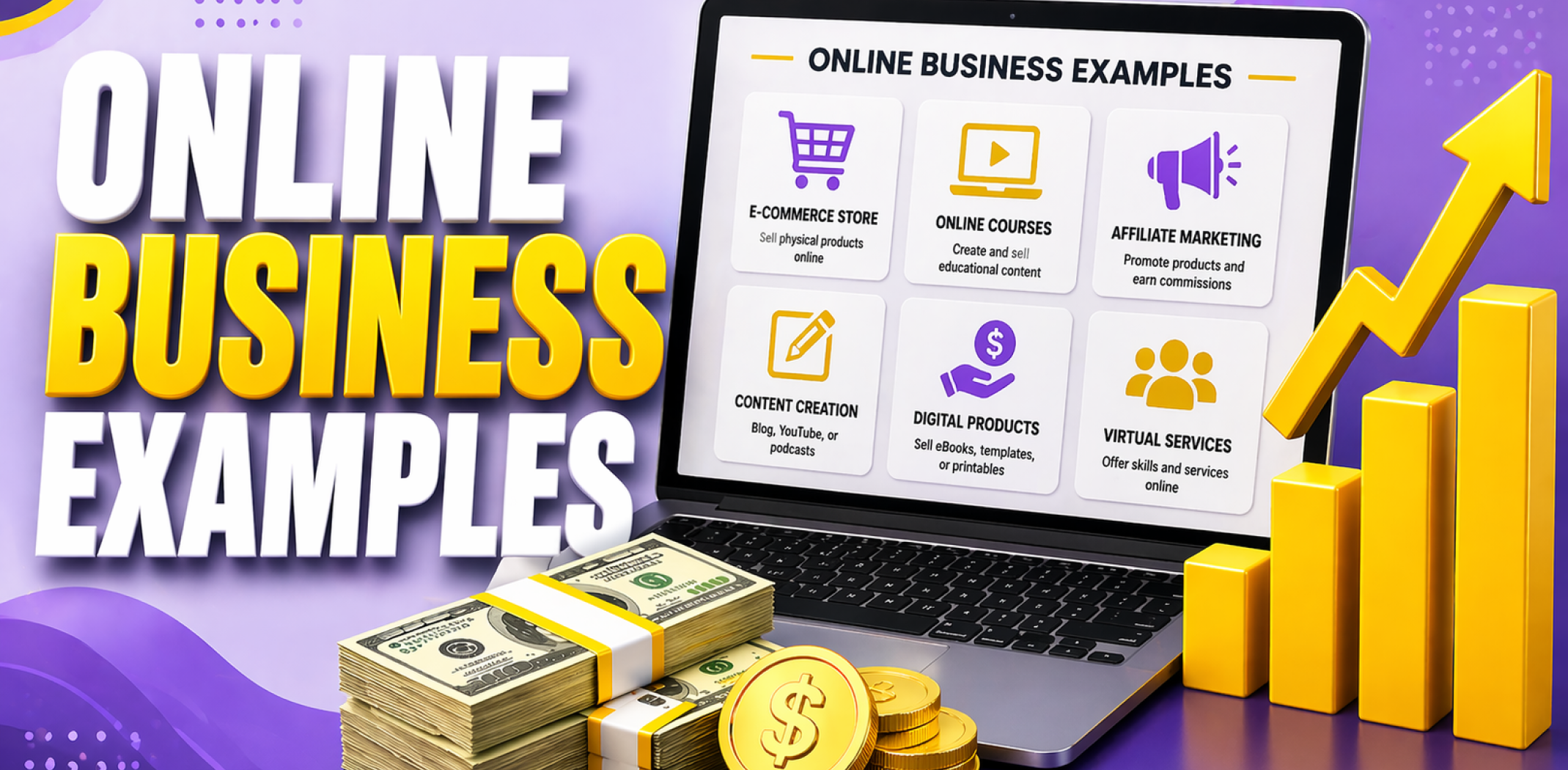
There are more online business examples to choose from in 2026 than at any point in history – and that is both exciting and overwhelming. Whether you are trying to escape the 9-to-5, build a side income, or go fully independent, the internet makes it genuinely possible. But not every model works the same way, and not every one suits every person.
This guide breaks down the most proven types of online businesses with real examples, honest earning expectations, and a clear breakdown of what each model actually demands. By the end, you will have a solid picture of which direction fits your situation – and a realistic plan for getting started.
Quick Answer: The most common and scalable online business examples in 2026 include dropshipping, affiliate marketing, freelancing, digital products, content creation, and ecommerce stores. Each model varies in startup cost, effort level, and income ceiling – the best choice depends on your skills, budget, and goals.
There is no single “best” online business – but there is almost certainly one that fits your circumstances better than the others. Let us walk through what is actually working right now.

What is an online business?
An online business is any venture that generates revenue primarily through the internet – whether that means selling physical products, delivering services remotely, publishing content for ad revenue, or licensing digital downloads. The defining feature is that your “storefront,” your delivery channel, and often your entire operational infrastructure lives online.
What makes online businesses particularly attractive in 2026 is how low the barriers to entry have become. You no longer need a physical location, a large upfront inventory, or a team of employees to launch something real. Many of the most successful online business examples started as one-person operations running on a laptop.
That said, “low barrier” does not mean “no effort.” Every model on this list requires consistency, learning, and time before it produces reliable income. The difference is that the ceiling is much higher and the risks are much lower than traditional brick-and-mortar options.
Why this works in 2026: Global ecommerce revenue is projected to surpass $6.8 trillion in 2025, and the share of consumers buying online continues to grow year over year. The infrastructure is already built – you just need to plug into it.
How much can you realistically earn from an online business?
Earnings vary enormously across models, and anyone promising guaranteed income figures is not being straight with you. What follows is an honest overview based on widely reported ranges from communities like Reddit’s r/entrepreneur and r/dropship, platform documentation, and independent income reports.
Most people launching their first online business hit consistent income somewhere between 60 and 90 days in – assuming they are treating it like a real business and not a weekend experiment. Full-time-equivalent income (roughly $3,000–$5,000/month) typically takes 6–12 months of focused effort for the models that suit beginners best.
One note on these figures: The upper ranges reflect experienced operators, not typical first-year results. Start with realistic expectations – $500–$1,500/month in your first three months is a solid, achievable goal for most models on this list.
With that context in place, here is a detailed look at the most viable online business examples available right now.
Product-based online business examples
Selling physical or digital products online remains one of the most scalable categories in the entire online business landscape. Here are the main models – with real-world examples for each.
Dropshipping and ecommerce stores
Dropshipping
Dropshipping is one of the most widely cited online business examples for good reason: it lets you sell physical products without holding any inventory. When a customer places an order, your supplier ships directly to them. Your role is to run the storefront, handle marketing, and manage the customer experience.
Real-world example: A store selling home organization products through a niche WooCommerce site, sourcing from AliExpress suppliers, running Facebook and TikTok ads, and generating $3,000–$8,000/month within the first year. This is a common profile among successful beginner operators.
Earning potential: $500–$10,000+/month depending on niche, ad spend, and traffic strategy. Margins typically range from 20%–40% per product.
Print-on-demand
Print-on-demand (POD) is a variation of dropshipping where designs are printed onto products – t-shirts, mugs, phone cases, hoodies – only when an order comes in. Platforms like Printful and Printify integrate with Etsy, Shopify, or WooCommerce to handle production and shipping automatically.
Real-world example: A graphic designer or hobbyist launches an Etsy shop around a specific theme (hiking, pets, pop culture), lists 30–50 designs, and earns $400–$1,500/month passively once the listings gain traction.
Earning potential: $200–$3,000/month for consistent operators; higher with paid traffic. Margins are lower than standard dropshipping – typically 15%–25% per item.
Private label / branded ecommerce
A step up from dropshipping, private label means working with a manufacturer to produce products under your own brand name. You control pricing, packaging, and brand identity. Amazon FBA (Fulfilled by Amazon) is the most common platform for this model.
Real-world example: An operator identifies a trending product category on Amazon – say, ergonomic desk accessories – sources a white-label product from a Chinese manufacturer, applies custom branding, and generates $5,000–$20,000/month in revenue once reviews accumulate.
Earning potential: $2,000–$20,000+/month, but requires upfront inventory investment ($1,000–$5,000 minimum) and a longer ramp-up period of 3–6 months.
Digital product stores
Selling ebooks, templates, and guides
Digital products require no inventory, no shipping, and no production cost after the initial creation. Platforms like Gumroad, Etsy (digital downloads), and Shopify make it simple to list and sell files directly to customers.
Real-world example: A marketing professional creates a set of 10 Canva social media templates, lists them on Etsy for $12 each, and earns $300–$900/month with zero ongoing effort after the initial listing setup.
Earning potential: $200–$5,000+/month. Highly scalable since the same product can be sold an unlimited number of times with no additional cost.
Online courses and memberships
If you have expertise in a specific area, packaging it into a structured course is one of the highest-margin online business examples available. Platforms like Teachable, Kajabi, and Podia handle hosting, payments, and delivery. Memberships add a recurring revenue dimension.
Real-world example: A fitness coach builds a 6-week home workout program on Teachable, sells it for $97, and generates $3,000–$8,000/month through email marketing and YouTube traffic.
Earning potential: $1,000–$30,000+/month for established educators with an audience. First sales typically come within 30–60 days for operators who already have an existing following.
Service-based online business examples
Service businesses trade time and expertise for money. They are often faster to start than product businesses but harder to scale because they depend on your direct involvement.
Freelancing and remote services
Freelance writing, design, and development
Freelancing is arguably the fastest way to start an online business with zero upfront cost. Platforms like Upwork, Fiverr, and Toptal connect skilled individuals with clients looking for writing, graphic design, web development, video editing, SEO, and dozens of other services.
Real-world example: A copywriter builds a Upwork profile, lands their first 3–5 clients within 30 days, and reaches $2,000–$4,000/month within three months of consistent outreach and delivery.
Earning potential: $1,000–$8,000/month depending on skill level and niche. The main ceiling is your available hours – which is why many successful freelancers eventually productize their services or move into agencies.
Virtual assistance and online admin
Virtual assistants (VAs) provide administrative, technical, or creative support to businesses and entrepreneurs remotely. Services include inbox management, scheduling, social media management, data entry, customer support, and more. Platforms like Belay, Time etc., and Zirtual connect VAs with clients.
Real-world example: A VA specializing in Pinterest management for ecommerce brands charges $25–$45/hour, takes on 3–4 retainer clients, and earns $2,500–$4,500/month working 20–30 hours per week.
Earning potential: $1,000–$5,000/month depending on specialization and number of clients. Niche VAs – those focused on specific industries or platforms – consistently command higher rates.
Consulting and coaching
If you have demonstrable expertise in a field – marketing, finance, operations, career development, fitness, relationships – consulting or coaching is a legitimate high-ticket online business model. Clients pay for your strategic input and accountability rather than deliverables.
Real-world example: A former HR manager launches a LinkedIn-based career coaching practice, charges $200–$400 per session, and builds a client base of 8–12 active clients generating $3,000–$6,000/month within 6 months.
Earning potential: $2,000–$15,000+/month for established practitioners. The income is high but tied directly to your calendar – making it a strong complement to a product-based income stream rather than a standalone long-term strategy.
Content and audience-based online business examples
These models are built on attention – you create content, attract an audience, and monetize that audience through multiple revenue streams. They take longer to build but can generate income across several channels simultaneously once established.
Blogging and SEO content sites
A blog or niche content site earns money through display advertising (Google AdSense, Mediavine, AdThrive), affiliate commissions, sponsored posts, and digital product sales. The model is slow to start – typically 6–18 months before meaningful traffic – but highly passive once rankings are established.
Real-world example: A personal finance blog targeting first-time investors publishes 80–100 in-depth articles over 12 months, reaches 50,000 monthly visitors, and earns $2,000–$4,000/month through a combination of AdThrive ads and affiliate partnerships with brokerage platforms.
Earning potential: $500–$10,000+/month for established sites with strong domain authority. Income per 1,000 visitors typically ranges from $15–$50 depending on niche and monetization mix.
YouTube and video content
YouTube monetization combines ad revenue (YouTube Partner Program), sponsorships, affiliate links, and merchandise. It is one of the most competitive online business examples but also one of the most durable – well-ranking videos continue to earn for years after publication.
Real-world example: A tech reviewer with 50,000 subscribers earns $800–$2,000/month from AdSense, an additional $1,000–$3,000/month from affiliate links to reviewed products, and periodic sponsorships adding another $500–$2,000 per deal.
Earning potential: $300–$10,000+/month across revenue streams. YouTube Partner Program eligibility requires 1,000 subscribers and 4,000 watch hours – most consistent creators reach this threshold in 6–12 months.
Affiliate marketing websites
Affiliate marketing is the practice of earning a commission by promoting other companies’ products or services. You do not handle the product, shipping, or customer service – you simply drive qualified traffic to offers and earn when visitors convert.
Real-world example: A review site covering home gym equipment targets keywords like “best adjustable dumbbells” and “home gym setup under $500,” earning 5%–10% commissions on Amazon Associates alongside higher-commission partnerships with fitness brands. A well-ranked 50-page site in this niche can generate $1,500–$5,000/month.
Earning potential: $200–$8,000+/month depending on traffic volume, niche commission rates, and content quality. High-ticket affiliate programs (software, finance, ecommerce tools) push the upper ceiling significantly higher.
Comparing online business models: a quick reference
Startup cost and time-to-income are the two variables that matter most for beginners. If you need income within 60 days and have limited capital, dropshipping and freelancing consistently outperform the other models in both categories.
Things to watch out for when starting an online business
Not every online business opportunity is what it claims to be. There are enough legitimate models on this list that you never need to rely on grey-area tactics – but it is worth knowing what to avoid.
Key principle: If a model promises income with no effort and no skill, it is not a business – it is a scam dressed up in business language.
Misleading income claims
Screenshots of $10,000 days and $100,000 months circulate constantly on social media. Most are cherry-picked revenue figures – not profit – or simply fabricated. Always look for documented, consistent income over 6–12 months, ideally with verifiable proof of expenses and margins. Revenue without context is meaningless.
Fake “guru” courses
The online business education space is full of courses that teach you to sell courses teaching others to sell courses. If the only documented success story belonging to the course creator is the course itself, that is a red flag. Legitimate educators can point to real product or service businesses they built before packaging that knowledge for sale.
Pyramid structures and MLM
Multi-level marketing (MLM) is technically legal but structured in a way that makes the majority of participants lose money. The FTC has documented that in most MLMs, more than 99% of participants make no meaningful profit. These are not online business examples – they are recruitment funnels. Avoid any opportunity where recruitment is the primary income mechanism.
Black-hat SEO and fake reviews
Buying reviews, using private blog networks (PBNs), or stuffing keywords into content might produce short-term results, but Google’s algorithm updates and Amazon’s review enforcement have become increasingly effective at penalizing these tactics. A business built on manipulation has no foundation – one algorithm update can wipe it out overnight.
What to do instead: Build organic traffic through genuinely useful content, earn reviews by delivering a great product and customer experience, and invest in legitimate paid advertising when your unit economics support it. These approaches take longer but produce durable results.
Which online business is right for you?
The honest answer depends on three things: how much capital you have, how much time you can commit, and what skills or interests you are starting with. Here is a clear breakdown by reader profile.
Complete beginner – limited budget, limited experience
If you are starting from zero, dropshipping is the most forgiving entry point among all online business examples. The upfront cost is minimal, the operational complexity is manageable, and there are enough tools and communities (AliDropship, Reddit’s r/dropship) to guide you through early mistakes. Expect to spend 10–15 hours per week in the first 60–90 days setting up, testing products, and learning paid traffic basics.
Intermediate – some skills, part-time commitment
If you already have a marketable skill – writing, design, coding, marketing, video editing – freelancing gives you the fastest path to meaningful income. You can realistically earn $1,500–$3,000/month within 60–90 days if you approach it systematically. Once you have consistent client income, reinvest a portion into building a passive income stream – affiliate content, digital products, or an ecommerce store – to reduce your dependence on active hours.
Advanced – full-time goal, ready to invest
If you are targeting $5,000+/month and are prepared to commit full-time effort, a combination of dropshipping or private label ecommerce with a content traffic strategy (SEO blog, YouTube channel) is the most proven path. The ecommerce side gives you direct revenue; the content side reduces your paid traffic dependency over time. Operators who combine both channels consistently outperform those who rely on ads alone.
Creator or subject-matter expert
If you have deep knowledge in a specific area – fitness, finance, parenting, cooking, business – a content-first strategy makes the most sense. Start a niche blog or YouTube channel, build an audience around your expertise, and layer in monetization through affiliate partnerships, digital products, and eventually your own courses or membership community. This path is slow (12–18 months to meaningful income) but builds the most durable and diversified income base of any model on this list.
Whichever direction you choose, the most important thing is to commit to one model before diversifying. The biggest mistake new online business owners make is spreading attention across three or four models simultaneously and executing none of them well.
AliDropship: Your complete all-in-one solution for starting dropshipping in 2026
If you want the simplest possible way to start dropshipping – especially if you’re brand new – AliDropship remains one of the most beginner-friendly tools available in 2026. It brings together store creation, product imports, automation, and marketing into a single streamlined system designed to help you launch quickly and grow confidently.
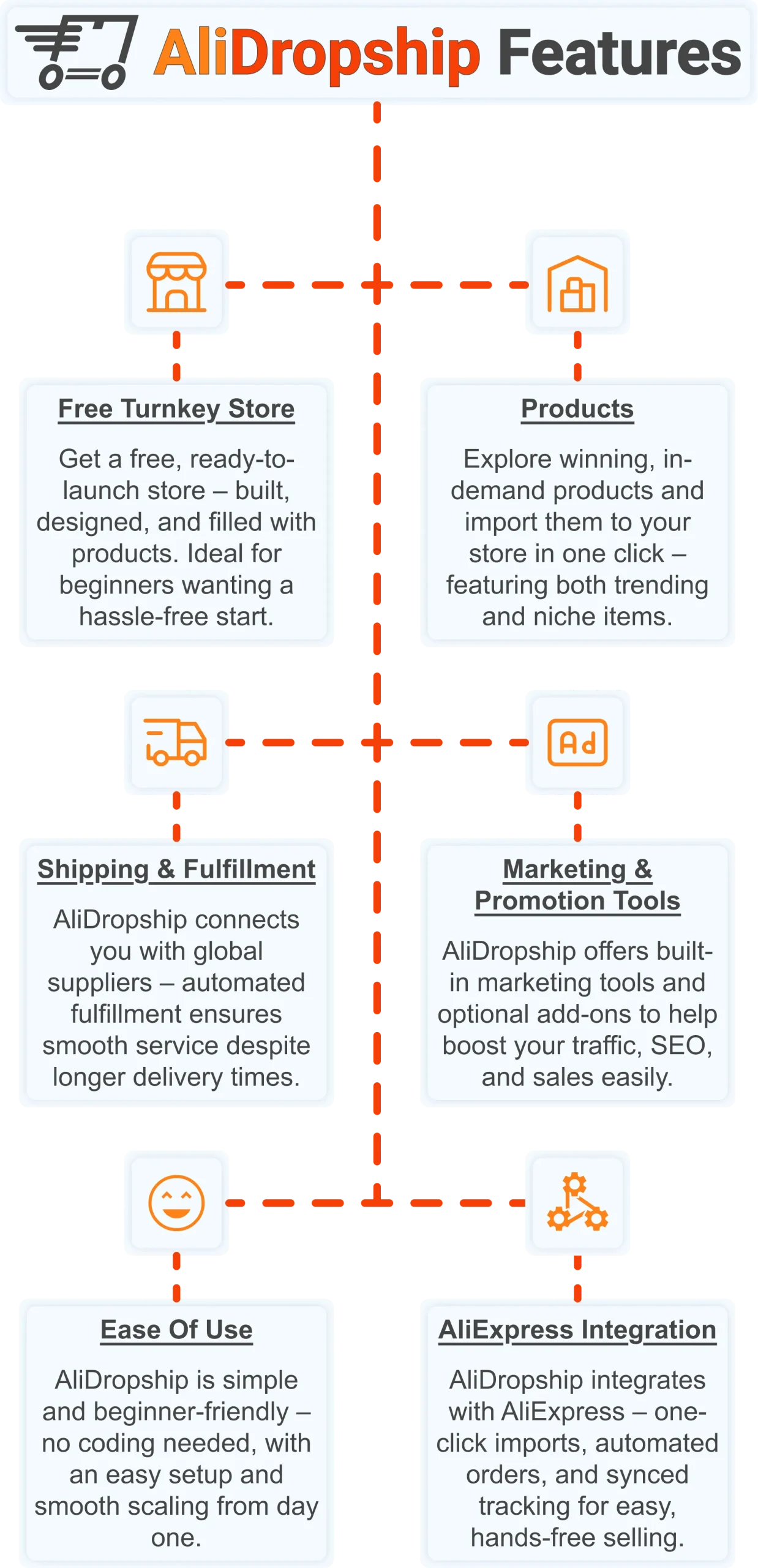
Free turnkey store 🛍️
Get a free turnkey store – built, designed, and filled with products. Ideal for beginners wanting a hassle-free start, the store comes fully optimized to attract customers right away, saving you time on setup. Plus, it includes professional design elements to give your business a polished, trustworthy look from day one. This ready-made foundation makes it easy to move seamlessly into product selection.
Products 📦
Once your store is set up, you can explore winning, in-demand products and import them in one click – featuring both trending and niche items. This wide selection lets you cater to diverse customer interests and test what works best. Regular updates ensure you always have fresh products, keeping your store competitive and relevant. With great products in place, smooth shipping becomes the next essential step.
Shipping & fulfillment 🚚
AliDropship connects you with global suppliers, and automated fulfillment ensures seamless order processing despite international delivery times. Customers receive real-time tracking updates, which builds confidence and trust in your store. Once shipping is handled reliably, you can focus on promoting your store and attracting traffic.
Marketing & promotion tools 📣
To maximize sales, AliDropship offers built-in marketing tools and optional add-ons that help boost traffic, SEO, and conversions. From email campaigns and discounts to social media integration, these tools empower you to reach and retain customers without needing prior marketing experience. With promotion strategies in place, managing your business becomes simpler and more efficient.
Ease of use 👌
AliDropship is beginner-friendly – no coding needed, with an intuitive dashboard that guides you through every step. Easy setup and smooth scaling let you expand your store without stress. As your business grows, adding new features, products, and marketing campaigns remains hassle-free, giving you more time to focus on sales.
AliExpress integration 🛒
Finally, AliDropship integrates seamlessly with AliExpress, enabling one-click imports, automated orders, and synced tracking. Your inventory stays up-to-date with the latest products and prices, while automated order processing frees you from manual tasks. Combined with the turnkey setup, reliable shipping, and built-in marketing tools, this integration ensures your dropshipping business is fully equipped for growth and success.
Among all the online business examples covered in this guide, dropshipping with AliDropship stands out as the clearest path from zero to a functioning, income-generating store. Get your free turnkey store and $100 welcome gift – and start your online business today.
What are the best online business examples for beginners?
Which online business can you start with no money?
How long does it take to make money from an online business?
What is the most profitable type of online business?
Are online businesses worth starting in 2026?