How To Market A Small Business: The Best Ideas For 2026

Small businesses now have access to the same marketing channels as major brands — social media, SEO, email automation, paid advertising — but without the budgets to match. That gap has always felt unfair. What has changed in 2026 is that the tools have become dramatically more affordable, more intuitive, and more effective for lean teams and solo operators. A well-chosen mix of small business marketing ideas can drive real, measurable growth — even if you are starting from nothing.
Quick answer: The best marketing ideas for small business in 2026 combine free digital channels (SEO, social media, email) with targeted local outreach (Google Business Profile, referral programs, community partnerships). No single strategy works for everyone — the right mix depends on your audience, your bandwidth, and your growth goals.
This guide covers 20+ proven small business marketing ideas across social media, content marketing, local outreach, paid advertising, and more — with honest notes on effort level, realistic outcomes, and which approaches make the most sense depending on where you are right now.
Before diving in, one principle worth keeping in mind: the businesses that grow consistently do not try to do everything at once. They pick two or three channels, execute them well for 60–90 days, and expand from there. Use this guide to identify your best starting points — then build from a position of strength.

What is small business marketing?
Small business marketing is the process of attracting, engaging, and retaining customers using a mix of digital and offline tactics suited to a business with limited time and budget. Unlike enterprise marketing — which relies on large teams, complex tech stacks, and multi-million dollar ad budgets — small business marketing prioritizes efficiency and selectivity. The goal is to find the channels where your target customers spend time, show up consistently, and give them a genuine reason to choose you over a competitor.
In 2026, small business marketing is largely digital-first. Platforms like Google, Instagram, TikTok, and email have leveled the playing field in meaningful ways. A local candle maker can reach 10,000 potential buyers with a single well-timed Reel. A solo web designer can rank on page one of Google with a focused content strategy. A one-product business can build a loyal email list of 5,000 subscribers without spending anything on ads. The barrier to effective marketing has never been lower — but the competition for attention has never been higher, which makes strategy and consistency more important than ever.
That said, offline methods still carry real weight — especially for businesses with a primarily local customer base. Word of mouth, community events, and strategic local partnerships often drive the most loyal and highest-value customers. The best approach is almost always a hybrid: digital reach combined with local trust-building.
How much can marketing realistically grow your revenue?
Results vary widely depending on your industry, starting point, and how consistently you execute. That said, here is a realistic breakdown of what small businesses typically see from each major marketing channel after 3–6 months of consistent effort:
These figures represent incremental revenue growth — not guaranteed results. Businesses in competitive niches may take longer to see traction, while those in underserved local markets can move faster. A realistic timeframe for any new marketing channel to show meaningful results is 60–90 days of consistent effort.
One note on these figures: The high end of each range typically applies to businesses that are already established and layer in paid amplification. If you are starting fresh, expect the lower portion of each bracket in the first 90 days — then scale as you learn what resonates with your audience.
The most important principle here is compounding. Email lists grow month on month. SEO rankings build on each other. Social audiences grow as your content gets shared. Marketing rarely delivers a straight line up — but the businesses that commit for 6–12 months consistently outperform those that switch tactics every few weeks.
Social media marketing ideas for small businesses
Social media remains one of the most accessible and cost-effective marketing channels for small businesses in 2026. The key is choosing platforms that match your audience — not trying to maintain a presence everywhere at once. A consistent, well-executed presence on two platforms will always outperform scattered activity across five.
Organic social content
Organic social media means posting content without paying for promotion. Done consistently, it builds brand awareness, nurtures trust, and drives steady traffic — all at no cost. The trade-off is time: you need to create content regularly, learn what resonates with your specific audience, and be patient while your following grows.
Instagram and visual storytelling
Instagram remains one of the top platforms for product-based and service businesses in 2026. Short-form Reels consistently outperform static posts in reach, with many small business accounts reporting 3–5x more views from video content compared to photos. The most effective Instagram approach for small businesses combines three content types: behind-the-scenes content (builds trust), product or service showcases (drives purchase intent), and educational posts (establishes authority). Aim for 3–5 posts per week, with at least 2 Reels in the mix. Use niche hashtags rather than broad ones — a post tagged #handmadejewelrybrooklyn will reach more relevant buyers than one simply tagged #jewelry.
Earning potential: $500–$2,000/mo in attributable sales from organic Instagram with an engaged following of 2,000–5,000 followers.
TikTok short-form video
TikTok still offers the fastest organic reach of any platform available to small businesses — and its algorithm continues to favor quality content over follower count. A well-crafted 30–60 second video from a brand-new account can still reach tens of thousands of people. The most effective formats for small businesses include “how it is made” videos, day-in-the-life content, product demonstrations, and honest behind-the-scenes clips. Post at least 4–5 times per week for best algorithmic traction. TikTok Shop integration also enables direct in-app purchases, which is especially useful for physical product businesses.
Earning potential: $300–$3,000/mo in attributable revenue once your account reaches 1,000+ followers, scaling significantly with viral content.
Facebook groups and community building
While Facebook has lost younger audiences to TikTok and Instagram, it remains highly effective for local businesses and community-driven brands. Creating a free Facebook group around a topic adjacent to your business — rather than just about your business — can build a loyal audience faster than a standard business page. A local fitness studio might run a “Home Workout Accountability” group. A boutique dog groomer might manage a “Dog Owners in [City]” community. These groups generate organic engagement, drive word of mouth, and position you as a trusted local expert without any ad spend.
Earning potential: $200–$1,500/mo in additional revenue from an active local group of 200–1,000 engaged members.
Paid social advertising
Paid social ads accelerate everything that organic content does — but they require budget and a learning curve. The most common mistake small businesses make is running ads before identifying a high-performing organic post to amplify. Always find what resonates organically first, then put spend behind it.
Facebook and Instagram ads
Meta’s advertising platform remains the most accessible paid social option for small businesses in 2026. With budgets as low as $5–$10 per day, you can run targeted campaigns to specific demographics, interests, locations, and behaviors. The most effective campaign types for small businesses are awareness campaigns (new audience reach), traffic campaigns (website visits), and conversion campaigns (purchases or sign-ups). Start with a $10/day budget, run for 7–10 days, and analyze which ad sets perform before scaling. A well-optimized Meta campaign typically achieves a cost per click of $0.50–$1.50 for most small business categories.
Boosted posts and retargeting
Retargeting — showing ads to people who have already visited your website or engaged with your social profiles — is consistently the highest-ROI paid tactic for small businesses. Targeting warm audiences who already know you exist means conversion rates are typically 2–4x higher than cold traffic campaigns. You can set up a basic retargeting campaign on Meta for $3–$5 per day. Combined with an automated email welcome sequence, retargeting can significantly reduce cart abandonment and recover lost sales without heavy ongoing work.
Measure what your advertising really earns
Simply input your ad spend, product cost, and sales generated from ads — the calculator will instantly show your net profit and a verdict on whether your ad campaign is profitable or needs adjustment.
| Under 2× | Loss — ad revenue cannot cover product cost plus ad spend |
| 2–3× | Tight — barely break-even after typical refund losses |
| 3–4× | Healthy — typical for established dropshipping operations |
| 4–6× | Strong — outperforming the median operator |
| 6×+ | Excellent — top-tier ad efficiency, scale aggressively |
Content marketing strategies that drive long-term growth
Content marketing is the long game of small business advertising ideas — slower to produce results than paid ads, but far more durable. A blog post that ranks on Google keeps driving traffic for years without ongoing spend. An email list you own cannot be taken away by a platform change. A YouTube channel compounds in value as your back catalogue grows. Businesses that invest in content marketing consistently outperform those relying solely on paid traffic within 12–18 months.
Blogging and SEO content
Search engine optimization remains one of the highest-ROI marketing strategies for small business available in 2026 — and it is entirely free. The core principle is straightforward: write content that answers questions your potential customers are already searching for. A plumber in Austin writes “how to fix a leaking pipe joint” and ranks for local searches in their area. A boutique clothing store writes “how to style wide-leg trousers” and attracts buyers through Google. Free tools like Google Search Console and Ubersuggest help identify what your audience is searching for. Aim for one well-researched, keyword-focused blog post per week, each with a clear call to action pointing toward your product or service.
Earning potential: $1,000–$5,000/mo in organic search revenue after 6–12 months of consistent, focused publishing in a well-defined niche.
Video marketing and YouTube
YouTube is the second-largest search engine in the world — and it is still dramatically underused by small businesses. Unlike TikTok, which rewards high posting frequency, YouTube rewards depth. A single well-produced 8–12 minute tutorial video can rank in Google search results and drive consistent traffic for years. Small businesses that use YouTube effectively combine educational content (how-to guides, product walkthroughs, comparison videos) with behind-the-scenes content that builds genuine trust. You do not need expensive equipment — a smartphone, decent lighting, and clear audio is enough to start. One video per week is a sustainable pace for building momentum in the algorithm.
Email marketing and newsletters
Email marketing consistently delivers one of the highest returns of any digital marketing channel — typically $36–$40 for every dollar spent, based on widely cited industry benchmarks. For small businesses, the priority is building the list first. Offer a lead magnet — a discount code, a free guide, or exclusive early access — to capture email addresses from website visitors and social followers. Then send a weekly or biweekly newsletter with genuine value: useful tips, product updates, behind-the-scenes content, and clear promotional offers mixed in. Platforms like Mailchimp (free up to 500 contacts), Klaviyo, and ConvertKit make it easy to build automated welcome sequences and abandoned cart flows without technical knowledge.
Why this works in 2026: Email is the only marketing channel where you own your audience outright — no algorithm can reduce your reach, and no platform update can take your list away.
Local and offline marketing ideas for small businesses
Digital marketing gets most of the attention, but local and offline tactics remain some of the most powerful small business advertising ideas available — especially for businesses that serve a specific geographic area. These methods build the kind of high-trust, high-lifetime-value customers that no social algorithm can replicate.
Google Business Profile
If you do one thing for your local marketing strategy this year, claim and fully optimize your Google Business Profile. It is free, takes under an hour to complete, and dramatically improves your visibility in local search results and Google Maps. Businesses with complete profiles — including photos, business hours, services listed, and regular updates — receive up to 70% more visits and 50% more purchase consideration than those with incomplete profiles, according to Google data. Ask every satisfied customer to leave a review, and respond to every review — positive or negative — within 48 hours. This signals trust to both Google and prospective customers browsing your listing.
Local partnerships and community events
Partnering with complementary local businesses is one of the most underrated low cost marketing ideas available. A yoga studio partners with a healthy cafe. A pet groomer connects with a veterinary clinic. A wedding photographer collaborates with a florist. Cross-promotions, shared social posts, bundled offers, and referral agreements cost nothing to set up and can produce a consistent stream of warm leads from day one. Community events — sponsoring local sports teams, hosting workshops, participating in farmers markets — build the kind of brand recognition that advertising spend cannot easily replicate.
Word of mouth and referral programs
Word of mouth remains the most trusted form of marketing for small businesses. Research by Nielsen has consistently shown that over 90% of consumers trust recommendations from people they know above any form of advertising. Turning satisfied customers into active advocates requires a deliberate system — not just hoping they spread the word naturally. A simple referral program (“refer a friend, both get 15% off”) can be implemented with a basic loyalty app or even a manual discount code. The goal is making it effortless for happy customers to recommend you — and rewarding them specifically when they do.
Low-cost digital marketing ideas for small businesses
Not every effective marketing strategy for small business requires significant spend. Some of the best online marketing ideas are completely free — they just require time, consistency, and a willingness to learn. Here are three underused digital tactics that deliver strong results without a significant budget.
Pinterest and visual search
Pinterest is a search engine with a social interface — and for product-based small businesses, it remains one of the most underused platforms available. Unlike Instagram or TikTok, Pinterest content has a long lifespan. A well-optimized pin can drive traffic for months or even years after it is first posted. Pinterest users skew toward high-intent buyers who are actively planning purchases and comparing options. Businesses in home decor, fashion, food, crafts, fitness, or wedding-related categories consistently see strong organic results. The key is optimizing pin descriptions with relevant keywords, linking directly to product or landing pages, and scheduling 5–15 pins per day using a tool like Tailwind.
Earning potential: $300–$2,000/mo in referral revenue from a well-maintained Pinterest profile with 50+ boards after 90 days of consistent pinning.
Micro-influencer partnerships
Influencer marketing has a reputation as an expensive tactic — but that is only true at the macro level. Micro-influencers (accounts with 1,000–50,000 followers in a specific niche) often accept product exchanges for honest reviews, charge very modest fees, or collaborate for free if your product genuinely fits their content. Their engagement rates typically outperform larger accounts by 2–3x, because their audiences are tightly focused and genuinely trust their recommendations. A small business selling organic skincare can partner with a 10,000-follower wellness creator for a fraction of what a celebrity endorsement costs — and often achieve stronger conversion rates. Platforms like Upfluence and AspireIQ, or a straightforward Instagram search, can help you find relevant micro-influencers in your niche.
Online directories and review platforms
Getting listed on relevant online directories — Yelp, Trustpilot, Google, and industry-specific platforms — is a free and often overlooked way to improve both local SEO and social proof simultaneously. Each directory listing creates an indexed page that can appear in search results for your business name or category. Businesses with 10 or more reviews on Yelp or Google receive significantly more click-throughs than those with fewer, even when ratings are similar. Set a target of generating 2–3 new reviews per week across your most important platforms, and make it easy for customers by sending a direct review link via email or SMS after each purchase.
Legal and ethical considerations in small business marketing
Effective small business marketing is honest marketing. There are several legal and ethical boundaries worth understanding — not just to avoid penalties, but to protect the trust you have worked hard to build.
What to avoid absolutely
Fake reviews are among the most damaging tactics a small business can use — and among the most common. Buying reviews on Google or Yelp, incentivizing reviews without proper disclosure, or posting fabricated testimonials on your website can result in platform removal, account suspension, or FTC enforcement action. The FTC updated its endorsement guidelines in 2023, and enforcement activity has increased markedly since. Purchased email lists and unsolicited bulk emails violate both the CAN-SPAM Act and GDPR, and can result in sender blacklisting that damages your email deliverability for years. In SEO, grey-area tactics — keyword stuffing, link schemes, cloaked content — may produce short-term gains but consistently result in long-term Google penalties that are difficult to recover from.
Key principle: Any marketing tactic you cannot explain transparently to your customers is worth reconsidering before you use it.
What to do instead
Build your review base organically — ask satisfied customers directly, provide a convenient review link, and respond to every review promptly. For influencer partnerships, ensure clear FTC disclosure (#ad, #sponsored, or equivalent) regardless of whether content is paid or gifted. For email, use only confirmed opt-in lists and include a visible unsubscribe option in every send. For SEO, focus on genuinely useful content that answers real questions — Google’s helpful content updates have consistently rewarded this approach and penalized manipulative shortcuts.
How to choose the right marketing strategy for your small business
The best small business marketing strategy is not the most sophisticated one — it is the one you can execute consistently with the time and budget you actually have. Here is a practical breakdown by reader profile:
Complete beginner
If you are just starting out, focus on three things: claim your Google Business Profile, choose one social media platform (Instagram or TikTok, depending on your product and audience), and start building an email list from day one. These three steps cost nothing and establish the foundation that every other marketing strategy builds on. Hold off on paid ads until you have a proven organic post or page that already converts — spending money before understanding what resonates with your audience is one of the most common and costly beginner mistakes.
Intermediate / part-time
If you already have a basic social and local presence, the next step is investing in content marketing. Launch a blog targeting 3–5 specific keywords your customers are actively searching for. Set up an automated email welcome sequence for new subscribers. Begin testing micro-influencer partnerships with a modest product gifting budget of $200–$500 per month. At this stage, a $5–$10 per day retargeting campaign on Meta can also deliver strong returns, because you now have an audience warm enough to retarget effectively.
Advanced / full-time growth goal
If your marketing is already generating consistent revenue and you are ready to scale, the focus shifts to systematizing what works. Build a full content calendar across two or three platforms. Invest in SEO with a target of 4+ focused blog posts per month. Launch a YouTube channel to capture long-tail search traffic that social platforms cannot reach. Expand your paid social budget with a structured testing framework: roughly 70% of budget on proven campaigns, 30% on testing new creatives and audiences. At this stage, the biggest single lever is typically email — a list of 5,000+ engaged subscribers, with smart segmentation and automation in place, can add $2,000–$5,000/mo in revenue with minimal ongoing effort.
Regardless of where you are starting, the core principle holds: pick your channels deliberately, measure what matters, and add complexity only after you have proven what works at a simpler level. Marketing rewards patience and consistency far more than it rewards complexity.
AliDropship: Your complete all-in-one solution for starting dropshipping in 2026
If you want the simplest possible way to start dropshipping – especially if you’re brand new – AliDropship remains one of the most beginner-friendly tools available in 2026. It brings together store creation, product imports, automation, and marketing into a single streamlined system designed to help you launch quickly and grow confidently.
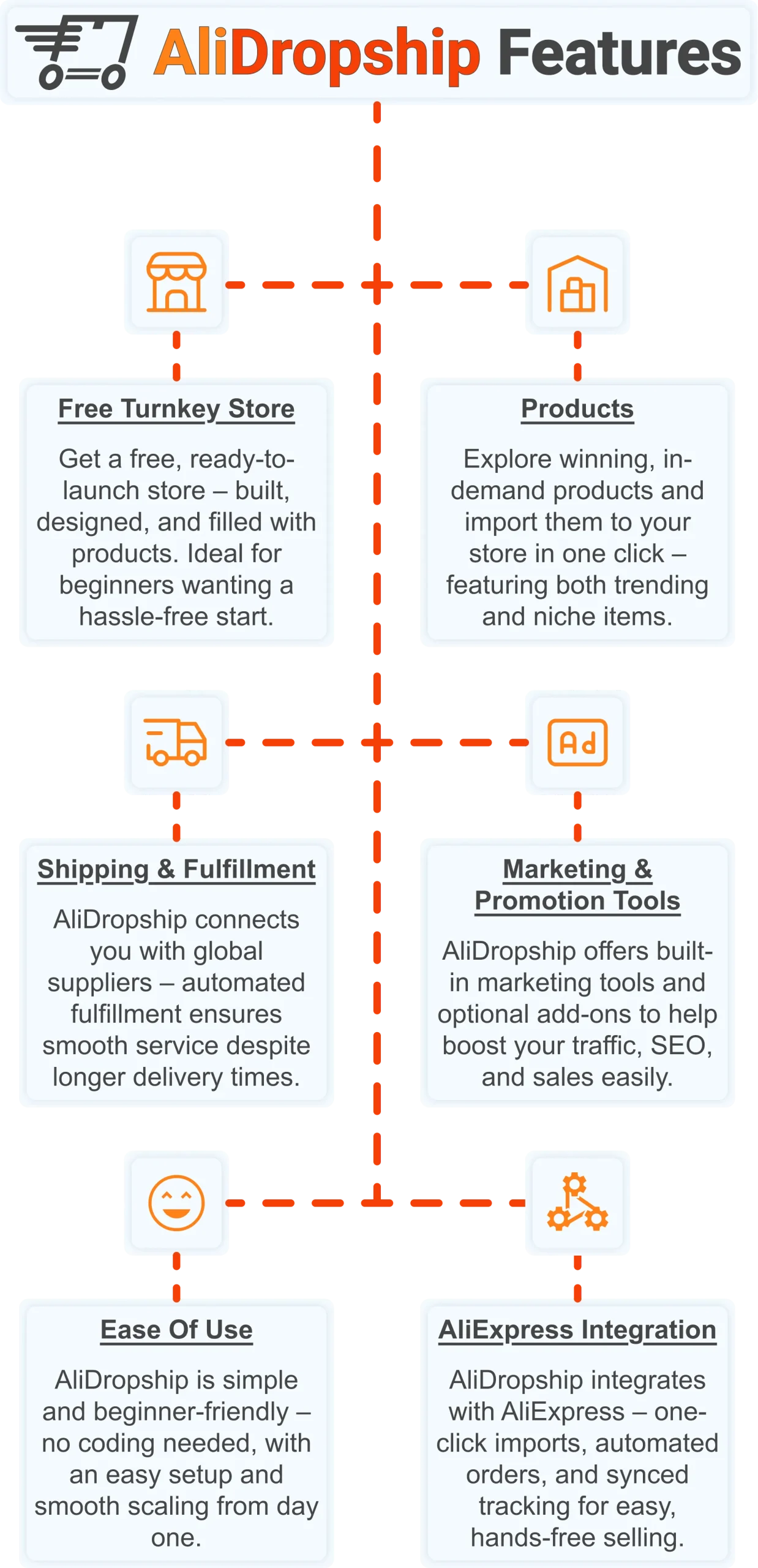
Free turnkey store 🛍️
Get a free turnkey store – built, designed, and filled with products. Ideal for beginners wanting a hassle-free start, the store comes fully optimized to attract customers right away, saving you time on setup. Plus, it includes professional design elements to give your business a polished, trustworthy look from day one. This ready-made foundation makes it easy to move seamlessly into product selection.
Products 📦
Once your store is set up, you can explore winning, in-demand products and import them in one click – featuring both trending and niche items. This wide selection lets you cater to diverse customer interests and test what works best. Regular updates ensure you always have fresh products, keeping your store competitive and relevant. With great products in place, smooth shipping becomes the next essential step.
Shipping & fulfillment 🚚
AliDropship connects you with global suppliers, and automated fulfillment ensures seamless order processing despite international delivery times. Customers receive real-time tracking updates, which builds confidence and trust in your store. Once shipping is handled reliably, you can focus on promoting your store and attracting traffic.
Marketing & promotion tools 📣
To maximize sales, AliDropship offers built-in marketing tools and optional add-ons that help boost traffic, SEO, and conversions. From email campaigns and discounts to social media integration, these tools empower you to reach and retain customers without needing prior marketing experience. With promotion strategies in place, managing your business becomes simpler and more efficient.
Ease of use 👌
AliDropship is beginner-friendly – no coding needed, with an intuitive dashboard that guides you through every step. Easy setup and smooth scaling let you expand your store without stress. As your business grows, adding new features, products, and marketing campaigns remains hassle-free, giving you more time to focus on sales.
AliExpress integration 🛒
Finally, AliDropship integrates seamlessly with AliExpress, enabling one-click imports, automated orders, and synced tracking. Your inventory stays up-to-date with the latest products and prices, while automated order processing frees you from manual tasks. Combined with the turnkey setup, reliable shipping, and built-in marketing tools, this integration ensures your dropshipping business is fully equipped for growth and success.
Every marketing idea in this guide can drive traffic and attention — but AliDropship gives you the store to convert that traffic into real, recurring income. Get your free turnkey store and $100 welcome gift today and put your small business marketing skills to work.
What are the best marketing ideas for small business in 2026?
How can a small business market itself with no budget?
What is the most effective small business marketing strategy?
How do small businesses use social media marketing effectively?
How long does it take for small business marketing to show results?