Is Skillshare Legit? An Honest 2026 Review Of Pricing

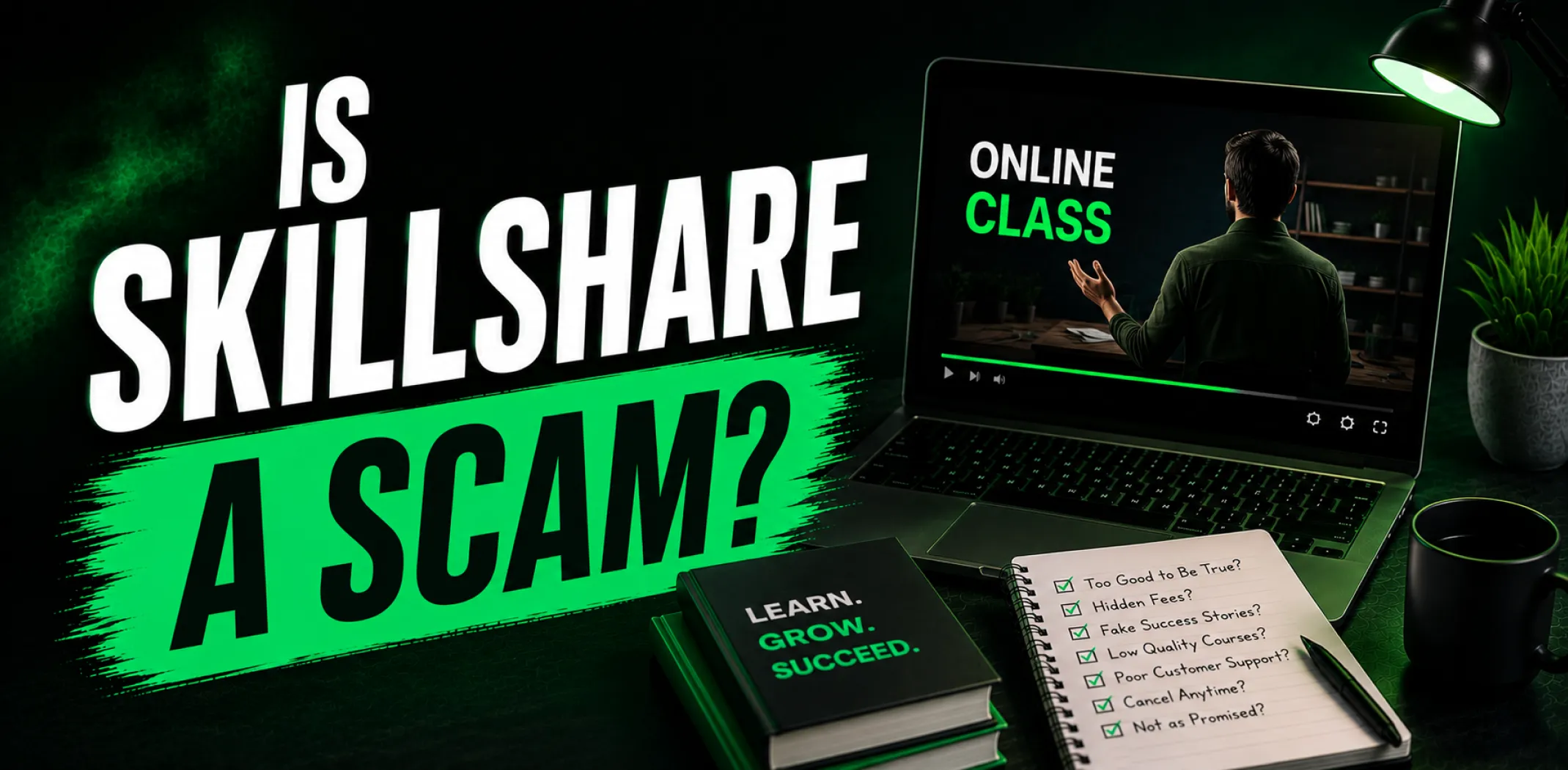
If you have typed “is Skillshare legit” into a search bar, you are probably weighing one of two things: whether it is safe to hand over your card details for a subscription, or whether it is worth building an income as a teacher on the platform. In 2026, both questions have real, specific answers, and neither one is a flat yes or no.
This review breaks down what Skillshare actually is, what the evidence says about its legitimacy, where the real complaints come from, and how it stacks up against other ways to learn or teach online.
What is Skillshare and how does it work in 2026?
Skillshare is a subscription-based online learning community founded in 2010 by Michael Karnjanaprakorn and Malcolm Ong. The company is headquartered in New York City and, as of 2026, has raised more than 100 million dollars in venture funding from investors including Union Square Ventures, Spark Capital, and Adobe.
Rather than selling individual courses, Skillshare charges one flat membership fee for unlimited access to its class library, which covers creative fields like design, illustration, photography, and video, alongside business and technology topics.
On the student side, the mechanics are simple: you subscribe, browse thousands of classes, and complete a hands-on project at the end of each one for peer feedback. On the teacher side, anyone can apply to publish a class for free, and approval is usually fast if the topic fits Skillshare’s guidelines.
Instead of setting your own price, you earn a share of a monthly royalty pool based on how many minutes paying subscribers spend watching your classes, plus a flat referral bonus for every subscriber who signs up through your personal link.
In practice, that means Skillshare works less like a traditional online school and more like a streaming service for skills, paired with a creator-payout system similar in spirit to platforms like YouTube.
Is Skillshare legitimate? What the evidence shows
Legitimacy questions about Skillshare almost always come down to one thing: is this a real company that will deliver what it promises, or something closer to a shell operation. On the facts, Skillshare is unambiguously the former.
It has operated continuously since 2010, is registered and headquartered in New York City, and has taken more than 100 million dollars from institutional investors who conduct their own due diligence before writing checks. A company cannot fake fifteen years of continuous operation and multiple funding rounds.
That said, legitimate does not mean complaint-free. A separate 2026 aggregate analysis spanning Trustpilot, Sitejabber, G2, app stores, Reddit, and Better Business Bureau filings found ratings ranging from 2.8 out of 5 on Sitejabber up to 4.8 out of 5 on the Apple App Store, a split that tracks closely with what people are actually rating: class content scores well, subscription management does not.
The same analysis found that billing issues, not course quality or non-payment, account for roughly a third to half of all negative reviews, well above the 15 to 25 percent rate typical of subscription services generally.
What are the common complaints and red flags?
The complaint pattern on Skillshare is narrow and consistent, which is itself informative. Reviewers are not describing missing payouts, fake classes, or an inability to log in. They are describing a specific, repeatable friction point: the free trial converting into a full annual charge, and a cancellation flow that some users find difficult to complete with confidence.
✓ What is actually true: Skillshare has run continuously since 2010, is backed by more than 100 million dollars in institutional funding, and reports millions of active students. The verified complaints are almost entirely about billing and refund policy, not the company’s existence or ability to deliver its service.
A December 2025 Better Business Bureau complaint described a refund request being denied by what the user described as an automated response, and multiple Trustpilot reviewers describe multi-step cancellation flows that leave them unsure whether the cancellation actually went through.
Skillshare’s own responses to these reviews consistently point to a renewal confirmation email sent at signup, which is accurate but does not fully address why so many users report the same confusion. As of 2026, this remains the single biggest gap between Skillshare’s stated policies and how users experience them in practice.
On the teacher side, the red flags are different: several instructors report that Skillshare has changed its royalty and payment formulas more than once since 2022, most notably a shift toward a fixed monthly Teacher Fund rather than a pure royalty pool.
That is not evidence of a scam, but it is evidence that teacher income on Skillshare is variable and can move when the company changes its formula, which matters if you are counting on it as steady income.
What do real users say about Skillshare?
Individual accounts vary widely, which is normal for a platform with millions of users. The two composite examples below reflect patterns that show up repeatedly across Trustpilot, Sitejabber, and Reddit threads about Skillshare.
Neither story is representative of every Skillshare user on its own, but together they line up with the aggregate data: strong marks for the actual learning experience, weaker marks for subscription mechanics.
How does Skillshare compare to other learning platforms?
Skillshare’s closest competitors, Udemy, Coursera, and LinkedIn Learning, use a meaningfully different pricing structure, and that difference matters more than most reviews mention. Skillshare sells unlimited access for one flat fee. Udemy sells individual courses, often deeply discounted, that you own permanently once purchased.
Neither structure is objectively better. Someone who takes three or four classes a month across different topics usually comes out ahead on Skillshare’s flat fee. Someone who wants one specific, in-depth course and does not plan to keep browsing usually comes out ahead buying it outright on a per-course platform.
Is Skillshare worth it? Our honest verdict
Weighing the legitimacy evidence against the complaint pattern, Skillshare lands in a specific, unglamorous middle ground: a real company delivering a real service, with a subscription business model that occasionally collects money from people who thought they had already canceled.
Legitimate, but read the cancellation policy before you subscribe.
Skillshare is a real, well-funded company with genuinely useful creative classes and a working teacher-payout system. It is best suited to people who browse and finish several classes a month, and to teachers who already have an audience to bring with them, since royalty pool payouts alone rarely add up to significant income. Set a calendar reminder before your free trial ends, since Skillshare has no satisfaction-guarantee refund policy once the annual charge goes through.
What factors should you weigh before subscribing?
In 2026, deciding whether Skillshare fits you comes down to a handful of concrete factors rather than a single legitimacy question.
What you actually want to learn
Skillshare’s library leans heavily creative and business-adjacent. If you need an accredited certificate for a job requirement, a platform like Coursera, which partners directly with universities, is a better fit than Skillshare’s project-based, non-accredited classes.
The subscription math
At 168 dollars a year, Skillshare only beats buying individual courses elsewhere if you realistically finish more than three or four classes annually. Fewer than that, and a one-time course purchase on a per-course platform is usually cheaper.
Whether you plan to teach, not just learn
Teacher income is driven by watch-time minutes, and Skillshare’s own figures put average teacher earnings around 3,000 dollars a year, with top earners over 100,000 dollars typically already having an outside audience. Publishing a class with zero existing following is unlikely to replace a job.
Your own cancellation habits
Given how consistently billing complaints show up in reviews, treat the free trial like any auto-renewing subscription: set a calendar reminder several days before the trial ends, and confirm cancellation with a follow-up email rather than assuming an in-app click was enough.
How much you value structure over depth
Skillshare classes run shorter and more project-focused than a typical university-style course. That format suits people who want quick, practical wins over a long weekend, but it is a poor substitute for the depth of a multi-week accredited program.
None of these factors make Skillshare a scam or a bad product. They simply describe who it fits well and who it does not, which is the more useful question than a blanket legit-or-not verdict.
Is Skillshare legitimate?
Is Skillshare safe to use?
How does Skillshare make money?
Does Skillshare really pay teachers?
What are the best alternatives to Skillshare?