Is Ko-fi Legit? An Honest 2026 Review For Creators

If you have come across a creator’s Ko-fi page and wondered whether the platform is safe – or if you are a creator thinking about setting one up – you are asking a sensible question. The creator monetization space is full of platforms with confusing fees, patchy payout records, and terms that seem designed to trip you up.
Ko-fi has been around since 2012, and in 2026 it is one of the most widely trusted tip-and-support platforms in the creator economy. But “widely trusted” still leaves room for real limitations worth understanding before you build on it.
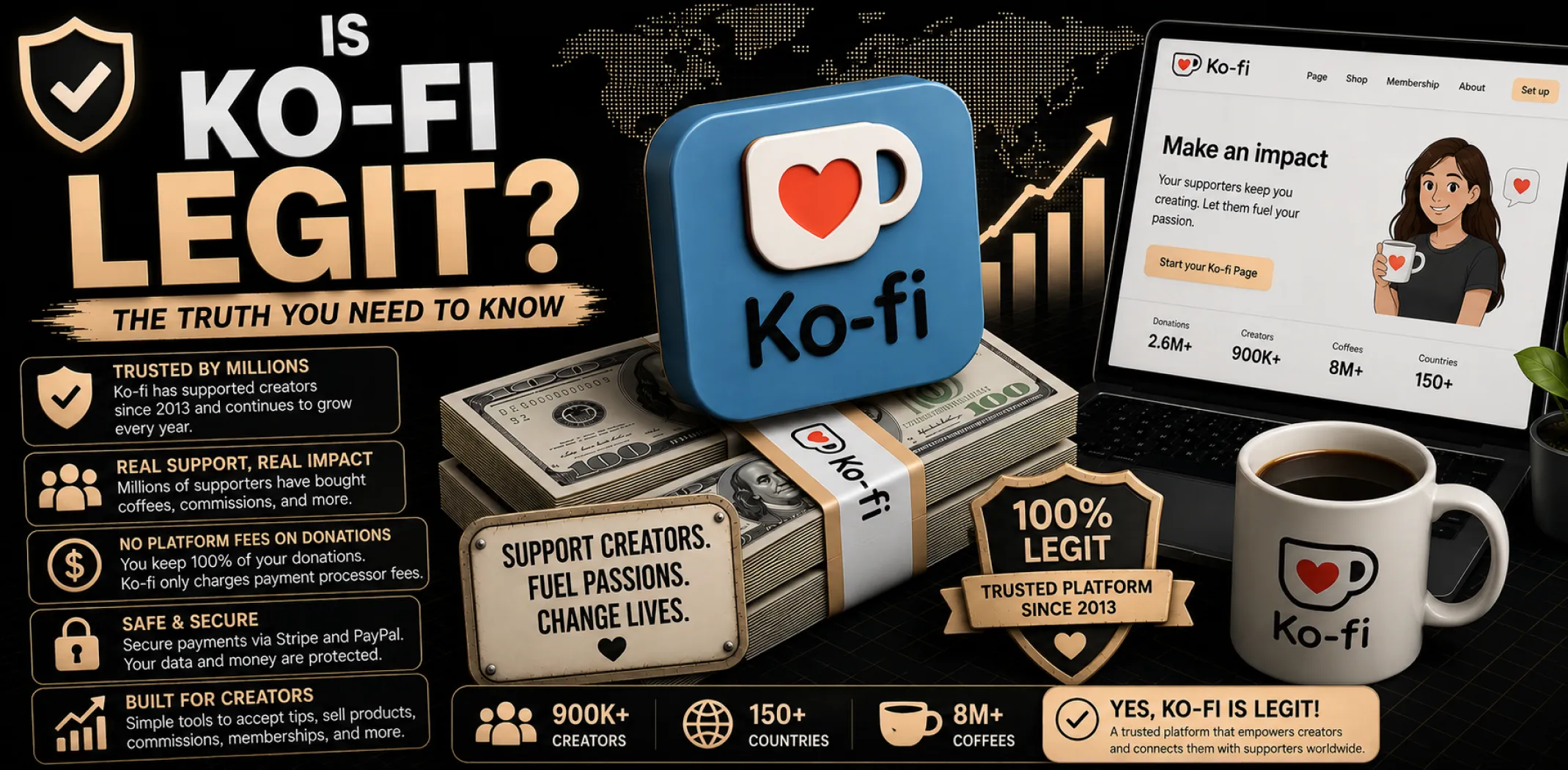
So, is Ko-fi legit? Yes – straightforwardly and without major caveats. It is a real UK-registered company, pays out instantly through Stripe and PayPal, charges 0% on one-time tips on the free plan, and holds a 4.6-star rating on Trustpilot from over 700 reviews.
That said, it does have a transparent content policy that catches some creators unexpectedly, and its earnings ceiling is lower than many alternatives. Both are worth knowing before you commit.
Quick verdict
Ko-fi is a legitimate, well-established creator support platform founded in 2012 and incorporated in the UK. It charges 0% on one-time tips, pays out instantly via Stripe or PayPal, and holds a 4.6-star Trustpilot rating from over 700 reviews. It is best suited to creators who already have an engaged audience and want a low-friction supplementary income layer – not a scalable standalone business.
Key takeaways
- Ko-fi is a real UK company (Ko-fi Labs Ltd), incorporated in 2017, with over 1.5 million creators and more than $200 million in total payouts since launch.
- The free plan charges 0% on one-time tips – one of the most creator-friendly fee structures in the industry; shop sales and memberships incur a 5% fee on the free plan.
- Ko-fi Gold costs $12 per month for new users and drops all platform fees to 0% – it pays for itself once you are earning around $240 per month from shop or membership sales.
- Ko-fi holds a 4.6-star Trustpilot rating – significantly better than Buy Me a Coffee (3.5 stars) and far better than Patreon (1.2 stars).
- The most common complaint is automated content moderation that can suspend accounts without a clear explanation – a real issue, though Ko-fi provides a formal appeals process.
What is Ko-fi and how does it work?
Ko-fi started in 2012, founded by Henry Hoffman in the United Kingdom as the simplest possible way for artists and writers to receive a small financial thank-you from their audience – literally the price of a coffee.
In 2017, the platform was formalized as Ko-fi Labs Ltd, with Nigel Pickles and Simon Ellington joining to build out the structure behind what had grown from a side project into a platform used by hundreds of thousands of creators. By 2025, Ko-fi reported over 1.5 million active creator pages and more than $200 million in cumulative payouts since launch.
The platform is headquartered in Cambridge, UK, and processes payments through Stripe and PayPal. Unlike platforms such as Patreon, which routes money through its own accounts before releasing it to creators, Ko-fi passes payments directly – which is why payouts are instant rather than monthly. When a supporter buys you a coffee, the money hits your Stripe or PayPal account in real time, not at the end of the month.
In terms of what you can actually do on Ko-fi: you create a free page in under 15 minutes, add a bio and profile image, and link your payment account.
Supporters can then send you one-time tips at whatever amount they choose, subscribe to a monthly membership tier you define, buy digital products or commissions from your shop, or fund a specific project through Ko-fi’s built-in crowdfunding feature. You can also publish posts, share updates with supporters, and connect the platform to Discord for community perks.
One thing to understand from the start: Ko-fi does not bring you an audience. There is no Explore section where new supporters discover creators organically, and no algorithm promoting your content to strangers.
The platform is a payment layer that sits on top of an audience you build elsewhere – through social media, a newsletter, a YouTube channel, or an open-source project. If you have that audience, Ko-fi is one of the most frictionless ways to monetize it. If you do not, the platform cannot help you build one.
Is Ko-fi legitimate? What the evidence shows
Ko-fi is legitimate – and the evidence for that is unusually strong by creator platform standards. Its 4.6-star Trustpilot rating from over 700 reviews puts it well ahead of its most direct competitors. Patreon holds 1.2 stars from nearly 900 reviews. Buy Me a Coffee holds 3.5 stars from over 1,400 reviews.
Ko-fi’s score is not inflated by a small sample – it is consistently high across a substantial review base, with named support staff praised by name in a significant proportion of positive reviews.
Instant payouts are a significant credibility signal. When money from a supporter goes directly to your Stripe or PayPal account in real time – not through Ko-fi’s accounts, not held until the end of the month – there is no structural mechanism for the platform to withhold your earnings.
This is a fundamentally different model from platforms that hold funds centrally before disbursing them, and it is one reason Ko-fi’s payout-related complaint volume is so much lower than competitors.
The company is also genuinely independent and intentionally so. Ko-fi has explicitly positioned itself as a creator-first platform with no outside investors to answer to, which gives it more flexibility to prioritize low fees and transparent policies over growth metrics. That positioning has not just been marketing – the 0% fee on tips has remained in place since launch despite competitive pressure from funded rivals.
What are Ko-fi’s actual fees – and is Gold worth it?
Ko-fi’s fee structure is one of the most straightforward in the creator economy, but it does have layers that are worth understanding before you choose a plan. The short version: tips cost you nothing on the free plan; everything else costs 5% unless you pay for Gold.
In both cases, Stripe or PayPal processing fees also apply – typically 2.9% plus $0.30 per transaction – and these are charged by the payment processor, not Ko-fi. On a $10 digital download sold on Ko-fi Gold, you would keep approximately $9.41 after processing.
On the free plan, you would keep approximately $8.91. These are still among the best net margins available on any creator platform in 2026, particularly compared to Patreon’s fees of 5% to 12% depending on plan.
Common complaints and red flags – what to know before you sign up
Ko-fi’s overall review picture is strongly positive, but the complaints that do appear are worth understanding – particularly if your content sits in areas Ko-fi’s automated moderation system tends to flag.
Common misconception: Many creators assume Ko-fi’s open, low-friction setup means it will accept any kind of content. In practice, Ko-fi uses an automated moderation system that can unpublish pages – sometimes without an immediately clear explanation – if content or linked external profiles trigger its guidelines. Ko-fi does not allow adult content, and it can also take action based on content you post outside Ko-fi if it considers that content incompatible with its platform. The good news: unlike some competitors, Ko-fi has a formal three-strikes system and a documented appeals process for most suspensions.
Automated content moderation errors are the most common complaint in negative Ko-fi reviews. The platform uses automated rules to catch fraud, spam, and content policy violations – and those systems occasionally flag creators who have not broken any rules.
A Trustpilot reviewer who migrated from Patreon described being permanently banned immediately after setup, with no explanation given despite careful adherence to Ko-fi’s published guidelines. Ko-fi’s official response confirmed the appeals process exists and encouraged the reviewer to use it, but acknowledged that automated bans can sometimes be triggered in error.
Support response times are the second most common issue. Ko-fi is a small, independent company, and while most users praise its support team by name, the volume of creator accounts means ticket response times can stretch to days or occasionally longer for account-level issues.
One reviewer noted a 15-day wait before a ticket was automatically closed without resolution. Ko-fi replied to that review within 24 hours on Trustpilot – a sign the company monitors its reputation and responds publicly – but acknowledged the delay was not acceptable.
Adult content restrictions catch some creators off guard. Ko-fi does not allow adult content on the platform, including in your shop, posts, or memberships. Critically, Ko-fi can also take action against your page if it is linked to – or from – external profiles that host adult content, even if your Ko-fi page itself does not.
Creators who produce adult content off-platform and use Ko-fi as a separate tip link may find their pages affected. This is clearly documented in Ko-fi’s content guidelines, but it is not prominently surfaced during setup.
Key difference from other platforms: Ko-fi’s content moderation issues, while real, are fundamentally different in nature from the payout problems documented on competitors. Ko-fi is not withholding money that belongs to you – it is restricting access based on content policy. Payouts go directly to your own Stripe or PayPal account; there is no mechanism for Ko-fi to hold or redirect your earnings once a transaction completes.
What do real users say about Ko-fi in 2026?
Ko-fi’s Trustpilot reviews tell a largely consistent story: the platform works as described, support is responsive for most issues, and the fee structure is genuinely fair. Negative reviews cluster around content moderation and support delays – not around money going missing or accounts being arbitrarily suspended at payout time. Here are two representative creator experiences.
How much can you realistically earn on Ko-fi?
Earnings on Ko-fi depend almost entirely on the size and engagement of your existing audience. The platform does not generate traffic or surface your page to new supporters, so your income potential is capped by how many people already follow your work elsewhere. With that context, here are realistic 2026 ranges based on creator type and audience size.
Is Ko-fi worth it – honest verdict
For what it is designed to do, Ko-fi is one of the best options available in 2026. The 0% fee on tips is genuinely rare and genuinely useful. Instant payouts eliminate the most common source of creator frustration on competing platforms.
The company is independent, creator-aligned, and has a 14-year track record of paying out. If you have an existing audience and want the simplest possible way to let them support you financially, Ko-fi is a strong and trustworthy choice.
The honest limitation is not about legitimacy – it is about ceiling. Ko-fi works as a supplement to your income, not as a foundation for a scalable online business. Tips are inherently variable. Memberships require consistent content delivery.
And the platform cannot bring you new supporters – every dollar you earn on Ko-fi starts with someone who already knows and trusts your work elsewhere. Creators who want to build income that is not tethered to an existing audience need a different kind of platform.
Legitimate, creator-friendly, and genuinely one of the best in its category
Ko-fi is a legitimate UK-registered company with a 14-year operating history, instant payouts, 0% fees on tips, and a 4.6-star Trustpilot rating that reflects a genuine majority positive experience. It is well-suited to creators with existing audiences who want a low-friction, low-cost supplementary income layer. It is not a foundation for building new audiences or scaling a standalone online business – for that, an owned ecommerce platform with built-in traffic generation is a fundamentally more powerful starting point.
A free store and a free Amazon business – launched in under 60 seconds
Sign up once and walk away with two complete income streams: a done-for-you store loaded with 100+ digital products, and an Amazon Seller Kit with listings already formatted and ready to go live. Keep 50–70% of every sale, with no inventory, no shipping, and no logistics on your end.
Which type of creator is Ko-fi the right fit for?
Ko-fi works well for specific situations and less well for others. Here is a clear breakdown of where it fits – and where a different approach makes more sense.
Strong fit: creators with an engaged existing audience
If you already have followers on YouTube, social media, GitHub, or a newsletter who engage with and trust your work, Ko-fi is one of the cheapest and most reliable ways to accept their support. Zero fee on tips, instant payouts, and no monthly cost on the free plan make it easy to start without any financial risk.
Strong fit: artists and illustrators selling digital products
Ko-fi has a strong reputation among the visual arts community in particular. Its shop feature handles digital downloads well, commissions are a native product type, and the platform’s aesthetic skews toward art-forward creators. Many illustrators earn $500 to $2,000 per month combining tips, commission slots, and digital print sales.
Weaker fit: creators wanting scalable, audience-independent income
Ko-fi cannot build an audience for you. If you are starting from zero followers and want to generate online income through advertising or product sales that reach new customers – rather than existing fans – Ko-fi is the wrong tool. An owned ecommerce store with built-in ad capabilities is a fundamentally stronger starting point for this goal.
Best long-term play: own your income infrastructure
Even the best third-party platforms have content policies, platform risk, and terms that can change. The most resilient online income strategy combines a tip layer like Ko-fi with an owned business – a store you control completely, where you are not dependent on any platform’s continued goodwill to receive your earnings.
Want to build online income that does not depend on an existing audience? Here is how AliDropship works
Ko-fi is genuinely good at what it does. But it requires an audience to generate income, and it has a ceiling once that audience is fully engaged. AliDropship solves both constraints: it provides a fully built store, ready-made products, and a built-in advertising system that can generate sales from day one – regardless of whether you have an existing following.
Free turnkey store – built, designed, and filled with products
Your store arrives professionally designed, pre-loaded with 50 bestselling products, and fully optimized to convert. No setup fees, no coding, no design time. You start at the product-testing stage – not the store-building stage. Hosting, SSL, and payment gateway are all included.
Winning products, one-click import
Browse trending and niche items from AliDropship’s catalog – including brand-name and digital products – and import them to your store in one click. The catalog updates regularly so your store always has fresh, competitive inventory without manual research.
Automated fulfillment and real-time tracking
Orders are processed automatically through global supplier connections. Customers receive real-time tracking updates – building trust and reducing support volume. You do not touch the shipping logistics; the platform handles it end-to-end.
Built-in marketing and promotion tools
Email campaigns, discount management, abandoned-cart recovery, live countdown timers, and social media integration are all included or available as add-ons. No prior marketing experience required – the tools guide you through each campaign type.
Beginner-friendly – no coding, no learning curve
An intuitive dashboard walks you through every step. Adding products, running campaigns, and scaling your catalog require no technical knowledge. As your business grows, the platform scales with you – adding features without adding complexity.
AliExpress integration – one-click imports, synced inventory
AliDropship connects directly to AliExpress for one-click product imports, automated order processing, and synced tracking. Inventory stays current with the latest products and prices. Combined with the turnkey store and automated fulfillment, this integration makes the entire operation manageable for one person.
Is Ko-fi a legitimate platform for creators?
How does Ko-fi make money if it charges 0% on tips?
Ko-fi earns revenue through two main streams. First, it charges a 5% fee on shop sales, memberships, and commissions for creators on the free plan. Second, it offers Ko-fi Gold at 12 dollars per month, which drops all platform fees to 0%. The Contributor tier is an opt-in model where creators share 5% of tip income with Ko-fi in exchange for premium features. Ko-fi does not take a percentage of one-time tips on the basic free plan, which is one of the most creator-friendly fee structures in the industry.
Does Ko-fi really pay out instantly?
Yes. Ko-fi passes payments directly to your connected Stripe or PayPal account in real time. There is no monthly payout cycle, no minimum withdrawal threshold, and no central holding account. When a supporter buys you a coffee or purchases a digital product, the money arrives in your payment account immediately after the transaction completes. This instant direct-payment model is the primary reason Ko-fi has far fewer payout complaints than competitors who route funds through their own accounts first.
What are the biggest risks of using Ko-fi?
The main risks on Ko-fi are content moderation and support response times. Ko-fi uses an automated system to enforce its content guidelines, and some creators report being suspended without a clear explanation – particularly those whose external profiles or content touch on adult themes. Ko-fi does not allow adult content on the platform or via linked external pages, and this policy can catch creators off guard. Unlike payout risks on other platforms, these issues do not involve money being withheld – Ko-fi does not hold creator earnings – but they can result in loss of access to your page and community. Ko-fi provides a formal appeals process and a three-strikes system for most violations.
What are the best Ko-fi alternatives for online income?
For tip-based and low-fee creator income, the most direct Ko-fi alternative is Buy Me a Coffee, which charges a flat 5% on all transactions. However, Buy Me a Coffee holds a significantly lower Trustpilot rating of 3.5 stars and has a documented pattern of account suspensions with withheld payouts that Ko-fi does not share. Patreon offers more advanced membership tools but charges 5 to 12% and holds a 1.2 out of 5 Trustpilot rating. For creators who want income that does not require an existing audience, an owned ecommerce store through a platform like AliDropship provides a fundamentally different model: built-in advertising, ready-made products, and no dependency on fans already knowing your work.