DoorDash Side Hustle: Real Pay, Pros And Cons

Over 6 million people have signed up as DoorDash drivers in the United States alone. That number tells you something important: the appeal of making money on your own schedule is real. But a huge sign-up pool also means more competition for orders, thinner margins, and harder decisions about whether the time you spend behind the wheel is actually paying off. So – is DoorDash a good side hustle, or is it one of those gigs that looks better on paper than it does in practice?
Quick Answer: DoorDash is a legitimate, flexible side hustle that works well for earning an extra $200–$600 per month in your spare time – but it has a hard earnings ceiling, real vehicle costs, and no path to scalable income.
This guide covers everything you need to make an honest call: what drivers actually earn after expenses, what the pros and cons look like in 2026, and how DoorDash stacks up against other ways of building income on the side – including one that doesn’t require a car at all.

What is DoorDash and how does it work as a side hustle?
DoorDash is a food delivery platform where independent contractors – called Dashers – pick up orders from restaurants and deliver them to customers. Founded in 2013, it has grown into the largest food delivery service in the US, holding roughly 65% of the national market. That scale matters: more market share means more available orders, which is a genuine advantage over smaller competitors.
As a Dasher, you work as an independent contractor, not an employee. You choose your own hours, accept or decline individual orders, and get paid per delivery rather than an hourly wage. Pay is calculated using three components: base pay ($2–$10 per order depending on distance, time, and desirability), promotions like Peak Pay during busy hours, and customer tips – which you keep in full.
Getting started is straightforward. You need to be at least 18, have a valid driver’s license, pass a background check, and have access to a vehicle, bike, or scooter depending on your market. The background check typically takes 3–7 business days, and in competitive markets, there may also be a waitlist before you can start dashing regularly.
The model sounds simple – and in many ways it is. The catch is that your earning potential is directly tied to how many hours you put in, what market you operate in, and how strategically you pick orders. DoorDash doesn’t scale the way a business does. It scales the way a second job does: more hours in, more money out, but no compounding effect over time.
How much can you realistically earn with DoorDash?
This is where most DoorDash coverage gets misleading – because the gross numbers look decent, but they don’t tell the whole story. Most Dashers report earning $15–$30 per hour before expenses. After fuel, vehicle maintenance, and self-employment taxes, the real take-home is closer to $9–$15 per hour in most markets. That gap matters a lot when you’re deciding whether a side hustle is worth your time.
Here’s a breakdown of how DoorDash earnings compare across common side hustle approaches:
DoorDash sits solidly in the middle ground: more reliable than reward apps, more accessible than freelancing, but harder to scale than ecommerce. For someone wanting quick extra cash with no setup time, it’s a reasonable option. For someone building toward meaningful income growth, the ceiling is a real limitation.
One note on these figures: Full-time DoorDash earnings of $2,000–$3,600/month net assume a mid-to-large market, consistent peak-hour shifts, and disciplined order selection. Drivers in smaller markets or those working off-peak hours typically earn significantly less. Reaching the upper end requires treating it like a business – not just turning the app on.
It’s also worth noting that DoorDash earnings don’t compound or grow over time. A Dasher earning $15/hour in 2026 will likely still earn $15/hour in 2027, unless they actively optimize their strategy or move to a higher-demand market. That’s the defining limitation of time-for-money side hustles.
The real pros and cons of DoorDash as a side hustle
No honest review of DoorDash side hustle income skips the downsides. Here’s a grounded look at what actually works in your favor – and what works against you.
What DoorDash gets right
Flexible scheduling 🕐
This is DoorDash’s strongest genuine selling point. You can dash during lunch breaks, evenings, weekends, or any window that fits your existing schedule. There are no shifts to commit to in advance, and you can stop at any time. For people with unpredictable schedules or primary jobs with variable hours, that flexibility is genuinely valuable.
Low barrier to entry
Getting started requires almost nothing beyond a vehicle, a smartphone, and a clean background check. There’s no formal training, no certification, and no upfront cost. For someone who needs extra income quickly and doesn’t have time to build a skill or launch a business, DoorDash is one of the fastest ways to start earning.
You keep 100% of tips
DoorDash doesn’t take a cut of customer tips, which is a meaningful distinction from some competitors. Tips often represent 50–70% of total Dasher income, so this policy directly affects your take-home. In markets with generous tipping culture and high-value orders, this can push your gross earnings well above the base pay alone.
Fast Pay and same-day access
DoorDash offers a Fast Pay feature that lets you cash out earnings once per day for a $1.99 fee, and the DasherDirect card provides instant access to earnings after each delivery at no cost. For anyone managing tight cash flow, that immediacy is a real advantage over side hustles that pay weekly or monthly.
What DoorDash gets wrong
The expense problem is bigger than it looks
This is the single most important thing to understand before you start dashing. DoorDash doesn’t reimburse gas, vehicle maintenance, insurance, or depreciation. You’re an independent contractor, which means all of those costs come out of your pocket. A Dasher grossing $20/hour in a mid-size market typically nets $12–$15 after accounting for fuel, wear and tear, and self-employment tax. In high-mileage markets or with a fuel-inefficient vehicle, that net figure can drop further. Always calculate your actual take-home – not the number the app shows you.
Self-employment taxes catch people off guard
As an independent contractor, you’re responsible for self-employment tax at 15.3% of net income, on top of your regular federal and state income tax. Most financial planners recommend setting aside 25–30% of your gross DoorDash earnings to cover this. Many new Dashers skip this step and face a difficult tax bill in April. The good news: mileage deductions at the 2026 IRS rate of $0.725 per mile can offset a significant chunk of that liability – but only if you track every mile.
The earning ceiling is fixed
No matter how good you get at DoorDash, your income is capped by the hours you can physically work. There’s no way to leverage your time, automate income, or build equity. A Dasher putting in 20 hours a week will always need to put in 20 hours a week to earn the same amount. That’s a fundamental structural limit that separates gig work from scalable income models.
Market saturation and algorithm changes
In many urban and suburban markets, the number of active Dashers has increased significantly, making high-value orders harder to capture consistently. DoorDash’s algorithm also prioritizes drivers with higher acceptance rates for better orders, which can push new or selective drivers toward lower-value deliveries. Drivers on Reddit and Indeed consistently report that earnings have softened compared to 2021–2022 peak gig-economy conditions. The platform still works – but it’s more competitive than it used to be.
Physical wear and unpredictable conditions
Dashing during high-demand windows – dinner rushes, late nights, bad weather – is where the money is. But those are also the conditions that involve more traffic, more challenging driving, and higher stress. Weather boosts pay, but it also means driving in rain or snow. There’s a physical and mental cost that’s easy to underestimate when you’re calculating hourly rates on a spreadsheet.
How to maximize DoorDash driver pay if you decide to go for it
If DoorDash fits your situation and you want to make the most of it, strategy matters more than raw hours. Here are the approaches consistently reported by high-earning Dashers.
Work the right hours
Lunch (11am–2pm) and dinner (5pm–9pm) are the most profitable windows, with Friday and Saturday dinner shifts being the peak of the week. Working outside these windows during slow periods is where earnings drop and time feels wasted. If you’re doing DoorDash as a true side hustle alongside a primary job, targeting evening and weekend shifts makes the most financial sense.
Be selective with orders
Accepting every order is a fast way to erode your hourly rate. Experienced Dashers use a simple rule: if the payout divided by total miles is less than $1.50–$2.00, they decline. Short, high-tip orders in dense restaurant zones are far more profitable than long drives for low base pay. The app shows you the payout and distance before you commit – use that information strategically.
Multi-app to increase order flow
Running DoorDash alongside Uber Eats or Grubhub simultaneously – known as multi-apping – lets you cherry-pick the best-paying orders from whichever platform offers them at any moment. Drivers who multi-app consistently report 15–30% higher hourly earnings than single-app drivers. The key is strict discipline: never accept overlapping orders that would compromise delivery times or customer ratings.
Track every mile for tax deductions
This is not optional. At the 2026 IRS standard rate of $0.725 per mile, a Dasher driving 15,000 miles per year has over $10,800 in potential deductions. Full-time drivers who track mileage properly can save $3,000–$7,000 on their annual tax bill. Use a dedicated mileage tracking app – Everlance, Stride, and MileIQ are all solid options – and log every business trip, including the miles driven between deliveries, not just the delivery itself.
Know your actual net hourly rate
The most important habit for any Dasher is calculating real take-home, not gross. Track your total earnings per shift, subtract your fuel costs (estimate $0.15–$0.25 per mile), set aside 25–30% for taxes, and divide by actual hours worked including wait time. Your net $/hour figure is the only number that matters for deciding whether a particular shift or market is actually worth your time.
Pro Tip: Many top Dashers identify two or three specific restaurant zones with the shortest wait times in their market and park strategically between orders – this compresses dead time and raises the effective hourly rate without adding mileage.
DoorDash vs other gig economy alternatives
DoorDash is one of many options in the gig economy, and it’s worth knowing how it stacks up before committing your time.
DoorDash vs Uber Eats
DoorDash holds roughly 65% of the US food delivery market, which means more consistent order volume in most cities and suburbs. Uber Eats can edge ahead in very dense urban markets where surge pricing applies more often. Most high-earning delivery drivers don’t choose between them – they run both simultaneously. If you’re going to do food delivery seriously, multi-apping these two platforms is the standard approach among experienced drivers.
DoorDash vs Instacart
Instacart involves grocery shopping and delivery, which typically means larger orders and longer in-store time. Instacart pay can be higher per order, but the per-hour rate is less predictable given how long grocery shopping takes. DoorDash is generally faster per order, which makes it easier to optimize your hourly rate through selective order acceptance.
DoorDash vs Uber/Lyft rideshare
Rideshare platforms like Uber typically show higher median hourly gross rates than DoorDash – one data source tracking 115,000+ Dashers found DoorDash median gross at around $11–$13/hour versus Uber’s $21/hour. However, rideshare comes with higher vehicle requirements, mandatory rideshare insurance ($50–$150/month extra), more interior wear, and often more stressful passenger interactions. For a true side hustle with lower vehicle cost, DoorDash has real advantages.
DoorDash vs ecommerce as a side hustle
This is the comparison most people don’t consider – and it’s the most important one if your goal is income that grows over time. Food delivery generates active income: you earn while you work and stop earning when you stop. Ecommerce generates income that compounds: a store built over 60–90 days can generate sales while you’re sleeping, at your primary job, or doing anything else. The setup requires more initial effort, but the ceiling is fundamentally different. A delivery driver earning $15/hour has a fixed rate. An ecommerce store earning $500/month in month three can reach $2,000 or $5,000/month twelve months later without proportionally more time invested.
Legal and tax considerations every Dasher needs to know
DoorDash side hustle income comes with real legal and financial obligations that are easy to overlook when you’re just getting started. Getting these wrong can cost you significantly.
Independent contractor status means you own your taxes
DoorDash does not withhold taxes from your earnings. As a 1099 contractor, you’re responsible for paying self-employment tax (15.3%), federal income tax, and state income tax on all DoorDash income. The standard advice is to set aside 25–30% of every payment. If you expect to owe more than $1,000 in taxes for the year, the IRS requires you to make quarterly estimated tax payments – missing these can trigger underpayment penalties.
Track everything and deduct everything legitimate
The mileage deduction is your biggest tax tool, but it’s not the only one. You can also deduct a portion of your phone bill (business-use percentage), delivery bags and equipment, parking fees, tolls, and any vehicle inspections required for the gig. Keep records throughout the year – waiting until April to reconstruct expenses is how people miss legitimate deductions worth hundreds of dollars.
What to absolutely avoid
Key principle: Never misrepresent your income, inflate deductions, or claim personal miles as business miles. DoorDash income is fully taxable and the IRS is increasingly focused on gig worker compliance. The legitimate deductions available to Dashers are already generous – there’s no upside to crossing the line, and the downside is significant.
Also avoid accepting orders that seem unusual or that ask you to deviate from normal delivery behavior. While rare, scams targeting delivery drivers do exist. Stick to in-app instructions and DoorDash’s official support channels for anything that doesn’t seem right.
Is DoorDash a good side hustle for you? Honest recommendations by profile
The honest answer is: it depends entirely on what you actually need from a side hustle. Here’s a direct breakdown by reader profile.
If you need cash fast with zero setup
DoorDash is genuinely one of the best options available. The barrier to entry is as low as it gets for a real income source, the application is straightforward, and you can start earning within a week of signing up. If you have a vehicle, a smartphone, and a few hours a week, DoorDash can add $200–$400 to your monthly income without any skill development or upfront investment. For this specific goal – speed and simplicity – it delivers.
If you want a consistent part-time income supplement
DoorDash works well here too, as long as you go in with clear expectations. Commit to peak-hour shifts, track your real net earnings, stay on top of your tax obligations, and treat it as a business rather than an app you occasionally open. Done consistently and strategically, part-time dashing in a decent market can net $400–$700 per month. That’s meaningful supplemental income, and for many people it’s exactly what they need.
If you want to replace your primary income
This is where DoorDash gets genuinely difficult. Reaching $2,000–$3,600/month net requires 40+ hours per week, strong market conditions, and relentless discipline on order selection and expenses. It’s achievable, but the physical demands and vehicle costs make it unsustainable for most people long-term. If full-time income replacement is your goal, DoorDash can be a bridge – but it’s not a destination.
If you want income that grows without more hours
Then DoorDash is the wrong tool entirely. Gig delivery work is fundamentally a time-for-money exchange with no leverage. If you’re thinking about building something that earns beyond your active hours – a side income that grows as you learn and invest in it – ecommerce is the direction to look. It takes longer to get started, but the income potential is not capped by how many hours you can physically work. The difference between a side hustle and a real income asset is whether it can operate without you.
AliDropship: Your complete all-in-one solution for starting dropshipping in 2026
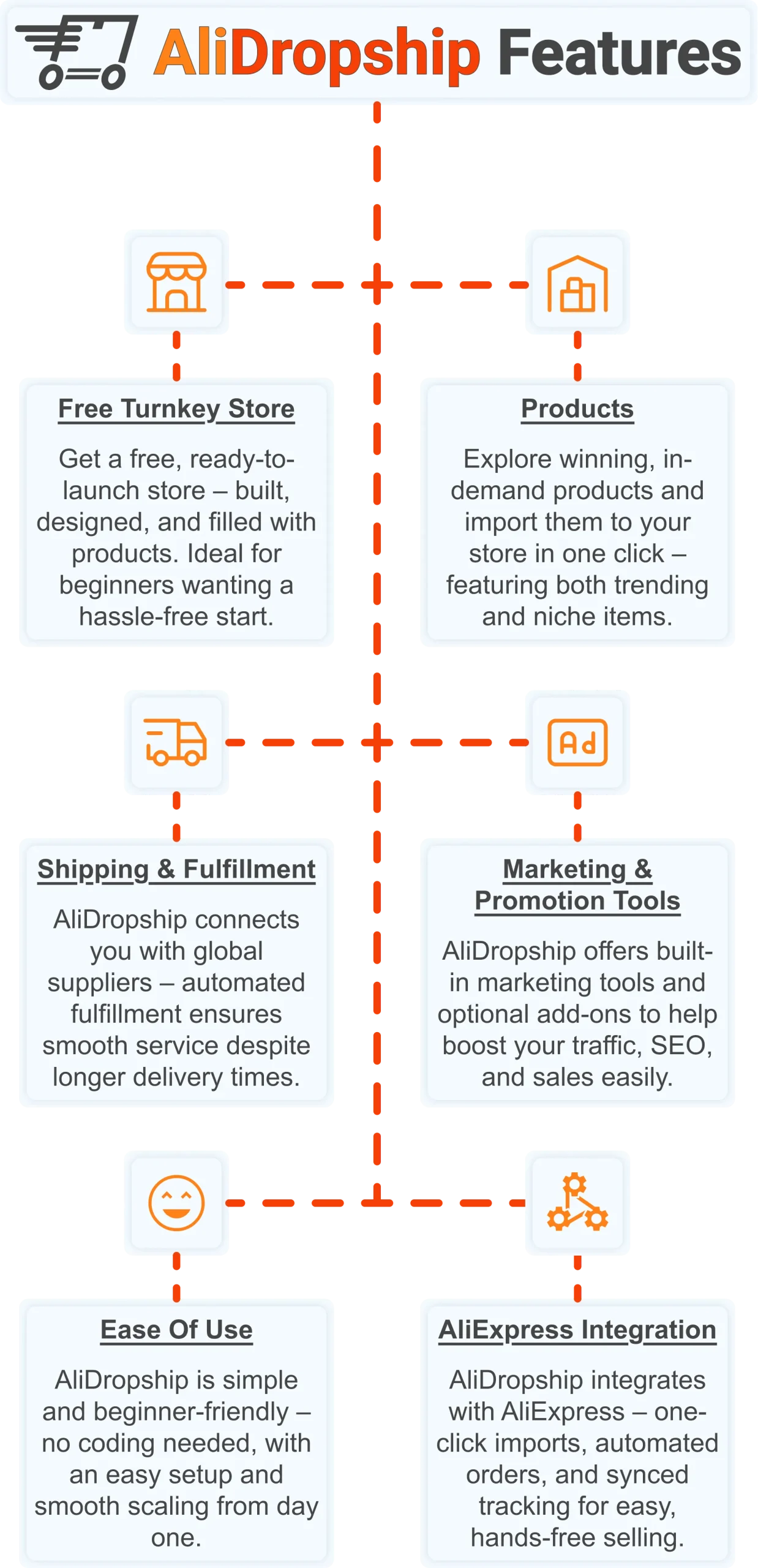
If you want the simplest possible way to start dropshipping – especially if you’re brand new – AliDropship remains one of the most beginner-friendly tools available in 2026. It brings together store creation, product imports, automation, and marketing into a single streamlined system designed to help you launch quickly and grow confidently.
Free turnkey store 🛍️
Get a free turnkey store – built, designed, and filled with products. Ideal for beginners wanting a hassle-free start, the store comes fully optimized to attract customers right away, saving you time on setup. Plus, it includes professional design elements to give your business a polished, trustworthy look from day one. This ready-made foundation makes it easy to move seamlessly into product selection.
Products 📦
Once your store is set up, you can explore winning, in-demand products and import them in one click – featuring both trending and niche items. This wide selection lets you cater to diverse customer interests and test what works best. Regular updates ensure you always have fresh products, keeping your store competitive and relevant. With great products in place, smooth shipping becomes the next essential step.
Shipping & fulfillment 🚚
AliDropship connects you with global suppliers, and automated fulfillment ensures seamless order processing despite international delivery times. Customers receive real-time tracking updates, which builds confidence and trust in your store. Once shipping is handled reliably, you can focus on promoting your store and attracting traffic.
Marketing & promotion tools 📣
To maximize sales, AliDropship offers built-in marketing tools and optional add-ons that help boost traffic, SEO, and conversions. From email campaigns and discounts to social media integration, these tools empower you to reach and retain customers without needing prior marketing experience. With promotion strategies in place, managing your business becomes simpler and more efficient.
Ease of use 👌
AliDropship is beginner-friendly – no coding needed, with an intuitive dashboard that guides you through every step. Easy setup and smooth scaling let you expand your store without stress. As your business grows, adding new features, products, and marketing campaigns remains hassle-free, giving you more time to focus on sales.
AliExpress integration 🛒
Finally, AliDropship integrates seamlessly with AliExpress, enabling one-click imports, automated orders, and synced tracking. Your inventory stays up-to-date with the latest products and prices, while automated order processing frees you from manual tasks. Combined with the turnkey setup, reliable shipping, and built-in marketing tools, this integration ensures your dropshipping business is fully equipped for growth and success.
If DoorDash has shown you what a flexible income stream looks like, dropshipping shows you what a scalable one can look like. Get your free AliDropship store today and start building income that does not stop when you do.
Is DoorDash a good side hustle in 2026?
How much do DoorDash drivers make per hour after expenses?
What are the biggest downsides of DoorDash side hustle income?
Is DoorDash better than other gig economy jobs?
What is a better alternative to DoorDash as a side hustle?