Is Doba Legit Or A Scam? What Sellers Need To Know

Quick verdict
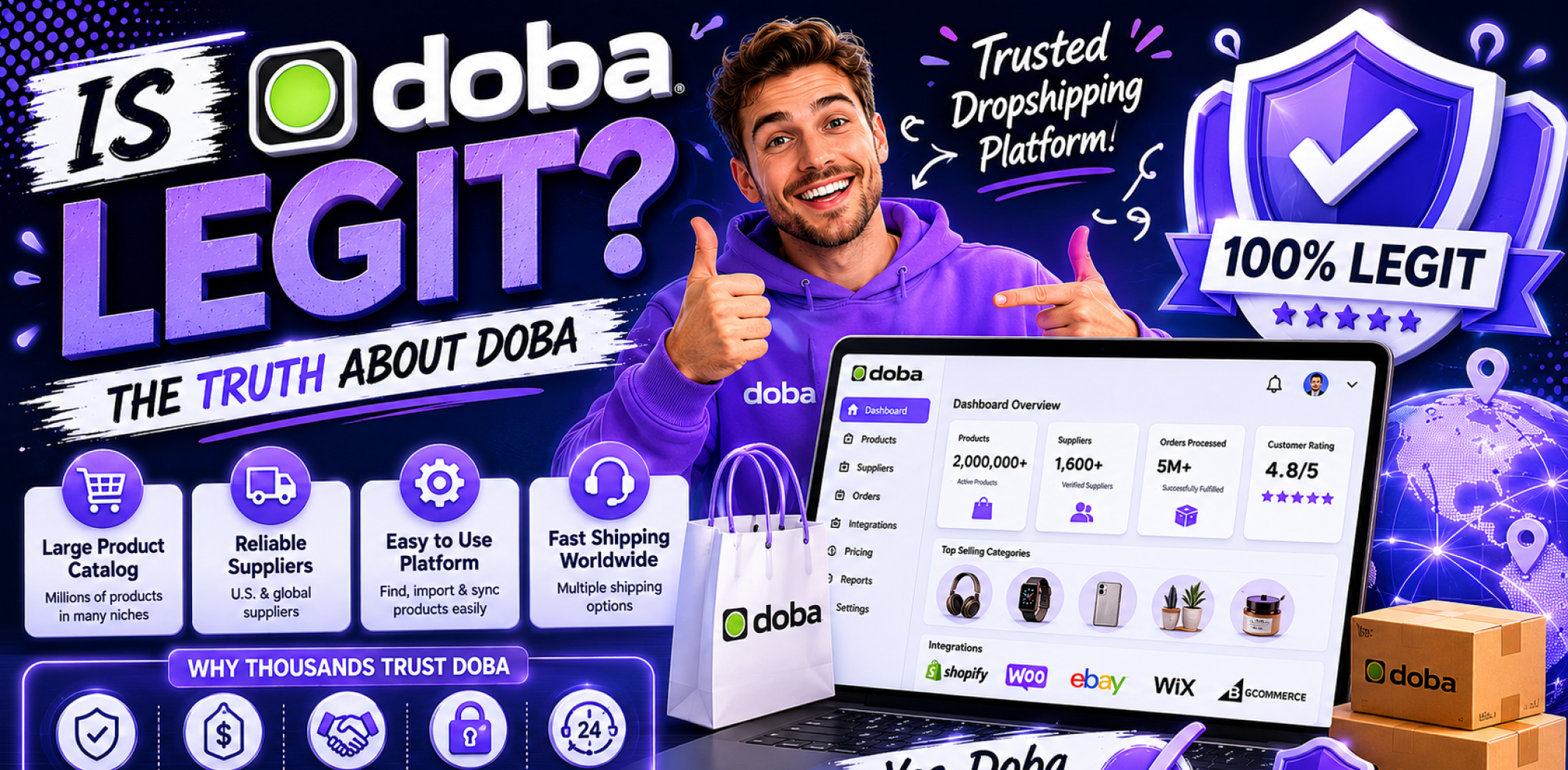
Doba is a legitimate dropshipping supplier directory founded in 2002 and serving 3.2 million sellers worldwide. It is not a scam. However, its Trustpilot score sits at 2.9 out of 5, and recurring complaints about high wholesale pricing and inconsistent support make it a platform best approached with clear expectations rather than blind confidence.
Key takeaways
- Doba is a legitimate US-based platform founded in 2002 with over 1 million product SKUs and a supplier network that is approximately 90% US-based.
- Doba earns a 2.9 out of 5 on Trustpilot and a 1.18 out of 5 on the Better Business Bureau, driven mainly by pricing and customer service complaints.
- Doba functions as a supplier directory and sourcing tool — it does not build your store, provide a built-in ad system, or handle marketing for you.
- Pricing starts at $24.99 per month after a $0.99 trial, but total costs rise quickly if you need higher listing limits or multi-channel selling.
- Beginners who need a complete, ready-to-earn setup — store, products, and advertising in one place — will need a different kind of platform to get started.
What is Doba and how does it work?
In 2026, Doba is one of the longest-running names in the US dropshipping space. Founded in 2002 and headquartered in Lehi, Utah, it has been connecting online retailers with wholesale suppliers for over two decades. The core idea is straightforward: instead of hunting down suppliers yourself, you log in to Doba, search its catalog of 1 million+ SKUs, and import products directly to your store. Doba sits in the middle between you and the supplier, handling the order routing when a sale comes in.
That positioning makes Doba a supplier directory and sourcing platform rather than a complete ecommerce solution. It does not build your store. It does not run your ads. It connects your existing store to a product catalog and routes orders through. Whether that is enough for your needs depends entirely on what stage you are at and what you already have in place.
The platform integrates with Shopify, WooCommerce, Amazon, eBay, Walmart, TikTok Shop, Wix, and BigCommerce. When an order comes in on any of those channels, Doba routes it to the relevant supplier who ships directly to the buyer. You never hold stock. In March 2026, Doba launched Doba Pilot, an AI system that lets sellers manage sourcing and multi-channel listing via natural language commands — though it is still in beta.
Is Doba legitimate? What the evidence shows
Yes — Doba is a legitimate business with more than 20 years of operating history. It is not a fake directory, not a pyramid scheme, and not a scam designed to take your money and disappear. The company is headquartered in Lehi, Utah, has served over 3.2 million sellers worldwide, and its supplier network is vetted and predominantly US-based. As of 2026, that foundation is solid.
That said, being legitimate and being the right platform for you are two different questions. Doba earns its revenue through monthly subscriptions — not commissions on your sales — which means the platform makes money whether your store performs or not. That is a standard SaaS model, but it is worth understanding before you sign up.
What complicates the legitimacy picture is the review data. Doba holds a 2.9 out of 5 on Trustpilot and a 1.18 out of 5 on the Better Business Bureau — both sitting well below average. These figures do not mean the platform is fraudulent; they mean that a meaningful number of real users walked away unhappy. The patterns in those reviews are consistent and worth taking seriously before you commit.
Common Doba complaints and red flags
Across Trustpilot, SiteJabber, Reddit, and the BBB, three complaints appear again and again in Doba reviews. None of them indicate fraud — but together they paint a picture of a platform that regularly falls short of beginner expectations.
Common misconception:
✕ “Doba is a scam because the products are overpriced.”
✓ Doba is not a scam — it is a legitimate intermediary. The pricing issue is structural: Doba acts as a middleman between you and the supplier, which adds a layer of cost. Multiple independent reviewers on Trustpilot confirm that Doba wholesale prices can be close to or sometimes higher than retail prices on Amazon and eBay, which compresses margins. That is a business model limitation, not evidence of fraud.
The second recurring complaint is customer service. Multiple Trustpilot and SiteJabber reviewers describe difficulty reaching support, unanswered emails, and live chat sessions that led nowhere. For sellers who hit a fulfillment problem or a billing issue, slow support can directly cost them money and customers. This is one of the more serious practical risks with the platform.
The third pattern involves the trial and billing. Several reviewers mention being charged after a trial without sufficient advance warning. Doba’s current trial is priced at $0.99 for 7 days and converts to a paid plan automatically. This is disclosed in the sign-up flow, but the volume of complaints suggests it catches some users off guard — particularly those who signed up expecting a completely free evaluation period.
Important: Set a calendar reminder before you start a Doba trial. The $0.99 period converts automatically to a paid subscription. Cancel before the trial ends if you decide the platform is not right for you.
What do real Doba users say?
The user experience with Doba splits fairly clearly along two lines: sellers who came in with realistic expectations about what a supplier directory does, and sellers who expected something closer to a complete ecommerce solution. The first group tends to find value. The second group tends to be disappointed.
How does Doba pricing work — and what does it actually cost?
As of 2026, Doba offers four main subscription tiers after the $0.99 introductory trial. The Start-up plan begins at $24.99 per month, the Business plan at $49.99 per month, and Business Pro at $174.99 per month. Enterprise pricing is custom. The higher plans unlock more product listings, more channel integrations, and advanced automation features.
What the subscription does not include is your store. If you plan to sell on Shopify, you pay Shopify separately — typically $39–105 per month depending on the plan. If you sell on Amazon, you pay Amazon seller fees on top of that. Add the Doba subscription and your baseline monthly costs before a single sale can easily exceed $70–80 per month at the entry level. That is the real-world cost picture that a lot of beginner-facing Doba marketing glosses over.
Is Doba worth it — honest verdict
In 2026, Doba occupies a narrow but real niche. It is a viable sourcing layer for sellers who already have a store, already understand dropshipping fundamentals, and are specifically looking for a US-based supplier catalog to improve their fulfillment speed. If that describes you, the $24.99 entry plan is low-risk enough to test.
For everyone else — beginners who do not yet have a store, sellers with thin margins who cannot absorb the markup structure, or anyone who needs a platform to do more than supply products — the gaps are hard to ignore. Doba does not run ads, does not build your store, and does not generate traffic. Those responsibilities sit entirely with you, at additional cost.
The Trustpilot score of 2.9 and the BBB score of 1.18 are real signals. They do not mean Doba is a scam, but they do mean that a significant proportion of real users found the platform fell short of what they needed. Read those reviews carefully before you commit to any paid plan.
Legitimate platform — but only right for a specific type of seller
Doba is a real, operating business with 20+ years of history and a large US supplier network. It is best suited to experienced sellers who already have store infrastructure in place and need a reliable domestic product catalog. Beginners or anyone seeking an all-in-one ecommerce setup will find that Doba covers only one piece of the puzzle — at a recurring monthly cost that starts before you make a single sale.
How does Doba compare to alternatives?
Doba is one of several supplier-directory-style platforms. Understanding where it sits relative to alternatives helps clarify whether it fits your particular situation.
Your ecommerce store and your Amazon business — both ready from day one
AliDropship gives you a fully built store pre-loaded with products, a built-in advertising system that can drive orders on day one, plus a complete Amazon Seller Kit — all from a single free signup. No monthly sourcing fee before you earn. No separate store platform to pay for.
Is Doba right for you? Four scenarios
Whether Doba makes sense for your situation depends heavily on where you are in your ecommerce journey. Here are four realistic buyer profiles to help you decide.
You already have a store and want US suppliers
If you have a functioning Shopify or multi-channel store and need a domestic product catalog for faster fulfillment, Doba is a real option. The 90% US-based supplier network is a genuine advantage for sellers targeting American buyers with delivery speed as a differentiator.
You are brand new to ecommerce
Doba does not build your store, run your ads, or teach you how to market. A beginner signing up expecting an all-in-one business will still need to invest in a store platform, learn paid advertising, and find their own traffic — at extra cost on top of the Doba subscription.
You are budget-conscious and need strong margins
Reviewers consistently note that Doba wholesale prices on popular items leave thin margins once platform fees and shipping are accounted for. If protecting margin is your primary concern, running a full cost comparison — Doba subscription plus store fees versus direct supplier pricing — before signing up is essential.
You want AI-assisted dropshipping tools
Doba launched its AI Pilot feature in beta in March 2026, covering sourcing, listing, and multi-channel management via natural language commands. It is a promising direction, though still early. If AI automation is a deciding factor, keep an eye on how the beta matures over the next two quarters before committing to a premium plan.
What makes AliDropship a different kind of starting point
Doba and AliDropship solve different problems. Doba is a product sourcing layer — it assumes you already have a store and know how to drive traffic. AliDropship is a subscription-based ecommerce platform built for people who are starting from zero, with no experience and no tech skills required.
Free turnkey store — built, designed, and filled with products
Your store arrives professionally designed, pre-loaded with 50 bestselling products, and fully optimized to convert. No setup fees, no coding, no design time. You start at the product-testing stage — not the store-building stage. Hosting, SSL, and payment gateway are all included.
Winning products, one-click import
Browse trending and niche items from AliDropship’s catalog — including brand-name and digital products — and import them to your store in one click. The catalog updates regularly so your store always has fresh, competitive inventory without manual research.
Automated fulfillment and real-time tracking
Orders are processed automatically through global supplier connections. Customers receive real-time tracking updates — building trust and reducing support volume. You do not touch the shipping logistics; the platform handles it end-to-end.
Built-in marketing and promotion tools
Email campaigns, discount management, abandoned-cart recovery, live countdown timers, and social media integration are all included or available as add-ons. No prior marketing experience required — the tools guide you through each campaign type.
Beginner-friendly — no coding, no learning curve
An intuitive dashboard walks you through every step. Adding products, running campaigns, and scaling your catalog require no technical knowledge. As your business grows, the platform scales with you — adding features without adding complexity.
AliExpress integration — one-click imports, synced inventory
AliDropship connects directly to AliExpress for one-click product imports, automated order processing, and synced tracking. Inventory stays current with the latest products and prices. Combined with the turnkey store and automated fulfillment, this integration makes the entire operation manageable for one person.
Is Doba a legitimate dropshipping platform?
What are the main Doba complaints from real users?
How much does Doba cost per month in 2026?
What are the best alternatives to Doba for beginners?
Is Doba safe to use for dropshipping?