Is Doba A Scam Or Legit Dropshipping Platform?

Quick verdict
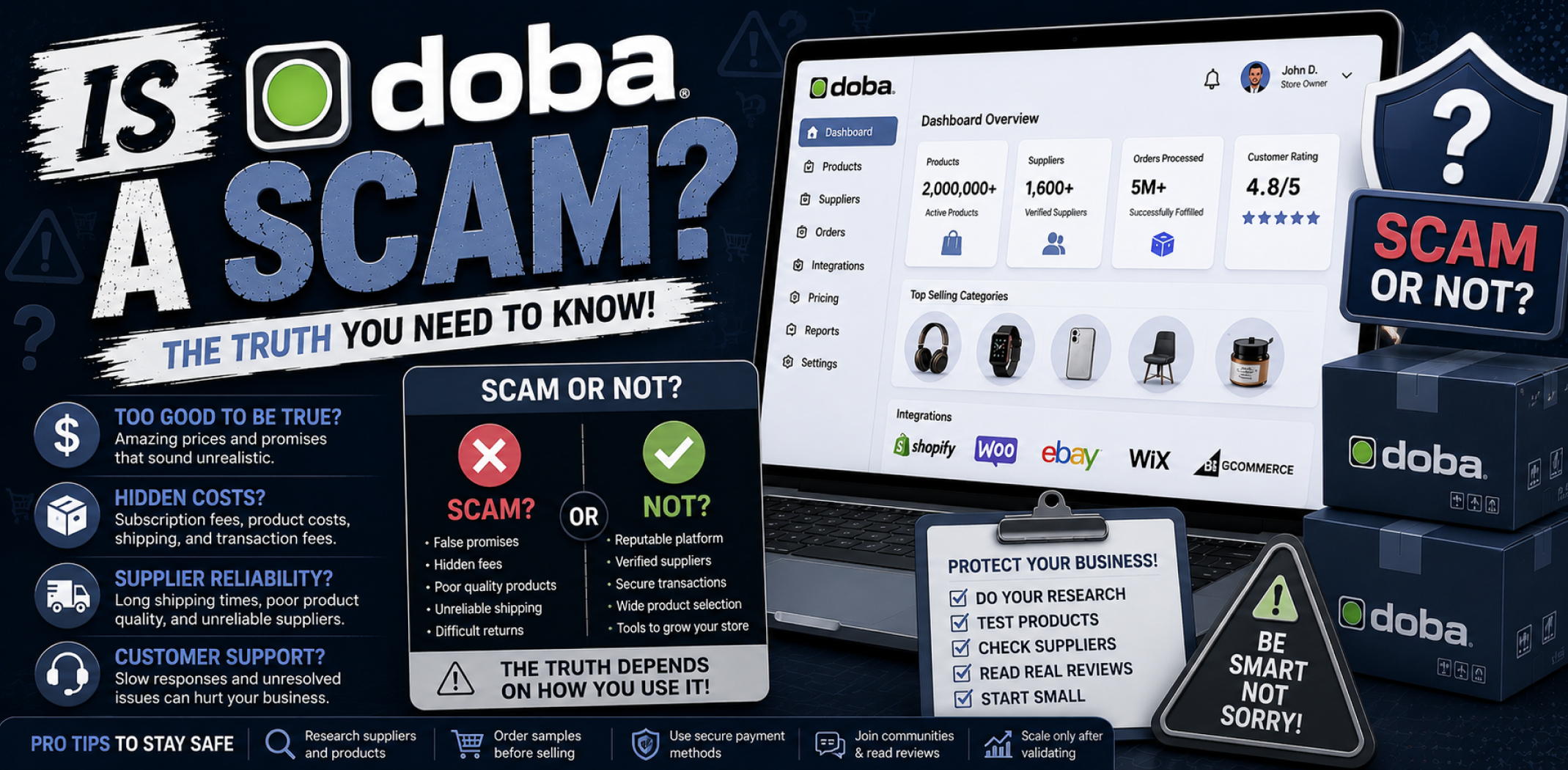
Doba is a legitimate US-based dropshipping supplier directory founded in 2002 – not a scam. However, a 2.9 out of 5 score on Trustpilot, documented complaints about thin profit margins, billing difficulties, and poor product descriptions mean it is far from the best option for most beginners in 2026.
Key takeaways
- Doba has operated since 2002 and is headquartered in Lehi, Utah – it is a real, registered business.
- Doba’s Trustpilot score sits at 2.9 out of 5 across 89 reviews, with recurring complaints about billing practices and unshipped orders.
- Many users report that Doba’s “wholesale” prices are at or above Amazon retail prices, making consistent profit difficult.
- Doba does not build your store or run your ads – it is a product-sourcing tool only, requiring additional platforms and marketing spend.
- Platforms like AliDropship give beginners a fully built store, products, and a built-in ad system for a fraction of the effort.
If you have been searching “is Doba a scam” in 2026, you are not alone. Doba has been around for over two decades, which gives it a credibility advantage over fly-by-night platforms – but age alone does not make a platform good. The reviews are mixed, the complaints are specific, and the profit margin issue is real. This article gives you the honest, unfiltered answer so you can make the right call before you spend a cent.
What is Doba and how does it work?
Doba is a US-based dropshipping supplier marketplace founded in 2002 and headquartered in Lehi, Utah. In simple terms, it acts as a middleman between you – the seller – and a network of wholesale suppliers who hold inventory in American warehouses. You pay a monthly subscription, browse the product catalog, import listings to your store on Shopify, WooCommerce, or Amazon, and when a customer orders, Doba routes the fulfillment to the supplier who ships directly to the buyer.
As of 2026, Doba claims access to over 2 million SKUs across categories including home and garden, electronics, apparel, and sporting goods. The platform has evolved over the years to include AI-powered product curation tools, automated price and inventory syncing, and a “Growth Coach” service on higher-tier plans.
The key thing to understand about Doba’s model is what it does not do. It does not build your store, set up your product pages, run your ads, or do your customer service. You need a separate ecommerce platform (Shopify, WooCommerce, etc.), a separate marketing strategy, and a working knowledge of how to price products competitively. Doba is purely the sourcing layer.
Is Doba legitimate? What the evidence shows
In 2026, Doba is a legitimate and legally registered business – that much is not in question. It has operated continuously since 2002, holds an A+ rating from the Better Business Bureau (though this reflects complaint responsiveness, not customer satisfaction scores), and processes real orders for real sellers every day. The platform’s Shopify App Store rating of 4.6 out of 5 across 97 reviews reflects a segment of users who find genuine value in the automation and US-based fulfillment.
That said, legitimacy and quality are two different things. Doba’s Trustpilot profile tells a more complicated story, with a score of 2.9 out of 5 that includes serious complaints about billing, unshipped orders, and margin-killing supplier prices. The question is not whether Doba is a scam – it is not – but whether it is the right platform for your business goals.
Where Doba genuinely delivers is in the area of US-based fulfillment. Because suppliers stock inventory in American warehouses, shipping times are typically 3–7 business days rather than the 2–4 week window common with AliExpress-based platforms. For sellers targeting quality-conscious US buyers, that speed advantage is real and measurable.
Common Doba complaints and red flags to know
The complaints about Doba that appear across Reddit threads, Trustpilot, and the Shopify App Store reviews follow a consistent pattern. These are not isolated bad experiences – they are structural issues with the platform model that affect a meaningful portion of users.
Important: ✕ Common belief: “Doba sells at true wholesale prices, so margins are easy to hit.” ✓ Reality: Multiple independent reviews and user reports confirm that a significant portion of Doba’s catalog is priced at or above Amazon retail – meaning you would need to sell below Amazon to be competitive, which eliminates your profit entirely.
The profit margin problem. This is the most consistent complaint across review platforms. Because Doba acts as an aggregator rather than a direct wholesaler, its prices include a middleman markup on top of the supplier’s cost. Many sellers report discovering that the “wholesale” price on a product is within cents of what it sells for on Amazon or eBay, leaving no realistic margin after shipping, fees, and ad spend.
Billing and cancellation complaints. A recurring theme in Trustpilot and BBB complaints involves difficulty cancelling subscriptions and unexpected charges. Several users describe being charged after attempting to cancel, with customer service citing policy terms to deny refunds. Doba’s terms do not offer a money-back guarantee if you are dissatisfied with the platform’s performance – only a 30-day return window on physical product orders.
Product description quality. Both negative Shopify App Store reviews and Trustpilot complaints flag poor product descriptions as an ongoing issue. Thin, generic copy means sellers must rewrite listings manually before publishing – adding time and effort that erodes the platform’s convenience advantage.
Inventory accuracy. Some users report inventory displayed as available in Doba’s system turning out to be out of stock at the supplier level, leading to orders they could not fulfill and refunds they had to issue to end customers.
Important: Doba does not provide the actual names of the individual suppliers in its network. You are dependent on Doba as the intermediary for all communication, dispute resolution, and returns – which means if a supplier goes unresponsive, your options are limited.
What do real users say about Doba?
User experiences with Doba split into two clear camps. Those using it as a supplementary sourcing tool for an already-established store with existing traffic tend to rate it positively. Those who signed up expecting a complete dropshipping solution – store, products, traffic, and profit – are generally disappointed. Here are two representative user stories drawn from publicly available reviews.
How does Doba compare to alternatives?
Doba is not the only dropshipping sourcing platform on the market, and in 2026 it faces significant competition from tools that address the exact problems Doba users complain about most. Here is how it stacks up against two major alternatives.
Is Doba worth it – honest verdict
Doba is not a scam. It is a real platform with real suppliers and real fulfillment. But in 2026, “not a scam” is a low bar. The honest assessment is that Doba works for a specific, narrow profile of seller – someone who already has an operational store and customer traffic, and who needs a US-based supplier network to improve shipping times. For that person, Doba can be a useful tool.
For everyone else – particularly beginners who have no store, no existing traffic, and limited budget – Doba introduces a set of problems it does not help you solve. You still need to build a store, research competitive margins product by product, drive your own traffic, and manage customer service. The subscription fee runs on regardless of whether you make a sale.
Legitimate platform with significant limitations for beginners
Doba is a real dropshipping supplier directory with over 20 years of operation and genuine US-based fulfillment. However, thin margins on much of the catalog, documented billing complaints, and the requirement to bring your own store and traffic make it a poor fit for most new sellers in 2026. It works best as a supplementary sourcing tool for established sellers – not as a starting point for a new business.
Your store and your Amazon business – both ready from day one
AliDropship builds your store, loads it with products, and gives you a built-in ad system that can start driving orders the same day. No margin research. No separate platforms. No monthly fee during your 14-day trial – and a free $40 ad coupon included.
Want a better starting point? Here is what AliDropship does differently
If the core frustration with Doba is that it gives you products but not a business, AliDropship is worth understanding. Founded in 2015 and based in Irvine, California, AliDropship is a subscription-based ecommerce platform built specifically for people starting an online business with no experience and no tech skills. It has helped launch over 1,500,000 stores in 150+ countries and has earned a 4.7-star rating on Trustpilot.
The core difference is scope. Where Doba gives you access to a product catalog that you import to an existing store you run yourself, AliDropship gives you a complete, ready-to-earn business – store built, products loaded, advertising included. You sign up, activate ads at $10–50 per day, and the platform handles the rest. There is no separate Shopify subscription, no manual product research, and no store-building phase to get through before you can test whether your products sell.
Free turnkey store – built, designed, and filled with products
Your store arrives professionally designed, pre-loaded with 50 bestselling products, and fully optimized to convert. No setup fees, no coding, no design time. You start at the product-testing stage – not the store-building stage. Hosting, SSL, and payment gateway are all included.
Winning products, one-click import
Browse trending and niche items from AliDropship’s catalog – including brand-name and digital products – and import them to your store in one click. The catalog updates regularly so your store always has fresh, competitive inventory without manual research.
Automated fulfillment and real-time tracking
Orders are processed automatically through global supplier connections. Customers receive real-time tracking updates – building trust and reducing support volume. You do not touch the shipping logistics; the platform handles it end-to-end.
Built-in marketing and promotion tools
Email campaigns, discount management, abandoned-cart recovery, live countdown timers, and social media integration are all included or available as add-ons. No prior marketing experience required – the tools guide you through each campaign type.
Beginner-friendly – no coding, no learning curve
An intuitive dashboard walks you through every step. Adding products, running campaigns, and scaling your catalog require no technical knowledge. As your business grows, the platform scales with you – adding features without adding complexity.
AliExpress integration – one-click imports, synced inventory
AliDropship connects directly to AliExpress for one-click product imports, automated order processing, and synced tracking. Inventory stays current with the latest products and prices. Combined with the turnkey store and automated fulfillment, this integration makes the entire operation manageable for one person.
An ecommerce store and an Amazon business – both ready from day one
Free ecommerce store
Fully built, product-loaded, and ad-ready. Your store can start earning on day one of your free trial.
Amazon Seller Kit
Tap into a $514B marketplace with 300M active buyers. Your import file is ready to upload from day one.
Is Doba a scam or a legitimate dropshipping platform?
Is Doba worth it for beginners in 2026?
How does Doba make money?
What are the biggest risks of using Doba?
What are the best alternatives to Doba for dropshipping?