Instagram Monetization: Proven Strategies For 2026

Instagram is no longer just a photo-sharing app – it is one of the most commercially active platforms on the planet, with over 2 billion monthly active users and a creator economy that shows no signs of slowing down. Yet most people scrolling through their feeds right now have no clear plan for turning that audience into real income. If you have been wondering how to monetize Instagram without a celebrity following or a marketing degree, this guide cuts through the noise and gives you a practical answer.
Quick Answer: Instagram monetization in 2026 works through a combination of methods – sponsored content, affiliate marketing, product sales, and Reels income – and the most consistent earners use at least two or three of them simultaneously. You do not need millions of followers to start.
The good news is that Instagram has expanded its built-in monetization tools significantly over the past two years, while third-party options like affiliate networks, dropshipping platforms, and digital product stores have made it easier than ever to connect your content directly to cash. This guide covers every legitimate method, what each one realistically pays, and how to pick the right combination for where you are right now.
Before diving into the methods, it helps to set realistic expectations. Instagram monetization is a business – not a lottery ticket. The creators earning $3,000 to $10,000 per month treat it like one: they post consistently, track what converts, and layer multiple income streams rather than waiting on a single payout. With that mindset in place, here is everything you need to know.

What is Instagram monetization?
Instagram monetization means using your presence on the platform to generate income – whether through brand deals, commissions on products you recommend, direct sales from your own store, or payments from Instagram itself. The concept has existed since the earliest days of influencer culture, but the tools available in 2026 are more mature, more accessible, and more diverse than they have ever been.
As of 2026, Instagram offers several native monetization features: the Reels bonus program (in eligible markets), Instagram Subscriptions, the Gifts feature for live content, and branded content tools that automatically add a “Paid partnership” label to sponsored posts. Combined with third-party options – affiliate networks, ecommerce integrations, and digital product platforms – a single Instagram account can realistically plug into five or more separate income streams at the same time.
Important note: Instagram monetization is not passive income in the traditional sense. Each method requires ongoing content, audience trust, and consistent effort to generate meaningful returns. Anyone selling you the idea that it runs on autopilot from day one is oversimplifying at best.
What separates Instagram from most other social platforms is its visual-first format – ideal for product discovery – combined with Stories and Reels, which generate significantly higher engagement rates than static posts. For business owners, service providers, and content creators alike, Instagram remains one of the highest-ROI organic marketing channels in 2026 according to multiple influencer marketing industry reports.
These tools and income streams vary widely in effort required and ceiling potential. The next section breaks down exactly what to expect – by method, by effort level, and by realistic monthly figures.
How much can you realistically earn from Instagram?
The honest answer depends on your niche, audience size, engagement rate, and how many methods you combine. Below is a clear breakdown of what each approach typically pays for an account with between 5,000 and 100,000 engaged followers.
These ranges are realistic for accounts with 5,000 to 100,000 engaged followers. A 10,000-follower account in a high-value niche like personal finance or B2B software can outperform a 500,000-follower general entertainment account on nearly every metric that matters to brands and affiliate programs.
One note on the ceiling figures: the top-end numbers above require full-time commitment, an established audience, and usually 60–90 days of consistent effort before income stabilizes. Most creators earn their first $50–$200/month within 30–60 days and scale from there.
The strongest performers in 2026 are combining at least three of these methods – typically a content-based income stream (brand deals or Reels), a referral stream (affiliate marketing), and a product stream (selling something directly). Each stream reinforces the others because the same content drives traffic to all of them simultaneously.
With realistic expectations in place, here is a detailed look at each method and how to get started with it.
Top ways to monetize Instagram in 2026
Instagram gives you more monetization options than almost any other social platform – but not all of them are created equal. Below are the most reliable methods available in 2026, organized by type, with a clear breakdown of what each one requires and what it realistically pays.
Sponsored posts and brand collaborations
Brand deals remain the most recognized form of Instagram monetization, and for good reason – they can be extraordinarily lucrative at scale. A single sponsored post from a mid-tier creator (100,000–500,000 followers) typically earns between $1,000 and $5,000, while macro-influencers can command $10,000 or more per placement. That said, you do not need 100,000 followers to land paid collaborations.
Micro-influencers with 5,000 to 50,000 highly engaged followers in a specific niche are actively sought out by brands precisely because their audiences trust them more. A fitness creator with 8,000 engaged followers recommending a protein supplement will typically outperform a generic lifestyle account with 200,000 passive ones in terms of actual conversions – and brands increasingly know this.
How to land your first brand deal
The fastest route to your first paid collaboration is direct outreach – not waiting for brands to find you. Build a simple media kit containing your follower count, average engagement rate, audience demographics, and any past results. Pitch brands whose products you genuinely use, and focus on smaller emerging brands rather than household names in your early stages – they are more likely to respond and more willing to work with growing accounts.
Instagram’s Creator Marketplace, accessible through the Professional Dashboard, also connects creators directly with brands that are actively seeking partnerships. Keep your rates anchored to industry benchmarks: most micro-influencers charge between $100 and $500 per post, while creators above 50,000 followers can reasonably target $500 to $2,000+ per placement depending on the deliverable scope.
What to charge for sponsored posts
A useful baseline formula: $100 per 10,000 followers, adjusted for your engagement rate. If your engagement rate is above 3%, you can charge a premium. If it sits below 1%, brands will negotiate down. Always factor in the full scope of deliverables – a single static post is significantly cheaper to produce than a Story series combined with a Reel and two feed posts, and your rate should reflect that difference.
Earning potential: $100–$10,000+ per post, depending on follower count, niche, and deliverables.
Instagram affiliate marketing
Instagram affiliate marketing is one of the most beginner-accessible monetization methods because it requires no brand relationships, no product creation, and no upfront investment. You share a product using a unique link or promo code, someone buys through it, and you earn a commission – typically between 3% and 40% depending on the product category and affiliate program.
Affiliate marketing works particularly well on Instagram because the platform’s visual format is ideal for product demonstration. A Reel showing a product in use, or a Story with a link sticker, tends to convert significantly better than a text-based recommendation because viewers can see the product in context before they click.
Getting started with affiliate marketing on Instagram
The most accessible entry points are Amazon Associates (broad product range, 1%–10% commissions), ShareASale and Impact (mid-range commissions, brand-specific programs), and LTK – formerly LikeToKnowIt – which is especially popular among fashion, beauty, and home decor creators. For higher commission rates, software and digital product affiliate programs pay between 20% and 40% per sale, with some offering recurring monthly commissions on subscriptions.
To use affiliate links on Instagram: paste your primary link into your bio, use the link sticker in Stories for individual products, and include your promo code or a “link in bio” direction in your Reels captions. Instagram’s native affiliate tool (available in eligible markets) also lets you tag products directly in posts and earn through Instagram’s built-in affiliate system without signing up for a separate network.
Best affiliate programs for Instagram creators
Program selection depends heavily on your niche. Fashion and home creators do well with LTK, Amazon, and retailer-specific programs. Tech and software creators should target SaaS affiliate programs, where 20%–40% recurring commissions are common. Health and wellness creators typically perform well with supplement and fitness equipment brand programs. One detail worth checking before you commit: look for programs with a 30-day or longer cookie window, which ensures you get credit for purchases made several days after someone first clicked your link.
Earning potential: $50–$5,000/month, depending on niche, audience size, and commission structure.
Monetize Instagram Reels
Reels are Instagram’s highest-reach content format in 2026, consistently outperforming static posts and carousels for new audience discovery. This makes them valuable for two distinct purposes: earning directly through Instagram’s bonus program, and driving warm traffic to every other monetization channel you run alongside it.
The Instagram Reels bonus program
Instagram’s Reels Play bonus program pays eligible creators based on video views – but it is invitation-only, subject to market availability, and has been restructured several times since its 2021 launch. Reported payouts vary widely, with creator estimates ranging from $0.01 to $0.05 per view. A Reel that reaches 500,000 views could theoretically generate $5,000 to $25,000, but the majority of creators report average monthly earnings from the program of $100–$2,000.
Important: The Reels bonus program is available in the US and select other markets, with eligibility requirements that shift regularly. Treat it as supplemental income, not a primary revenue source.
Making Reels work for affiliate and product sales
Even without access to the bonus program, Reels are one of the strongest traffic-driving formats available. A Reel that demonstrates a product naturally and directs viewers to a link in the caption or bio converts passive viewers into buyers at a significantly higher rate than static posts. Multiple creator case studies report short-form video generating 3–5x higher click-through rates on affiliate links compared to carousel posts covering the same product recommendation.
Earning potential: $50–$2,000/month from bonuses alone; substantially more when Reels are consistently used to drive affiliate or product traffic.
Selling products on Instagram
Selling products through Instagram – whether physical, digital, or dropshipped – represents the highest-ceiling monetization method on this list. Unlike sponsored posts (paid once per placement) or affiliate commissions (a percentage of someone else’s sale), product sales let you capture the full margin on every transaction. Done well, it is a business in its own right, not just a side income stream.
Instagram Shopping and dropshipping
Instagram Shopping lets you create a product catalog within the app and tag items directly in posts, Stories, and Reels. When a user taps a product tag, they see the name, price, and a direct link to purchase. Paired with a dropshipping model – where a supplier fulfills orders on your behalf and you keep the margin – this creates a low-overhead ecommerce setup that scales naturally with your content output.
The most successful Instagram dropshippers in 2026 focus on niche stores rather than general catalogs. A store built around outdoor gear, pet accessories, or minimalist home organization is far easier to market through targeted Instagram content than a store that sells everything. Niche audiences are more specific, more engaged, and convert at noticeably higher rates.
Digital products and ebooks
Digital products are the highest-margin option of all: once created, they cost nothing to deliver. Common formats include ebooks, Lightroom presets, recipe guides, workout plans, Notion templates, and online courses. Price points typically range from $7 to $197 for individual products, with creators keeping close to 100% of the sale price minus payment processor fees. Instagram’s link in bio – using tools like Linktree or Stan Store – makes directing followers to a digital product storefront straightforward without requiring a full website build.
Earning potential: $500–$15,000+/month for ecommerce and dropshipping; $200–$5,000+/month for digital products.
Instagram Subscriptions and fan support
For creators with a highly engaged core audience, recurring subscription income offers predictable monthly cash flow that does not depend on algorithm performance or brand deal availability. It is slower to build than other methods but arguably the most stable once it is established.
Setting up Instagram Subscriptions
Instagram Subscriptions (available in the US and expanding to additional markets in 2026) lets eligible creators charge a monthly fee for access to exclusive content – subscriber-only Stories, Lives, posts, and direct messaging. Prices typically range from $0.99 to $9.99 per month. The program requires a Creator or Business account, and in most markets you need at least 10,000 followers to qualify. Instagram takes a percentage of subscription revenue, with terms that have varied as the program has scaled.
Third-party fan support platforms
For creators outside Instagram’s subscription markets, or those wanting a higher earnings ceiling, Patreon and Buy Me a Coffee offer platform-agnostic alternatives. Both allow Instagram creators to redirect their most engaged followers to a separate platform where they pay for exclusive content, early access, or direct Q&A sessions. Commission rates on these platforms run from 5% to 12%, leaving creators with the majority of their earnings and full control over pricing and content structure.
Earning potential: $100–$3,000/month depending on subscriber count and price point.
Whether you use Instagram’s native tools or a third-party platform, the key advantage of subscription income is its compounding effect – each new subscriber adds to a revenue base that stays stable even when a Reel underperforms or a brand deal falls through.
Legal and ethical considerations for Instagram monetization
Instagram monetization is a legitimate business activity – and like any business, it comes with legal obligations and ethical responsibilities worth taking seriously. Ignoring these is not just a moral issue; it is a practical one. Creators who violate disclosure rules or platform policies risk losing brand deals, facing account restrictions, and permanently damaging the audience trust they spent years building.
Key principle: Transparency is not optional – it is a legal requirement in most markets and a long-term competitive advantage with your audience.
The US Federal Trade Commission (FTC) requires creators to clearly disclose any material connection to a brand when promoting their products – whether that connection is a payment, a gifted product, or an affiliate commission. The disclosure must be clear and prominent: “Ad”, “Sponsored”, or “Paid partnership with [brand]” at the beginning of a caption or as a clearly visible overlay on a Story. Burying “#ad” among 20 other hashtags does not satisfy the FTC’s updated disclosure standards.
What to avoid absolutely
Buying fake followers or engagement is the most common shortcut creators attempt – and one of the most self-defeating. Beyond violating Instagram’s Terms of Service, fake engagement actively inflates your follower count while deflating your engagement rate, which is the metric brands and affiliate networks actually scrutinize. Verification tools that audit creator accounts before partnerships are now standard practice among most brands.
Grey-area tactics like undisclosed affiliate links, exaggerated income claims in promotional content, or publicly endorsing products you have never used can lead to account bans, regulatory action from oversight bodies, or permanent reputational damage within your niche community – none of which are recoverable quickly.
What to do instead
Only promote products you have genuinely used or believe in. Use Instagram’s native branded content tool to tag brand partners, which automatically adds a “Paid partnership” label to your post without requiring you to manually write a disclosure every time. Disclose affiliate relationships in every post containing an affiliate link – not just some of them. If you are unsure whether a material relationship requires disclosure, the safe answer is always to disclose it.
Long-term, ethical monetization outperforms shortcuts every time. Audiences notice authenticity. Brands prefer creators with clean, verifiable track records. And platforms consistently reward accounts that operate within their guidelines over those that attempt to game the system.
How to choose your Instagram monetization path
Not every method makes sense for every creator, and trying to pursue all of them at once is a reliable way to execute none of them well. Here is a practical framework based on where you currently are with your account.
Complete beginner (under 5,000 followers)
Start with affiliate marketing and Reels. Affiliate marketing requires no upfront investment and can generate commissions from day one if your content is relevant and your niche is specific enough to attract buyers. Reels will grow your audience faster than any other format, which in turn accelerates every other monetization method you add later. Pick one niche, post Reels consistently – at minimum 4–5 per week – and join one affiliate program that aligns naturally with your content without forcing a recommendation your audience would not believe.
Intermediate creator (5,000–50,000 followers)
Add brand collaborations to the mix. At this stage, your engagement rate matters more than your raw follower count. Create a media kit, reach out to 10–15 brands in your niche each month, and start with gifted partnerships if paid deals are not immediately available – these build case studies and a portfolio. Maintain your affiliate income in parallel, and consider launching a low-ticket digital product in the $7–$27 range to test how willing your audience is to purchase directly through you.
Advanced creator (50,000+ followers)
At this level, the ceiling on individual monetization methods starts to become visible. Brand deals pay well but are inconsistent and negotiation-heavy. Affiliate commissions scale with traffic but are ultimately capped by your existing audience size. The most significant income unlock at this stage is building something you fully own – a product, a store, or a course – that converts your Instagram traffic into revenue you control completely and that does not reset when the platform changes its algorithm.
Ecommerce, specifically dropshipping, is the most accessible entry point into product-based income for Instagram creators. It requires no product creation, no inventory management, and can be launched with a fraction of the capital required to develop your own branded product line.
General principle for all creators
Diversify early and build toward ownership. Platform algorithms change, brand budgets tighten, and affiliate programs restructure their commissions without warning. The most resilient monetization model in 2026 is one where your Instagram account is the top of the funnel – not the entire business. Use the platform to attract and warm an audience, then own the transaction through your own store, product, or list.
AliDropship: Your complete all-in-one solution for starting dropshipping in 2026
If you want the simplest possible way to start dropshipping – especially if you’re brand new – AliDropship remains one of the most beginner-friendly tools available in 2026. It brings together store creation, product imports, automation, and marketing into a single streamlined system designed to help you launch quickly and grow confidently.
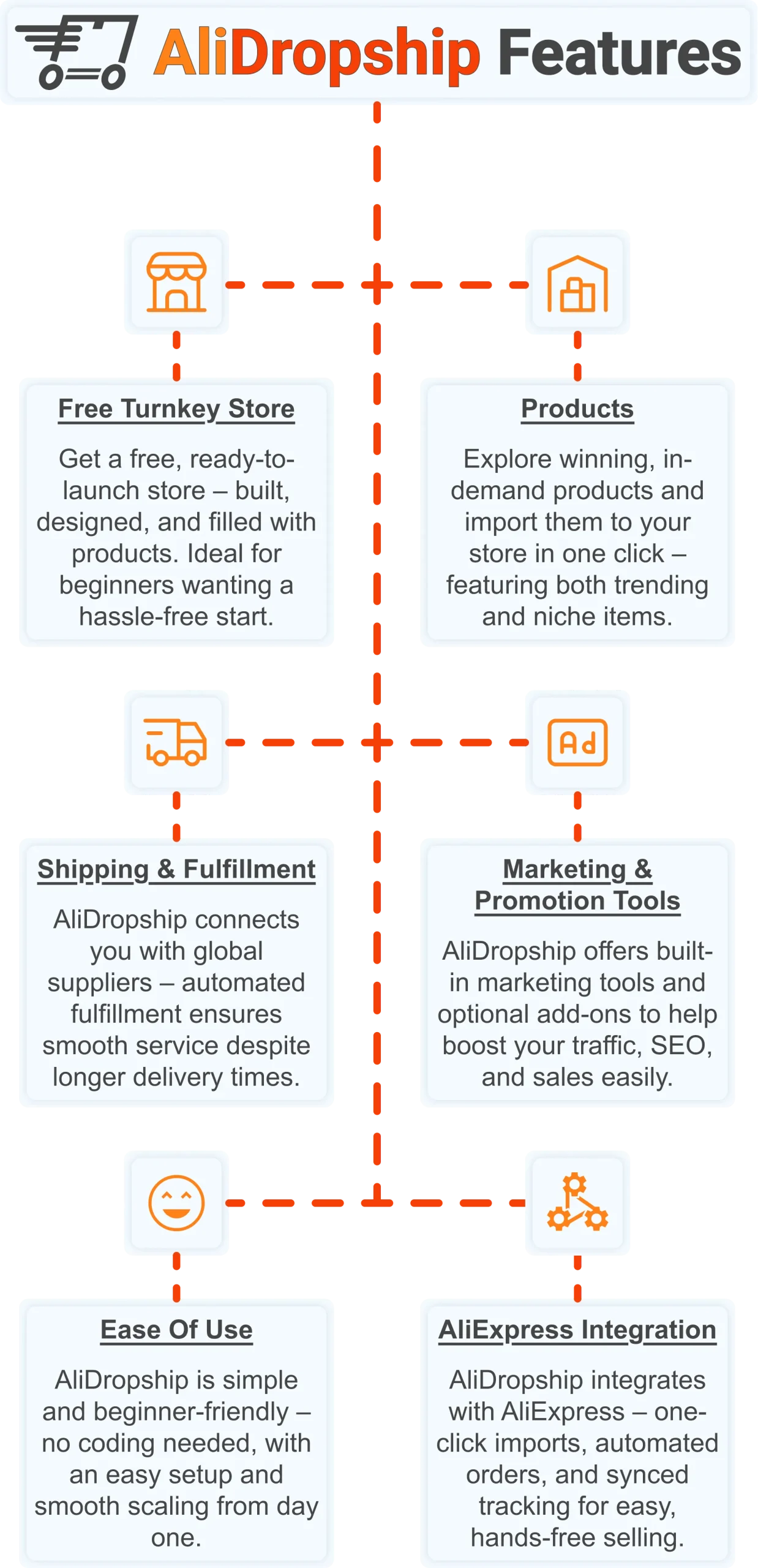
Free turnkey store 🛍️
Get a free turnkey store – built, designed, and filled with products. Ideal for beginners wanting a hassle-free start, the store comes fully optimized to attract customers right away, saving you time on setup. Plus, it includes professional design elements to give your business a polished, trustworthy look from day one. This ready-made foundation makes it easy to move seamlessly into product selection.
Products 📦
Once your store is set up, you can explore winning, in-demand products and import them in one click – featuring both trending and niche items. This wide selection lets you cater to diverse customer interests and test what works best. Regular updates ensure you always have fresh products, keeping your store competitive and relevant. With great products in place, smooth shipping becomes the next essential step.
Shipping & fulfillment 🚚
AliDropship connects you with global suppliers, and automated fulfillment ensures seamless order processing despite international delivery times. Customers receive real-time tracking updates, which builds confidence and trust in your store. Once shipping is handled reliably, you can focus on promoting your store and attracting traffic.
Marketing & promotion tools 📣
To maximize sales, AliDropship offers built-in marketing tools and optional add-ons that help boost traffic, SEO, and conversions. From email campaigns and discounts to social media integration, these tools empower you to reach and retain customers without needing prior marketing experience. With promotion strategies in place, managing your business becomes simpler and more efficient.
Ease of use 👌
AliDropship is beginner-friendly – no coding needed, with an intuitive dashboard that guides you through every step. Easy setup and smooth scaling let you expand your store without stress. As your business grows, adding new features, products, and marketing campaigns remains hassle-free, giving you more time to focus on sales.
AliExpress integration 🛒
Finally, AliDropship integrates seamlessly with AliExpress, enabling one-click imports, automated orders, and synced tracking. Your inventory stays up-to-date with the latest products and prices, while automated order processing frees you from manual tasks. Combined with the turnkey setup, reliable shipping, and built-in marketing tools, this integration ensures your dropshipping business is fully equipped for growth and success.
If you are already building an audience on Instagram, pairing it with a dropshipping store gives your followers something to buy – and gives you an income stream that does not depend on the next post going viral. Claim your free turnkey store and $100 welcome gift and start selling today.
How to monetize Instagram?
How many followers do you need to monetize Instagram?
How much does Instagram pay per 1000 views on Reels?
What is Instagram affiliate marketing and how does it work?
Can you make money on Instagram without a huge following?