Side hustle starter pack with a $100 welcome gift inside
Claim a free store with a head-start gift today!
Get for free

How To Make Money Online Selling Tech Gadgets In 2026

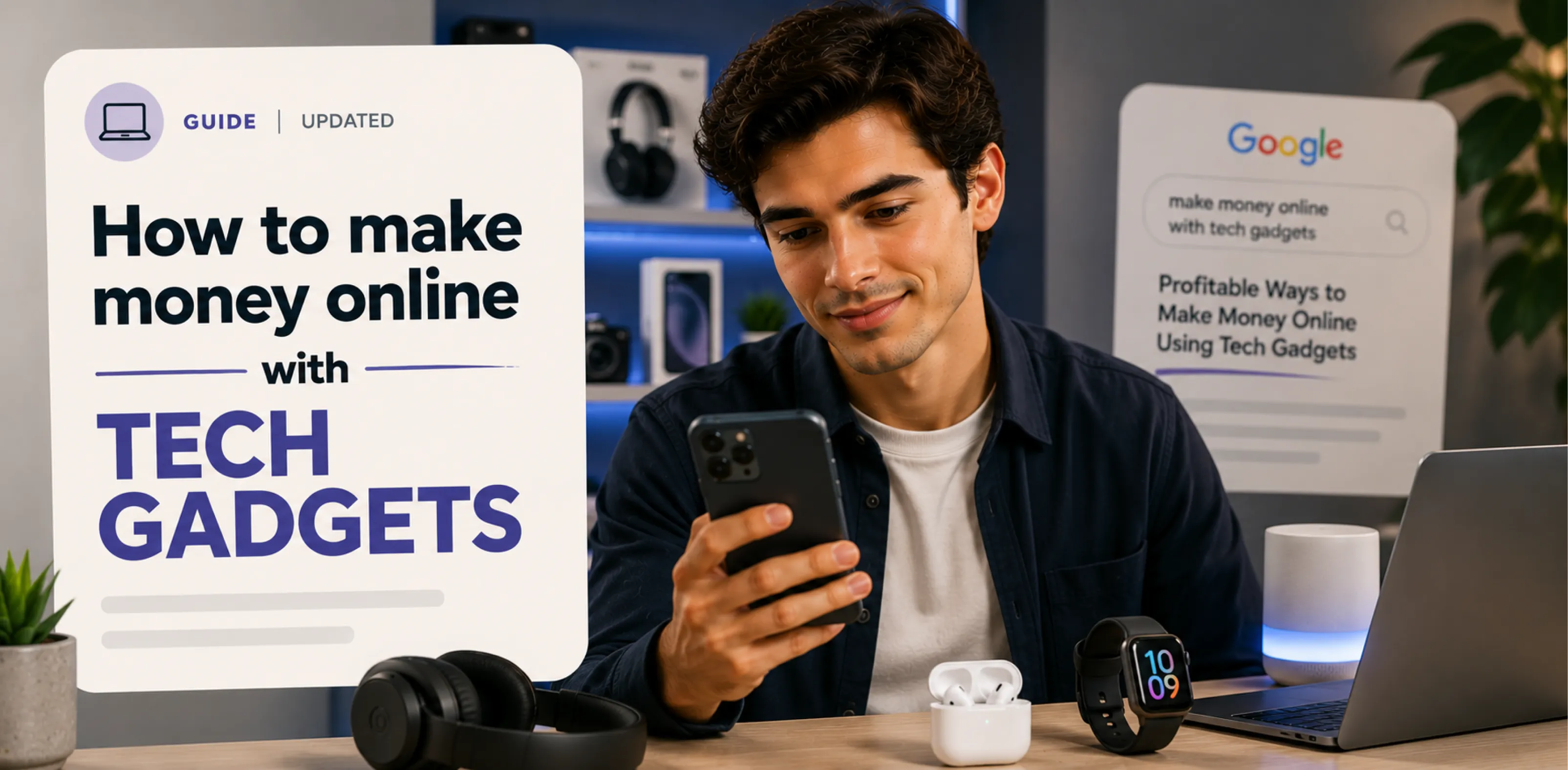
Featured image for an article about how to make money online with tech gadgets

If you have ever spent an evening comparing spec sheets just to settle an argument with a friend, rebuilt your entire smart home setup because a better gadget came out, or talked someone through choosing between two nearly identical devices, you already have more useful skill than most people realize.

What a lot of tech enthusiasts and gadget hobbyists do not realize is that the same interest can become a real online business, without needing an engineering background, a huge following, or years of experience running a company. The instinct that pushes you to compare one more spec sheet is the same instinct that helps you understand what other tech buyers are struggling to figure out.

Quick Answer
The most direct way to make money online with tech gadgets is to launch a ready-made digital store stocked with gadget buying guides, courses, and checklists, then use one-click ads to reach people who are already searching for tech buying help.

The people searching for tech buying help online are not a small niche. Gadget comparison guides, smart home setup courses, and upgrade planning resources are some of the most consistently searched topics on the internet, in every season of the year, from January gear upgrade resolutions to the fall push around new product launches and holiday shopping.

That steady demand is exactly what makes it possible to build a store around this topic without needing to invent a new product every time a device trend shifts, since the underlying reasons people want help choosing and setting up tech do not really go away.

🛍️
💡
📣
Your free store is ready today
14-day free trial • Cancel anytime • $39/month after trial

Start My Free Store ⤻

🛍️
Your free store is ready today
14-day trial • Cancel anytime • $39/mo after

This guide walks through the real numbers behind an online tech gadgets business, how a ready-made digital store works, what you could actually stock if you love gadgets, and the practical steps to get one running in 2026. Along the way, you will see honest examples of what a single sale looks like, real strategies other sellers use, and the common questions people ask before deciding to try it themselves.

Real numbers behind an online tech gadgets business

Before getting into strategy, it helps to see the actual figures behind this kind of store. None of these numbers are a promise of what you personally will earn, since that depends on the effort and time you put in, but they do explain how the model works and why it appeals to people who love gadgets but do not want to build a business from scratch.

Understanding the mechanics first also makes it easier to judge whether a specific strategy or product choice later in this guide is actually a good fit for your own goals.

Digital margin per sale
50-70%
The share you keep on each digital guide or course sold through your store.
Store setup time
Minutes
Your store arrives built and stocked, so there is no design or coding step.
Stores launched on AliDropship
1.5M+
A track record built over years, not a brand-new or unproven platform.

One thing that makes a digital tech gadgets store different from many other online business models is what happens the moment someone buys. A guide, course, or checklist is delivered the second payment clears, with nothing to pack and nothing to wait on, and no separate step for you to manage before the customer gets what they paid for.

The example below shows how that plays out on a single sale, using round numbers to keep the math easy to follow.

Real example – one sale
Customer pays
$27
Product cost
-$9
You keep, this sale
$18
Self-study gadget buying guide. One-sale example, not a projection.
What this means for you

The same margin repeats on every sale, with no stock sitting between you and the customer.

This example uses one guide at one price point, and real prices vary by product. The point is not the dollar figure itself, it is that the margin does not shrink because of storage costs, packaging, or shipping delays, since delivery happens automatically the moment a customer checks out.

No inventory
Instant delivery
50-70% margin

How an online tech gadgets store actually works

The mechanics behind this kind of business are simpler than most people expect, and that is by design. There is no need to write your own comparison guide from a blank page, test out every device yourself, or figure out a delivery system on your own, since a ready-made platform handles the structure and you focus on choosing what to sell and getting it in front of the right audience.

🛍️
💡
📣
The platform is already built for you
14-day free trial • Cancel anytime • $39/month after trial

See My Free Store ⤻

🛍️
The platform is already built for you
14-day trial • Cancel anytime • $39/mo after

The three steps below cover the entire process from signing up to your first sale.

🛍️
Stock your store
Add gadget guides, courses, checklists, and toolkits from the catalog to your store in a few clicks.
📣
Turn on one-click ads
Set a daily budget between 10 and 50 dollars and the built-in system handles targeting for you.
Products deliver themselves
When someone buys, the guide or course delivers instantly, and your margin is yours to keep.

Because everything after the ad click is automated, your daily task list stays short. Most of your time goes into deciding which products to feature, reviewing how your ads are performing, and occasionally refreshing your catalog with newer titles, rather than managing logistics or answering fulfillment questions behind the scenes.

That structure is part of why this model appeals to people who already follow tech closely as a hobby or work another job and only have a limited amount of time to give it each week.

Two ways to sell to tech enthusiasts

Not every digital product for tech enthusiasts looks the same, and it helps to understand the two broad types before deciding what to stock. Both can live in the same store, and most successful sellers eventually carry a mix of both rather than betting everything on one format. Knowing the tradeoffs up front makes it easier to decide where to start.

Type A
Guides and courses
Structured, one-time learning resources
Typical price$16-$44
Update frequencyOccasional
Buyer commitmentLonger, self-paced
DeliveryInstant download
Margin50-70%
⚠️
A one-time buyer may not return quickly, since the guide covers everything they need for a while.
Type B
Checklists and trackers
Lightweight, repeat-friendly tools
Typical price$7-$20
Update frequencyFrequent
Buyer commitmentShort, repeatable
DeliveryInstant download
Margin50-70%

Lower price points make these an easy add-on sale alongside a guide or course.

Most stores that do well long term carry a bit of both. Guides and courses give the store some higher-ticket items that anchor your average order value, while checklists and trackers keep the catalog feeling fresh and give returning visitors a reason to buy again without needing an entirely new product line every month.

A simple way to think about it is that guides sell the decision, and checklists sell the follow-through. If you are only just starting out, it is reasonable to lead with 2 or 3 guides and fill the rest of your early catalog with lower-priced checklists, since that mix keeps your upfront selection process manageable.

🛍️
💡
📣
See the full gadget product catalog
14-day free trial • Cancel anytime • $39/month after trial

Browse The Catalog ⤻

🛍️
See the full gadget product catalog
14-day trial • Cancel anytime • $39/mo after

What can you sell if you are into tech gadgets?

If tech gadgets are genuinely your thing, this is the part of the store you will enjoy curating the most, since it lets your own interest actually shape the business rather than sitting behind the scenes.

The AliDropship digital catalog includes products built specifically around gadget buying decisions, smart home setup, and everyday tech troubleshooting, all of which arrive ready to add to your store without any extra formatting or setup on your end.

Digital product line – Self-study
Gadget guides and courses
Instant delivery
Demand year roundStrong
Margin per sale55-70%
Gadget buying guides
Smart home setup courses
Tech troubleshooting guides

This line covers structured resources for people trying to choose the right device and people setting up connected homes, including comparison frameworks, room-by-room smart home planning, and step-by-step guides for solving common tech problems. New titles are added to the catalog on a regular basis.

Tip: Feature 3 to 5 of these products at a time so new visitors are not overwhelmed by choice.

Digital product line – Repeat use
Comparison checklists and upgrade trackers
Instant delivery
Repeat purchase potentialHigh
Margin per sale50-65%
Device comparison checklists
Upgrade planning trackers
Setup and unboxing templates

These lower-priced tools pair well with a guide or course as an add-on, and they tend to bring buyers back more often since a tracker is something people replace or update as their device lineup evolves. AliDropship also carries a growing catalog of 100 or more AI-powered toolkits, with new categories added regularly, which can sit alongside these products for buyers who want something more personalized.

Tip: Bundle a tracker with a guide at checkout to lift your average order value.

Between these two product lines, a tech-focused store can cover people trying to make a first big gadget purchase, homeowners building out a smart home, and anyone planning a yearly device upgrade, which gives you more than one audience to reach without needing to build separate stores.

You do not need to stock every option at once, since starting with a focused catalog of 8 to 12 products is usually easier to manage than launching with everything available on day one.

It is worth being honest that no product catalog sells itself, no matter how strong the demand is behind the niche. The store gives you a running start with real products and real demand behind them, but pairing the right products with the right ads is still the part that takes ongoing attention, especially in the first few weeks while you are still learning which angles resonate with your specific audience.

P.S. Curating a gadget product catalog from scratch would normally take weeks of research, and your store already comes stocked and ready to launch.
14-day free trial · Cancel anytime · $39/month after trial

Success stories from tech-focused sellers

Real examples make the model easier to picture than numbers alone. The two stories below are composite examples built from common patterns among AliDropship store owners, not verified individual case studies, but they reflect how this kind of store typically develops in its first few months, including the kinds of decisions that tend to matter most early on.

Both examples focus on people who started with a narrow catalog and a modest ad budget, since that is the most common starting point for new sellers in this niche.

📱
Connor – Denver, Colorado
AliDropship · gadget buying guides store · 2025

Connor had spent years being the person friends asked before buying any new device and wanted a way to put that knowledge to use without becoming a full-time reviewer. He launched a store focused on buying guides and smart home courses, then set a small daily ad budget aimed at people searching for beginner smart home resources. His first sale came within the first two weeks, and he has since kept the catalog updated with newer titles as they are added.

His biggest takeaway was to keep the store narrow at first, since trying to cover every device category at once made early ads harder to target.

🔌
Amara – Lagos, Nigeria
AliDropship · tech setup toolkits · 2025

Amara had recently built out her own smart home setup and wanted a side income that did not depend on reviewing new products constantly. She stocked her store with tech setup toolkits and comparison checklists aimed at other first-time smart home buyers, rather than advanced tinkerers. Within her first month, add-on checklist sales made up close to a third of her total orders, which she had not expected going in.

Her key lesson was that lower-priced add-ons can carry more of the order volume than the headline product does.

*Individual results vary and depend on the time you put in.
🛍️
💡
📣
Your $100 welcome gift is waiting
14-day free trial • Cancel anytime • $39/month after trial

Claim My Store ⤻

🛍️
Your $100 welcome gift is waiting
14-day trial • Cancel anytime • $39/mo after

Strategies that work for a tech-focused store

A store full of good products still needs a plan behind it, since even the best catalog will underperform without a sensible approach to targeting and pricing. These four approaches come up again and again among sellers who stick with this niche past the first few months, and each one is something you can start applying from your very first week.

🛍️

Pick one device category to start

Launching with a single focus, such as smart home devices or wearables, keeps your ads focused and your catalog easy to manage while you learn what actually sells.

Example: A store built around 10 smart home-only products is easier to advertise than one spread across 5 device categories at once.
📣

Target the moment, not just the category

People search for gadget help around specific events, like a new product launch or moving into a new home, so ad copy that speaks to that moment tends to perform better than generic phrasing.

Example: An ad mentioning a new-home smart setup can outperform one that just says learn about smart devices.
💡

Bundle a tracker with every guide

Pairing a low-cost checklist or tracker with a higher-ticket guide at checkout is one of the simplest ways to lift your average order value without adding new products.

Example: Adding a 9-dollar upgrade planning tracker to a 32-dollar course raises the order to 41 dollars.
🔍

Refresh your catalog with the seasons

Interest in tech gadgets spikes around January gear upgrade resolutions, back-to-school season, and the fall push around new product launches and holiday shopping, so rotating which products you feature to match the calendar keeps ads relevant.

Example: Featuring buying guides 6 weeks before peak holiday shopping season.

None of these strategies require advanced marketing knowledge or a background in ecommerce. They are the kind of adjustments you make over your first few weeks as you see which products and ad angles get the most attention from real visitors, and small changes to targeting or bundling often make a bigger difference than adding a large number of new products all at once.

Turn your gadget knowledge into a store
50-70% margin
14-day free trial • Cancel anytime • $39/month after trial
Your store
switch
ON

Your margin:
Up to 70%
14-day free trial • Cancel anytime •
$39/month after trial

Turn My Store ON

Factors that affect your results

Every store performs a little differently, and a handful of factors tend to explain most of the difference between a slow start and a fast one. These are worth reviewing honestly before you launch, since a few small adjustments here often matter more than which specific products you choose to feature first.

01

How specific your audience targeting is

Ads aimed at first-time buyers planning a smart home setup in 3 months tend to outperform ads aimed at anyone interested in gadgets in general, since the message speaks to a real situation.

02

How consistent your ad budget is

A steady 15 dollars a day over several weeks usually teaches the ad system more than a one-time 50 dollar burst, since consistent data helps targeting improve over time.

03

How fresh your catalog stays

Returning to your store every few weeks to add newer guides or seasonal products keeps repeat visitors from running out of things to buy.

04

How you price your bundles

A tracker priced at 9 dollars next to a 32 dollar course tends to sell better as a pair than either product priced on its own at a similar combined total.

05

How much time you give it before judging results

Most sellers see clearer patterns after 60 to 90 days of running ads, since the first couple of weeks are mostly about the system learning who responds to your products.

None of these factors are complicated on their own, but together they explain most of the gap between stores that stall out and stores that keep growing past the first month. Reviewing this list again after your first few weeks of ads can help you spot which factor is actually holding your store back, rather than guessing.

Before you scroll past
The three things most people wonder about
🤔

Do I need to be a tech expert myself?

No. You are curating and selling products built by others, not writing the content yourself, so your job is choosing what to feature and running ads, not becoming a device expert personally.

💸

What if I spend on ads and get zero sales?

The 14-day free trial and included 40 dollar ad coupon are built for exactly this kind of testing, so you can try the model before committing to a paid plan.

🔍

Is AliDropship a legitimate platform?

Over 1,500,000 stores have been launched on AliDropship, and the platform holds a 4.7 star rating on Trustpilot, both of which are checkable, independent signals rather than internal marketing claims.

Are you ready to launch your gadget store?
Real margin on every digital sale, with no stock to manage in between.

Start My Free Store

14-day free trial · Cancel anytime · $39/month after trial
Are you ready to launch your gadget store?
Real margin on every digital sale, with no stock to manage in between.

Start My Free Store

14-day free trial · Cancel anytime · $39/month after trial

With the factors and common objections out of the way, it is worth looking at the platform itself, since the store, the digital products, and the ad system all come from the same place and are designed to work together rather than as separate tools you need to connect yourself.

What is AliDropship and why it works in 2026

No experience? No problem. If you want the simplest way to start an online business in 2026, AliDropship is one of the most beginner-friendly platforms out there. It brings your store, your digital products, your delivery, and your marketing together in one place, so you can launch fast and grow with confidence.

Over 1,500,000 stores have already been built on AliDropship, and the platform has been featured by Forbes, Entrepreneur, Inc., NBC, Business, and Fox News.

1.5M+
stores launched
4.7★
on Trustpilot
$1.5B+
earned by owners
150+
countries

🛍️

Free turnkey store

Your store comes fully built, designed, and stocked with digital products, ready to go the moment you sign up. There is nothing to code and nothing to design from scratch. It looks polished and professional from day one, so you can skip the setup work and get straight to the business.

📦

Products

Once your store is live, you can build your catalog with digital products like gadget guides, courses, checklists, and AI-powered toolkits that are delivered instantly and let you keep up to 70 percent margin of each sale. New products are added regularly, so your store always has something fresh to offer. With your lineup sorted, delivery is already handled.

Instant fulfillment

Every digital product delivers itself the moment a customer buys, with no packing, no shipping, and no waiting. Guides, courses, checklists, and AI-powered toolkits arrive automatically, so you never touch a single order manually. Fulfillment runs itself, so you are free to focus on bringing in customers.

📣

Marketing and promotion tools

To help you sell, AliDropship’s built-in ad system is its most popular feature. While most platforms expect you to learn and manage your own marketing, this one does it for you, so there is no need to set up Google Ads or Facebook Ads yourself. Choose your daily budget, anywhere from 10 to 50 dollars, and the system handles targeting, creatives, and optimization behind the scenes.

👌

Ease of use

AliDropship is built for beginners: no coding, no confusing dashboards, just a simple, guided setup that walks you through every step. The whole platform works right from your phone, and a personal growth manager is available by chat if you ever get stuck. As you grow, adding new products, ads, and features stays just as simple.

All of this is designed so that the platform handles the repetitive, technical parts of running a store, leaving you free to focus on the part that actually benefits from your interest in tech gadgets, which is choosing good products and speaking to the right audience.

Whether you are drawn to buying decisions, smart home setup, or lighter tools like trackers, the setup stays the same, and the only real variable is which products you decide to feature.

Before you decide
Everything included to make starting easy
🆓
14-day free trial
Full platform access. No credit card required to start.
🎯
$40 ad coupon included
Your first campaign costs nothing, the coupon covers it.
Cancel anytime
No lock-in. No cancellation fees. Leave any time.
🏪
Store built for you
No setup, no design, no coding. It is ready when you are.
Instant digital delivery
Every guide and course delivers itself, automatically.

Between the free trial, the included ad coupon, and the ability to cancel whenever you like, there is very little standing between deciding to try this and actually seeing your store live, especially compared to the time and cost it would normally take to build a website, source products, and set up your own ad accounts from scratch.

If you have made it this far, you already understand the model better than most people who never get past the idea stage of thinking about turning a gadget hobby into income. The last step is simply deciding to try it while the trial and welcome gift are available, and there is no reason that first small step needs to feel like a big decision.

No stock to manage · No setup fees · Built for you

Your gadget store
is ready to launch

Store setup usually costs $299+
FREE
Get My Free Store →

Your store arrives pre-built and stocked with gadget guides, courses, and checklists that load real digital products and delivers every order automatically.

14-day free trial
$39/month after
Cancel anytime
$40 ad coupon included
✓ Store built for you
✓ No stock to manage
✓ Instant delivery
FAQ

Do I need to be a tech expert to sell gadget products online?

No, you do not need to be a tech expert to run this kind of store. You are curating and selling digital guides, courses, and checklists built by others, not creating the content yourself. Your main job is choosing which products to feature and running ads, which does not require advanced technical skills. A 14-day free trial lets you test the model before paying anything.

How much does it cost to start a gadget products store?

AliDropship costs 39 dollars a month after a 14-day free trial, and that trial includes a 40 dollar ad coupon to cover your first campaign. The only other regular cost is your ad spend, which most sellers set between 10 and 50 dollars a day. There are no separate setup fees, since the store arrives already built.

Do I need to hold inventory or ship products myself?

No, every product in this store is digital, including guides, courses, checklists, and AI-powered toolkits, so there is nothing to stock or ship yourself. Each product delivers automatically the moment a customer completes their purchase. This removes warehousing and shipping entirely from the process.

How long does it take to make a first sale?

Most sellers see their first meaningful patterns emerge over 60 to 90 days of running consistent ads, though results vary by budget and targeting. Some see a first sale within the initial 2 weeks of launching. Consistency in ad spend tends to matter more than a large one-time budget.

Can I sell gadget products alongside other niches in one store?

Yes, AliDropship stores can carry products across more than one niche, and many sellers do exactly that. Starting narrow with 8 to 12 gadget-focused products is usually easier to manage while you learn what sells. You can always expand your catalog to other niches once your gadget section is established.
avatar
By Agnes Kazaryan
Agnes is an SEO copywriter with a background in digital marketing. Every piece she creates is crafted with care – to connect with people, not just search engines.
×