How To Create My Own Online Store In 2026

So you want to create your own online store – but you’re not sure where to start, what platform to use, or whether it can actually make you money. Fair questions. The good news is that starting an ecommerce business in 2026 is more accessible than ever, and you don’t need a development background or a big budget to do it.
Quick Answer: To create your own online store, you need to choose a business model (dropshipping, print-on-demand, or selling your own products), pick a platform (Shopify, WooCommerce, or a ready-made solution), add products, set up payments, and launch. With the right setup, you can be live within a day – and earning within 60–90 days.
This guide walks you through every major decision you’ll face, from picking a niche to choosing the right tools, so you can build something real – not just another abandoned side project.

What is an online store and why start one in 2026?
An online store is a website where you sell products or services directly to customers – no physical shopfront required. The customer browses your catalog, adds items to their cart, pays online, and receives the order either digitally or by mail. You handle the selling; a supplier, manufacturer, or platform handles the inventory.
The reason so many people are asking how to create their own online store right now is simple: global ecommerce revenue is projected to exceed $6 trillion in 2026, and an increasing share of that is flowing through independent stores rather than marketplace giants. Consumers are more comfortable than ever buying from smaller brands they discover on social media or through search – which means there’s real room for new players.
What has changed most dramatically in recent years is the barrier to entry. You no longer need to code a website from scratch, rent warehouse space, or negotiate minimum orders with manufacturers. Business models like dropshipping let you sell products that are sourced, packed, and shipped entirely by a third-party supplier – your job is to market the store and handle customer service.
How much can you realistically earn from your own online store?
This is probably the most important question to answer honestly, because the gap between what gets advertised and what most people actually experience is wide. Income from an online store depends heavily on your business model, your niche, how much time you invest in marketing, and how quickly you learn from early results.
Here is a realistic breakdown of what different store types tend to generate in their first year:
These are realistic ranges based on consistent, full-time or near-full-time effort – not best-case scenarios. Most new store owners see their first meaningful sales within 60–90 days, but breaking into daily profitability typically takes 4–8 months of focused work on product selection, traffic generation, and conversion optimization.
One note on the higher figures: the $500+/day ceiling for own-product stores reflects established businesses with repeat customers and strong brand recognition – not a typical first-year outcome. If you’re starting out, anchor your expectations around the lower end of each range and treat anything above that as a bonus.
Step-by-step: How to create your own online store
There is no single right path to building an online store, but there is a logical order of decisions that saves you from costly mistakes later. Here is the sequence that works for most beginners in 2026.
Choose your business model
Before you pick a platform or design a logo, you need to decide how your store will actually operate. Your business model determines your startup costs, your profit margins, your workload, and your growth ceiling.
Dropshipping
Dropshipping is the most popular model for first-time store owners, and for good reason. You list products in your store, a customer buys one, and your supplier ships it directly to them – you never touch the inventory. Your profit is the margin between your selling price and the supplier’s cost. Startup costs are low (typically under $100), and you can test multiple niches without committing to bulk stock.
Earning potential: $30–$150/day with consistent marketing and a focused niche after 3–6 months.
Print-on-demand
Print-on-demand (POD) works similarly to dropshipping but is focused on custom-designed products – t-shirts, mugs, phone cases, posters, and so on. You create the designs, upload them to a POD platform like Printful or Printify, and they handle printing and shipping per order. Margins are slimmer than standard dropshipping, but it is an excellent creative outlet and requires almost no upfront investment.
Earning potential: $10–$60/day with strong design work and targeted traffic.
Selling your own products
If you make something – handmade goods, local produce, specialty items – selling through your own store gives you full control over pricing, branding, and the customer relationship. Margins are higher than dropshipping, but you take on inventory risk and fulfillment responsibility. This model suits makers, artisans, and small manufacturers looking to move beyond marketplace listings on platforms like Etsy.
Earning potential: Variable – anywhere from $20/day to $500+/day depending on your product category and production capacity.
Digital products
Digital products – ebooks, courses, templates, guides, software tools – have zero inventory and instant delivery, which makes them one of the most scalable ecommerce models. The challenge is that the market is competitive in popular categories, and you need to invest upfront in creating something genuinely valuable. Once a digital product is made, however, you can sell it unlimited times with no additional production cost.
Why this works in 2026: Consumer demand for self-improvement, business tools, and educational content continues to grow, and buyers are increasingly comfortable purchasing digital goods from independent creators.
Pick your niche
A niche is the specific segment of the market you will serve. “Everything for everyone” is not a viable strategy for a new online store – the margins are too thin and the competition from Amazon and Walmart is too strong. The best niches share a few traits: passionate buyers, repeat purchase potential, and products that are hard to find locally.
Some of the strongest performing niches in 2026 for independent ecommerce stores include: pet accessories and supplements, home organization, eco-friendly products, hobby and craft supplies, fitness gear for specific sports, and niche beauty products catering to underserved demographics. The common thread is specificity – “dog toys for small breeds” outperforms “pet products” every time.
Important: Avoid choosing a niche purely because it looks profitable on paper. If you have no genuine interest in the category, maintaining the store long enough to see results becomes significantly harder.
Choose your ecommerce platform
Your platform is the software that powers your store – the checkout, the product catalog, the payment processing, the customer accounts. This is one of the most consequential decisions you will make, because switching platforms later is time-consuming and disruptive.
Shopify
Shopify is the most widely used hosted ecommerce platform and for good reason – it is reliable, well-supported, and has a vast ecosystem of apps and integrations. Plans start at around $39/month, which adds up over time, but the ease of setup is hard to beat. It is best suited for stores that expect to scale quickly and want access to advanced marketing and analytics tools.
WooCommerce
WooCommerce is a free, open-source plugin for WordPress. It gives you far more control and flexibility than Shopify, and the base software costs nothing – but you pay for hosting, themes, and premium extensions. It is a strong choice if you already know WordPress or want to avoid monthly platform fees. The technical learning curve is steeper than Shopify.
Ready-made store solutions
A third option – particularly popular with dropshippers – is getting a fully pre-built store from a provider like AliDropship. Instead of setting up hosting, installing a plugin, configuring a theme, and importing products one by one, you receive a store that is already built, stocked, and optimized. This dramatically compresses the time between “deciding to start” and “being ready to sell.”
Why this works in 2026: Speed to market matters. Every week spent on technical setup is a week not spent on traffic and sales. Ready-made stores eliminate the most friction-heavy part of the process.
Set up your domain and branding
Your domain name is your store’s address on the internet. Keep it short, easy to spell, and relevant to your niche. Avoid hyphens, numbers, and anything that requires explanation when spoken aloud. A .com extension is still the strongest choice for ecommerce credibility.
For branding, you do not need to invest thousands in a logo and brand identity upfront. Free tools like Canva handle logo creation well enough for a new store. What matters more at launch is consistency – using the same color palette, font, and tone of voice across your store, your social profiles, and your email communications.
Add products and write compelling listings
Once your store is live, every product listing needs three things: a clear, keyword-rich title; a description that addresses the buyer’s main concern; and high-quality images. With dropshipping, supplier images are often provided, but the best-performing stores replace generic images with lifestyle photos that show the product in context.
Pricing strategy matters here too. Research what competitors charge and position yourself competitively – not necessarily cheapest, but with a clear reason for the price. Bundles, free shipping thresholds, and limited-time offers all help convert browsers into buyers.
Set up payments and shipping
You need at least two payment options at checkout – credit/debit card processing and PayPal. Stripe powers card payments on most platforms and is straightforward to set up. PayPal builds buyer confidence, especially for first-time customers who are hesitant to enter card details on a new store.
For shipping, clarity beats complexity. Define your shipping zones, set flat rates or free shipping thresholds, and communicate delivery timelines honestly in your store’s FAQ and at checkout. Unexpected shipping costs at checkout are the single biggest driver of cart abandonment – so transparency here pays off directly in conversions.
How to drive traffic to your new online store
A store with no visitors is a store with no sales. Traffic generation is where most new store owners underinvest – they spend weeks perfecting their product pages and then expect Google to send customers automatically. It does not work that way. You need an active traffic strategy from the moment your store is live.
SEO for ecommerce stores
Search engine optimization is the most cost-effective long-term traffic channel for online stores. The goal is to rank your product and category pages in Google for searches your ideal customers are already making. On-page SEO – keyword-optimized titles, descriptions, and image alt text – is table stakes. The bigger opportunity is content: a store blog covering topics your niche audience searches for can drive consistent organic traffic that compounds over time.
Results from SEO are not immediate – typically 3–6 months before meaningful organic traffic appears – but the payoff is traffic that does not require ongoing ad spend to maintain.
Paid advertising
Paid ads on Meta (Facebook and Instagram) and Google give you immediate, targetable traffic. The tradeoff is cost – you need a testing budget to identify which products and creatives convert. A reasonable starting budget is $10–$30/day per campaign during the testing phase. Once you identify winners, you scale the spend. Paid advertising is faster than SEO but requires disciplined budget management and a willingness to accept early losses as the cost of data.
Social media and organic content
TikTok, Instagram Reels, and Pinterest are powerful free channels for ecommerce stores in visually driven niches – home decor, fashion, beauty, fitness, food. Organic content on these platforms can go viral without any ad spend, driving sudden spikes in traffic and sales. The catch is consistency: building an audience requires regular posting over weeks and months, not a few sporadic uploads.
Email marketing
Email is the highest-ROI marketing channel in ecommerce, with average returns of $36–$42 for every $1 spent according to industry benchmarks. The mechanism is simple: capture visitor emails with a discount or lead magnet, then nurture those subscribers with product recommendations, promotions, and valuable content. Abandoned cart emails alone – automated messages sent when someone leaves without buying – typically recover 5–15% of lost sales.
Tools like Klaviyo and Mailchimp integrate directly with Shopify and WooCommerce and have free tiers suitable for new stores. Build your list from day one, even before you have products to sell.
Legal and ethical considerations for your online store
Setting up the legal and compliance side of your store is not the most exciting part of the process, but skipping it creates real risk – including frozen payment accounts, fines, or forced store shutdowns. Here is what you need to address before you start taking orders.
Business registration and taxes
In most countries, selling online counts as operating a business. Depending on your jurisdiction, you may need to register as a sole trader, LLC, or limited company before accepting payments. Even where registration is technically optional at launch, a registered business entity protects your personal assets and makes it easier to open a business bank account.
Sales tax and VAT obligations vary by country and, in the US, by state. Most ecommerce platforms now handle automatic tax calculation at checkout – but you remain responsible for filing and remitting what you collect. Speak to a local accountant before you cross significant revenue thresholds.
Key principle: Run a compliant business from the start. Retroactively fixing tax or registration issues once you are generating serious revenue is far more disruptive than setting things up correctly upfront.
What to avoid absolutely
A few practices are unfortunately common in ecommerce – and all of them carry serious consequences:
- Fake reviews: Paying for or fabricating product reviews violates the terms of service of every major platform and is increasingly subject to FTC enforcement action in the US and equivalent regulators elsewhere. Build your review base organically by following up with genuine customers post-purchase.
- Misleading product descriptions: Exaggerating what a product does – especially in health, fitness, or supplement categories – creates legal exposure and erodes customer trust. Stick to what the product actually delivers.
- Dropshipping branded products without authorization: Selling counterfeit or grey-market goods under authentic brand names is illegal and will get your store and payment accounts shut down. Only work with verified suppliers selling legitimate products.
Privacy policy and terms of service
Your store must have a privacy policy if you collect any customer data – which you do the moment someone visits your site via Google Analytics, adds something to their cart, or subscribes to your email list. GDPR applies if any of your customers are in the EU. CCPA applies if you serve California residents.
Free privacy policy generators exist for basic compliance, but a solicitor or online legal service can help you draft something watertight if you expect significant volume.
How to choose the right approach for your situation
After covering the full landscape – business models, platforms, traffic, and legal considerations – the honest question is: what is actually right for you? The answer depends mostly on your starting point.
Complete beginner
If you have never run an online business before, the single most important thing is getting live quickly so you can learn from real data. Choose dropshipping as your model – the low startup cost and zero inventory risk means the cost of experimenting is manageable.
Use a ready-made or turnkey store solution to skip the technical setup phase entirely. Focus your first 90 days on learning one traffic channel and testing 5–10 products before drawing any conclusions about what works.
Intermediate / part-time
If you have some digital marketing experience or have tried ecommerce before without hitting your stride, you are probably ready to invest more seriously in a focused niche. Build on WooCommerce or use a customizable turnkey solution.
Dedicate real time to SEO and email marketing – these compound over months and provide the kind of predictable, sustainable traffic that paid ads alone cannot guarantee. Set a specific revenue target (say, $1,500/month in net profit) and work backward from it to understand what volume of sales and conversion rate you need.
Advanced / full-time goal
If you are committed to building ecommerce as your primary income source, treat it like a business from day one. Register properly, track your numbers weekly, and reinvest profits into your best-performing products and traffic channels rather than cashing out too early.
Consider layering multiple revenue streams – your own store alongside a marketplace presence on Amazon or eBay – to reduce single-channel risk. At this level, the operational challenges are less about technology and more about building reliable systems, supplier relationships, and a recognizable brand.
Ecommerce is one of the few genuine paths to building a location-independent, scalable income in 2026. The tools have never been more accessible, the market has never been larger, and the barrier to entry has never been lower. The window is open – the question is whether you step through it.
AliDropship: Your complete all-in-one solution for starting dropshipping in 2026
If you want the simplest possible way to start dropshipping – especially if you’re brand new – AliDropship remains one of the most beginner-friendly tools available in 2026. It brings together store creation, product imports, automation, and marketing into a single streamlined system designed to help you launch quickly and grow confidently.
Free turnkey store 🛍️
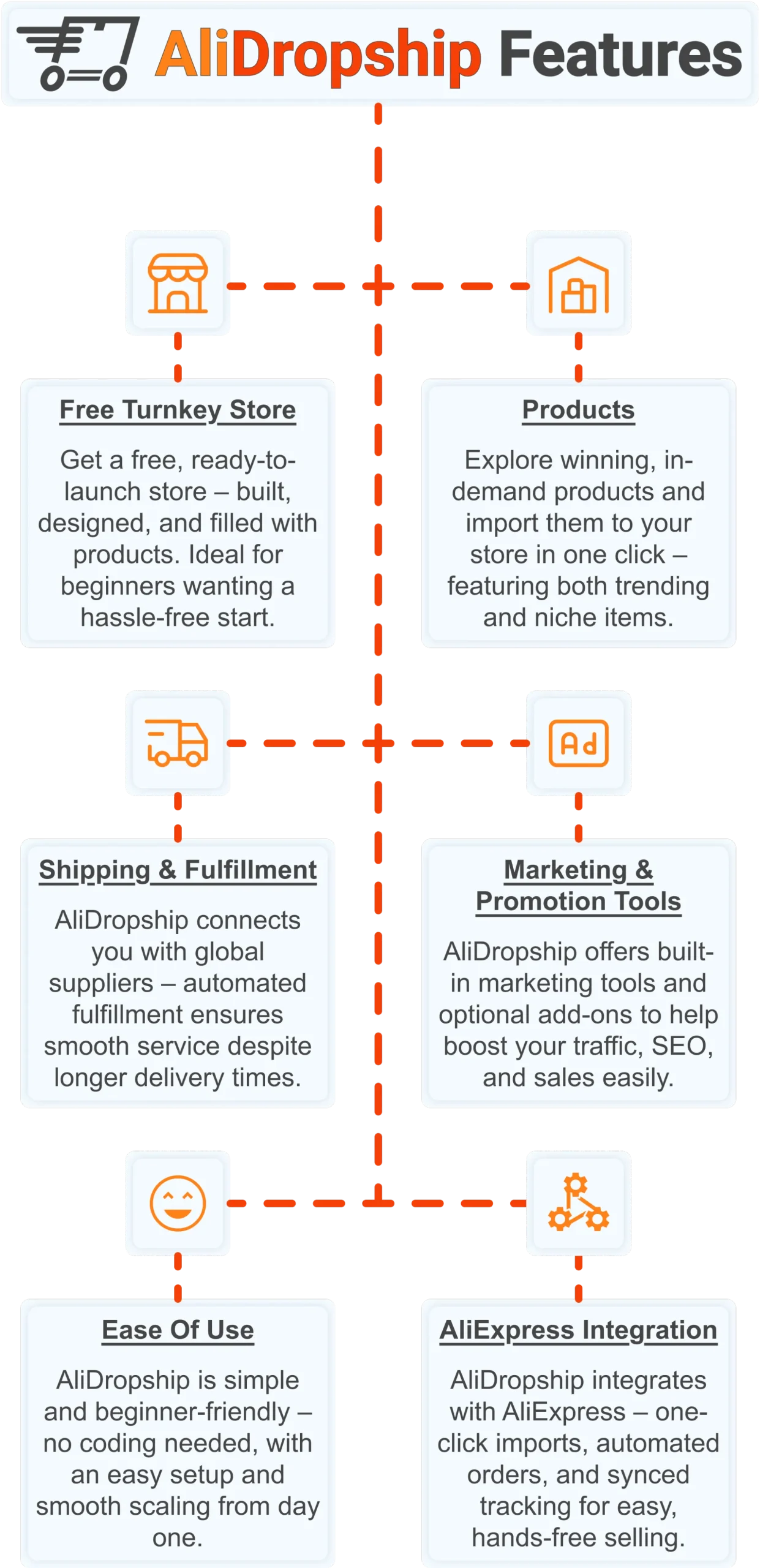
Get a free turnkey store – built, designed, and filled with products. Ideal for beginners wanting a hassle-free start, the store comes fully optimized to attract customers right away, saving you time on setup. Plus, it includes professional design elements to give your business a polished, trustworthy look from day one. This ready-made foundation makes it easy to move seamlessly into product selection.
Products 📦
Once your store is set up, you can explore winning, in-demand products and import them in one click – featuring both trending and niche items. This wide selection lets you cater to diverse customer interests and test what works best. Regular updates ensure you always have fresh products, keeping your store competitive and relevant. With great products in place, smooth shipping becomes the next essential step.
Shipping & fulfillment 🚚
AliDropship connects you with global suppliers, and automated fulfillment ensures seamless order processing despite international delivery times. Customers receive real-time tracking updates, which builds confidence and trust in your store. Once shipping is handled reliably, you can focus on promoting your store and attracting traffic.
Marketing & promotion tools 📣
To maximize sales, AliDropship offers built-in marketing tools and optional add-ons that help boost traffic, SEO, and conversions. From email campaigns and discounts to social media integration, these tools empower you to reach and retain customers without needing prior marketing experience. With promotion strategies in place, managing your business becomes simpler and more efficient.
Ease of use 👌
AliDropship is beginner-friendly – no coding needed, with an intuitive dashboard that guides you through every step. Easy setup and smooth scaling let you expand your store without stress. As your business grows, adding new features, products, and marketing campaigns remains hassle-free, giving you more time to focus on sales.
AliExpress integration 🛒
Finally, AliDropship integrates seamlessly with AliExpress, enabling one-click imports, automated orders, and synced tracking. Your inventory stays up-to-date with the latest products and prices, while automated order processing frees you from manual tasks. Combined with the turnkey setup, reliable shipping, and built-in marketing tools, this integration ensures your dropshipping business is fully equipped for growth and success.
Creating your own online store is the most direct path to building real ecommerce income in 2026 – and AliDropship gives you the fastest, most complete way to do it. Get your free turnkey store and start building your business today.
How do I create my own online store for free?
What is the best platform to create an online store in 2026?
The best platform depends on your experience level and budget. Shopify is the most beginner-friendly hosted option with plans starting at around 39 dollars per month. WooCommerce is free to install but requires separate hosting and more technical configuration. Ready-made store solutions from providers like AliDropship offer the lowest barrier to entry because everything including design, products, and automation is handled for you. For a complete beginner who wants to start selling as quickly as possible in 2026, a turnkey dropshipping store is the most practical starting point.
How long does it take to build an online store?
A basic online store can be set up in as little as 1 to 3 days using a hosted platform like Shopify or a ready-made solution. Building from scratch on WooCommerce typically takes 1 to 3 weeks including domain setup, theme customization, and product imports. The most time-intensive approach is building a custom-coded store, which can take several months. If speed to market is a priority, a turnkey dropshipping store solution compresses the entire setup phase into a single day so you can focus on marketing and sales from the start.
Can I create an online store without any technical skills?
Yes, you can absolutely create an online store without any coding or technical background. Platforms like Shopify, Wix, and AliDropship are specifically designed for non-technical users and guide you through every step with visual editors and automated tools. AliDropship turnkey stores are delivered already built and optimized, so there is no technical work required on your part at all. The most important skills for running a successful online store are not technical – they are marketing, product research, and customer communication. Anyone willing to learn these can build a profitable store regardless of their tech background.
How much money do I need to start my own online store?
The minimum realistic budget to start a dropshipping store is around 0 to 100 dollars if you use a free or low-cost turnkey solution. A self-built Shopify store costs at least 39 dollars per month for the platform, plus domain registration at around 10 to 15 dollars per year. You should also budget 200 to 500 dollars for initial paid advertising to drive your first traffic and test your product selection. WooCommerce hosting starts at around 5 to 10 dollars per month. Overall, a realistic launch budget for a serious first store is 300 to 600 dollars, though it is possible to start for less if you rely on organic traffic channels in the early months.